


Moscow, Damascus Reject OPCW Accusations on Chemical Weapons Attacks

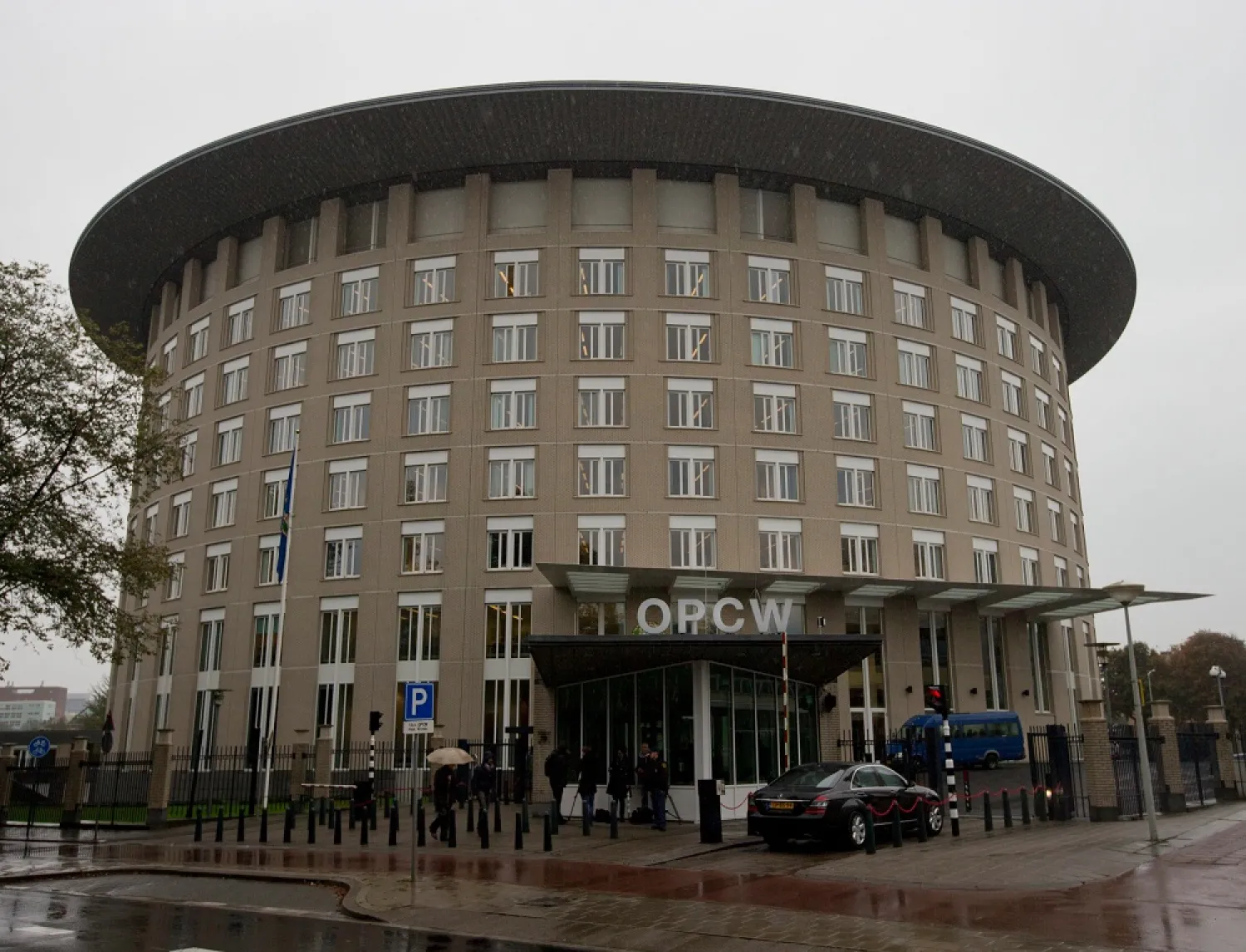
An exterior view of the headquarters of the world's chemical watchdog OPCW, in The Hague, Netherlands, Oct. 11, 2013. (AP)
TT

Moscow, Damascus Reject OPCW Accusations on Chemical Weapons Attacks

An exterior view of the headquarters of the world's chemical watchdog OPCW, in The Hague, Netherlands, Oct. 11, 2013. (AP)

Moscow and Damascus dismissed on Thursday accusations by the Organization for the Prohibition of Chemical Weapons (OPCW) that the Syrian air force was behind a series of attacks using sarin and chlorine on an opposition-held town in 2017.

The OPCW investigative team said in a 82-page report issued Wednesday that the Syrian air force dropped bombs containing either chlorine or sarin on a hospital and open farmland in the central town of Latamneh, injuring over 70 people and killing at least three, a surgeon and two other people. Livestock was also killed.

The attacks came amid intense fighting over the opposition-controlled town and parts of northern Hama, the central province where Latamneh is located. It was followed by a regime attack on Khan Sheikoun, a town further north, with suspected chemical agents that killed nearly 100 people.

The Khan Sheikoun attack is not part of the new report but it prompted US missile strikes in April 2017 that targeted Syrian air bases from where the attacks are believed to have been launched.

Moscow rejected the OPCW as politicized, saying it had ignored Russian warnings against releasing the report before comprehensively checking facts.

“The experts, who accused Syria of incidents that took place in 2017, have depended on judgments released by the Fact-Finding committee which included rough violations of the basic principle of the OPCW work that stipulates the need for a logic succession of events while collecting and keeping material evidence,” said Russia’s permanent mission at the OPCW.

It described the accusations as “untrustworthy,” adding that it relied on investigations that were carried out remotely and on statements from “terrorist” groups and the White Helmets volunteer group, which Damascus labels as “terrorists.”

Syria denounced Thursday the report as misleading.

“Syria condemns in the strongest terms what was stated in the report," an unnamed official with the Foreign Ministry said, according to a statement on state media. “At the same time, it categorically denies that it used toxic gases in the town of Latamneh or in any other Syrian city or village.”

The official charged the report relied on “fabricated allegations" from opposition areas, including by militant groups, dominated by al-Qaeda-linked fighters and the White Helmets.

The investigative team concluded that “there are reasonable grounds” to believe the perpetrators of the use of sarin as a chemical weapon in Latamneh in 2017, on March 24 and March 30, and that the use of chlorine as a chemical weapon on March 25, 2017, was part of the Syrian Arab Air Force, coordinator Santiago Oñate-Laborde said.

The investigation included interviews with witnesses, analysis of samples taken from the sites of the attacks, as well as review of symptoms reported by those affected and medical staff, along with examination of imagery, including satellite images.

Syrian authorities repeatedly refused to cooperate with the investigation, the report said.

The Syrian regime consistently rejects allegations it used chemical weapons during the country’s grinding civil war. The new report is likely to fan new calls for accountability for Bashar Assad’s regime.

The Syrian official also said such “false accusations will not deter Syria from continuing its war on terrorism.” Damascus considers all opposition groups terrorists and has kept up military operations against opposition-held areas, lately squeezing nearly 4 million civilians and tens of thousands of fighters in a shrinking enclave in northwestern Syria. A ceasefire went into effect there in March.

The OPCW team was established after Russia blocked the extension of a joint UN-OPCW investigation set up in 2015 that accused Syria of using chlorine in at least two attacks, in 2014 and 2015, and of unleashing the nerve agent sarin in Khan Sheikhoun.

Syria joined the OPCW in 2013 after it was blamed for a deadly poison gas attack in a Damascus suburb. Th regime then declared that some 1,300 tons of chemical weapons and precursor chemicals were subsequently destroyed in an unprecedented international operation.

However, the organization still has unanswered questions on whether Syria has fully disposed of its stockpile.



Iraq’s Nujaba Movement Warns against ‘US Plot’ to Integrate PMF in New Security Ministry

Slain Iranian Supreme Leader Ali Khamanei (R) and Nujaba Movement leader Akram al-Kaabi in Tehran in December 2018. (Supreme leader’s website)
TT

Iraq’s Nujaba Movement Warns against ‘US Plot’ to Integrate PMF in New Security Ministry

Slain Iranian Supreme Leader Ali Khamanei (R) and Nujaba Movement leader Akram al-Kaabi in Tehran in December 2018. (Supreme leader’s website)

The Iran-aligned Nujaba Movement in Iraq warned on Saturday against an “American plot” to merge the pro-Iran Popular Mobilization Forces (PMF) in state institutions, presenting new Prime Minister Ali al-Zaidi with his first test in imposing state monopoly over arms.

It made its warning in wake of a visit to Iraq earlier this week by former US Central Command Commander David Petraeus, who also previously led US forces stationed in Iraq.

The new Iraqi government appears to be a taking a tougher stance against the Iran-aligned armed factions in the country in wake of attacks launched from Iraq against Saudi Arabia and the United Arab Emirates.

Riyadh and Abu Dhabi have said the attacks were launched from Iraqi territory. Zaidi has slammed the attacks as “criminal acts”.

Spokesperson for the Commander-in-Chief of the Iraqi Armed Forces Sabah al-Numan said the committee probing the attacks will cooperate with Riyadh and Abu Dhabi to uncover the perpetrators.

“The official statements are not up for debate: the security of our brothers is a read line and there can be no replacing the rule of law,” he said in statements carried by the official state news agency INA.

Any party found responsible for the attacks will face judicial and military measures, he vowed, adding that the attacks were a “threat to Iraq’s national security and flagrant violation of its sovereignty”.

On the state monopoly over arms, al-Numan said the decision “is not a mere political slogan, but a security strategy that must be implemented.”

“The success of the government will be measured by how much it establishes itself as the sole party that holds power over weapons,” he stressed.

Prominent armed factions, such as the Kataib Hezbollah and Kataib Sayyid al-Shuhada, have not made any statements over the recent developments.

The Nujaba Movement, however, has openly defied the state’s decision to impose monopoly over weapons.

The party, which is seen as the most hardline, has also rejected attempts to restructure the PMF.

Deputy head of the movement’s executive council Hussein al-Saeedi said: “The resistance’s weapons are not open to compromise.”

“Stripping the factions of their weapons will leave society exposed to the ongoing threats,” he declared from Basra.

He also slammed as an “American plot” the alleged plan to merge the PMF with the federal police and other forces as part of a new “federal security ministry”.

He said such efforts are “futile” and “impossible to execute”, warning that insisting on forging ahead with the plan will have “political and popular implications.”


10,000 Kurds Apply for Syrian Citizenship

Syrian Kurds demonstrate to mark Kurdish Language Day, demanding constitutional recognition of the Kurdish language by the Syrian government, in Qamishli, Syria, May 14, 2026. (Reuters)
TT

10,000 Kurds Apply for Syrian Citizenship

Syrian Kurds demonstrate to mark Kurdish Language Day, demanding constitutional recognition of the Kurdish language by the Syrian government, in Qamishli, Syria, May 14, 2026. (Reuters)

Damascus announced on Saturday that it has received over 10,000 applications for Syrian citizenship from Kurds in wake of a recent decree that preserves their rights in the country.

The Interior Ministry said it received applications for citizenship from 2,892 families and 10,516 individuals.

The majority of the applications were filed in the northeastern Hasakeh region, followed by Aleppo, Raqqa, then Deir Ezzor.

Authorities began receiving applications for citizenship from the Kurds on April 6. A May 7 deadline for receiving applications was extended to allow people more time to complete their official procedures ahead of applying.

Receiving the application is the first step towards citizenship. It will be followed by interviews with applicants to verify their documents and eligibility. The final step culminates in receiving citizenship and a document that allows them to enjoy all of their civilian rights.

The process covers all Kurds who do not have an identification document in Syria, as well as expatriates.


Lebanon Civil Defense Says Israeli Strike Destroys its Nabatieh Facility

Smoke rises from the site of an Israeli strike that targeted the southern Lebanese village of Kfar Tibnit on May 21, 2026. (Photo by Abbas FAKIH / AFP)
TT

Lebanon Civil Defense Says Israeli Strike Destroys its Nabatieh Facility

Smoke rises from the site of an Israeli strike that targeted the southern Lebanese village of Kfar Tibnit on May 21, 2026. (Photo by Abbas FAKIH / AFP)

Lebanon's civil defense agency said early on Sunday its regional facility in the southern city of Nabatieh had been destroyed by an Israeli strike.

The Directorate General of Civil Defense said the building had collapsed and a large number of vehicles and equipment had been damaged by a "direct hit in a hostile Israeli strike".

It added there were no reports of casualties among its personnel, who had been moved to another location before the incident, said AFP.

The civil defense agency condemned "this attack on a center dedicated to humanitarian and relief work", stressing that it was facing "growing risks and challenges" in carrying out its operations.

Israeli strikes in Lebanon have continued despite a truce that came into effect on April 17, with Israel saying it is targeting Iran-backed Hezbollah.

Lebanon's health ministry has recorded the deaths of 123 rescuers and health workers in Israeli strikes since the country was drawn into the wider regional war on March 2 when Hezbollah launched rockets at Israel in retaliation for the death of Iran's supreme leader in US-Israeli strikes.