Syrian president Bashar Assad Tuesday appointed caretaker prime minister Hussein Arnous to draw up a new cabinet. (AFP)
Syrian president Bashar Assad Tuesday appointed caretaker prime minister Hussein Arnous to draw up a new cabinet as the country grapples with a stinging economic crisis and a coronavirus outbreak.
"President Assad issues decree number 210 for year 2020, which tasks... Hussein Arnous with forming a government," the presidency said in a statement.
Formerly the minister for water resources, Arnous replaced Imad Khamis in June and served as interim prime minister until parliamentary polls were held last month.
Khamis was sacked following a wave of public criticism over the government's handling of an economic crisis that has seen the value of the Syrian pound plummet against the dollar on the black market. He had served as premier for four years.
Like Assad and Khamis, Arnous has been the target of US and European Union sanctions.
A new wave of US measures against Syria that came into force in June has prompted fears of deeper economic turmoil.
Arnous' government will also have to oversee ongoing efforts to combat the country's novel coronavirus outbreak.
Syria has recorded 2,293 cases of infection, including 92 deaths, in government-held areas, but medics and residents say the real number of cases is likely to be much higher.
Arnous, 67, hails from Maaret al-Numan in Idlib province, half of which is controlled by extremists and allied opposition factions.
He graduated from the faculty of civil engineering at the University of Aleppo in 1978 and later held several official posts, including governor of the eastern province of Deir Ezzor and then the southern province of Quneitra.
He took over the ministry of public works in 2013 and then the ministry of water resources in 2018.
Assad's government now controls around 70 percent of Syria after nine years of war.
The conflict has killed at least 380,000 people and displaced half of the country's pre-war population.
Lebanon Caught between US, Iran in Reclaiming its Independent Decision-makinghttps://english.aawsat.com/arab-world/5281930-lebanon-caught-between-us-iran-reclaiming-its-independent-decision-making
Lebanese army soldiers carry the coffin of captain Elie Khoury, who was killed on Saturday in an Israeli airstrike, during his funeral procession in Kfar Jarra, southern Lebanon, Monday, June 8, 2026. (AP)
Lebanon Caught between US, Iran in Reclaiming its Independent Decision-making
Lebanese army soldiers carry the coffin of captain Elie Khoury, who was killed on Saturday in an Israeli airstrike, during his funeral procession in Kfar Jarra, southern Lebanon, Monday, June 8, 2026. (AP)
Iran’s attack on Israel in retaliation to Israeli strikes on Sunday on Beirut’s southern suburbs, a Hezbollah stronghold, carried several messages.
It was seen as an attempt to reinforce its claim over Lebanon as a bargaining chip in its confrontation with the United States and Israel that it can use in the ongoing negotiations in Pakistan.
It remains to be seen if Iran has succeeded in seizing the initiative in this file and tie Lebanon’s stability to its own negotiations with the US, or if the attack deepened the Lebanese state’s drive to separate the Lebanese file from the Islamabad talks and further pursue the US-sponsored negotiations with Israel.
Lebanese President Joseph Aoun openly slammed Iran last week for using Lebanon as a “bargaining chip” in its negotiations with the US and demanded that it cease interfering in its internal affairs. Hezbollah, which is backed by Iran, has been adamant that Lebanon be included in the Pakistan negotiations, putting it at odds with the Lebanese state.
Head of the Saydet El Jabal Gathering, former MP Fares Souaid noted that since 1969, Lebanon has witnessed several conflicts between foreign powers over usurping the country’s independent decision-making and holding negotiations on its behalf with or without consulting it.
The Palestinian Liberation Organization tried to do so decades ago, then it was followed by the Syrian regime, under Hafez al-Assad, that imposed hegemony over Lebanon for several years and now, the country finds itself in the Iranian sphere of influence, he told Asharq Al-Awsat.
“The Lebanese state, represented by President Joseph Aoun and Prime Minister Nawaf Salam, has now succeeded in reclaiming the initiative for the first time since 1969,” Souaid added.
This has been achieved with evident US support after Washington realized the importance of separating the Lebanese file from Iran and preventing Tehran from negotiating in its name, he went on to say.
“Iran has been trying to claim that the Lebanese negotiations with Israel are a farce and that Lebanon will be unable to achieve its demands, or impose an Israeli withdrawal without it. Iran has been claiming that it alone will be able to achieve this [for Lebanon], but it will fail,” stressed Souaid.
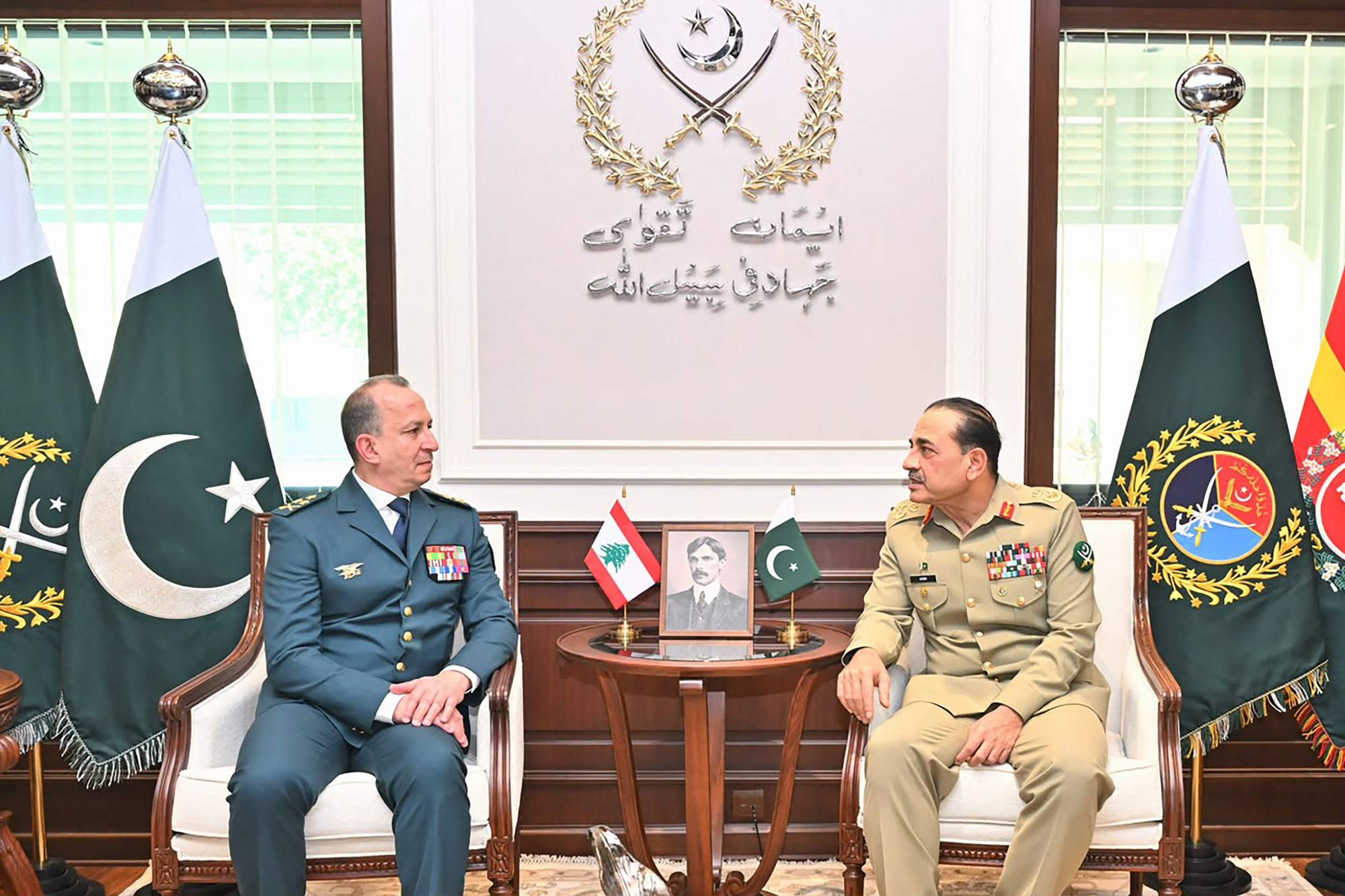
This handout photograph taken and released on June 9, 2026 by Pakistan's Inter-Services Public Relations (ISPR) shows Pakistan's Army Chief and Field Marshal Asim Munir (R) speaking with General Rodolphe Haykal, Commander-in-Chief of the Lebanese Armed Forces during their meeting in Rawalpindi. (Handout / Pakistan's Inter-Services Public Relations (ISPR) / AFP)
The Iranian embassy in Beirut posted on its social media an image of two clasped hands, with one covered with the Lebanese flag and the other the Iranian one, and the statement “always with you” in Lebanese dialect.
The post sparked hundreds of comments in support and criticism from users about Iranian and Lebanese interests.
Souaid noted the “sharp division in Lebanon between one camp that wants the country to be a mere bargaining chip for Iran, and another that wants to consolidate the authority of the Lebanese state and its independent decision-making.”
“The state is committed to its independent decision-making, while Iran is trying to usurp it through sparking a war in Lebanon and exploit the Israeli strike on Beirut’s southern suburbs as if to say that it alone holds the keys to the solution,” he added.
“Iran will not succeed in reclaiming Lebanon’s decision-making or again impose its authority over the country,” he stressed.
Army commander in Pakistan
Amid the developments, Lebanese army commander Rodolphe Haykal was in Islamabad at the invitation of his Pakistani counterpart Asim Munir .
The military has not revealed details about the visit.
An informed source confirmed to Asharq Al-Awsat that he was visiting at his counterpart’s invitation and that the trip was coordinated with President Aoun.
Pakistan has expressed its readiness to offer assistance to the Lebanese army in terms of its deployment in the South after the Israeli withdrawal, it said, noting that Islamabad enjoys the trust of the Americans, Iranians and the Israelis given its role in the mediation efforts between the US and Iran.
Israeli Minister Ben-Gvir under Investigation in Italy over Gaza Flotillahttps://english.aawsat.com/arab-world/5281929-israeli-minister-ben-gvir-under-investigation-italy-over-gaza-flotilla
Israel's far-right national security minister Itamar Ben Gvir (C) arrives at the site of a suspected shooting attack in the town of Tzur Yitzhak in central Israel close to the occupied West Bank on June 7, 2026. One person was killed and four others wounded in multiple suspected shooting attacks in Israel on June. (Photo by Jack GUEZ / AFP)
Israeli Minister Ben-Gvir under Investigation in Italy over Gaza Flotilla
Israel's far-right national security minister Itamar Ben Gvir (C) arrives at the site of a suspected shooting attack in the town of Tzur Yitzhak in central Israel close to the occupied West Bank on June 7, 2026. One person was killed and four others wounded in multiple suspected shooting attacks in Israel on June. (Photo by Jack GUEZ / AFP)
Italian prosecutors put Israel's far-right National Security Minister Itamar Ben-Gvir under investigation over the treatment of activists who were part of a Gaza flotilla last month, a judicial source said on Monday.
The source, who asked not to be named, confirmed earlier reports by Italian news agencies and said Ben-Gvir was being investigated on suspicion of torture and kidnapping of Italian citizens who were among the activists, Reuters said.
If the probe determines charges are warranted, prosecutors could lodge a formal request for trial.
In response to the Italian investigation, Ben-Gvir said in a statement: "I will not shy away from one investigation or another and will continue to stand proudly alongside our fighters."
Israel and Ben-Gvir have faced mounting international criticism after the minister in late May released a video showing detained Gaza activists kneeling with their hands bound after Israel intercepted the aid flotilla in international waters.
Organizers said the 430 activists detained by Israeli police included citizens of Italy and South Korea.
In a video Ben-Gvir posted on X, officers forced an activist to the ground after she chanted "Free, free Palestine".
The government of Italian Prime Minister Giorgia Meloni called the treatment of the activists "unacceptable" and summoned the Israeli ambassador for an explanation.
Italy subsequently asked the European Union to discuss sanctions against Ben-Gvir, while France has decided to ban Ben-Gvir from its territory.
Flotilla organizers say they aimed to break Israel's blockade of Gaza by delivering humanitarian assistance, something aid bodies say is still in short supply despite a US-brokered ceasefire between Israel and Hamas in place since October 2025 that includes guarantees of increased aid.
Israel says its naval blockade on Gaza is lawful.
Lebanon’s Aoun Says Will Not Meet Netanyahu Before Reaching Agreement to End Warhttps://english.aawsat.com/arab-world/5281904-lebanon%E2%80%99s-aoun-says-will-not-meet-netanyahu-reaching-agreement-end-war
17 January 2025, Lebanon, Baabda: Lebanese President Joseph Aoun speaks during a press conference at Baabda Palace. (dpa)
TT
TT
Lebanon’s Aoun Says Will Not Meet Netanyahu Before Reaching Agreement to End War
17 January 2025, Lebanon, Baabda: Lebanese President Joseph Aoun speaks during a press conference at Baabda Palace. (dpa)
Lebanese President Joseph Aoun made a rare direct appeal to the Israeli government and its people to come to the negotiating table to end the war, warning in a CNN interview aired Monday that a military solution "will never provide you with security and safety."
"We are ready, we are willing, we are committed. Are you? If you are, let's sit and talk," said Aoun.
The Lebanese government is in direct talks with Israel, mediated by Washington, to reach a full cessation of hostilities, despite opposition by Iran-backed group Hezbollah, which is fighting Israeli troops in southern Lebanon.
Aoun said he would not meet Israeli Prime Minister Benjamin Netanyahu before reaching an agreement to end the war.
He said any deal would be a non-aggression pact and not a full peace deal.
"We need to end the state of hostility between Lebanon and Israel. Forever. And this (pact) could be a path forward for a just and lasting peace," Aoun said.
Aoun said Lebanon would move in line with the 2002 Arab Peace Initiative, which offers normalization with Israel across the Arab world in exchange for Palestinian statehood and Israel's withdrawal from occupied territories.
"But we cannot jump from A to B directly. We have to go through different steps," Aoun said.
LEBANESE DYING FOR IRAN'S INTERESTS, AOUN SAYS
The war erupted on March 2 when Hezbollah fired on Israel in support of its ally Tehran. Israel responded with an air campaign and ground operations that have left swathes of southern Lebanon occupied.
More than 3,600 people have been killed in Israeli strikes on Lebanon and more than one million Lebanese are displaced.
The US declared a ceasefire on April 16, but fighting has continued, and Lebanon says Israel has carried out nearly 3,500 strikes since the truce was announced.
Israel struck Beirut's southern suburbs on Sunday in retaliation for Hezbollah fire on northern Israel, triggering a 24-hour direct exchange of fire between Iran and Israel that threatened to wreck Washington's efforts to reach an agreement with Tehran to end their more than three-month-old war.
Aoun told CNN that Lebanon sought a good relationship with Iran based on mutual respect and non-interference, and said Lebanon's people were being killed to serve Iran's interests.
In an earlier clip from the interview aired on Friday, Aoun accused Iran of using Lebanon as a bargaining chip in its talks with the United States, in some of his toughest criticism yet of Tehran.
لم تشترك بعد
انشئ حساباً خاصاً بك لتحصل على أخبار مخصصة لك ولتتمتع بخاصية حفظ المقالات وتتلقى نشراتنا البريدية المتنوعة