


Shelled City in North Ukraine Fears Becoming 'Next Mariupol'

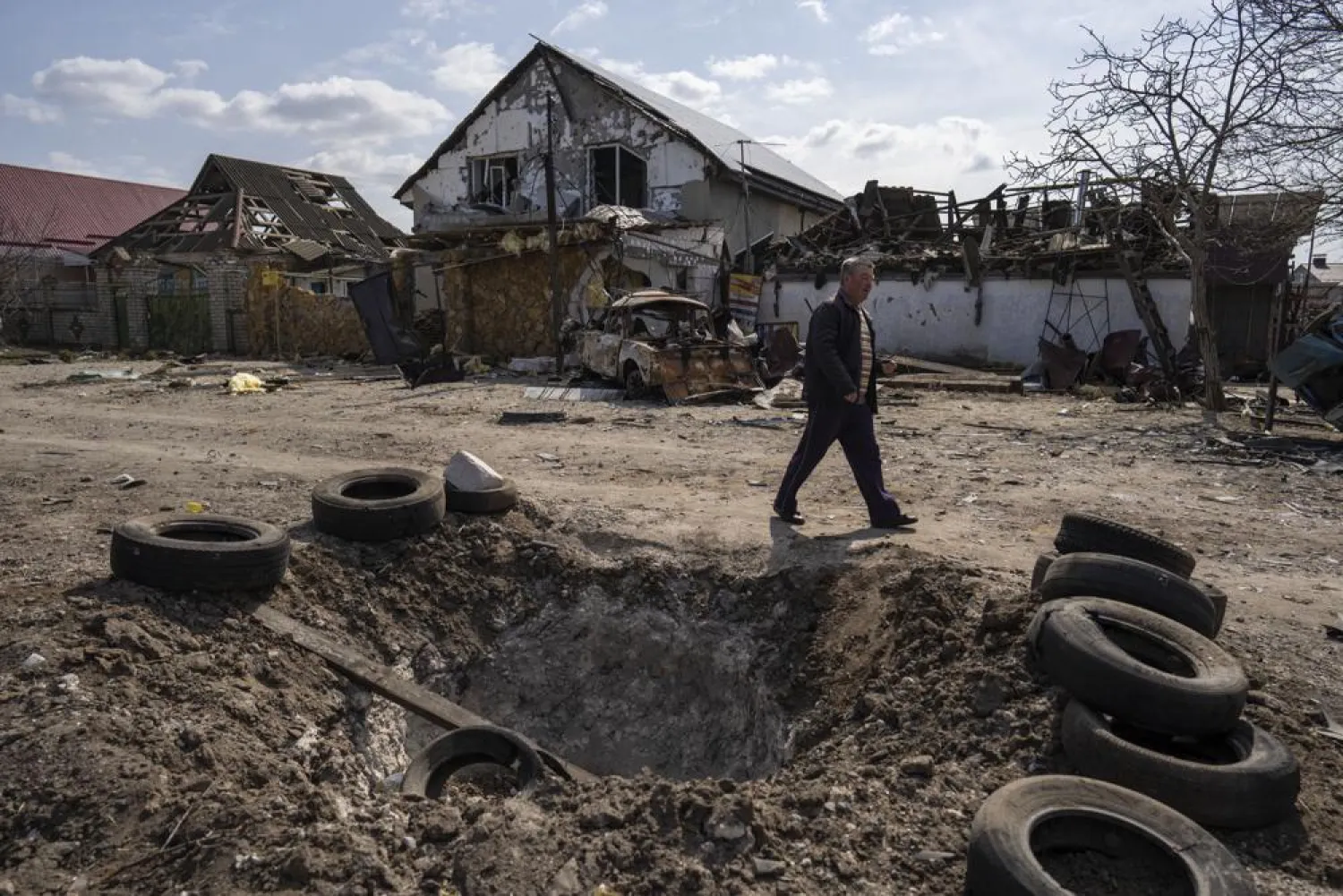
A man walks behind a crater created by a bomb and in front of damaged houses following a Russian bombing earlier this week, outskirts Mykolaiv, Ukraine, Friday, 25, 2022.(AP)
TT

Shelled City in North Ukraine Fears Becoming 'Next Mariupol'

A man walks behind a crater created by a bomb and in front of damaged houses following a Russian bombing earlier this week, outskirts Mykolaiv, Ukraine, Friday, 25, 2022.(AP)

Like many residents of Ukraine's besieged city of Chernihiv, linguistics scholar Ihar Kazmerchak spends his nights in a bomb shelter and starts his day lining up for the little potable water authorities have left to hand out.

Surrounded by Russian forces and under constant bombardment, the northern city known for its eclectic monasteries has no electricity, heating or running water. The lists at pharmacies of the medicines no longer available grow longer by the day.

“In basements at night, everyone is talking about one thing: Chernihiv becoming next Mariupol,” Kazmerchak, 38, said, referring to the southern port city 845 kilometers (525 miles) away that has suffered some of the worst horrors since Russia invaded Ukraine.

The fear is not misplaced. Russian bombs destroyed Chernihiv's main bridge over the Desna River on the road leading to Kyiv on Wednesday; on Friday, artillery shells rendered the remaining pedestrian bridge impassable, cutting off the last possible route for people to get out or for food and medical supplies to get in.

Just over a month into the invasion, Russia's attack has slowed into a grinding war of attrition as its military tries to pound cities like Chernihiv into submission. Bombings of hospitals and other non-military sites, such as the Mariupol theater where Ukrainian officials said a Russian airstrike is believed to have killed some 300 people last week, have given rise to war crime allegations.

Questions about the direction of Russia's offensive surfaced Friday when a high-ranking military official said the main objective of the first stage of the operation — reducing Ukraine’s fighting capacity — had “generally been accomplished.” Col.-Gen Sergei Rudskoi, deputy chief of the Russian general staff, said Russian forces could now focus on “the main goal, the liberation of Donbas.”

Donbas is the largely Russian-speaking eastern region where Russian-backed separatists have been fighting Ukrainian forces since 2014 and where many residents desire close ties to Moscow. Mariupol is located there, although outside of the two territories controlled by the separatists.

US officials said Russian troops appeared to have halted for now their ground offensive aimed at capturing the capital, Kyiv, and were concentrating more on gaining control of the Donbas region in the country’s southeast.

However, British defense officials reported Saturday that the Russian military continues to besiege a number of other major Ukrainian cities, including Chernihiv, which is located 146 kilometers (91 miles) from Kyiv.

“It is likely Russia will continue to use its heavy firepower on urban areas as it looks to limit its own already considerable losses, at the cost of further civilian casualties,” the UK Ministry of Defense said in its latest intelligence briefing on the war.

Ukrainian President Volodymyr Zelenskyy, appearing by video-link at Qatar's Doha Forum, on Saturday compared the destruction of Mariupol to the Syrian and Russian destruction wrought on the city of Aleppo.

“They are destroying our ports,” Zelenskyy said. “The absence of exports from Ukraine will deal a blow to countries worldwide.”

He called on countries to increase their exports of energy to give European nations an alternative to Russian oil and gas.

“The future of Europe rests with your efforts,” he said.

In Kyiv, ashes of the dead are piling up at the main crematorium because so many relatives have left, leaving urns unclaimed. For civilians who decided to stay or have been unable to leave under constant shelling, the misery is growing more severe.

In Yasnohorodka, a village some 50 kilometers (30 miles) west of Kyiv that Russian troops who occupied earlier in the week, appeared to have been pushed out as part of a counteroffensive by Ukrainian forces. Houses on the main crossroads lay in ruins. The tower of the village church was damaged.

“You can see for yourself what happened here. People were killed here. Our soldiers were killed here,” Yasnohorodka resident Valeriy Puzakov said.

In Chernihiv, hospitals are no longer operating, and residents cook over open fires in the street because the power is out.

Chernihiv Mayor Vladyslav Atroshenko has said that more than half of the city’s 280,000 residents fled amid the unrelenting attack.

Russian forces, he told Ukrainian television, “are deliberately destroying civilian infrastructure – schools, kindergartens, churches, residential buildings and even the local football stadium.”

It has been impossible to count the dead, but Atroshenko estimated the figure was “in the hundreds.”

Located only about 70 kilometers (45 miles) from the border with Belarus on the road to Kyiv, Chernihiv was attacked in the early days of the war and encircled by Russian troops this month, but its defenders so far have prevented a takeover.

“Chernihiv has become a symbol of the Russian army’s failed blitzkrieg, in which the plan was to take the city over in one day and advance towards Kyiv,” Mykola Sunhurovskyi, a military analyst at the Kyiv-based Razumkov Center think tank, said.

Kazmerchak started spending his night in a bomb shelter after a Russian bomb hit the Stalin-era movie theater next to the 12-story residential building where he lived. A Russian missile also destroyed the hotel not far from his house.

“The walls were shaking so much that I thought my house would collapse any minute and I would be left under the rubble,” Kazmerchak said.

Dwindling supplies led to long lines out of the few grocery stores that still had food. Shelling killed 10 civilians on March 16 as they waited outside to buy bread. Residents hunkered down and stayed home, but as the siege endures, some have given up on trying to stay safe, Kazmerchak said.

“Ravaged houses, fires, corpses in the street, huge aircraft bombs that didn’t explode in courtyards are not surprising anyone anymore,” he said. “People are simply tired of being scared and don’t even always go down to the basements.”



Trump to Travel to China Next Month, with US Trade Policy in Focus

US President Donald Trump arrives at Joint Base Andrews in Maryland, US, February 19, 2026. (Reuters)
TT

Trump to Travel to China Next Month, with US Trade Policy in Focus

US President Donald Trump arrives at Joint Base Andrews in Maryland, US, February 19, 2026. (Reuters)

US President Donald Trump will travel to China from March 31 to April 2 for a highly anticipated meeting between the world's two biggest economies, following the Supreme Court's decision to overturn Trump's sweeping tariffs against imported goods.

A White House official confirmed the trip on Friday, just before the highest US court struck down many of the tariffs Trump has used to manage sometimes-tense relations with China.

Trump is expected to visit Beijing and meet Chinese President Xi Jinping as part of a lavish, extended visit. Trump was last in China in 2017, ‌the most ‌recent trip by a US president.

A key topic had been whether ‌to ⁠extend a trade ⁠truce that kept both countries from further hiking tariffs. After Friday's ruling, however, it was not immediately clear whether - and under what legal authority - Trump would restore tariffs on imports from China.

TRUMP SEES TRADE IMBALANCE AS NATIONAL EMERGENCY

The administration has said the tariffs were necessary because of national emergencies related to trade imbalances and China's role in producing illicit fentanyl-related chemicals.

"That's going to be a wild one," Trump told foreign leaders visiting Washington on Thursday ⁠about the trip. "We have to put on the biggest display you've ‌ever had in the history of China."

The Chinese ‌embassy in Washington did not immediately respond to a request for comment. Beijing has not ‌confirmed the trip.

The visit would be the leaders' first talks since February and their first ‌in-person visit since an October meeting in South Korea. At that October meeting, Trump agreed to trim tariffs on China in exchange for Beijing cracking down on the fentanyl trade, resuming US soybean purchases and keeping rare earth minerals flowing.

While the October meeting largely sidestepped the sensitive issue of ‌Taiwan, Xi raised US arms sales to the island in February.

Washington announced its largest-ever arms sales deal with Taiwan in December, ⁠including $11.1 billion in ⁠weapons that could ostensibly be used to defend against a Chinese attack. Taiwan expects more such sales.

China views Taiwan as its own territory, a position Taipei rejects. The United States has formal diplomatic ties with China, but it maintains unofficial ties with Taiwan and is the island's most important arms supplier. The United States is bound by law to provide Taiwan with the means to defend itself.

Xi also said during the February call that he would consider further increasing soybean purchases, according to Trump.

Struggling US farmers are a major political constituency for Trump, and China is the top soybean consumer.

Although Trump has justified several hawkish policy steps from Canada to Greenland and Venezuela as necessary to thwart China, he has eased policy toward Beijing in the past several months in key areas, from tariffs to advanced computer chips and drones.


Diplomacy Is Still the Only Viable Path to Peace in Ukraine, UN Refugee Chief Barham Salih Says

UNCHR High Commissioner Barham Salih talks during an interview with The Associated Press in Kyiv, Ukraine, Friday, Feb. 20, 2026. (AP)
TT

Diplomacy Is Still the Only Viable Path to Peace in Ukraine, UN Refugee Chief Barham Salih Says

UNCHR High Commissioner Barham Salih talks during an interview with The Associated Press in Kyiv, Ukraine, Friday, Feb. 20, 2026. (AP)

There are many obstacles to a peace deal in Ukraine, but a diplomatic solution remains the only viable option, the newly appointed head of the UN refugee agency said Friday, warning that humanitarian operations are increasingly overstretched because of multiple global crises.

Barham Salih, Iraq’s former president who was elected UNHCR high commissioner in December, made his first visit to Ukraine since taking office.

After traveling to Ukraine’s front-line cities, including Kharkiv and Zaporizhzhia, he met with President Volodymyr Zelenskyy and discussed the latest in efforts to secure a peace deal. He also discussed the future of UNHCR operations as Ukraine endures Russian attacks on its energy grid during a harsh winter.

“You have to be hopeful, but I do understand the difficulties in the situation, and it’s clear, of course, there are many, many impediments along the way, but at the end of the day, there is no military solution. There needs to be peace, a durable and just peace so that people can go back to their lives,” he said, speaking to The Associated Press in an interview in Kyiv.

“Things are not necessarily easy, definitely not easy, but let’s redouble the effort to make sure that diplomacy has a chance and really bring about a durable and just peace to this war that has been going on for far too long,” he added.

Of the agency’s $470 million appeal for Ukraine, only $150 million has been pledged. The shortfall reflects deep cuts across the humanitarian sector, making it increasingly difficult to deliver aid across multiple crises.

There are 3.7 million Ukrainians displaced within the country and nearly 6 million Ukrainians outside the country who have become refugees in Europe and elsewhere, he said.

“This tells you the gap between what is needed and what is available,” he said. “My appeal to the international community is, really, this is not the moment to walk away, this is not a moment to look the other way round. These vulnerable populations need support. We should deliver this help to them.”

The UN agency in Ukraine predicts 10.8 million Ukrainians will require humanitarian assistance in 2026, according to a report from the agency. The most critical needs are concentrated along the war’s front lines in the eastern and southern parts of Ukraine, as well as in the northern border region. Intensified hostilities produce fresh waves of displacement.

The agency’s Ukraine appeal competes with large-scale conflicts in Sudan and Gaza. Since his appointment, Salih has spent only one week in his Geneva office, traveling to Kenya, Chad, Türkiye and Jordan before visiting Ukraine.

Drastic cuts to US humanitarian funding under President Donald Trump has accelerated the erosion of global humanitarian infrastructure and severely undermined the ability of organizations to deliver aid.

There are 117 million displaced people worldwide, including at least 42 million refugees, Salih said. Two-thirds face protracted displacement and remain dependent on humanitarian assistance.

Deciding where to prioritize given shrinking resources is “difficult” he said.

“It’s really very difficult to prioritize given the scale of the problem. I was in Kenya and I was in Chad recently and I was in Türkiye and in Jordan talking to refugees from Syria. And of course, now in Ukraine, these are all pressing issues, pressing requirements,” he said.

“We need to be there to help people, but also I have to say we really need to look at durable solutions too as well. It’s not a matter of sustaining dependency or humanitarian assistance,” he added.

In his meeting with Zelenskyy, Salih said they discussed the need to focus on the “recovery phase and sustainable solutions and self reliance as we go forward,” he said.


Israel Army Says on ‘Defensive Alert’ Regarding Iran but No Change to Public Guidelines

Israeli air defense system fires to intercept missiles during an Iranian attack over Tel Aviv, Israel, Thursday, June 19, 2025. (AP)
TT

Israel Army Says on ‘Defensive Alert’ Regarding Iran but No Change to Public Guidelines

Israeli air defense system fires to intercept missiles during an Iranian attack over Tel Aviv, Israel, Thursday, June 19, 2025. (AP)

The Israeli army said it was on "defensive alert" as the United States threatens potential military action against Iran, but insisted there were no changes in its guidelines for the public.

"We are closely monitoring regional developments and are aware of the public discourse concerning Iran. The (Israeli military) is on defensive alert," army spokesman Brigadier General Effie Defrin said in a video statement published Friday.

"Our eyes are wide open in all directions, and our finger is more than ever on the trigger in response to any change in the operational reality," he added, but emphasized "there is no change in the instructions".