
Anger Simmers over Syria's Economic Collapse

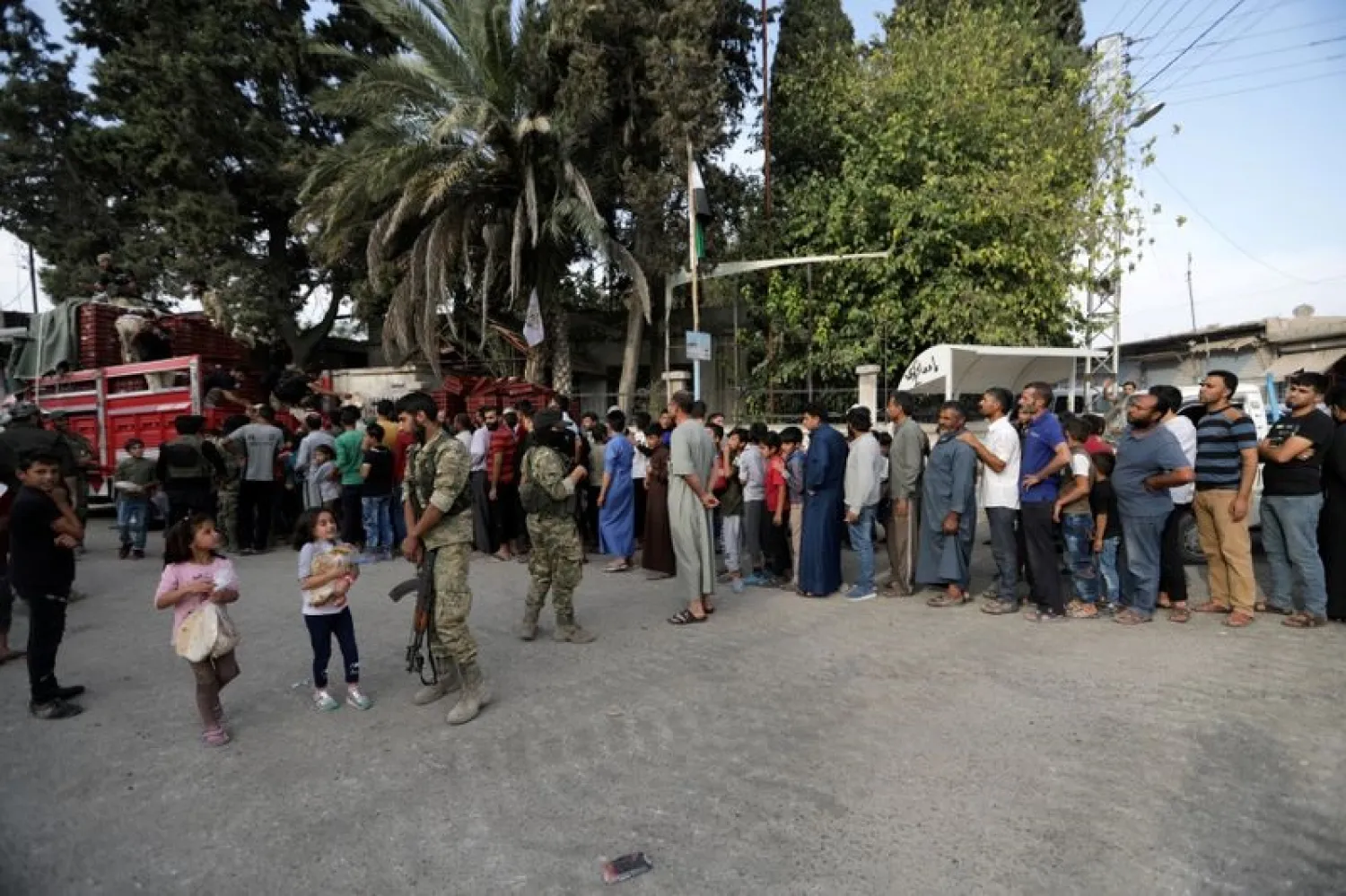
People stand in a queue to get bread in the border town of Tal Abyad, Syria, October 15, 2019. (Reuters)
TT

Anger Simmers over Syria's Economic Collapse

People stand in a queue to get bread in the border town of Tal Abyad, Syria, October 15, 2019. (Reuters)

In the back alleys of the old city of Damascus, Yaseen al-Obeid carries sacks of bricks to make some extra cash and supplement his monthly foreman’s salary of $15.

Like many other Syrians, one job is not enough; the 52-year-old has to find money to feed his wife and six children.

“Every time I go to bed I say to myself that I hope a rocket comes and kills me and rids me of this life,” he told Reuters via video link from his home in a run-down part of the Syrian capital.

Obeid’s problems are common among the estimated 17 million people left in Syria after a decade-long war that decimated the economy, killed hundreds of thousands of people and displaced more than 11 million, or around half the pre-war population.

President Bashar al-Assad, who with the help of Russian and Iranian forces has all but crushed the insurgency, faces a challenge that may be just as daunting - rebuilding a country from the rubble when economic headwinds are gaining strength.

The country is not yet at peace. Hostile Turkey controls territory in the northwest where many of the four million people who fled Assad’s bombing see Ankara as their protector.

The United States has a small military presence in the northeast that underpins Kurdish forces in a region where major oilfields are located and much of the country’s wheat was grown.

And now, with tightening US sanctions, neighboring Lebanon’s financial collapse, COVID-19 hitting remittances from Syrians abroad and allies Russia and Iran unable to provide enough relief, the prospects for economic recovery look poor.

“You don’t have sources of foreign currency, neither oil nor wheat - all of it we are paying from scarce hard currency. The government’s resources are limited,” said leading Damascus-based Syrian businessman Khalil Touma.

The government did not respond to Reuters questions about its economic record and about dissatisfaction over people’s worsening financial situation.

In televised speeches over the last year, Assad has blamed Western sanctions for Syria’s economic woes, and late in 2020 also pointed to the Lebanese banking crisis that has frozen Syrian depositors out of their accounts.

A cumulative total of $226 billion in gross domestic product was lost due to the war from 2011 to 2016, according to the World Bank.

More recently, purchasing power has collapsed along with the Syrian pound, which began to slide in late 2019 and hit a new low of 4,000 to the dollar this month.

A new 5,000 Syrian pound note issued in January was a reminder to some of the threat of hyperinflation, although the government said that was not the reason for the new note.

The pound’s fall has wiped out much of Obeid’s income. His salary was worth far more when it traded at 47 to the dollar before the conflict.

What hurts most is hearing his children tell him they go to bed hungry.

“My son tells me ‘I have not filled my stomach’. They sleep without eating.”

Queueing for bread
The country’s food subsidy system used to supplement Obeid’s salary, guaranteeing cheap bread. But cracks have begun to show, with residents saying that queues for bread across government-controlled areas can run up to five hours long as wheat imports dwindle.

Witnesses said fights had broken out, although open dissent against the authorities is still relatively rare amid fears that they will crack down to quell it.

The government did not respond to questions about whether it sought to stifle dissent.

Memories are still fresh of how peaceful protests in 2011 were met with deadly force, fueling an insurgency against Assad’s government that became a multi-sided war.

Another uprising against him looks unlikely, ahead of elections later in 2021 which he appears certain to win.

The government has reduced bread and gasoline allowances in an attempt to cut waste, but some businessmen say not all of its economic policies are working.

“There are a lot of decisions taken by the government that actually put up obstacles rather than make matters easier,” Touma said.

In Damascus, some residents say that signs of economic strain are everywhere, including beggars and homeless people roaming the streets of more affluent areas.

Meanwhile, the lifestyle of Syria’s elite appears relatively untouched behind the gated compounds of Yafour neighborhood close to the Damascus-Beirut highway.

Smart restaurants are teeming with customers.

“There is extreme spending on luxuries by a group who pay in foreign currency ... This is not the time,” Touma told Reuters.

Syria’s educated middle class is also suffering.

Some have lost thousands of dollars of savings they invested in banks in Lebanon, once a safe haven amid war and sanctions.

Garment trader Ibrahim Shahloub used to go to Beirut regularly to collect the interest on his savings and keep his family afloat.

With Lebanon’s banks freezing depositors out of their accounts as the country went into financial meltdown, he cannot access his money.

“The only hope we had was to go to Europe and we did not. The hope has gone, it has died, it has been buried,” he said.

Loyalists unhappy
Salary increases for war veterans and the military establishment cannot keep up with spiraling prices, and even in Jabla in the Mediterranean province of Latakia - an Assad family stronghold - some Syrians say they are unhappy.

Iskander Najoum, a former fighter for a pro-Assad militia, has adorned his walls with pictures of the leader and a fallen brother Ali. He talks with pride about Assad’s visit to his hometown last October after it was hit by forest fires.

But despite the veneration, Najoum is angry with officials he says have stolen funds meant to compensate farmers for the fires that swept the coastal province, the worst in decades.

“How are we going to fight corruption and bribery? How can an employee live on 60,000 pounds?” asked Najoum, who lost his left hand in the fighting. “Is this our reward for standing up to terrorism for 10 years and giving everything?”

The government did not respond to a question about people’s perception of corruption among officials.

Rare protests over eroding living conditions in government-controlled areas fizzled out last year, but frustration remains over dwindling supplies of bread and fuel.

Keeping a tight lid on dissent is a priority ahead of presidential elections, Syrians familiar with official thinking said.

Some activists say fear of arrest has already muzzled a once vocal social media, after dozens of students, civil servants, a judge and prominent journalists were detained for speaking out about poor living conditions and alleged corruption.

In a recent case, Hala Jerf, 54, a prominent television presenter and long-time supporter of Assad, was arrested at a checkpoint near Damascus in January on her way to work after she posted Facebook posts critical of the government.

“Putting the spotlight on corruption and the corrupt is a bigger crime than corruption itself,” said Rajaa Jerf, Hala’s sister.

The government did not immediately respond to a request for comment on Jerf’s case.

Suhaib Ibrahim, a former university student, joined peaceful demonstrations and later fought for the opposition after losing his mother and sister in airstrikes on Jobar, 2 km northeast of the old city walls of Damascus.

He, for one, saw little chance of renewed protests.

“They have not changed anything and things only got much worse,” he said. “We paid dearly.”


Attacks on Ebola Treatment Centers Are One of Several Problems Affecting Congo’s Outbreak Response

People wait to be attended at the Mongbwalu General Referral Hospital, as aid agencies intensify efforts to contain an Ebola outbreak caused by the Bundibugyo virus in Mongbwalu, Democratic Republic of Congo, May 23, 2026. (Reuters)
TT

Attacks on Ebola Treatment Centers Are One of Several Problems Affecting Congo’s Outbreak Response

People wait to be attended at the Mongbwalu General Referral Hospital, as aid agencies intensify efforts to contain an Ebola outbreak caused by the Bundibugyo virus in Mongbwalu, Democratic Republic of Congo, May 23, 2026. (Reuters)

Arson attacks on Ebola treatment centers in eastern Congo show how authorities are faced with a number of serious complications — including a backlash in local communities — as they try to stop an outbreak of an infectious disease that has been declared a global health emergency.

The burning of the centers in two towns at the heart of the outbreak shows the anger in a region beset by violence linked to armed rebel groups, the displacement of a large number of people, the failure of local government and international aid cuts that experts say have stripped health facilities in vulnerable communities.

"A devastating set of emergencies are converging," said the Physicians for Human Rights nonprofit.

Here's a look at the longstanding crises in eastern Congo that have made it home to one of the world's worst humanitarian disasters, and how they are now affecting the response to a rare type of Ebola:

The region has a constant threat of violence

Eastern Congo has seen violence by dozens of separate rebel groups for years, some of them with links to foreign countries or Islamic State.

The Rwanda-backed M23 rebels are in control of parts of the region. While the Congolese government still largely controls the northeastern Ituri Province, which is the epicenter of the Ebola outbreak, that control is tenuous. The Allied Democratic Forces, a Ugandan group linked to ISIS, is one of the dominant rebel groups there and responsible for violent attacks against civilian targets.

Before the outbreak, Doctors Without Borders said in an assessment of the situation in Ituri that the insecurity had worsened recently, causing doctors and nurses to flee and leaving overwhelmed health facilities and "catastrophic" conditions in some parts.

Nearly a million people are displaced in Ituri

Nearly 1 million people in Ituri have been displaced from their homes by conflict, according to the United Nations humanitarian office.

That means this Ebola outbreak is "unfolding in communities already facing insecurity, displacement and fragile health care systems," said Gabriela Arenas, Regional Operations Coordinator at the International Federation of Red Cross and Red Crescent Societies.

It's a significant concern that the disease might spread to the large displacement camps near the city of Bunia, where the first cases were reported.

Authorities have announced more than 700 suspected Ebola cases and more than 170 suspected deaths, mostly in Ituri. But cases have been reported in two other eastern provinces, North Kivu and South Kivu, where M23 are in control, and also in the neighboring country of Uganda.

That means that part of the outbreak in Congo is being managed by the government and part by rebel authorities, with an array of aid agencies also helping.

Aid cuts were devastating for eastern Congo

Health experts say international aid cuts last year by the United States and other rich nations were devastating for eastern Congo because it has so many problems.

The cuts "reduced the capacity to detect and respond to infectious disease outbreaks," said Thomas McHale, public health director at Physicians for Human Rights. Congo has had more than a dozen previous Ebola outbreaks.

Aid groups fighting this outbreak on the ground say they don't have the equipment they need, like face shields and suits to protect health workers from infection, testing kits, and body bags and other materials needed to safely bury the bodies of victims, which can be highly contagious.

"We have made requests to different partners, but we have not yet really received anything," said Julienne Lusenge, president of Women’s Solidarity for Inclusive Peace and Development, an aid group operating a small hospital near Bunia.

"We only have hand sanitizer and a few masks for the nurses."

The Bundibugyo type of Ebola virus responsible for the outbreak has no approved vaccine or treatment.

Health and aid workers also face anger from local communities

The burning of two treatment centers by people in the Rwampara and Mongbwalu areas — which have the highest case counts — show how a backlash in some communities is further complicating the response.

Colin Thomas-Jensen, director of impact at the Aurora Humanitarian Initiative, said the attacks may reflect the "built-in skepticism and anger" of people in eastern Congo over how the region has been treated, with years of violence from foreign-linked rebel groups and a failure of their government and international peacekeepers to protect them, he said.

Another source of anger has been the strict protocols around the burial of suspected victims of Ebola, which authorities are taking charge of wherever they can to prevent further spread of the disease when families prepare the bodies and people gather for a funeral.

The first burning of an Ebola center in Rwampara was by a group of local youths trying to retrieve the body of a friend who died, according to witnesses and police. The witnesses said the crowd accused the foreign aid group operating there of lying about Ebola.

Authorities in northeastern Congo have now banned funeral wakes and gatherings of more than 50 people in an effort to curb the spread, and armed soldiers and police are guarding some burials carried out by aid workers.


Report: Netanyahu Relegated from Partner to Passenger in Trump's War on Iran

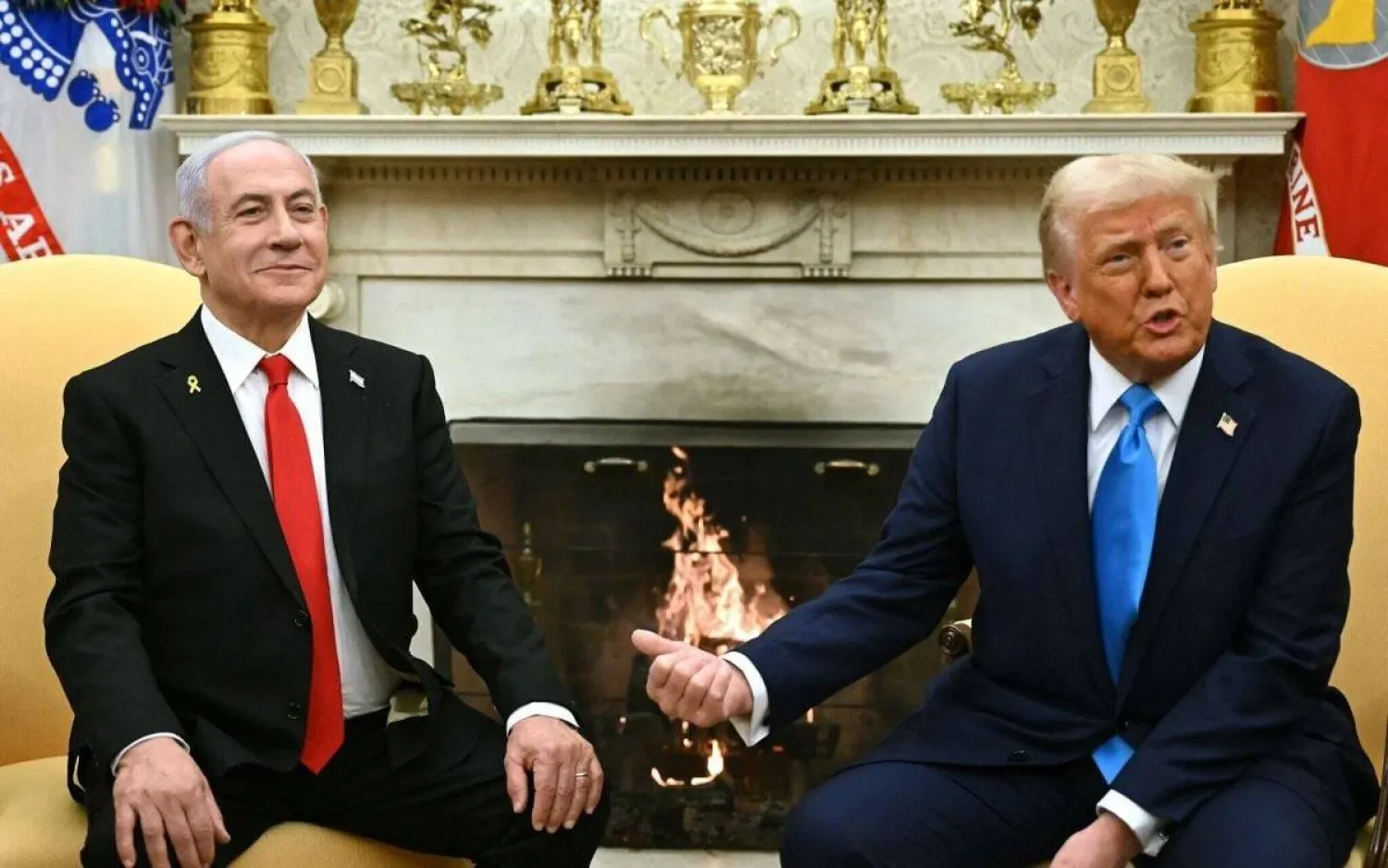
 US President Donald Trump, right, meets with Prime Minister Benjamin Netanyahu in the Oval Office of the White House, in Washington, Feb. 4, 2025. (AFP)
US President Donald Trump, right, meets with Prime Minister Benjamin Netanyahu in the Oval Office of the White House, in Washington, Feb. 4, 2025. (AFP)
TT

Report: Netanyahu Relegated from Partner to Passenger in Trump's War on Iran

 US President Donald Trump, right, meets with Prime Minister Benjamin Netanyahu in the Oval Office of the White House, in Washington, Feb. 4, 2025. (AFP)
US President Donald Trump, right, meets with Prime Minister Benjamin Netanyahu in the Oval Office of the White House, in Washington, Feb. 4, 2025. (AFP)

In the run-up to the February 28 attack on Iran, Prime Minister Benjamin Netanyahu of Israel was not only in the Situation Room with President Trump, he was leading the discussion, predicting that a joint US-Israeli strike could very well lead to the demise of the regime in Iran.

“Just a few weeks later, after those sanguine assurances proved inaccurate, the picture was starkly different. Israel was so thoroughly sidelined by the Trump administration, two Israeli defense officials said, that its leaders were cut almost entirely out of the loop on truce talks between the United States and Iran,” said a New York Times report on Saturday.

“Starved of information from their closest ally, the Israelis have been forced to pick up what they can about the back-and-forth between Washington and Tehran through their connections with leaders and diplomats in the region as well as their own surveillance from inside the Iranian regime,” said the two officials, who spoke on the condition of anonymity to discuss sensitive matters.

“The banishment from the cockpit to economy class has potentially significant consequences for Israel, and especially for the prime minister, who faces an uphill re-election battle this year.”

“Netanyahu has long sold himself to Israeli voters as a kind of Trump whisperer,” uniquely capable of enlisting and retaining the president’s support. In a televised speech early in the war, he portrayed himself as the president’s peer, assuring Israelis that he talked to Trump “almost every day,” exchanging ideas and advice, “and deciding together.”

“He had led Israel to war in February with grand visions of achieving a goal he has pursued for decades: stopping Iran’s push for nuclear weapons once and for all. As the war began with a stunning decapitation of much of the government in Tehran, it seemed as though an even more grandiose dream might come true: the toppling of the regime.”

“But many in Trump’s inner circle had always viewed the idea of regime change as absurd. And it wasn’t long before American and Israeli priorities began to diverge more, especially after Iran closed the Strait of Hormuz, sending oil prices soaring and pressuring Trump into agreeing to a ceasefire.”

Far from vanquished, Tehran has behaved as though it won the war, merely by surviving it. Israel, by contrast, has seen its biggest objectives for the war elude its grasp.

Netanyahu set three goals at the start of the war: toppling the regime, destroying Iran’s nuclear program and eliminating its missile program. None have been realized.

Instead of burying Iran’s nuclear ambitions, a recent American proposal called for a 20-year suspension of, or moratorium on, Iranian nuclear activity and that time frame may have gotten smaller in subsequent proposals. That raises the prospect that an eventual deal could resemble the Obama administration’s 2015 nuclear accord, which Netanyahu fought against at the time and Trump exited from three years later.

With the Trump administration excluding Israel from the negotiations, Iran’s arsenal of ballistic missiles may have been left off the table, as far as Israeli officials know. In that respect, any deal would fail to improve on the 2015 agreement, which Netanyahu assailed in part because it did not address Iran’s missiles.

It would also be a dismaying setback for the Israeli public, for whom life largely ground to a halt as the nation was bombarded by Iranian missiles in March and April.

There are other concerns for Israel about the possible contours of a US-Iran agreement, including a lifting of economic sanctions against Tehran. Doing so could amount to an economic lifeline, flooding Iran with billions of dollars that it could then use to rearm and to help its proxy forces, like Hezbollah, replenish their own arsenals with weapons to use against Israel.

While little is certain yet about the shape of an eventual deal — and any agreement could still be postponed by a renewal of fighting — what seems clear is that Israel’s partnership with the United States has come at a steep price. A country that for generations prided itself on “defending ourselves by ourselves,” and whose leaders exasperated a succession of American presidents with their hardheaded recalcitrance, is now making little secret of its need, and willingness, to submit to Trump’s demands.

As Defense Minister Israel Katz said on April 23, as Trump threatened to resume the war and bomb Iran back to the “Stone Age”: “We are only waiting for the green light from the US.”

“That admission was a humbling climbdown from the heady first days of the war, when the two countries achieved air supremacy and were so confident of success that they urged the Iranian people to topple the regime and secure their future,” said the NYT.

Within two weeks, it became clear that the war would not produce instant victory, as Trump had hoped. The White House, and some Israeli leaders, put aside their hopes for regime change, and Trump turned his attention toward ending the fighting.

“He had viewed Netanyahu as a war ally, but not as a close partner when it came to negotiating with the Iranians,” American officials familiar with his thinking said; in fact, he considered Netanyahu someone “who needed to be restrained when it comes to resolving conflicts.”

Israel soon found itself demoted from “equal partner” to something more akin to a “subcontractor” to the US military.

Israel would often clear plans with the United States, only to have the Trump administration throw it under the bus after those plans were executed, such as when Israel struck the South Pars natural gas field and oil facilities along the Gulf in southern Iran.

Trump even pressured Israel to bring a premature halt to its campaign against Hezbollah in Lebanon within days after the ceasefire on April 8, forcing Israel to accept restraints on its fighting with a hostile adversary right on its border.

“The sidelining is particularly hard to take for some Israeli officials, who, speaking on condition of anonymity, noted that the country willingly shouldered some of the war’s more controversial assignments.”

For Netanyahu, it has meant repeatedly recalibrating his rhetoric, and even adjusting his description of Israel’s war objectives, in response to Trump’s frequent vacillations.

After initially telling his citizens that Israel’s goals were to “remove” the existential threats of an Iranian nuclear weapon and of its ballistic missile arsenal, by March 12 Netanyahu was articulating a new idea. This one downplayed the fact that those threats had not been removed, and instead exalted Israel’s close partnership with the United States.

“Threats come and threats go, but when we become a regional power, and in certain fields a global power, we have the strength to push dangers away from us and secure our future,” he said. What gave Israel such newfound strength in the eyes of its adversaries, Netanyahu asserted, was his alliance with Trump — “an alliance like no other.”


*David M. Halbfinger and Ronen Bergman for The New York Times


A Grieving Father Buries His 6-Year-Old After a Land Mine Kills 3 Children in Syria’s Idlib

Idris Al-Ridah, center, weeps as he prays during the funeral of his son Mohammed, who was killed in an explosion caused by war remnants while playing with other children in the village of Abu Habbah in eastern Idlib countryside, in Abu Habbah, Syria, Thursday, May 21, 2026. (AP)
TT

A Grieving Father Buries His 6-Year-Old After a Land Mine Kills 3 Children in Syria’s Idlib

Idris Al-Ridah, center, weeps as he prays during the funeral of his son Mohammed, who was killed in an explosion caused by war remnants while playing with other children in the village of Abu Habbah in eastern Idlib countryside, in Abu Habbah, Syria, Thursday, May 21, 2026. (AP)

Idris al-Ridah wept as he carried the lifeless body of his 6-year-old son Amir, wrapped in a yellow and brown blanket, in northwest Syria.

The father collapsed to the ground as he laid his son to rest, his small body lowered into a grave next to two other young children who were siblings, Aya al-Fankih, 4, and Rayan al-Fankih, 6.

The three children were killed on Thursday in the village of Abu Habbah, in the countryside in the northwestern province of Idlib, when a land mine left behind from Syria's war exploded while they were playing near a well.

The deaths are the latest reminder of the dangers posed by unexploded war remnants scattered across the country years after the conflict began.

Mines and booby traps have killed and maimed hundreds of Syrians since Syria’s conflict began in March 2011, leaving about half a million people dead.

The Syrian Civil Defense said four other children who were near the well were also wounded in the blast.

"We heard a very loud explosion next to our house,” one resident, Mahmoud al-Aleiwi. He added that “when we got to the location there were a number of children’s bodies thrown around the well.”

He said one of the children was thrown 300 meters (984 feet) away by the explosion and was found on the roof of a house.

At a nearby hospital, wounded children cried as family members tended to them. One child had shrapnel wounds across his face and body, his legs wrapped in bandages. Another lay in bed with blood visible through bandages wrapped around his head.

Ten-year-old Ibrahim al-Suwadi was injured last month in a separate explosion caused by unexploded ordnance inside a damaged school in the town of al-Habit in Idlib’s southern countryside.

Sitting beside his father inside their home, al-Suwadi described how he was playing with his friends at the school when they went inside a room and found the mine.

“Two brothers picked it up and took it to the bathroom,” the boy said. “We thought it was an exploded mine so we started throwing rocks at it. All of a sudden, an older boy grabbed my hand and we ran, the mine exploded and I lost consciousness then I don’t remember anything.”

His father said the family had fled their village in 2013 during fighting and spent years living in displacement camps before returning after the fall of Bashar Assad’s government in December 2024.

Humanitarian organizations say unexploded ordnance remains one of the deadliest legacies of Syria’s war.

“Syria has ranked among the top contaminated countries around the world over the past years,” said Jakub Valenta, head of humanitarian disarmament and peace building for the Danish Refugee Council in Syria. He added that according to the data from the United Nations, around 14.3 million people are in danger of explosive ordnance in the country.

Valenta said the explosive hazards include anti-personnel mines, anti-tank mines and other unexploded devices left behind in residential and agricultural areas.

“We’re estimating that around 1,200 people and probably more have been affected by explosive ordnance accidents directly,” he said. “Out of those 1,200 people there were around 740 fatal casualties. The vast majority of these people are men and children.”

According to the Danish Refugee Council, around 60% of contaminated areas in Syria are agricultural lands, complicating efforts by displaced families to return home and rebuild livelihoods.

In Damascus’ southern suburb of Kisweh earlier this month, Syrian trainees working with Danish Refugee Council teams carefully removed and destroyed unexploded ordnance during training exercises aimed at expanding local demining capacity.

The organization says it has recruited and trained new Syrian explosive ordnance disposal teams to help clear contaminated areas and educate communities about the risks.

“The number of the casualties is among the highest worldwide in terms of explosive accidents and victims,” Valenta said.

“These people suffer lifelong injuries, physical like losing a limb or their vision and suffer mental health problems," he said. “These people also lose their jobs and livelihoods."