

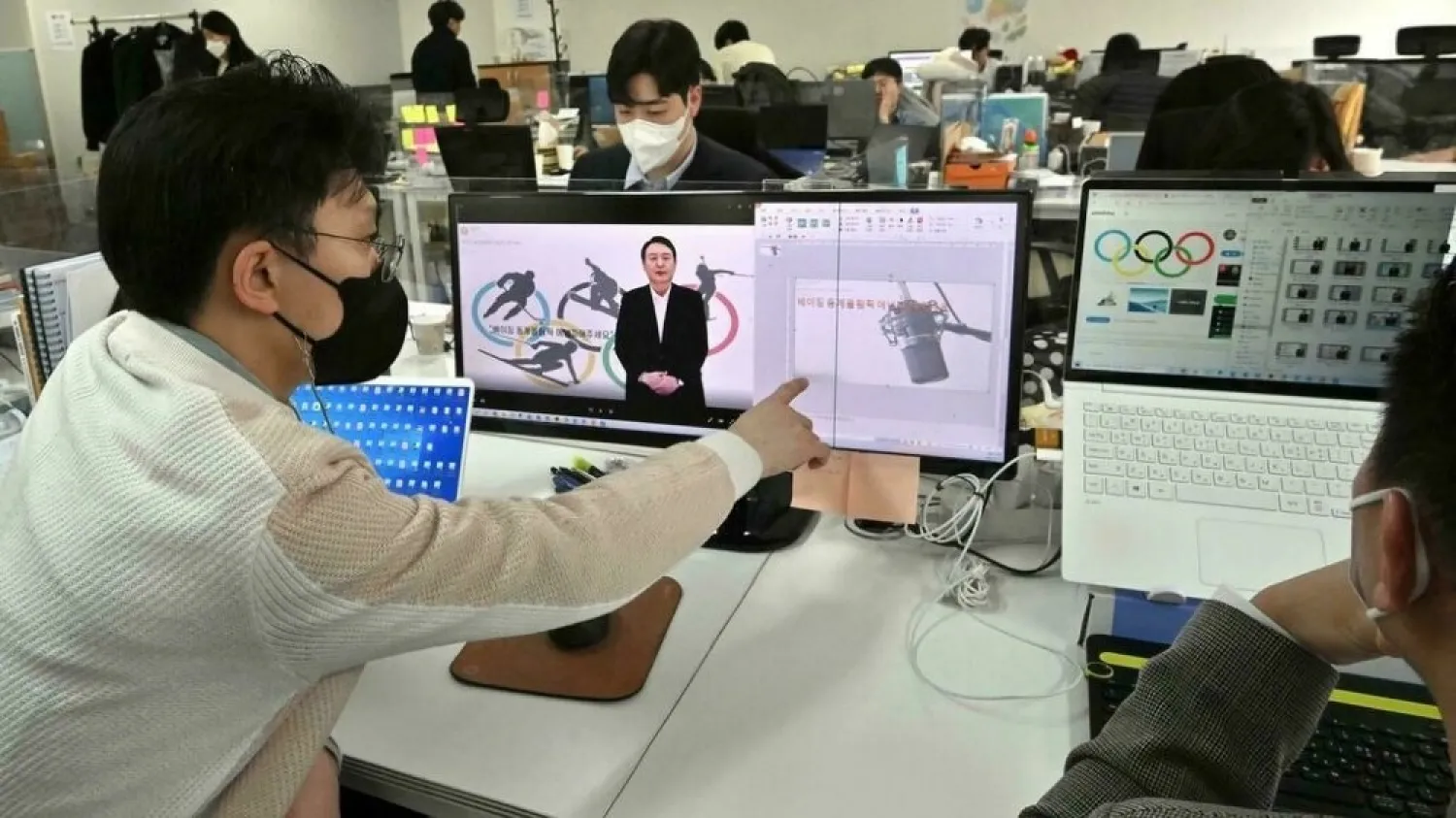

Deepfake Democracy: South Korean Candidate Goes Virtual for Votes

AI Yoon's creators believe he is the world's first official deepfake candidate Jung Yeon-je AFP
TT

Deepfake Democracy: South Korean Candidate Goes Virtual for Votes

AI Yoon's creators believe he is the world's first official deepfake candidate Jung Yeon-je AFP

In a crowded campaign office in Seoul, young, trendy staffers are using deepfake technology to try to achieve the near-impossible: make a middle-aged, establishment South Korean presidential candidate cool.

Armed with hours of specially-recorded footage of opposition People Power Party candidate Yoon Suk-yeol, the team has created a digital avatar of the frontrunner -- and set "AI Yoon" loose on the campaign trail ahead of a March 9 election, AFP said.

From a deepfake video of Barack Obama insulting Donald Trump to failed New York mayoral candidate Andrew Yang campaigning in the metaverse, AI technology has been used in elections before.

But AI Yoon's creators believe he is the world's first official deepfake candidate -- a concept gaining traction in South Korea, which has the world's fastest average internet speeds.

With neatly-combed black hair and a smart suit, the avatar looks near-identical to the real South Korean candidate but uses salty language and meme-ready quips in a bid to engage younger voters who get their news online.

It's been a huge hit. AI Yoon has attracted millions of views since making his debut January 1.

Tens of thousands of people have asked questions, but it's not the usual policy-related fare.

"President Moon Jae-in and (rival presidential candidate) Lee Jae-myung are drowning. Who do you save?" one user asks AI Yoon.

"I'd wish them both good luck," the avatar snaps back.

Meta-snark
At first glance, AI Yoon could pass for an actual candidate -- an apt demonstration of how far artificially generated videos, known as deepfakes, have come in the last few years.

The real Yoon recorded more than 3,000 sentences -- 20 hours of audio and video -- to provide enough data for a local deepfake technology company to create the avatar.

"Words that are often spoken by Yoon are better reflected in AI Yoon," said Baik Kyeong-hoon, the director of the AI Yoon team.

What the avatar actually says is written by his campaign team, not by the candidate himself.

"We try to come up with humorous and satirical answers," Baik told AFP.

The approach has paid off. AI Yoon's pronouncements have made headlines in South Korean media, and seven million people have visited the "Wiki Yoon" website to question the avatar.

"If we had only produced politically correct statements, we would not have this reaction," Baik said.

"The political establishment has been too slow in the face of a fast-changing society," he added.

When answering questions posed by users, AI Yoon mockingly refers to President Moon and his rival Lee as "Moon Ding Dong" and "Lee Ding Dong".

"I want to ask Moon Ding Dong this question: Who is our real enemy?" AI Yoon says, in a thinly-veiled swipe at what his critics say is the president's more conciliatory approach towards Pyongyang.

North and South Korea remain technically at war and Moon has met with Pyongyang's leader Kim Jong Un four times since taking office -- an approach candidate Yoon rejects as too soft.

The avatar politician has also used humour to try and deflect attention from Yoon's past scandals, for example claims he received inappropriate fruit gifts from a construction company when he was a senior prosecutor.

"I am not beholden to persimmons and melons. I am only beholden to the people," AI Yoon said -- although his campaign was later forced to acknowledge he had accepted some gifts.

The kind of script used by the campaign for AI Yoon draws on the language used in the online gaming world, Kim Myuhng-joo, professor of information security at Seoul Women's University, told local media.

"AI Yoon reads off the scripts compiled by its creators, who do not mince words," Kim said.

Ko Sam-seog, a staffer for Yoon's main opponent Lee, accuses the cyber-candidate of "downgrading political decorum".

But the snark is working: while polling for the March 9 election remains neck-and-neck, Yoon has pulled ahead of rival Lee Jae-myung with voters in their 20s.

– AI future -

Tech-savvy Baik and his two other team members -- all in their 20s and 30s -- are some of the youngest staffers in the sprawling Yoon campaign.

They come with AI Yoon's responses in rapid-fire brainstorming sessions, which can take as little as 30 minutes, in contrast to the carefully-honed rhetoric usually found in public policy debates.

South Korea's election monitor allows AI candidates to campaign on the condition it is clearly identified as deepfake technology, and does not spread misinformation.

The technology has more often been flagged as harmful -- the 2018 deepfake video of Obama was produced by Oscar-winning filmmaker Jordan Peele to warn viewers about trusting material they encounter online.

But Baik thinks AI is the future of election campaigns.

"It's so easy to create huge amounts of content with deepfake technology," he told AFP.

"It is inevitable that this will be used more and more."


Hotels Strive to Be Found as AI Models Conduct Travel Search

The rise of AI to plan and book travel will force hotels to make themselves visible when people describe what type of room they would like. JOEL SAGET / AFP/File
TT

Hotels Strive to Be Found as AI Models Conduct Travel Search

The rise of AI to plan and book travel will force hotels to make themselves visible when people describe what type of room they would like. JOEL SAGET / AFP/File

With people increasingly adopting AI to help plan their vacations, hotels are working to make sure that you check them out -- and check in.

Whether using ChatGPT or AI-enabled travel sites like Layla.ai, it is already possible to pose search questions like: "Calm hotel with west-facing balcony" or "Charming hotel with spa that accepts dogs".

This simple switch to plain speech searches belies major technical changes that mean hotels have to learn to become visible to AI models, AFP said.

"We're in complete upheaval: last year 35 percent of French people used artificial intelligence to find a hotel, a cafe or a restaurant," said Nicolas Marette, founder of Cust place, a French company that helps firms optimize their digital presence.

According to a recent study by the Boston Consulting Group (BCG), around 37 percent of travelers are already using AI-enabled online travel sites to plan and book trips.

Hospitality industry players have taken notice.

A quarter of hospitality firms "have an AI strategy that is starting to produce real returns across multiple organizational activities", according to the BCG report.

"What a hotel needs to do to get well referenced by search engines is not the same thing that they need to do to get referenced by artificial intelligence," said Johanna Benesty at BCG.

Moreover, not all AI models "work in the same way," she added.

- Plain speech, elaborate task -

At French hospitality group Accor, which owns dozens of chains including Pullman, Sofitel, Mercure and Ibis, "we've been trying for a year already to understand how to make ourselves more relevant... and be more visible," the group's AI and data science chief Nicolas Maynard told a recent industry conference.

But that can be a challenge as AI users see fewer options, meaning securing a top ranking becomes even more critical.

"It's a big change: with Google a search gives you 50 results... while if you ask ChatGPT it will give you five" and that is it, Maynard added.

The switch to plain speech means big changes for hotels.

"The biggest challenge is to understand vague requests like 'I want a romantic hotel in the south'," Maynard said.

Because Accor's systems do not currently classify properties by such attributes, the group has its work cut out.

"We need to adapt our systems to take semantics into account," Maynard said.

- Hyper detailed -

But beyond semantics, AI will allow hotels to provide customers with a wealth of information.

Best Western France's director Olivier Cohn said he believed "what will make the difference is our ability to answer client questions more thoroughly".

Hotels could respond to even the most detailed client questions such as "knowing if there is a power socket on the left side of the bed because they are used to sleeping on that side of the bed and charging their devices", he said.

While such questions are simple in and of themselves, current systems and staff can struggle to answer in such detail, said Cohn, whose chain counts more than 4,000 hotels throughout the world.

Some hotels are already deploying AI chatbots to help answer simple guest questions, allowing staff to provide higher-value services.

But winning the referencing game isn't only up to the hotels themselves.

BCG notes that "algorithms elevate properties with comprehensive, high-trust, multisource information over those with sparse or inconsistent digital footprints", meaning that client descriptions and reviews will also be important.

But just like online travel agencies (OTA) charge commissions and offer premium service for a price, AI models are already beginning to do the same.

"The familiar OTA commission model will evolve into AI-era distribution fees, charged for prominence and relevance in algorithmic recommendations," the BCG report said.


Google, Meta, TikTok Hit by EU Consumer Complaints about Handling of Financial Scams

FILE PHOTO: The logo of Meta is seen during the Viva Technology conference dedicated to innovation and startups at Porte de Versailles exhibition center in Paris, France, June 12, 2025. REUTERS/Benoit Tessier/File Photo
TT

Google, Meta, TikTok Hit by EU Consumer Complaints about Handling of Financial Scams

FILE PHOTO: The logo of Meta is seen during the Viva Technology conference dedicated to innovation and startups at Porte de Versailles exhibition center in Paris, France, June 12, 2025. REUTERS/Benoit Tessier/File Photo

Alphabet's Google, Meta Platforms and TikTok were hit with complaints from European Union consumer groups on Thursday for allegedly failing to protect users from financial scams on their platforms, putting them at risk of regulatory fines.

The move highlights growing pressure worldwide on Big Tech to do more to address the negative impacts of social media, particularly for children and vulnerable users.

The complaints, filed by the European Consumer Organisation (BEUC) and 29 of its members in 27 European countries, were submitted to the European Commission and national regulators under the Digital Services Act, which requires large online platforms to do more to tackle illegal and harmful content, Reuters reported.

"Meta, TikTok and Google not only fail to proactively remove fraudulent ads but also do little when being notified about such scams," BEUC Director General Agustin Reyna said in a statement.

"If they fail to address the financial scams circulating on their platforms, fraudsters will continue to reach millions of European consumers daily, leaving people at risk of losing hundreds to thousands of euros to fraud," he said. Google and Meta rejected the complaints and said they work proactively to protect their users.

A Google spokesperson said: "We strictly enforce our ad policies, blocking over 99% of violating ads before they ever run. Our teams constantly update these defences to stay ahead of scammers and protect people."

Meta said it found and removed over 159 million scam ads last year, 92% before anyone reported them. "We invest in advanced AI, tools, and partnerships to stop them," a spokesperson said.

TikTok said it takes action against violations, adding that scams are an industry-wide challenge while bad actors constantly adapt their tactics.

The consumer groups, meanwhile, said they reported nearly 900 ads suspected of breaching EU laws between December last year and March this year but the platforms only took down 27% of the ads and 52% of the reports were rejected or ignored.

The groups urged regulators to investigate whether the companies were complying with the rules and to impose fines for breaches.

DSA fines can reach as much as 6% of a company's global annual turnover.


SDAIA Outlines Comprehensive Data Quality Journey to Support National AI Initiatives

The Saudi Authority for Data and Artificial Intelligence (SDAIA)
TT

SDAIA Outlines Comprehensive Data Quality Journey to Support National AI Initiatives

The Saudi Authority for Data and Artificial Intelligence (SDAIA)

The Saudi Data and Artificial Intelligence Authority (SDAIA) highlighted data quality as a critical foundation for enhancing information reliability, boosting performance, and enabling accurate business decisions, as part of its efforts during the Year of Artificial Intelligence 2026 to raise awareness about data importance.

The authority noted that high data quality serves as the cornerstone for sustainable national trust, integrated digital services, operational savings, entrepreneurship, and readiness for artificial intelligence applications, SPA reported.

SDAIA stated that the data quality journey spans five phases, beginning with a creation phase, where data is entered according to standardized criteria.

This is followed by a storage and organization phase to structure data and eliminate duplication, and an integration and sharing phase, which assesses quality before data is reused.

The journey continues through an analysis and use phase, where report accuracy is tied directly to source quality, and culminates in a continuous improvement phase, which utilizes analysis and user feedback to constantly refine data sets.

SDAIA called on organizations to adopt comprehensive data quality practices and strictly adhere to national regulations and standards. This includes integrated data quality planning, prioritizing initial assessments, developing data rules, and establishing clear performance indicators to measure improvement.

The authority also emphasized the importance of conducting periodic reviews and enabling users to report quality problems, which will ultimately maximize the efficiency of digital services and AI applications across the Kingdom.
