
French FM Calls on Iran to Make 'Major Concessions'

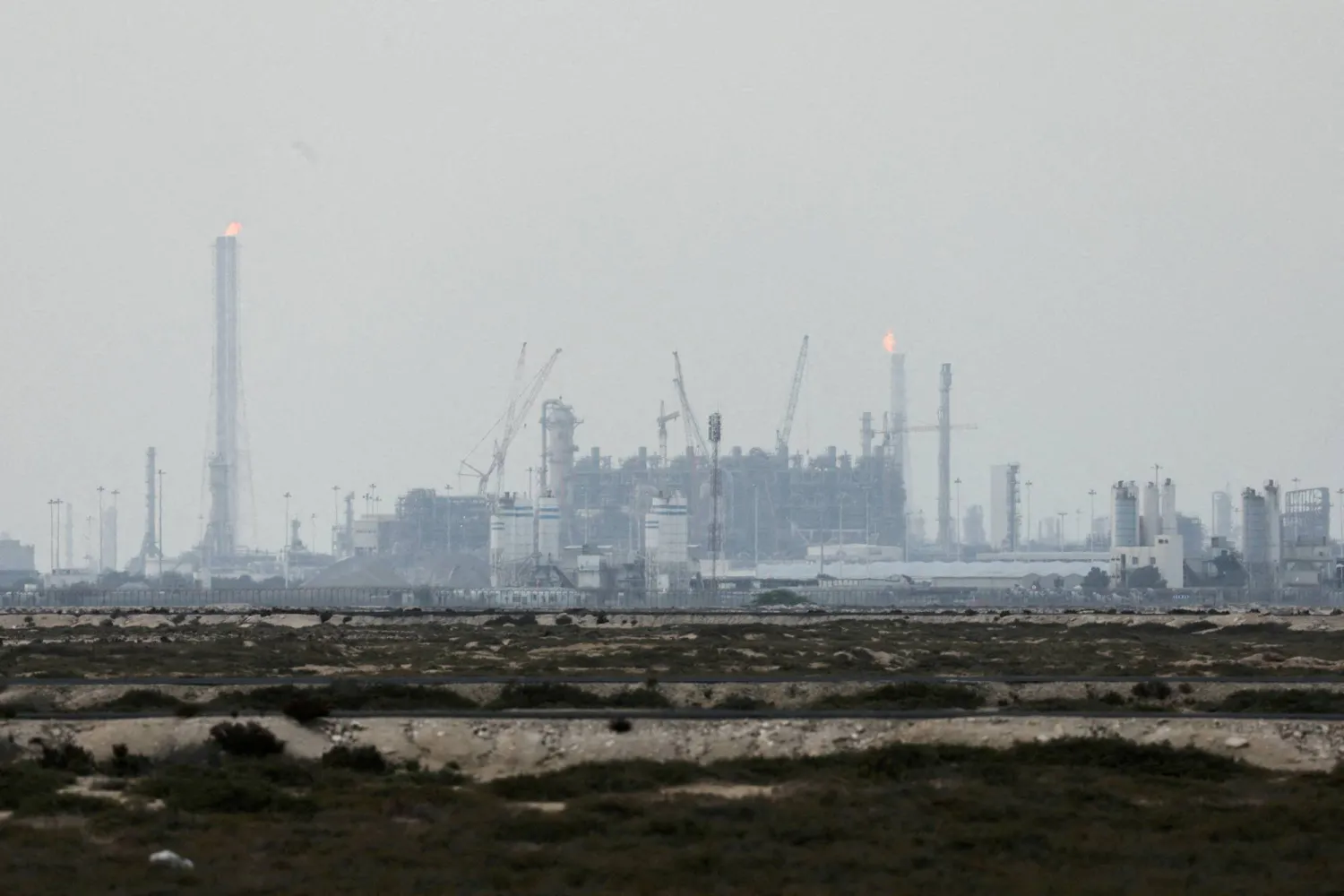
FILE PHOTO: QatarEnergy's liquefied natural gas (LNG) production facilities, amid the US-Israeli conflict with Iran, in Ras Laffan Industrial City, Qatar March 2, 2026. REUTERS/Stringer/File Photo
TT

French FM Calls on Iran to Make 'Major Concessions'

FILE PHOTO: QatarEnergy's liquefied natural gas (LNG) production facilities, amid the US-Israeli conflict with Iran, in Ras Laffan Industrial City, Qatar March 2, 2026. REUTERS/Stringer/File Photo

French Foreign Minister Jean-Noel Barrot said Friday on a visit to Israel that Iran must make major concessions as part of any long-term political solution following the Middle East war.

"Whatever the outcome of the ongoing military operations, it must be complemented by a political solution that produces lasting results," Barrot told journalists in Tel Aviv, AFP reported.

"In this regard, the Iranian regime must be prepared to make major concessions -- a radical change of stance."

Barrot repeated a European call for a moratorium on strikes against energy infrastructure after an Israeli bombardment of Iran's key gasfield pushed up energy prices.

France's top diplomat, who visited Beirut on Thursday, expressed France's "reservations" about Israel's ground operations to fight Iran-backed Hezbollah in Lebanon.

He called on Israel to seize an "historic opportunity" and hold direct talks with the Lebanese authorities, after French President Emmanuel Macron agreed to host negotiations.

"The Lebanese government has signalled its unprecedented openness to direct talks at the highest level with Israel," he said.

Israel's Foreign Minister Gideon Saar said he had discussed with Barrot the "scope of attacks on Israel from Lebanese territory".

"Unfortunately, the Lebanese government and its army are not taking any meaningful action against Hezbollah, neither militarily nor in other aspects," Saar wrote on X.

He also called on the EU to list Hezbollah "in its entirety as a terrorist organization, not only its military wing, as several European countries already did".

Barrot said that regional stability in the Middle East also depended on the implementation of US President Donald Trump's peace plan for Gaza that halted two years of war in October.

The Trump plan envisions the disarmament of Hamas, the gradual withdrawal of the Israeli military and the deployment of an International Stabilization Force, with a transitional Palestinian technocratic committee overseeing day-to-day governance.


Italy Discussing Expanding EU Aspides Mission to Include Strait of Hormuz, Defense Minister Says

Italian Defense Minister Guido Crosetto. (Asharq Al-Awsat)
TT

Italy Discussing Expanding EU Aspides Mission to Include Strait of Hormuz, Defense Minister Says

Italian Defense Minister Guido Crosetto. (Asharq Al-Awsat)

Italy’s defense minister said discussions are underway to expand the European Union’s Red Sea naval mission, Aspides, to include the Strait of Hormuz, warning that Iran’s missile and nuclear ambitions pose a global threat.

In an interview with Asharq Al-Awsat, Defense Minister Guido Crosetto said the EU is considering widening the mandate of its “Aspides” mission to protect maritime navigation beyond its current area of operations.

“The discussions aim to allow the European Union to extend maritime security operations, including the protection of the Strait of Hormuz,” he underlined.

However, Crosetto stressed that any such effort would require a broader international coalition, noting that Asian economies depend more heavily on the strategic waterway.

“This alliance goes far beyond Europe,” he noted. “Given the strait’s vital importance to Asia, it is only fair that Asian countries assume greater responsibility.”

Saudi and Gulf role

Crosetto praised Saudi Arabia’s handling of Iranian attacks, which he described as “provocative,” calling Riyadh’s response “extremely serious and important.”

“From the beginning, Saudi Arabia worked to prevent escalation,” he said. “It defended itself without being drawn into retaliation and helped create the conditions that now allow us to believe the war may be over.”

He continued that the conflict underscored a key lesson for Gulf states: that peace depends on credible defense and deterrence.

“They were attacked despite not taking hostile action,” he noted. “Even if calm returns, there is no guarantee Iran’s behavior will not change again.”

The minister added that the strikes, including on energy infrastructure and desalination plants, showed that civilian sites must be protected alongside military assets.

Growing defense ties

Crosetto said defense cooperation between Italy and Saudi Arabia has accelerated in recent years, particularly in industrial partnerships.

He said: “Italy does not simply sell. We aim to build joint development partnerships fully aligned with Vision 2030.”

He pointed to a recent satellite agreement and ongoing talks covering air defense, naval systems, aviation and helicopters.

“Our cooperation goes beyond transferring production to include technology transfer and exchange,” he remarked.

Italy also offered support during the conflict, deploying defensive systems against missiles and drones.

“We assisted friendly countries facing unjustified aggression,” he said, stressing that the support was not commercial.

Hormuz must remain open

Crosetto firmly rejected any suggestion that Iran could impose transit fees or restrictions in the Strait of Hormuz, saying: “It is absolutely unacceptable for Iran to impose any fees or constraints. The strait must remain a free passage.”

He warned that allowing countries to weaponize strategic waterways would set a dangerous precedent.

“Otherwise, others could follow — from the Houthis to states controlling the Strait of Malacca, the Panama Canal or Gibraltar. That would be sheer madness,” he stressed.

Iran and regional security

Crosetto said Italy maintains communication channels with Tehran but acknowledged ties are limited. “Our relations with Iran are not particularly strong. The issue today is identifying who our real counterpart is.”

He argued that power in Iran is increasingly concentrated in the hands of the Revolutionary Guard Corps, making diplomacy more difficult.

“They represent one of the main obstacles to peace,” he said.

The minister also warned that Iran’s military capabilities extend beyond the region, saying: “As Iran has targeted Riyadh, Doha or Dubai, it could target Rome, Paris or Berlin tomorrow. This is unacceptable.”

He added that Iran obtaining nuclear weapons would be a threat “not only to Israel, but to the entire world.”

NATO and European defense

Asked about concerns over NATO’s future following remarks by US President Donald Trump, Crosetto expressed confidence in the alliance.

“NATO will endure for a very long time,” he said. “It is an added value for both Europe and the United States.”

He stressed that recent conflicts have reshaped Europe’s understanding of deterrence, highlighting the importance of coordination among allies.

“The broader and more interconnected defense becomes, the stronger it is,” the minister emphasized, calling for a greater European role alongside NATO, including non-EU countries such as Türkiye, Ukraine and Norway.

Drones

Crosetto said Italy is studying recent conflicts — from Ukraine to the Gulf — to reassess national security risks.

He argued that while the war in Ukraine appears conventional, fought in trenches reminiscent of World War I, it is fundamentally modern due to the widespread use of drones.

“Drones are now the most used weapons and account for a large share of losses,” he stated.

By contrast, the Gulf conflict has been largely aerial and missile-based, with drones — increasingly enhanced by artificial intelligence — transforming defense strategies.

The minister remarked that future defense systems must be multilayered to counter evolving threats.


Israeli Intelligence Reveals Major Fracture in Iran’s Leadership

A member of the Iranian security forces stands guard next to a banner honoring Iran's slain supreme leader Ali Khamenei in Tehran on March 31, 2026. (AFP)
TT

Israeli Intelligence Reveals Major Fracture in Iran’s Leadership

A member of the Iranian security forces stands guard next to a banner honoring Iran's slain supreme leader Ali Khamenei in Tehran on March 31, 2026. (AFP)

Tel Aviv has confirmed a major fracture in the Iranian leadership, which implies a partial collapse of the regime in Tehran in wake of the US-Israeli war on Iran, revealed a report by the Military Intelligence Directorate of the Israeli Army (Aman).

According to Aman, the absence of Supreme Leader Ali Khamenei, killed in joint US-Israeli air strike on February 28, has left a significant power vacuum in the country.

It said his son and successor, Mojtaba, lacks the charisma of his father and does not command the same religious stature or political weight. He is also still recovering from severe injuries sustained from a strike during the war and therefore, is considered unable to take real power.

The Aman report, published by the Walla website on Sunday, listed the names of Iran’s current leaders who remained in power after the US and Israeli strikes eliminated 55 key leading figures.

In addition to Mojtaba Khamenei, the list includes former Iranian Revolutionary Guards Corps (IRGC) intelligence chief Hossein Taeb, who is also a senior adviser to Mojtaba and his secretary. Taeb is regarded as a hardline official, who considers any agreement with the West as betrayal and an existential threat to the regime.

Another survivor of the Iranian leadership is IRGC commander Ahmed Vahidi, a former Minister of Defense and Interior, who is widely considered a major hardliner.

The list also includes parliament speaker and one of Iran’s top negotiators, Mohammad Bagher Ghalibaf, a veteran conservative politician who is interested in improving the economy and preventing Iran’s social and political collapse.

Among the reformists, the list includes President Masoud Pezeshkian, who is pursuing a more moderate path focused on economic reform and easing international sanctions. However, his powers are constrained by the IRGC.

Another reformist is Iranian Foreign Minister Abbas Araghchi, who was a negotiator in the first nuclear deal in 2015. A senior Aman official said Araghchi is viewed as a diplomat skilled in navigating complex negotiations while attempting to preserve Iranian “dignity” against US demands.

An Israeli general in Aman said the Israeli and US strikes has decimated the inner circle of the supreme leader, forcing Tehran to rely on a more fragmented and weak leadership structure that suffers from internal tensions despite the ceasefire.

The general added that the war, assassinations, the absence of Ali Khamenei, the destruction and lack of communication among security and political figures, have all fractured the Iranian leadership, complicating its ability to make decisions and coordinate.

Aman said the hardliners have gained more power in Iran and are now capable to ruin any deal reached between reformists and the US.


Ukrainian Drones Kill Man in South Russia

This handout satellite image courtesy of 2026 Vantor taken and made available on April 16, 2026, shows smoke rising from the Tuapse oil refinery of in Tuapse, south-western Russia. (Handout / Satellite image ゥ2026 Vantor / AFP)
TT

Ukrainian Drones Kill Man in South Russia

This handout satellite image courtesy of 2026 Vantor taken and made available on April 16, 2026, shows smoke rising from the Tuapse oil refinery of in Tuapse, south-western Russia. (Handout / Satellite image ゥ2026 Vantor / AFP)

A Ukrainian drone attack killed a man and wounded another in the resort city of Tuapse on the Black Sea in southern Russia, the regional governor said Monday.

It was the second assault on the seaport in a matter of days, with drone debris damaging windows in buildings across the city, including apartments, a primary school, kindergarten, museum and church, Veniamin Kondratiev added.

"Tuapse came under yet another massive drone attack tonight. As a result, one man was killed at the seaport, according to preliminary information. I extend my deepest condolences to his family," Kondratiev said.

Another man was also wounded in the attack and received medical assistance, he added.

On Thursday, a 14-year-old girl and a young woman were killed by a nighttime drone attack on the same city, according to a previous statement by the governor.

Russia's defense ministry also reported that its air defenses had "destroyed 112 Ukrainian drones" overnight Sunday to Monday.