


Asharq Al-Awsat Names 5 Top Iran Guards Members Killed in Strikes Near Damascus Last Week

An Iraqi soldier monitors the situation across Iraqi-Syrian border at the al-Boukamal crossing. (Reuters)
TT

Asharq Al-Awsat Names 5 Top Iran Guards Members Killed in Strikes Near Damascus Last Week

An Iraqi soldier monitors the situation across Iraqi-Syrian border at the al-Boukamal crossing. (Reuters)

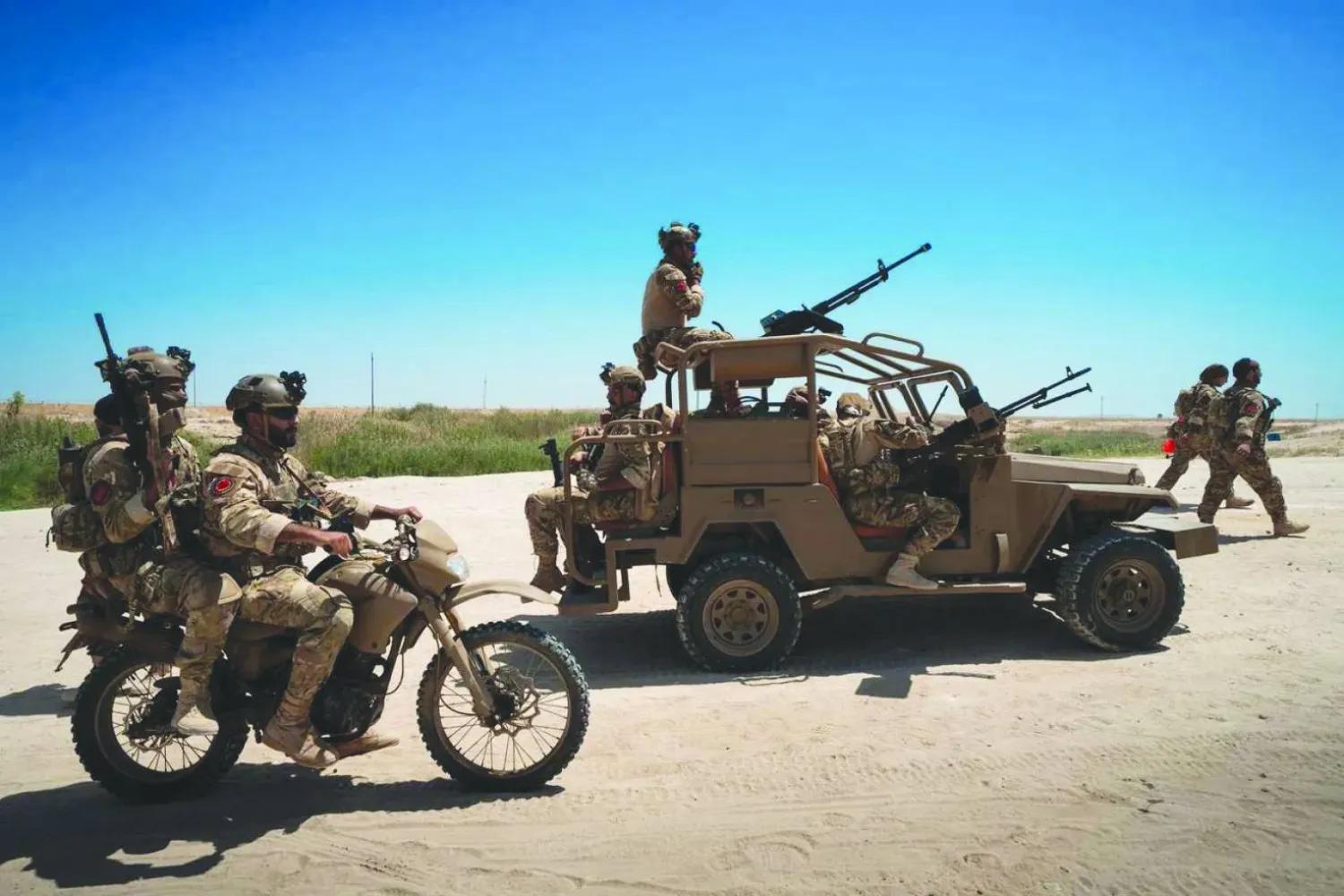
Senior officials were among the members of Iranian militias killed in possible Israeli and American air strikes on Syria last week, revealed field sources to Asharq Al-Awsat.

The raids on Friday and Saturday struck Iranian Revolutionary Guards Corps (IRGC) bases, headquarters and warehouses, as well as allied groups, across Syria, including near Damascus International Airport.

Preliminary reports said 12 militants, including senior members, were killed in the attacks.

Hezbollah media in Lebanon said four of its top members were killed in strikes on the al-Boukamal region near the border with Iraq.

IRGC media, meanwhile, denied that any of its members were killed in the strikes near Damascus airport.

Informed field sources, however, confirmed to Asharq Al-Awsat that at least two IRGC field commanders were killed.

The IRGC was holding a meeting in southern Damascus near the airport.

Local IRGC officials said a group of foreign militia leaders active in the eastern Deir Ezzor region were meeting in Damascus to discuss “some developments and plans,” sources told Asharq Al-Awsat. Some were killed and others wounded in the raid.

Five of the killed have been identified as “Al-Hajj Mahmoud”, Lebanese, who was the leader of one of Hezbollah’s most important units in Deir Ezzor; “Al-Hajj Raad”, Iraqi, who was the top Iraqi Popular Mobilization Forces official in the province; “Al-Hajj Ali”, Iranian, who was the IRGC’s intelligence official in the eastern region; “Al-Hajj Nevzat”, Afghani, who was responsible for all Afghan groups in Syria; and “Al-Hajj Ali”, Iranian, who was active in Deir Ezzor.

Syrian political analyst Mohammed Hassan ruled out the possibility that the raid was a response to attacks by the so-called “Islamic Resistance” in Iraq against an American base in northeastern Syria.

He told Asharq Al-Awsat that the strikes, which he described as “sophisticated”, took place three days after senior IRGC official Reza Mousavi was killed near Damascus.

He revealed that over the past week, over a thousand fighters had poured into regions held by pro-Iran militias in Deir Ezzor.

Hassan, who hails from the province and is an expert in monitoring extremist groups and Iranian militias, said the raids against the militias last week were most likely American.

The US was probably responding to the massive reinforcements in Deir Ezzor. The attacks near Damascus airport were probably carried out by Israel, he added.

Putin in Contact with Israel, Iran Leaders to Help 'De-escalate', Says Kremlin

Russian President Vladimir Putin takes part in a ceremony to receive letters of credence from newly appointed foreign ambassadors at the Grand Kremlin Palace in Moscow on January 15, 2026. (Photo by Ramil Sitdikov / POOL / AFP)
TT

Putin in Contact with Israel, Iran Leaders to Help 'De-escalate', Says Kremlin

Russian President Vladimir Putin takes part in a ceremony to receive letters of credence from newly appointed foreign ambassadors at the Grand Kremlin Palace in Moscow on January 15, 2026. (Photo by Ramil Sitdikov / POOL / AFP)

Russian President Vladimir Putin on Friday held phone calls with the leaders of Israel and Iran, the Kremlin said, offering mediation amid large-scale protests in Iran that have raised fears of a military confrontation in the region. 

Independent monitors say Iranian security forces have killed thousands in a forceful response to nationwide anti-government protests -- a crackdown that prompted threats of military action by the United States, Israel's key ally. 

Iran and Israel fought a brief war in June that saw unprecedented Israeli attacks on Iranian military and nuclear facilities. The United States had briefly joined those strikes, hitting three major Iranian nuclear sites. 

On Friday, Russia announced Putin was in contact with both Israeli Prime Minister Benjamin Netanyahu and Iranian President Masoud Pezeshkian in a bid to cool tensions between the two rivals. 

"The situation in the region is highly tense, and the president continues his efforts to facilitate de-escalation," Kremlin spokesman Dmitry Peskov said. 

Moscow is a close ally of Iran. It has also strived for good relations with Israel, though those ties became strained amid Russian criticsm of Israel's actions in Gaza since October 7, 2023. 

In a call with Israel's Netanyahu on Friday, the Kremlin said Russia had expressed its "readiness to continue its mediation efforts." 

It did not clarify what current efforts were being undertaken or comment on the protests in Iran. 

Moscow had previously offered mediation during the June war. 

Peskov said that Moscow would announce "the results of our telephone conversation with the Iranian President very soon." 

Netanyahu said Sunday that he hoped Iran would soon be freed from what he described as the "yoke of tyranny", amid the protests. 

However, the rallies appear to have diminished over the last few days in the face of repression and a week-long internet blackout. 

Iran has repeatedly accused the United States and Israel of inciting the unrest and trying to undermine the Islamic republic's national unity. 


Gold Eases as Strong US Data, Easing Geopolitical Tensions Sap Momentum

FILE PHOTO: A saleswoman displays a gold necklace inside a jewellery showroom on the occasion of Akshaya Tritiya, a major gold buying festival, in Kolkata, India, May 7, 2019. REUTERS/Rupak De Chowdhuri/File Photo
TT

Gold Eases as Strong US Data, Easing Geopolitical Tensions Sap Momentum

FILE PHOTO: A saleswoman displays a gold necklace inside a jewellery showroom on the occasion of Akshaya Tritiya, a major gold buying festival, in Kolkata, India, May 7, 2019. REUTERS/Rupak De Chowdhuri/File Photo

Gold prices ticked lower on Friday, extending losses from the previous session, as stronger-than-expected US economic data and easing geopolitical tensions in Iran hampered bullion's bullish momentum.

Spot gold eased 0.3% to $4,603.02 per ounce by 0918 GMT. However, the metal is poised for a weekly gain of about 2% after scaling a record peak of $4,642.72 on Wednesday. US gold futures for February delivery edged 0.4% lower to $4,606.70.

"There was ‌a lot of ‌momentum in the (gold) market, which seems to ‌have ⁠faded slightly ‌at the moment....the economic news flow out of the US has been causing some headwinds rather than tailwinds as of late, which is reflected in a somewhat stronger US dollar," said Julius Baer analyst Carsten Menke.

The US dollar hovered near a six-week high on the back of positive economic data on Thursday showing initial jobless claims dropped 9,000 ⁠to a seasonally adjusted 198,000 last week, below economists' forecast of 215,000.

A firmer ‌dollar makes greenback-priced bullion more expensive for overseas ‍buyers. On the geopolitical front, people ‍inside Iran, reached by Reuters on Wednesday and Thursday, said ‍protests appeared to have abated since Monday.

Safe-haven gold tends to do well during times of geopolitical and economic uncertainty. Meanwhile, gold demand in India stayed muted this week as prices hit record highs again, taking the shine off retail buying, while bullion traded at a premium in China as demand remained steady ahead of the Lunar ⁠New Year.

Spot silver shed 1.1% to $91.33 per ounce, although it was headed for a weekly gain of over 14% after hitting an all-time high of $93.57 in the previous session. "The silver market seemed very determined to reach the $100 per ounce threshold before moving lower again....speculative traders are keeping an eye on that level even though it would not be sustainable in the medium to longer-term," Menke added.

Spot platinum dropped 2.7% to $2,345.78 per ounce, and was set to gain more than 3.1% for the week so far. Palladium lost 2.6% to $1,755.04 per ‌ounce, after hitting a more than one-week low earlier, and was headed for a weekly loss of 3.3%.


IMF's Growth Forecasts to Show Resilience to Global Trade Shocks, Georgieva Says

International Monetary Fund (IMF) Managing Director Kristalina Georgieva speaks during an interview with Reuters, amid Russia's attack on Ukraine, in Kyiv, Ukraine January 15, 2026. REUTERS/Valentyn Ogirenko
TT

IMF's Growth Forecasts to Show Resilience to Global Trade Shocks, Georgieva Says

International Monetary Fund (IMF) Managing Director Kristalina Georgieva speaks during an interview with Reuters, amid Russia's attack on Ukraine, in Kyiv, Ukraine January 15, 2026. REUTERS/Valentyn Ogirenko

The International Monetary Fund's latest economic forecasts due next week will show the global economy's continued resilience to trade shocks and "fairly strong" growth, IMF Managing Director Kristalina Georgieva told Reuters on Thursday.

In an interview during a visit to Kyiv to discuss the IMF's loan to Ukraine, Georgieva suggested the IMF could again revise its forecasts slightly upward as the World Bank did this week.

In October, the IMF edged its 2025 global GDP growth forecast higher to 3.2% from 3.0% in July as the drag from US tariffs was less than initially ‌feared. It kept ‌its 2026 global growth outlook unchanged at 3.1%.

Asked what ‌the ⁠January forecasts ‌would show after the upgrade in October, Georgieva said: "More of the same - that the world economy is remarkably resilient, that trade shock has not derailed global growth, that risks are more tilted to the downside, even if performance now is fairly strong."

The IMF is expected to release its World Economic Outlook update on January 19.

Georgieva said risks were focused on geopolitical tensions and rapid technological shifts. Things could turn out well, ⁠she said, but the global economy could also face significant financial distress if the huge resources flowing into ‌artificial intelligence did not result in promised productivity gains.

"We ‍are in a more unpredictable ‍world, and yet, quite a number of businesses and policymakers operate as if ‍the world hasn't changed."

Georgieva said she worried that many countries had failed to build up sufficient reserves to deal with any new shock that could occur. The IMF currently has 50 lending programs, a high number by historic standards, but was bracing for more countries to seek funds, she said.

The IMF chief said US economic performance had been "quite impressive" despite a raft of tariffs imposed by President Donald ⁠Trump last year on nearly every country in the world.

She said overall tariff levels were lower than initially threatened, and the US accounted for only about 13% to 14% of global trade. Most other countries had also refrained - at least so far - from imposing retaliatory measures, which had helped limit the impact of the wave of US tariffs.

She said inflation and macroeconomic conditions could still worsen, though, if the trade picture darkened.

Geopolitical factors were also clouding the outlook and now played a more significant role than in years past, said Georgieva, who took office in October 2019, just months before the COVID-19 pandemic hit in early 2020.

"Regrettably, since I took ‌this job (in 2019), there has been one shock after another after another," she said.