


Egypt’s National Dialogue Announces Schedule, Participation of Civil Movement Remains Unclear

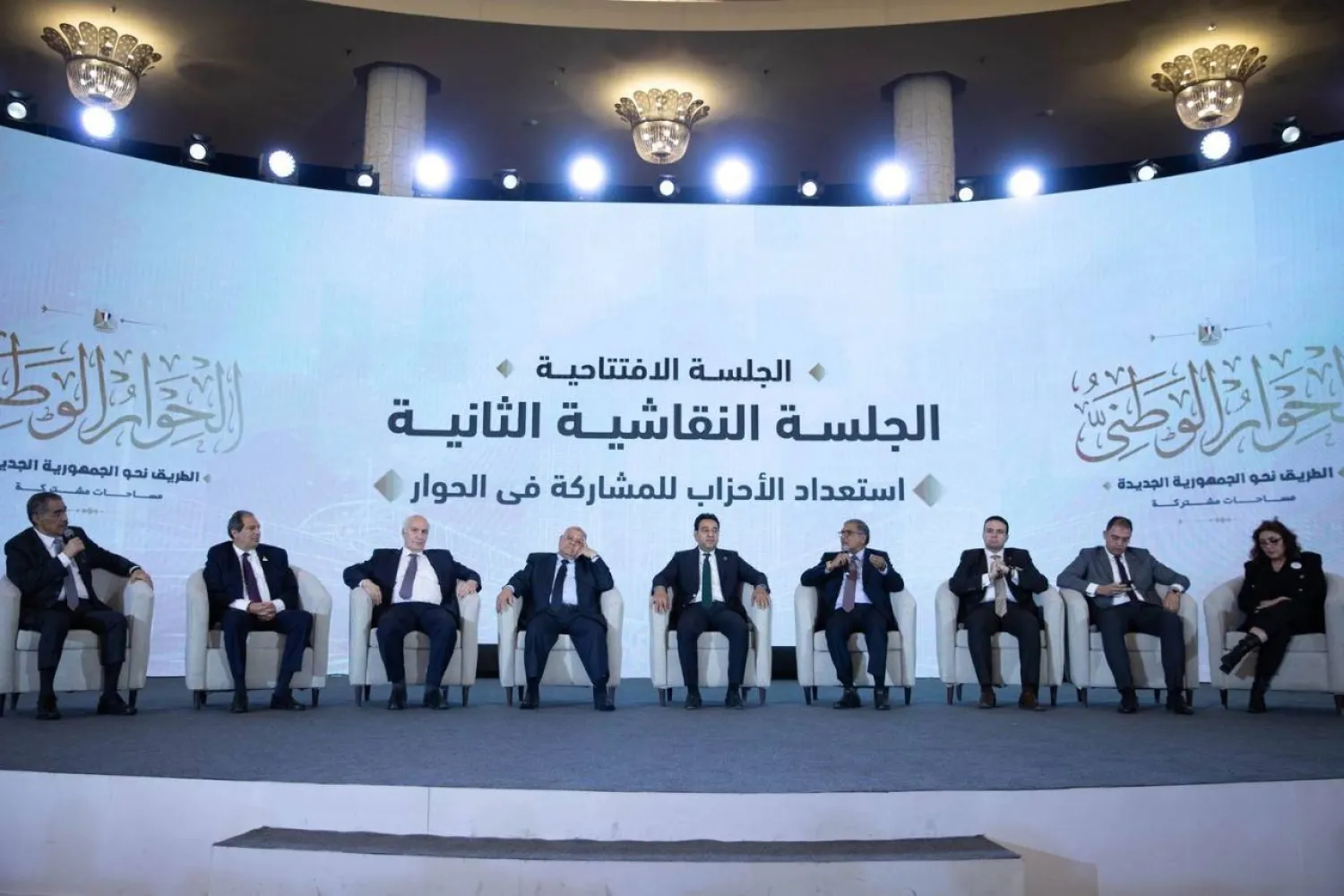
The opening session of the National Dialogue last Wednesday in Cairo (National Dialogue)
TT

Egypt’s National Dialogue Announces Schedule, Participation of Civil Movement Remains Unclear

The opening session of the National Dialogue last Wednesday in Cairo (National Dialogue)

The Board of Trustees of the National Dialogue in Egypt announced a schedule for the discussion sessions of its specialized committees, which would begin early next week.

The Board of Trustees held its twenty-fourth session at the headquarters of the National Training Academy, which will later host the meetings of the committees.

The Board scheduled public discussions Sunday, Tuesday, and Thursday at the Cairo International Convention Center in Nasr City.

It also agreed to consider holding up to four sessions per day, each for three hours.

According to the schedule, the political track will hold four sessions on Sunday to discuss the parliamentary electoral system, eliminating all forms of discrimination, and the challenges facing cooperatives.

The economic track will be held on Tuesday to discuss social protection programs, formulating Egypt’s tourist map, and means of stimulating all forms of tourism investments. While the social track’s session will be on Thursday, focusing on guardianship and national identity issues.

After its meeting, the Board issued a statement expressing its full confidence in the support of all parties and stakeholders in the country for the national dialogue.

The statement hoped all parties would give the dialogue an appropriate and reasonable opportunity and time.

The Board called on the parties to continue their positive efforts toward creating a democratic atmosphere for multi-candidate presidential elections.

It hailed the decisions of President Abdel Fattah El-Sisi, using his constitutional powers, to pardon more prisoners, calling on the Presidential Pardon Committee to intensify its legal efforts to release those who are still being held in detention without trial.

Meanwhile, several figures of the Civil Movement did not attend the meeting. Asharq Al-Awsat reached out to leaders of the movement, who refrained from commenting on their participation in the sessions.

The movement, which includes 12 opposition parties and ten public figures, hinted at the possibility of not continuing the dialogue after authorities arrested and imprisoned relatives and supporters of former lawmaker Ahmed Tantawi.

Tantawi said in March that he would run for president in the 2024 elections.

The statement confirmed that the movement, which participated in the opening session of the National Dialogue last Wednesday, recalled that the success of the dialogue and its participation depends on providing the appropriate atmosphere and ensuring the security and safety of all participants.

The statement indicated that the movement would exercise maximum restraint, reaffirming that continuing in this atmosphere is extremely difficult.

Sisi called for the National Dialogue last April to discuss various issues. The Board of Trustees of the Dialogue included public and opposition figures and academics.

Prime Minister Mostafa Madbouly attended the opening session last Wednesday with several ministers, ambassadors, heads of political parties, lawmakers, and media and public figures.



Türkiye’s Erdogan Says Discusses Syria, Gaza with Trump in 'Very Good' Call

US President Donald Trump, left, greets Turkish President Recep Tayyip Erdogan during a summit on Gaza in Sharm el-Sheikh on October 13, 2025. (AFP)
TT

Türkiye’s Erdogan Says Discusses Syria, Gaza with Trump in 'Very Good' Call

US President Donald Trump, left, greets Turkish President Recep Tayyip Erdogan during a summit on Gaza in Sharm el-Sheikh on October 13, 2025. (AFP)

Turkish President Recep Tayyip Erdogan discussed developments in Syria and Gaza in a call with US President Donald Trump, his office said on Wednesday, as Syria's ​Türkiye-backed government announced a ceasefire with US-allied Kurdish forces after days of clashes.

Syria's government this week seized swathes of territory in the northeast and gave the Kurdish-led Syrian Democratic Forces four days to agree on integrating into the central state.

The SDF's main ally, the United States, said in a statement that the partnership with the group had changed nature after Syria's ‌new government ‌emerged and urged the group to ‌accept.

"During ⁠the ​call, President ‌Erdogan stated that Türkiye was closely following developments in Syria, that Syria's unity, harmony and territorial integrity were important for Türkiye," the Turkish presidency said in a statement.

It added that Erdogan and Trump also discussed the battle with ISIS and "the situation of the ISIS prisoners in the Syrian prisons".

Türkiye deems the SDF a ⁠terrorist organization linked with the outlawed Kurdistan Workers Party (PKK), which has carried out a ‌four-decade insurgency against the Turkish state.

Ankara ‍has been engaged in a ‍peace process with the PKK, under which it says the ‍militant group - and its extensions - must disband and disarm.

Ankara, the main foreign backer of Syria's new government, has praised Damascus' advances against the SDF and repeatedly demanded that the group disband, disarm, and integrate into ​the Syrian state apparatus.

"Our President said that a Syria that is developing with all of its elements, is ⁠rid of terror and in peace will contribute to the region's stability," Erdogan's office said.

The two presidents also discussed developments in Gaza, it said, adding Erdogan told Trump that Türkiye would continue to work in coordination with its NATO ally the United States to achieve peace there.

Erdogan thanked Trump for inviting him to join the Board of Peace, it added.

Trump said earlier on Tuesday that he had a "very good call" with Erdogan, without elaborating, after having told reporters during a briefing prior to the meeting that the ‌discussions were going to be "very important".


Syria Gives Kurds Four Days to Accept Integration as US Signals End of Support

 A member of the Syrian army stands guard on the road towards Al-Hasakah, following the withdrawal of the Syrian Democratic Forces, Syria, January 20, 2026. (Reuters)
A member of the Syrian army stands guard on the road towards Al-Hasakah, following the withdrawal of the Syrian Democratic Forces, Syria, January 20, 2026. (Reuters)
TT

Syria Gives Kurds Four Days to Accept Integration as US Signals End of Support

 A member of the Syrian army stands guard on the road towards Al-Hasakah, following the withdrawal of the Syrian Democratic Forces, Syria, January 20, 2026. (Reuters)
A member of the Syrian army stands guard on the road towards Al-Hasakah, following the withdrawal of the Syrian Democratic Forces, Syria, January 20, 2026. (Reuters)

Syria's government set a four-day deadline on Tuesday for Kurdish-led forces to agree on integrating their last enclave into the central state as their former main ally, the United States, urged them to do so.

US envoy Tom Barrack in a social media post described integration as the "greatest opportunity" ‌the Kurds ‌now have in Syria.

He added that ‌the ⁠original purpose ‌of the Syrian Democratic Forces as a counterweight to ISIS militants had largely expired, and that the US had no long-term interest in retaining its presence in Syria, signaling the apparent end of Washington's backing.

The SDF, which has lost swathes of territory during government advances in ⁠recent days, said it accepted a ceasefire agreement with the Damascus government ‌and that it would not engage ‍in any military action ‍unless attacked.

A Syrian government statement said it had ‍reached an understanding with the SDF, long backed by the United States in the battle against ISIS, for it to devise an integration plan for Hasakah province or risk state forces entering two SDF-controlled cities.

The government announced a four-day ceasefire and said it had asked ⁠the SDF to submit the name of a candidate to take the role of assistant to the defense minister in Damascus as part of the integration.

The swift reversal for the SDF along one of Syria's main faultlines marks the biggest shift in territorial control in Syria since Sharaa toppled President Bashar al-Assad in 2024 and raises questions over the security of facilities holding ISIS detainees.


Israel Orders Gaza Families to Move in First Forced Evacuation Since Ceasefire

A Palestinian girl walks past the rubble of houses destroyed in Israeli strikes during the war, in Khan Younis, southern Gaza Strip, January 17, 2026. (Reuters)
TT

Israel Orders Gaza Families to Move in First Forced Evacuation Since Ceasefire

A Palestinian girl walks past the rubble of houses destroyed in Israeli strikes during the war, in Khan Younis, southern Gaza Strip, January 17, 2026. (Reuters)

Israeli forces have ordered dozens of Palestinian families in the southern Gaza Strip to leave their homes in the first forced evacuation since October's ceasefire, as residents and Hamas said on Tuesday the military was ​expanding the area under its control.

Residents of Bani Suhaila, east of Khan Younis, said the leaflets were dropped on Monday on families living in tent encampments in the Al-Reqeb neighborhood.

“Urgent message. The area is under Israeli army control. You must evacuate immediately,” said the leaflets, written in Arabic, Hebrew, and English, which the army dropped over the Al-Reqeb neighborhood in the town of Bani Suhaila.

In the two-year war before the US brokered ceasefire was signed in October, Israel dropped leaflets over areas that were subsequently raided or bombarded, forcing some families to move several times.

Residents and a source from the Hamas group said this was the first time they had been ‌dropped since then. ‌The Israeli military did not immediately respond to a request for comment.

SIDES FAR ‌APART ⁠ON ​NEXT PHASES

The ‌ceasefire has not progressed beyond its first phase, under which major fighting has stopped, Israel withdrew from less than half of Gaza, and Hamas released hostages in return for Palestinian detainees and prisoners.

Virtually the entire population of more than 2 million people are confined to around a third of Gaza's territory, mostly in makeshift tents and damaged buildings, where life has resumed under control of an administration led by Hamas.

Israel and Hamas have accused each other of major breaches of the ceasefire and remain far apart on the more difficult steps planned for the next phase.

Mahmoud, a resident from the ⁠Bani Suhaila area, who asked not to give his family name, said the evacuation orders impacted at least 70 families, living in tents and homes, ‌some of which were partially damaged, in the area.

"We have fled ‍the area and relocated westward. It is maybe the ‍fourth or fifth time the occupation expanded the yellow line since last month," he told Reuters by phone ‍from Khan Younis, referring to the line behind which Israel has withdrawn.

"Each time they move it around 120 to 150 meters (yards) inside the Palestinian-controlled territory, swallowing more land," the father-of-three said.

HAMAS CITES STATE OF HUMANITARIAN DISRUPTION

Ismail Al-Thawabta, director of the Hamas-run Gaza government media office, said the Israeli military had expanded the area under its control in eastern Khan Younis five times since ​the ceasefire, forcing the displacement of at least 9,000 people.

“On Monday, 19 January 2026, the Israeli occupation forces dropped warning leaflets demanding the forced evacuation of the Bani Suhaila area in eastern ⁠Khan Younis Governorate, in a measure that falls within a policy of intimidation and pressure on civilians,” Thawabta told Reuters.

He said the new evacuation orders affected approximately 3,000 people.

“The move created a state of humanitarian disruption, increased pressure on the already limited shelter areas, and further deepened the internal displacement crisis in the governorate,” Thawabta added.

Israel's military has previously said it has opened fire after identifying what it called "terrorists" crossing the yellow line and approaching its troops, posing an immediate threat to them.

It has continued to conduct air strikes and targeted operations across Gaza. The Israeli military has said it views "with utmost severity" any attempts by militant groups in Gaza to attack Israel.

Under future phases of the ceasefire that have yet to be hammered out, US President Donald Trump's plan envisages Hamas disarming, Israel pulling out further, and an internationally backed administration rebuilding Gaza.

More than 460 Palestinians and three Israeli soldiers have been reported killed since the ceasefire took ‌effect.

Israel launched its operations in Gaza in the wake of an attack by Hamas-led fighters in October 2023 which killed 1,200 people, according to Israeli tallies. Israel's assault has killed 71,000 people, according to health authorities in the enclave.