Israeli Court Acquits Border Police Officer Charged with Killing Autistic Palestinian

Khairy al-Hallaq, the father of Eyad al-Hallaq sits surrounded by pictures of his son in his family home in East Jerusalem, July 6, 2023. REUTERS/Sinan Abu Mayzer
TT

Israeli Court Acquits Border Police Officer Charged with Killing Autistic Palestinian

Khairy al-Hallaq, the father of Eyad al-Hallaq sits surrounded by pictures of his son in his family home in East Jerusalem, July 6, 2023. REUTERS/Sinan Abu Mayzer

An Israeli court on Thursday acquitted a border police officer who was charged with reckless manslaughter in the deadly shooting of an autistic Palestinian man in Jerusalem’s Old City three years ago.
The Jerusalem district court ruled that the officer was acting in self-defense when he shot and killed 32-year-old Eyad Hallaq. The case has drawn comparisons to the police killing of George Floyd in the United States.
The court described the incident as a tragic mistake, noting that the officer made a split-second decision in a dangerous situation.
Taking risks, the court said, “is an integral part of military activity.”
According to The Associated Press, the court said the officer, whose name has not been made public, was acting in “good faith” when he fatally shot Hallaq, believing him to be an attacker.
Hallaq's family has long criticized Israel's investigation into the killing. After the decision was handed down, Hallaq's mother, Rana, exited the courtroom crying.
She described her son as “simple, calm.”
“Because he was calm they killed him,” she said.
She added that she had great hope in God, “our Lord has another judgment.”
Hallaq, 32, was fatally shot just inside the Old City’s Lion’s Gate on May 30, 2020, as he was on his way to the special-needs institution that he attended.
Police, saying they thought he was a Palestinian attacker, pursued him and called for him to stop. According to accounts at the time, two members of Israel's paramilitary border police then chased him into a garbage room and shot at him as he cowered next to a bin. In total, police fired four bullets, shooting him twice, before he died, according to a court document.
A police investigation found the officer had defied instructions to stop shooting, and had acted in a “reckless” manner, according to a statement released after the verdict by the department's internal investigations unit.
Hallaq's father, Khairy, said he was shocked by the acquittal and vowed to pursue other legal action.
“We spent years in the courts waiting for the decision, but we did not expect this shocking decision,” he said. “We will not allow the murderer to be acquitted.”



Hamas Sources Acknowledge Differences with Mediators on Disarmament Plan

Gunmen from Hamas’ Izz ad-Din al-Qassam Brigades in Nuseirat refugee camp, central Gaza, February 2025 (EPA)
TT

Hamas Sources Acknowledge Differences with Mediators on Disarmament Plan

Gunmen from Hamas’ Izz ad-Din al-Qassam Brigades in Nuseirat refugee camp, central Gaza, February 2025 (EPA)

At a time when Palestinian sources told Asharq Al-Awsat that Egypt, Qatar, and Türkiye helped draft a plan submitted by the Board of Peace to disarm factions in Gaza, Hamas sources acknowledged “differences” with mediators over the proposal.

Sources familiar with the Gaza Administration Committee said mediators involved in ceasefire talks had been fully briefed on the Board of Peace plan before it was presented to Hamas and other factions.

A document published by Reuters and other media outlets last week showed that the Board of Peace, formed by US President Donald Trump, had proposed that Hamas dismantle its tunnel network in the Gaza Strip and give up weapons in stages over eight months.

The plan lays out a timeline starting with a national committee taking over security in Gaza and ending with a full Israeli withdrawal once “final verification” that the enclave is free of weapons is achieved.

Sources close to the Gaza Committee said the three mediating countries, working with the United States, helped shape the proposal, introducing amendments and comments during drafting.

After confirming receipt of the proposal last week, Hamas officials voiced anger at the Board of Peace’s High Representative for Gaza, Nickolay Mladenov, after he told the Security Council that reconstruction could not begin until disarmament phases were verified.

Mediator backing

Two Hamas sources in Gaza said they were unaware of any direct involvement by mediators in drafting the plan, but suggested that the mediators likely knew its details before it was presented.

A senior Hamas source outside Gaza said the group had not received clear confirmation of such involvement, but that the proposal’s language and mediator support indicated prior knowledge.

The senior source said the plan had been discussed internally and that some provisions were reviewed with mediators during meetings in Egypt and Türkiye in recent days.

They said a unified Palestinian position would be presented within a clear framework aimed at amending key clauses, rejecting any link between disarmament and progress on other steps.

They stressed “the need to obligate Israel to fulfill its commitments,” saying the current plan allows it to maneuver and pressure what he described as the “resistance” to achieve its core aim of keeping Gaza demilitarized while retaining security control.

“Differences are normal”

Asked about gaps between Hamas and mediators, the three sources agreed there were “differences,” one describing them as “normal.”

The senior source said the proposal does not fully meet Palestinian demands and requires factions to surrender weapons without a meaningful return from Israel.

They pointed to earlier ceasefire talks, when mediators showed responsiveness to faction demands, prompting them and the United States to engage positively with proposals, an approach factions hope will be repeated.

Hamas is likely to struggle to reject the plan outright and may instead seek amendments to secure what it sees as Palestinian gains. Israel has clearly rejected such changes and has signaled a possible return to war.

The plan calls for full disarmament, light and heavy weapons, factional, tribal, and personal, under a framework of “one law and one weapon,” while ensuring Hamas has no role in governing Gaza, either civilly or in security.

An Egyptian source told Asharq Al-Awsat about a week ago that Egypt’s Interior Ministry will receive thousands of candidates for a Palestinian police force tasked with maintaining security in Gaza under a ceasefire deal.

Recruits will undergo six weeks of training, with others set to train in Jordan.

The Gaza Administration Committee has recently opened applications for security roles in the new force, drawing tens of thousands of applicants, although the initial target is about 5,000 officers.

The United States, working with Israel, aims to start reconstruction in southern Gaza, particularly in Rafah, areas under Israeli control, before moving to Hamas-held areas.

Under the plan, reconstruction is tied to disarmament, a condition Hamas has consistently rejected.


Israeli Strikes Kill 5 in the Gaza Strip

Palestinians walk through a flooded area in a temporary tent camp after heavy rainfall in Gaza City, Thursday, March 26, 2026 (AP Photo/Jehad Alshrafi)
TT

Israeli Strikes Kill 5 in the Gaza Strip

Palestinians walk through a flooded area in a temporary tent camp after heavy rainfall in Gaza City, Thursday, March 26, 2026 (AP Photo/Jehad Alshrafi)

Israeli strikes killed at least five people in the Gaza Strip in two separate attacks on Tuesday, health officials said, in the latest violence overshadowing a fragile five-months-old US-brokered ceasefire deal.

Medics said an Israeli airstrike in Jabalia, north of the enclave, killed at least three people earlier in the day, while another airstrike killed two others in ⁠Khan Younis, in ⁠the south.

There was no Israeli comment on either of the two incidents.

Hamas and Israel have traded blame for violations of a ceasefire agreed last October. The Gaza health ⁠ministry said Israeli fire has killed at least 700 people since the ceasefire. Israel said four soldiers were killed by militants in Gaza over the same period.

Israel, along with the US, is also now engaged in a conflict with Iran, while Israeli forces have also invaded southern Lebanon in a new campaign ⁠against ⁠Iran-backed Hezbollah.


Israel's Katz on Lebanon: to Maintain Control Over Entire Area Up to Litani River

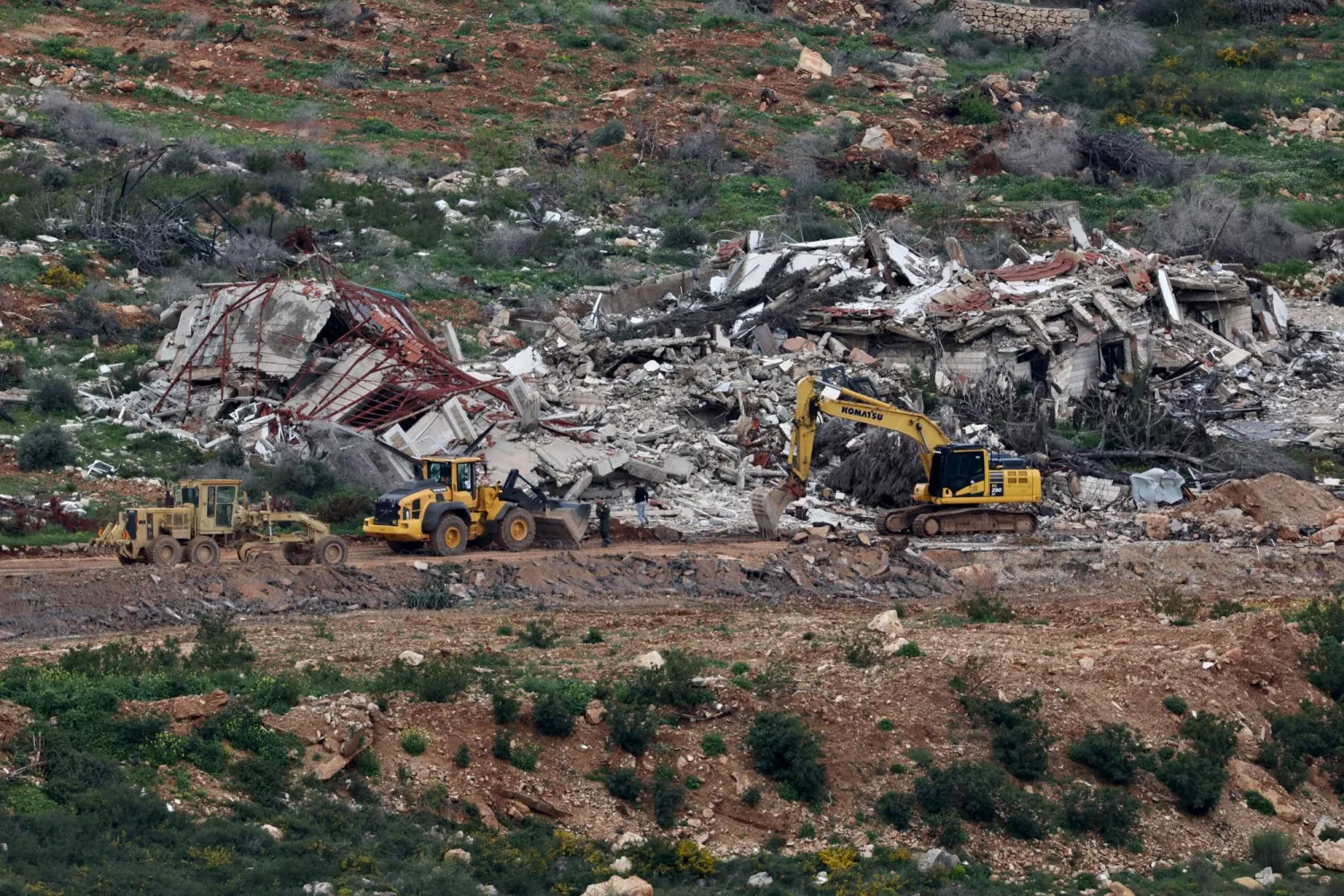
Israeli heavy machinery operates in the southern Lebanese village of Adeisseh, as seen from the Israeli side of the border in the Upper Galilee, northern Israel, 30 March 2026. EPA/ATEF SAFADI
TT

Israel's Katz on Lebanon: to Maintain Control Over Entire Area Up to Litani River

Israeli heavy machinery operates in the southern Lebanese village of Adeisseh, as seen from the Israeli side of the border in the Upper Galilee, northern Israel, 30 March 2026. EPA/ATEF SAFADI

Israel will establish a buffer zone inside southern Lebanon and maintain control over the entire area up to the Litani River once the conflict with Hezbollah ends, Israel's defense minister said on Tuesday.

"At the end of the operation, the IDF would control ⁠the area up to ⁠the Litani River, including the remaining Litani bridges, while eliminating Radwan forces that infiltrated the area and destroying all weapons there," Israel Katz ⁠said in a statement following a security assessment, calling it a "security zone.”

Radwan forces are an elite military unit of Hezbollah.

Katz said that the more than 600,000 Lebanese residents who have been evacuated northward would be barred from returning south of the Litani ⁠until ⁠the safety of residents in northern Israel is guaranteed.

To that end, "all homes in villages near the border in Lebanon would be destroyed, according to the model of Rafah and Beit Hanoun in Gaza, in order to permanently remove threats near the border to northern residents" in Israel, Katz said.

Israeli military spokesperson ⁠Lieutenant Colonel Nadav Shoshani said that Hezbollah had fired almost 5,000 drones, rockets and missiles at Israel during the conflict. The Israeli military also announced a new wave of strikes it said were targeting Hezbollah infrastructure in Beirut's southern suburbs.