UK, US Announce Aid to Support Women and Children in Yemen

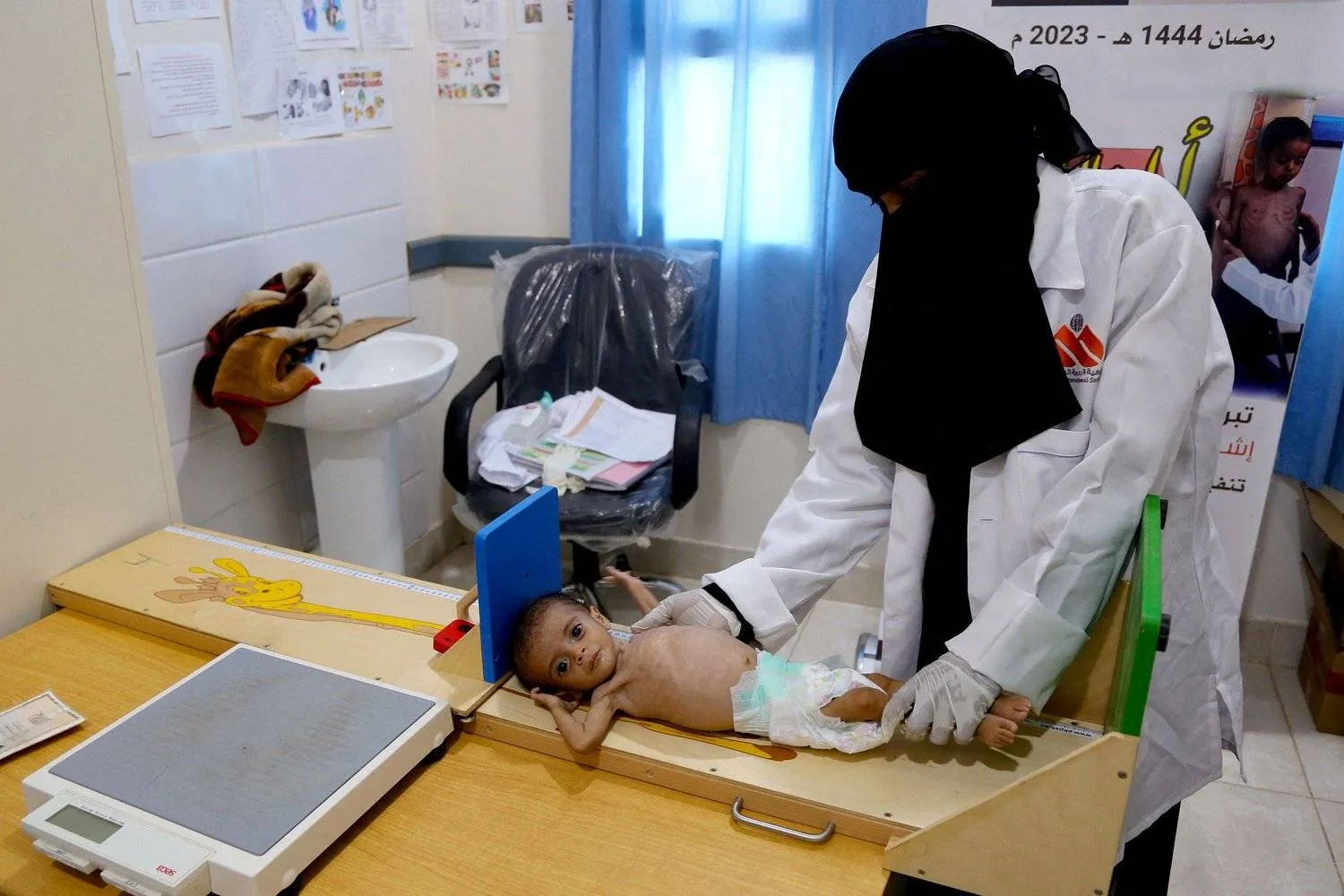
A Yemeni doctor checks a girl suffering from acute malnutrition (AFP)
TT

UK, US Announce Aid to Support Women and Children in Yemen

A Yemeni doctor checks a girl suffering from acute malnutrition (AFP)

The UK and the US, separately, announced new aid for Yemeni women and children, amounting to about $228 million.

UN announced that more than 5 million women in Yemen suffer from limited or no access to reproductive health services, including 1.5 million pregnant women who suffer from acute malnutrition.

The British Foreign Office announced a $205 million new healthcare support to vulnerable women and children in Yemen.

In a statement, the ministry said that the four-year aid program provides health care for about one million children and women annually, providing primary health care, including nutrition, water hygiene and sanitation, and sexual and reproductive health services, to some of the most vulnerable in Yemen.

The statement quoted Foreign Secretary James Cleverly as saying: “The conflict in Yemen continues to cause pain and suffering for millions of ordinary Yemenis, with women and children particularly paying a heavy price.”

The minister added that the UK remains committed to tackling the humanitarian crisis in Yemen, and the new Yemen Women and Children Program will deliver vital support to the most vulnerable.

The US Agency for International Development (USAID)’s Bureau for Humanitarian Assistance (BHA) contributes $23.4 million to the United Nations Population Fund (UNFPA) to provide emergency relief and life-saving reproductive health and protection services to 1.3 million of the most vulnerable women and girls in Yemen.

The Fund stated, in a statement, that the funding will allow UNFPA to provide an integrated package of reproductive health, protection, mental health, and psychosocial support services in 14 hospitals and four mobile health clinics.

Twenty women and girls’ safe spaces will be supported to provide psychosocial care, livelihood opportunities, and referral for legal aid and medical services.

The new funding will also help the delivery of immediate, life-saving supplies to families on the move as they flee conflict or natural disasters through support to the UNFPA-led Rapid Response Mechanism.

The UNFPA’s Representative in Yemen, Enshrah Ahmed, indicated that the needs of women and girls in Yemen are vast and urgent.

“This generous contribution will enable UNFPA and its partners to continue safeguarding the health and well-being of women and girls in surviving one of the world’s largest humanitarian crises,” she said.

The UN Fund confirmed that more than five million women and girls of childbearing age have limited or no access to reproductive health services, among them, 1.5 million pregnant women are acutely malnourished.

UNFPA requires US$40 million over the next five months to fund its life-saving response for women and girls' reproductive health and protection in Yemen.


Egypt, Iran FMs Discuss Regional Developments

Egypt's Foreign Minister Badr Abdelatty speaks during a plenary session of the International Institute for Strategic Studies (IISS) Manama Dialogue 2026 in Manama on October 31, 2026. (AFP)
TT

Egypt, Iran FMs Discuss Regional Developments

Egypt's Foreign Minister Badr Abdelatty speaks during a plenary session of the International Institute for Strategic Studies (IISS) Manama Dialogue 2026 in Manama on October 31, 2026. (AFP)

Egyptian Foreign Minister Badr Abdelatty held telephone talks on Thursday with his Iranian counterpart Abbas Araghchi on the latest regional developments and efforts to ease tensions, reported dpa.

An Egyptian Foreign Ministry spokesman said the ministers exchanged views on the latest developments and concerns over the possibility of renewed military conflict and its impact on regional and international security and stability.

Abdelatty underlined the importance of prioritizing diplomatic solutions and urged all parties to demonstrate the necessary openness to reach a political settlement to the crisis.

He stressed that exercising flexibility and arriving at compromises would serve the interests of all sides and prevent the region from sliding into a new wave of escalation, which could otherwise yield severe political, economic, and humanitarian repercussions for the region and the entire world.


Yemen Warns against Houthis Using Red Sea to Extort Int’l Community

The Yemeni and German delegations meet in Berlin. (Yemeni government media)
TT

Yemen Warns against Houthis Using Red Sea to Extort Int’l Community

The Yemeni and German delegations meet in Berlin. (Yemeni government media)

The Yemeni government warned of an expanding threat posed by the terrorist Houthi militia to regional security and international navigation, citing growing Iranian involvement in managing Houthi military operations and growing ties with terrorist organizations in the Horn of Africa. The warning coincided with continued Houthi attacks on civilians and the tightening of the siege on the city of Taiz.

Yemeni Foreign Minister Afrah Al-Zouba presented these concerns during a series of meetings in Berlin with German officials and experts at think tanks and research centers specialized in Yemeni affairs.

The discussions addressed the developments of the Houthi escalation since last June, as well as its military, humanitarian, and security repercussions on Yemen and the wider region.

Al-Zouba stated that the Houthis intensified their attacks following the landing of an aircraft belonging to Iran's Mahan Air, which is linked to the Iranian Revolutionary Guard Corps (IRGC), at Hodeidah airport.

She explained that the plane carried Iranian experts, funds, and advanced weaponry to support Houthi military operations, in direct violation of Yemeni sovereignty and international laws and resolutions.

The escalation reached the west coast and Bab al-Mandeb regions prior to a government deployment under Operation Dawn of Yemen.

Authorities cautioned against renewed efforts by the militia to expand along the west coast, threaten shipping lanes in the Red Sea and Bab al-Mandeb Strait, and leverage maritime corridors to pressure the international community.

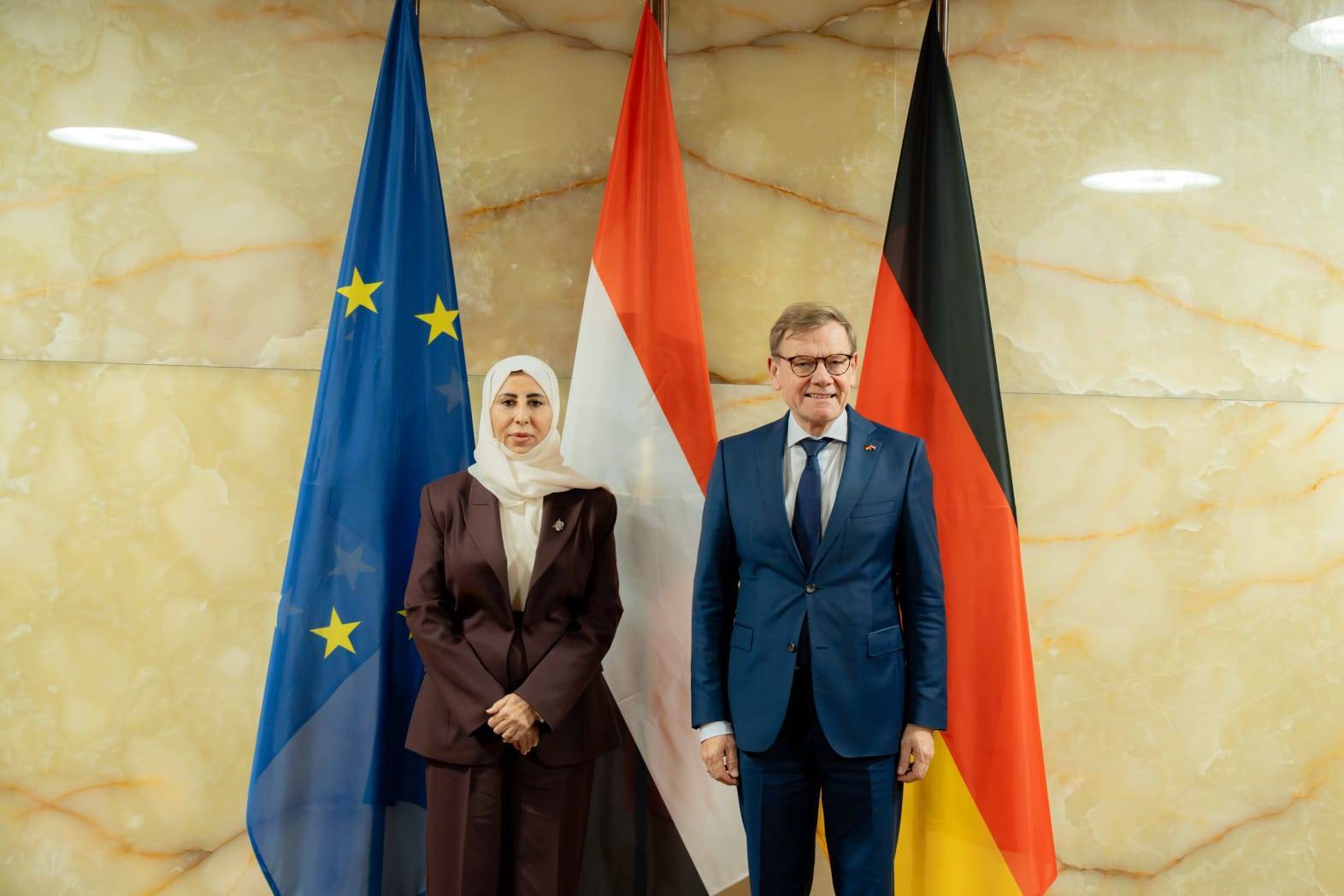
Meeting with German Foreign Minister Johann Wadephul, Al-Zouba warned that the Houthi threat extends beyond Yemen's borders, pointing to the militia’s targeting of Saudi territory and international shipping lanes, and the resulting risks to regional security and global energy and food supplies.

Yemeni Foreign Minister Afrah Al-Zouba meets with her German counterpart Johann Wadephul. (Yemeni government media)

She presented the Yemeni government's announcements regarding the participation of experts from the IRGC and Hezbollah in managing Houthi operations, in addition to the group's links with terrorist organizations in the Horn of Africa, chief among them the Somali Al-Shabaab movement.

These ties raise the level of threat to maritime security and regional stability, she warned.

The two sides discussed ways to develop the capabilities of the Yemeni Coast Guard to protect territorial waters and secure international trade routes, while strengthening bilateral consultation and information exchange regarding security developments in Yemen and the region.

Al-Zouba delivered a written letter from Chairman of the Presidential Leadership Council Dr. Rashad Al-Alimi to German Chancellor Friedrich Merz.

The message addressed bilateral relations, regional issues, and the latest updates on the situation in Yemen.

On the humanitarian level, Al-Zouba highlighted the Houthi siege on the city of Taiz, the targeting of civilian and health facilities, and the resulting closure of medical centers, medicine shortages, and lack of safe corridors, warning of catastrophic impacts on civilians.

She detailed the Houthi recruitment of child soldiers, indiscriminate landmine deployment, and the ongoing detention of UN and humanitarian personnel, noting the death of several detainees including UN staff member Mohammed Ibrahim Al-Shami.


Houthis Under Govt Pressure in al-Jawf, Lahj

Yemeni troops hold a position during clashes with Iran-backed Houthis in Yemen's northwestern al-Jawf province on November 2, 2026. (AFP)
TT

Houthis Under Govt Pressure in al-Jawf, Lahj

Yemeni troops hold a position during clashes with Iran-backed Houthis in Yemen's northwestern al-Jawf province on November 2, 2026. (AFP)

Yemeni government forces have advanced to a new phase of offensive operations against the Houthis in al-Jawf and Lahj governorates, according to military developments reflecting the expanding scope of Operation Dawn of Yemen.

The shift to offensive maneuvers coincided with government forces thwarting Houthi attempts to recapture previously lost positions in Marib and Taiz.

In the latest field updates, government forces successfully secured their positions across strategic mountain ranges in eastern Al-Jawf. This follows tactical advances into areas formerly controlled by the terrorist Houthi group.

Military officials said the breakthrough reinforces current positions and establishes the necessary conditions to sustain the advance toward al-Hazm, the governorate's capital.

Armed forces spokesman Majed al-Nuzaili said troops managed to recapture positions from the Houthis in several regions in al-Jawf.

He stressed that the operations will continue to reclaim positions from the group.

Government forces have advanced through the al-Dahidha mountain range, breaching Houthi fortifications and seizing military equipment. Airstrikes and drone operations also targeted Houthi strongholds and weapons depots across several locations.

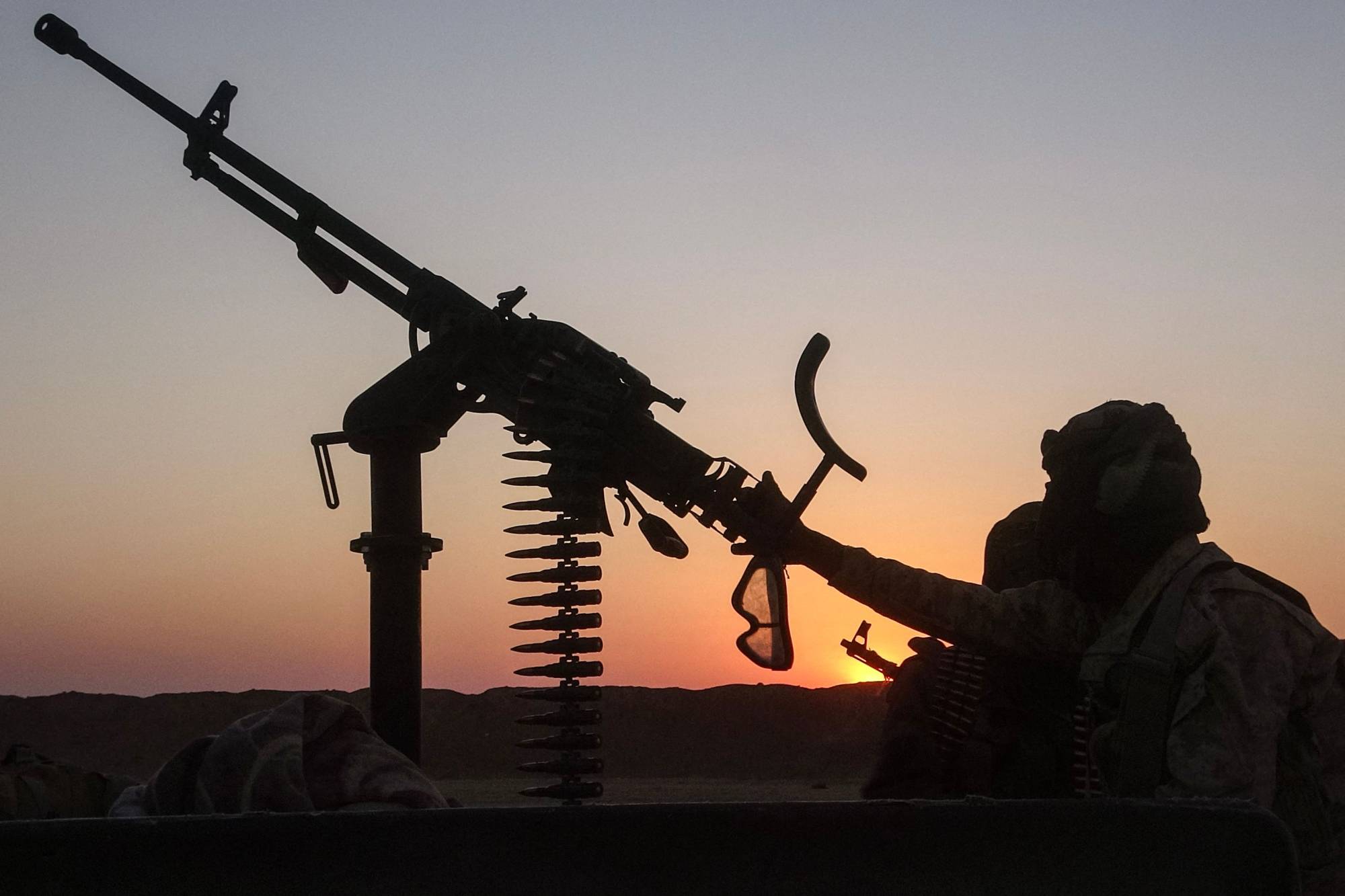
Yemeni forces sit on a pick-up truck mounted with a heavy machine-gun as they hold a position during clashes with Iran-backed Houthis in Yemen's northwestern al-Jawf province on November 2, 2026. (AFP)

This territorial gain holds strategic importance due to the mountainous terrain and its proximity to routes leading to al-Hazm, the Houthis' primary administrative and military hub in the governorate. Government forces are currently working to secure these newly recaptured positions before pressing forward with further operations.

In an attempt to contain this advance, the Houthi group launched a broad attack on government force positions in the Halhalan area. However, government forces managed to repel the assault and force the militants to retreat, said government military sources.

In Lahj, government forces have regained the initiative after reorganizing their military deployment along the Tur al-Baha axis, launching a swift counteroffensive to recapture areas seized by the Houthi group in the al-Maqatirah district.

Supported by warplanes, government troops breached the border of the district and advanced into Bani Abdan village, where heavy fighting continues in the surrounding vicinity. Military operations also expanded to target Houthi positions in the Hayfan and al-Zuraiqah al-Sham regions of the neighboring Taiz governorate.

These latest field updates indicate that government forces have successfully shifted from containing the initial Houthi push in al-Maqatirah to executing direct offensive operations to reclaim lost ground.

Military officials said the transition follows a strategic reinforcement of troops and a reorganization of the military command along the Tur al-Baha axis, effectively shifting the balance of power on this front.