


Yemen: Alimi Warns Int’l Community of Laxity towards Houthis, UN Envoy Calls for United Efforts

The Houthis threaten military escalation and use their weapons of Iranian origin (Reuters)
TT

Yemen: Alimi Warns Int’l Community of Laxity towards Houthis, UN Envoy Calls for United Efforts

The Houthis threaten military escalation and use their weapons of Iranian origin (Reuters)

Head of Yemen's Presidential Leadership Council, Rashad al-Alimi, issued a stern warning on Thursday to the international community against any laxity towards the Houthi's “approach” and refusal of renewing a humanitarian truce in Yemen.

Alimi accused the Houthis of obstinacy and warned against "any laxity on the part of the international community towards Houthi militias”. He said it would encourage them to continue with their threats to international peace and security.

The Yemeni official’s remarks came during a meeting with US Ambassador to Yemen, Steven Fagin, in Riyadh. The talks between the two officials touched on bilateral relations, the developments in Yemen, and the mediation efforts led by Saudi Arabia and Oman to renew the truce.

Yemen’s Saba news agency reported that Alimi praised the distinguished bilateral relations between Yemen and the United States, highly appreciating the US humanitarian aid that aims to alleviate the Yemeni people's suffering, exacerbated by the Houthi militia attacks on oil facilities and international navigation lines.

Yemeni sources mentioned that Alimi reiterated the Council and government's openness to all initiatives aiming for a comprehensive and sustainable peace based on nationally, regionally, and internationally agreed references.

Alimi pointed out that Houthis reject all peace efforts to alleviate Yemeni suffering while they continue their military escalation, cross-border hostile operations, and threats to target navigation lines in the Red Sea, Bab al-Mandab, and the Gulf of Aden.

He also mentioned their "arbitrary measures" against Yemenia Airways and the significant human rights violations against thousands celebrating the anniversary of the September 26 revolution.

- US support

Ambassador Fagin affirmed Washington's support for the Presidential Leadership Council, the government, and their economic and institutional reforms in various fields.

He praised the positive engagement at the presidential and government levels with efforts aimed at alleviating humanitarian suffering and reviving the peace process in Yemen.

- Call for uniting efforts

The Special Envoy of the Secretary-General for Yemen, Hans Grundberg, continues his regional tours to garner support for his initiatives to restore peace in Yemen, visiting Qatar and Oman.

Grundberg visited Muscat and met Omani Foreign Minister Badr al-Busaidi and other officials to discuss developments and progress in the UN peace mediation efforts in Yemen.

The Office of the Special Envoy (OSESGY) expressed gratitude for Oman's support.

It stressed the importance of concerted regional and international actions to help the parties agree on measures to improve living conditions in Yemen, a sustainable nationwide ceasefire, and the resumption of an inclusive political process under UN auspices.

Earlier, Grundberg visited Qatar and met the Minister of State for International Cooperation, Lolwah Al Khater, and other Qatari officials to discuss further consolidating regional and international support to UN mediation efforts in Yemen.

According to the office, they discussed the progress to support the parties to agree on measures to improve living conditions in Yemen, commit and implement a nationwide ceasefire, and resume an inclusive political process under UN auspices.

"While the solution to the conflict must be negotiated by Yemenis, greater regional cohesion undoubtedly gives greater hope of resolving the situation in Yemen. The region will have a great role in accompanying Yemen on a path for peace, reconstruction, and recovery," Grundberg said.

He lauded the support of the Emir of Qatar, Sheikh Tamim Bin Hamad Al-Thani, for a peaceful resolution to the conflict during his General Assembly speech.



Israel Says Will Take ‘Control’ of Security Zone up to Lebanon’s Litani River

Damage at the site of an Israeli strike targeting the Qasmiye bridge near Tyre, southern Lebanon, 23 March 2026. (EPA)
TT

Israel Says Will Take ‘Control’ of Security Zone up to Lebanon’s Litani River

Damage at the site of an Israeli strike targeting the Qasmiye bridge near Tyre, southern Lebanon, 23 March 2026. (EPA)

Israeli Defense Minister Israel Katz said on Tuesday that the military will take control of south Lebanon all the way to the Litani river.

"All five bridges over the Litani that were used by Hezbollah for the passage of terrorists and weapons have been blown up, and the Israeli military will control the rest of the bridges and the security zone up to the Litani," Katz said during a visit to a military command center in Israel.

Katz added that the hundreds of thousands of south Lebanon residents who were displaced by the Middle East war this month "will not return south of the Litani River until security is guaranteed for the residents of the north" of Israel.


Airstrikes Target HQ and Leader of Iran-Backed PMF in Iraq

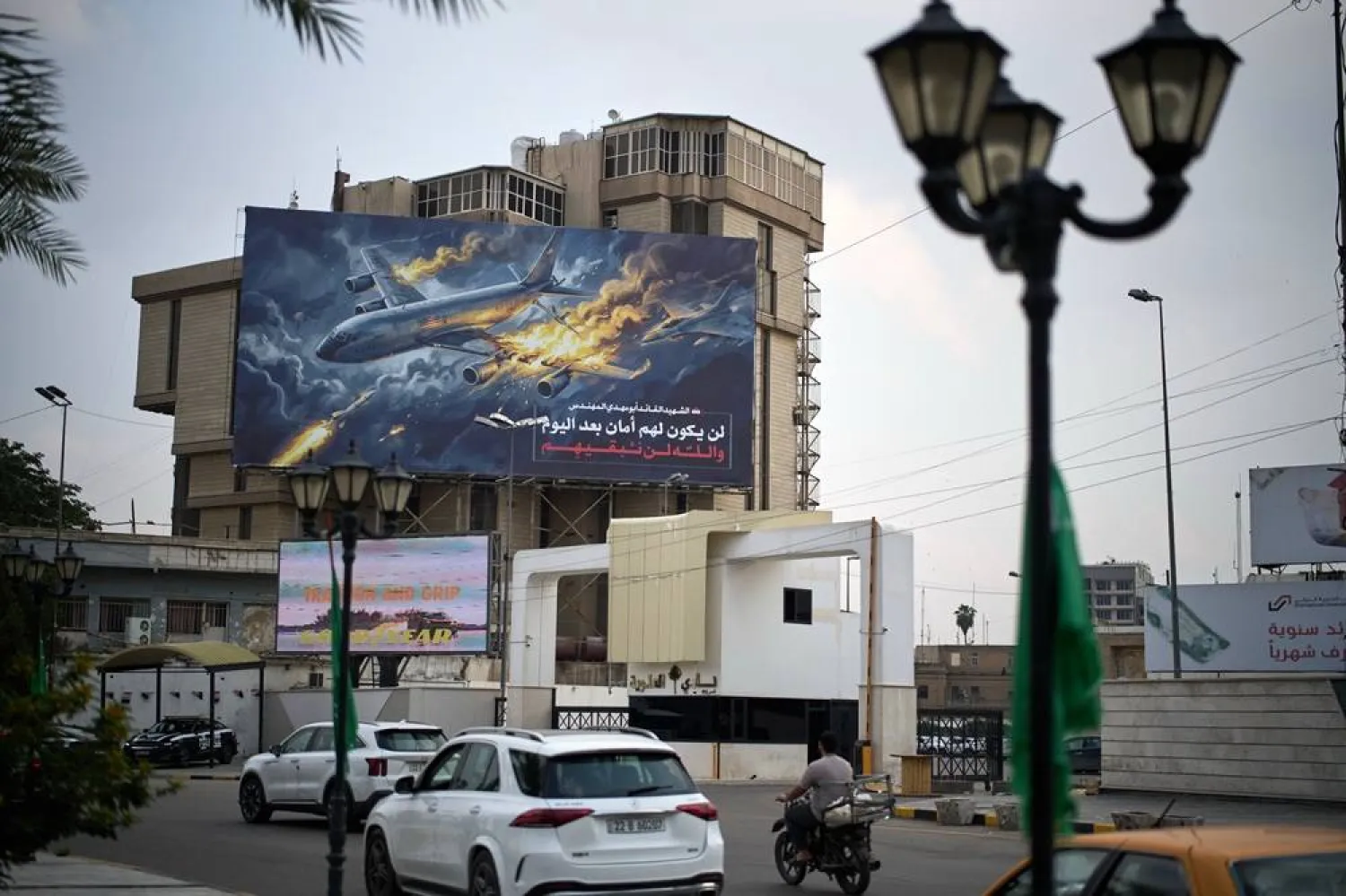
 A billboard displays an image depicting a US Air Force airplane in flames, the name of the Iraqi deputy PMF leader Abu Mahdi al-Muhandis who was killed in a US strike in 2020, and words that read in Arabic, "They will no longer have safety. By God, we will not spare them", in Baghdad, Iraq, Monday, March 23, 2026. (AP)
A billboard displays an image depicting a US Air Force airplane in flames, the name of the Iraqi deputy PMF leader Abu Mahdi al-Muhandis who was killed in a US strike in 2020, and words that read in Arabic, "They will no longer have safety. By God, we will not spare them", in Baghdad, Iraq, Monday, March 23, 2026. (AP)
TT

Airstrikes Target HQ and Leader of Iran-Backed PMF in Iraq

 A billboard displays an image depicting a US Air Force airplane in flames, the name of the Iraqi deputy PMF leader Abu Mahdi al-Muhandis who was killed in a US strike in 2020, and words that read in Arabic, "They will no longer have safety. By God, we will not spare them", in Baghdad, Iraq, Monday, March 23, 2026. (AP)
A billboard displays an image depicting a US Air Force airplane in flames, the name of the Iraqi deputy PMF leader Abu Mahdi al-Muhandis who was killed in a US strike in 2020, and words that read in Arabic, "They will no longer have safety. By God, we will not spare them", in Baghdad, Iraq, Monday, March 23, 2026. (AP)

Apparent US-Israeli airstrikes hit a headquarters of Iraq's Iran-backed Popular Mobilization Forces (PMF) and a residence belonging to its leader on Tuesday, an escalation of US-Israeli strikes on one of Tehran's main regional allies. 

PMF leader Falih al-Fayadh was not present when his residence was hit in the northern city of Mosul, which he uses only during visits to the city, according to two security sources. 

At least ‌15 PMF fighters ‌were killed in the airstrikes that hit ‌a ⁠headquarters of the ⁠group in Iraq's Euphrates valley province of Anbar, according to the sources and a statement from the group. 

The dead included the PMF's operations commander in the province, Saad al-Baiji. Later on Tuesday, a large crowd of angry mourners carried his coffin and portraits through the streets of Baghdad. 

The statement ⁠said US forces had targeted a command headquarters ‌in Anbar while personnel were ‌on duty. The security sources said the strikes there hit ‌during a meeting attended by senior commanders. 

Thirty other people were ‌wounded, security and health sources said. The health sources said some of the wounded were in critical condition and the death toll could rise. Reuters filmed ambulances bringing the wounded to hospital ‌in the regional capital Ramadi during the night. 

The PMF ⁠is ⁠an umbrella group of mostly Shiite paramilitary factions that was formally integrated into Iraq's state security forces and includes several groups aligned with Iran. 

In autonomous Iraqi Kurdistan, a ballistic missile attack killed six peshmergas, with the region accusing Iran of conducting the first such deadly attack since the war began. 

Neither the United States nor Iran commented on the accusations. 

Tehran-backed armed groups have launched attacks on US bases in Iraq and the US embassy since the United States and Israel launched their war on Iran on February 28. 

The conflict has spilled beyond Iran's borders, with Tehran launching strikes on Israel and Gulf Arab states hosting US military installations, while Israel has carried out attacks in Lebanon following cross-border fire by Iran-aligned Hezbollah. 


Hezbollah Escalates its Rhetoric, Threatens Lebanese Govt

23 March 2026, Lebanon, Chaat: A Hezbollah flag is seen fixed to the debris after an Israeli airstrike that targeted a residential home in Chaat. (dpa)
TT

Hezbollah Escalates its Rhetoric, Threatens Lebanese Govt

23 March 2026, Lebanon, Chaat: A Hezbollah flag is seen fixed to the debris after an Israeli airstrike that targeted a residential home in Chaat. (dpa)

Leading Hezbollah officials decided to escalate their rhetoric against the Lebanese government, threatening to take new political approaches after the war, even as its fighters battle Israeli troops on the ground.

The Iran-backed party has decided to effectively open a new battle in Lebanon, this time against the government and the political authority.

Mahmoud Qamati, deputy head of Hezbollah's political council, said last week: “A confrontation with the political authority is inevitable after the war.”

“Hezbollah is capable of turning the country and government upside down. The party’s patience has limits, and the traitors will pay for their betrayal,” he declared.

The government has slammed Hezbollah for dragging Lebanon to a new war with Israel and banned the group’s military operations. It has also expressed readiness for Lebanon to engage with negotiations with Israel to end the war.

Hezbollah political council member Wafiq Safa echoed Qamati’s remarks, saying the party will force the government to retract its decision to ban its military operations, “regardless of the way it will do so.”

At the moment, the party will not topple the government in the streets, but it has a “new agenda” that it will implement after the war, including street action, he said.

Hezbollah opponents dismissed the threats, saying the party was resorting to such rhetoric to rally its supporters after witnessing their displacement from the war, as well as the destruction of their homes and the mounting death toll.

Change MP Mark Daou told Asharq Al-Awsat: “Hezbollah is in the heart of the battle. It will try to escalate its positions to rally its supporters given their humanitarian plight and the party’s own failure in offering the displaced any real assistance.”

The Hezbollah leadership instructed its officials to “stir debates that are fodder for the media that would portray the party as coming under attack and so as the garner the public’s support,” he explained.

“Hezbollah is suffering from successive setbacks. The decisions taken by the government since 2024 until now are mounting against it,” he remarked.

“The party’s weapons are no longer legal and its allies have distanced themselves from it,” he added. It has also lost its ally, the Syrian regime, and its main backer Iran is under attack by the US and Israel.

“Hezbollah therefore has to protect itself by resorting to stoking sectarian tensions inside Lebanon,” Daou noted.

As for the post-war phase, that is up to the state to manage, such as reconstruction, protecting the people and addressing the affairs of the displaced, said the MP.

“The state will decide what will happen after the war. The Lebanese army also has a major responsibility to secure the situation in Lebanon and stop Hezbollah’s military operations so that the state can have control over decisions of war and peace,” he remarked.

Jad Al-Akhaoui, a Shiite opponent to Hezbollah and head of the Lebanese Democratic Coalition, said the party’s escalating rhetoric against the government “reflects changes in its political and military environment.”

“The blows it has suffered on various levels forced it to stoke tensions to compensate for its relative losses on the ground,” he told Asharq Al-Awsat.

He noted that there have been rising calls within the Shiite community, which is the party’s main support base, demanding that the state impose monopoly over arms and that Hezbollah be held responsible for dragging Lebanon to war.

Hezbollah has reacted to these calls by adopting a sharper rhetoric in an attempt to intimidate its internal opponents and prevent a new political movement that works against it from emerging, he explained.

On Safa’s statements, Al-Akhaoui said Hezbollah is sensing that there will be official or international efforts to curb the party’s activities after the war.

“So, it is acting preemptively by drawing red lines as if to say that any decision about his weapons will be confronted, perhaps through means that go beyond traditional politics,” he remarked.

Al-Akhaoui ruled out that Hezbollah would succeed in having full control over post-war Lebanon as it did before the conflict. “It will still hold major sway and have the ability to obstruct or impose conditions, but not have total control,” he added.