


Yemen Urges Firm Action Against Houthis to Resume Oil Exports

Houthis aboard a vehicle in one of the streets of Sanaa, Yemen  (EPA)
Houthis aboard a vehicle in one of the streets of Sanaa, Yemen (EPA)
TT

Yemen Urges Firm Action Against Houthis to Resume Oil Exports

Houthis aboard a vehicle in one of the streets of Sanaa, Yemen  (EPA)
Houthis aboard a vehicle in one of the streets of Sanaa, Yemen (EPA)

The Yemeni government is calling on the international community to take firm stances and measures against the Houthi group. It also urged efforts to resume oil exports, which have been halted for a year due to Houthi attacks on export ports.

This call from the Yemeni government comes at a time when the Houthi group continues to violate the ceasefire, particularly in southwestern Taiz fronts.

This is happening concurrently with suppression campaigns targeting those demanding their salaries in areas under Houthi control.

With over 80% of Yemenis enduring dire circumstances due to the ongoing war and Houthi insurgency, the government emphasized, during its address to the 54th session of the Human Rights Council, the necessity of enabling it to resume oil exports.

This would allow the government to fulfill its urgent financial obligations to its citizens, including paying salaries that support the population in coping with challenging living conditions and financing food imports into both government-controlled areas and Houthi-run regions.

Nabil Abdulhafiz, the Deputy Minister of Human Rights in the Yemeni government, reaffirmed the support for the National Committee to investigate allegations of human rights violations.

The committee is regarded as an independent national mechanism that efficiently and independently carries out its work, receiving all necessary facilitations and cooperation to uncover the truth, achieve accountability, justice, and provide reparations to victims.

The Yemeni government called upon the members of the Human Rights Council to address the human rights situation in Yemen.

The appeal stems from Yemen’s need for support, technical assistance, and capacity-building to enable the government to meet its human rights commitments.

The government is also seeking to encourage and support the committee in continuing its mission to ensure accountability and justice.

Moreover, Abdulhafiz said that recent steps taken in reshaping the Supreme Judicial Council are evidence of the Presidential Leadership Council’s commitment to achieving justice and revitalizing its institutions.

Abdulhafiz further noted that his country’s government “remains committed to the humanitarian ceasefire and the execution of all its provisions, while militias continue to defy their obligations, including opening crossings and roads between all Yemeni cities and lifting the siege on the city of Taiz.”

The Yemeni official accused the Houthi group of persistently violating and attacking civilians and displacement camps in areas such as Marib, Al-Dhale, Hodeidah, and Taiz.

These provocations manifest in their military build-up, parades, threats, and the unlawful use of military force.

Abdulhafiz urged the international community and the Human Rights Council to press the Houthi militias to cease their violations, halt their looting of Yemeni resources, and cease targeting vital facilities and infrastructure.



Israel’s Death Penalty Law Perpetuates Racial Discrimination, Says UN Watchdog

Protesters hold placards outside the Red Cross offices in Ramallah, in the Israeli-occupied West Bank, on March 31, 2026, during a rally against a bill approved by Israel's parliament that would allow the execution of Palestinians convicted on terror charges for deadly attacks. (AFP via Getty Images)
TT

Israel’s Death Penalty Law Perpetuates Racial Discrimination, Says UN Watchdog

Protesters hold placards outside the Red Cross offices in Ramallah, in the Israeli-occupied West Bank, on March 31, 2026, during a rally against a bill approved by Israel's parliament that would allow the execution of Palestinians convicted on terror charges for deadly attacks. (AFP via Getty Images)

Israel's new death penalty law permitting the execution of Palestinians convicted of deadly attacks perpetuates racial discrimination against them, a United Nations committee said Friday, urging its immediate repeal.

The law amounts to a grave erosion of human rights, the UN Committee on the Elimination of Racial Discrimination said in a statement.

Under the new law, passed by the Israeli parliament in March, Palestinians in the occupied West Bank convicted by military courts of carrying out deadly attacks classified as "terrorism" will face the death penalty as a default sentence.

"The new law is a severe blow to human rights, rolling back Israel's long-standing de facto moratorium on executions since 1962 and expanding the use of the death penalty," the committee said.

The law is "de facto applicable to Palestinians only" and sets a 90-day deadline for executions once a final judgement is rendered, the committee said.

Furthermore, it said Israel should ensure that all Palestinian detainees "are guaranteed their rights to equal treatment before the law, security of person, protection against violence or bodily harm, and access to justice".

The committee also called on Israel to "end all policies and practices that amount to racial discrimination against and segregation of Palestinians".

It said other countries should "ensure that their resources are not used to enforce or support discriminatory policies and practices against Palestinians living in the Occupied Palestinian Territory".

The committee of 18 independent experts monitors adherence to the Convention on the Elimination of All Forms of Racial Discrimination by its 182 states parties.

Under the convention, which came into force in 1969, countries must eliminate racial discrimination, eradicate practices of segregation and guarantee equality before the law without distinction as to race, color, descent or national or ethnic origin.

Israel ratified the convention in 1979.

In March, UN rights chief Volker Turk branded Israel's new law "cruel and discriminatory", warning that applying it in occupied Palestinian territory "would constitute a war crime".

Israel has only applied the death penalty twice: in 1948, shortly after the state's founding, against a military captain accused of high treason, and then in 1962, when the Nazi war criminal Adolf Eichmann was hanged.

Israel has occupied the West Bank since 1967 and violence in the territory has soared since Hamas's October 7, 2023, attack on Israel triggered the Gaza war.


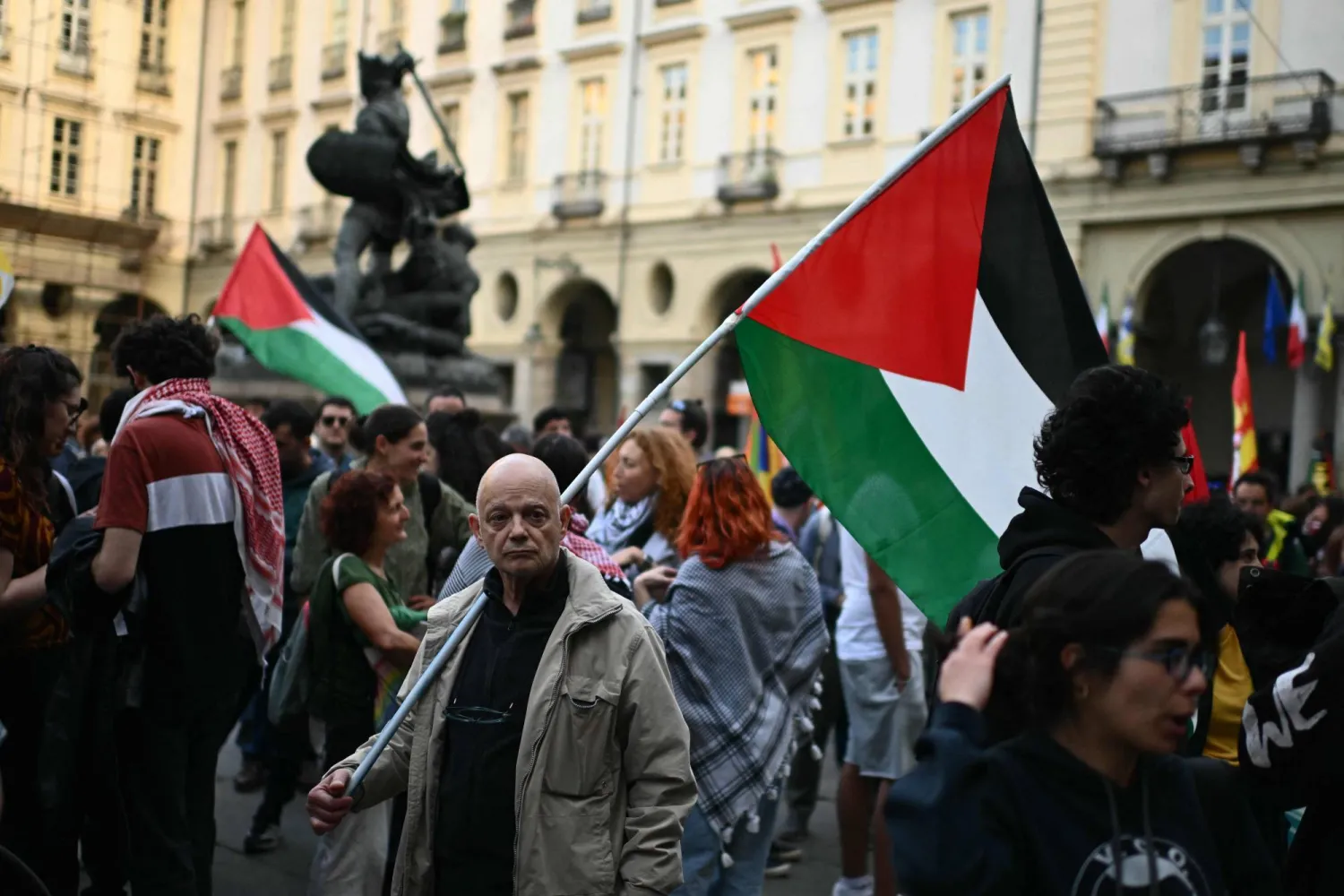
Activists on Gaza Aid Flotilla Detained by Israel Disembark in Crete

Protesters hold Palestinian flags during a demonstration to condemn the interception of the Global Sumud Flotilla by the Israeli army, in Turin on April 30, 2026. (Photo by MARCO BERTORELLO / AFP)
TT

Activists on Gaza Aid Flotilla Detained by Israel Disembark in Crete

Protesters hold Palestinian flags during a demonstration to condemn the interception of the Global Sumud Flotilla by the Israeli army, in Turin on April 30, 2026. (Photo by MARCO BERTORELLO / AFP)

Dozens of activists on a Gaza-bound aid flotilla which was intercepted by Israeli forces in international waters off Crete disembarked on Friday in the Greek island, an AFP journalist saw.

Escorted by Greek coast guards, some 175 activists were taken in four buses to a town whose name was not disclosed by the authorities.

Israel's foreign ministry earlier said around 175 activists had been taken off more than 20 boats on Thursday. Flotilla organizers put the number at 211.

"In coordination with the Greek government, the individuals transferred from the flotilla vessels to the Israeli vessel will be disembarked on a Greek beach in the coming hours," Israeli Foreign Minister Gideon Saar wrote on X late Thursday, thanking Greece "for its willingness to receive the flotilla participants".

Several European governments with nationals among those arrested have called on Israel to free the activists and called its action a flagrant contravention of international law.

But the United States backed Israeli authorities, calling the flotilla a "stunt".

"The United States expects all our allies...to take decisive action against this meaningless political stunt by denying port access, docking, departure and refueling to vessels participating in the flotilla," State Department spokesman Tommy Pigott said.

Initially made up of more than 50 boats, the flotilla's aim, according to the organizers, was to break the blockade of Gaza and bring humanitarian aid to the Palestinian territory, whose access remains largely restricted despite a fragile ceasefire between Israel and Hamas, in force since October.


Trump Congratulates Zaidi on His Nomination to Be Next Iraqi Prime Minister

This handout photograph taken and released by the Iraqi Prime Minister's Press Office on April 28, 2026 shows new prime minister-designate Ali al-Zaidi talking on the phone at his office in Baghdad. (Iraqi Prime Minister’s Press Office /AFP)
TT

Trump Congratulates Zaidi on His Nomination to Be Next Iraqi Prime Minister

This handout photograph taken and released by the Iraqi Prime Minister's Press Office on April 28, 2026 shows new prime minister-designate Ali al-Zaidi talking on the phone at his office in Baghdad. (Iraqi Prime Minister’s Press Office /AFP)

US President Donald Trump congratulated Ali al-Zaidi on his nomination to be next prime minister of Iraq on Thursday, saying that he looked forward to a highly productive new relationship.

Iraq's alliance of Shiite political blocs, the Coordination Framework, on Monday named Zaidi as its ‌nominee for the ‌post of prime minister, a ‌coalition ⁠statement said.

"We wish ⁠him success as he works to form a new Government free from terrorism that could deliver a brighter future for Iraq," Trump said in a post on Truth Social.

"We look ⁠forward to a strong, vibrant, ‌and highly ‌productive new relationship between Iraq and the United ‌States."

Trump also invited Zaidi to visit ‌Washington after forming a government during a phone call on Thursday in which he congratulated him on his nomination, according to ‌a statement from the Iraqi prime minister's media office.

The call reviewed ⁠strategic ⁠ties between Iraq and the US and ways to strengthen cooperation across multiple fields, the statement said, adding that both sides affirmed joint efforts to support regional stability.

Trump had threatened in January to withdraw Washington's support for Iraq if former Prime Minister Nouri al-Maliki was designated to form a cabinet.