

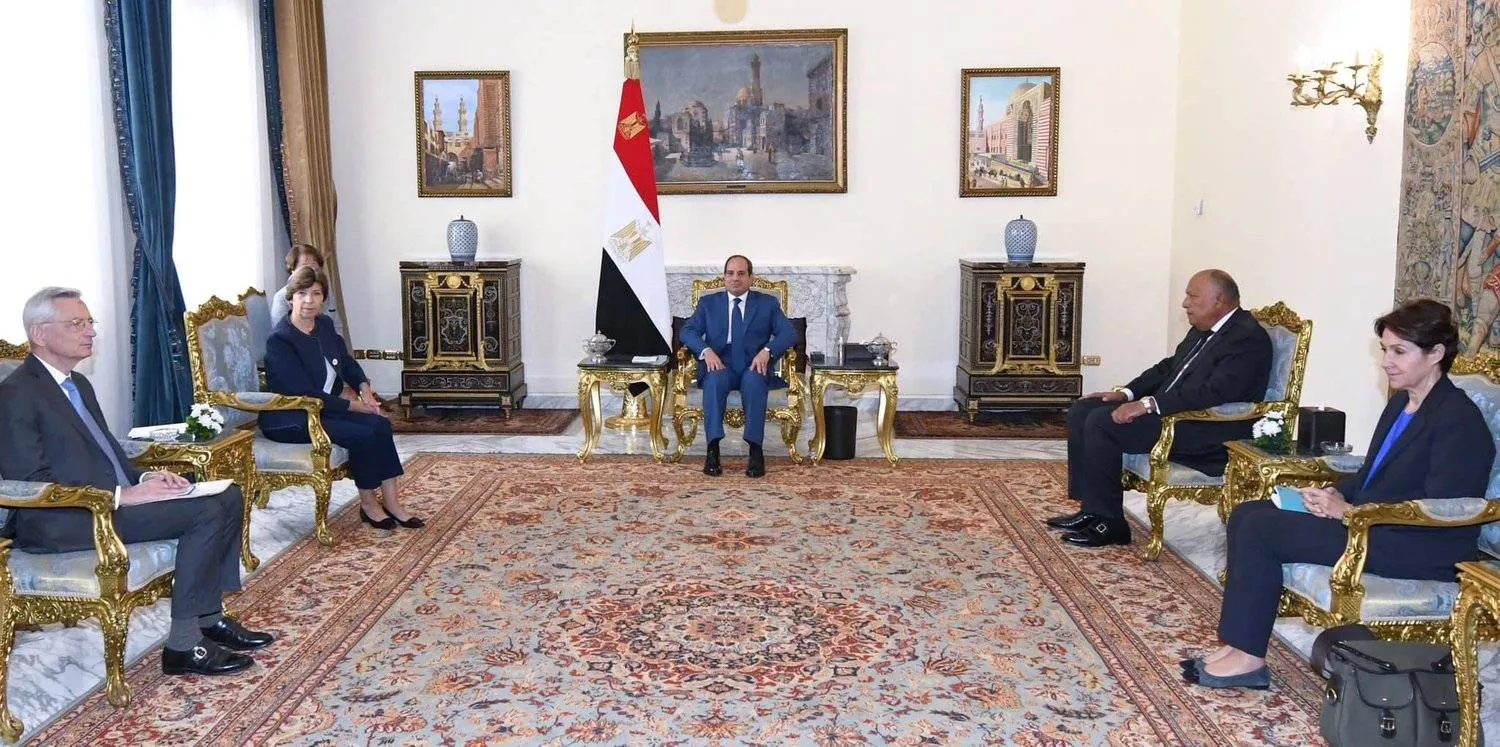

Egypt to Host Int’l Summit to Discuss Palestinian Developments

Egyptian President Abdel Fattah al-Sisi receives French Foreign Minister Catherine Colonna in Cairo. (Egyptian Presidency)
TT

Egypt to Host Int’l Summit to Discuss Palestinian Developments

Egyptian President Abdel Fattah al-Sisi receives French Foreign Minister Catherine Colonna in Cairo. (Egyptian Presidency)

Cairo is set to host an international summit on Saturday to discuss developments in the Palestinian-Israeli conflict and the peace process.

The Egyptian presidency has extended an official invitation to many countries to attend the summit, informed sources told Asharq Al-Awsat.

This included the US, China, Russia, Türkiye, and the European Union, and several Arab countries.

Leaders from Jordan, Palestine and the Gulf states are expected to attend, as well as representatives from international and regional organizations, including the UN and the Arab League.

Egyptian MP Mustafa Bakri affirmed to Asharq Al-Awsat that the summit will be attended by prominent Arab and international figures.

It will have two main objectives: firstly, to halt the Israeli aggression against Gaza and urgently alleviate the suffering of Palestinians.

Secondly, to explore a political horizon for resolving the Palestinian-Israeli conflict on the basis of a two-state solution and to support the Palestinian Authority as a key party to the solution.

The convening of the summit aligns with the decisions made during the Egyptian National Security Council meeting, presided over by President Abdel Fattah al-Sisi, on Sunday.

Sisi had announced a commitment to continue communications with international and regional partners to de-escalate the situation and halt the targeting of civilians in Gaza.

He emphasized that the only solution to the conflict is the two-state solution, while rejecting and condemning policies involving displacement or attempts to resolve the issue at the expense of neighboring countries.

“There is a consistent Egyptian role in achieving de-escalation and peace,” stressed Foreign Minister Sameh Shoukry during a press conference with his French counterpart Catherine Colonna in Cairo on Monday.

“There are risks of the crisis expanding and causing more casualties, with potential implications for security and stability,” he added.

Egypt’s top diplomat also highlighted that the current focus is on de-escalation, and it is essential to concentrate on the significance of a two-state solution and achieving peace.



Aidarous al-Zubaidi Faces Corruption, Land-Grabbing Investigations

 Aidarous al-Zoubaidi (AFP) 
 Aidarous al-Zoubaidi (AFP) 
TT

Aidarous al-Zubaidi Faces Corruption, Land-Grabbing Investigations

 Aidarous al-Zoubaidi (AFP) 
 Aidarous al-Zoubaidi (AFP) 

Yemen’s Attorney General, Qaher Mustafa, has ordered the formation of a judicial committee to investigate allegations of corruption, illicit enrichment, and related crimes attributed to Aidarous al-Zubaidi, according to a decision issued on Saturday. The committee has been instructed to proceed in accordance with the law.

The probe will examine accusations including abuse of power, land seizures, illicit oil trading, and involvement in commercial companies. Observers say these practices have deepened political and social divisions in Yemen’s southern governorates, fueling public anger over financial and administrative corruption.

Dr. Fares al-Bayl, head of the Future Center for Yemeni Studies, told Asharq Al-Awsat that al-Zubaidi “lacks political capital and administrative experience,” but rose to senior positions amid Yemen’s worst economic and political crisis. He alleged that al-Zubaidi exploited these posts to seize public funds, undermine state institutions, and conspire with external actors.

Al-Bayl said al-Zubaidi diverted large budgets - estimated at 10 billion Yemeni riyals monthly - under the name of the Southern Transitional Council, without legal authorization. He accused him of withholding revenues from the Port of Aden, customs, and taxes from the Central Bank, and channeling funds to armed formations outside state control.

Additional claims include the imposition of illegal levies on traders and citizens, the creation of multiple revenue-collection checkpoints, and the failure to transfer taxes on qat, fuel, cement, transport, tourism projects, and private investments to the state treasury.

Administratively, al-Bayl alleged that al-Zubaidi dismantled state institutions, replaced qualified personnel with loyalists, paralyzed essential services such as electricity, water, and the judiciary, and established parallel security bodies, creating administrative chaos and a lack of accountability. He also cited documented allegations of secret prisons, torture, enforced disappearances, and unlawful detentions of political opponents and journalists.

Security analyst Ibrahim Jalal described the alleged corruption as a reflection of power dominance and the monopolization of wealth and authority, often through illegal means and at the expense of citizens’ livelihoods.

Economist Adel Shamsan said the swift move by the Attorney General to open investigations carries important political and legal implications, reinforcing accountability and the rule of law. He noted that the action could help contain political fallout, ease polarization, and reassure markets and donors, supporting financial stability and reducing uncertainty.

According to documents reviewed by Asharq Al-Awsat, al-Zubaidi allegedly seized vast tracts of land in Aden. Many of these properties were reportedly registered in the names of relatives or close associates.

Additional allegations include oil shipments through Qena Port in Shabwa and corruption cases involving exchange and furniture companies based in Aden.


Israel PM Holds Coalition Meeting After Objecting to Gaza Panel

Israeli Prime Minister Benjamin Netanyahu gestures during a joint press conference with US Secretary of State Marco Rubio (not pictured) at the Prime Minister's Office, during Rubio's visit, in Jerusalem, September 15, 2025. (Reuters)
TT

Israel PM Holds Coalition Meeting After Objecting to Gaza Panel

Israeli Prime Minister Benjamin Netanyahu gestures during a joint press conference with US Secretary of State Marco Rubio (not pictured) at the Prime Minister's Office, during Rubio's visit, in Jerusalem, September 15, 2025. (Reuters)

Israeli Prime Minister Benjamin Netanyahu convened a meeting of his ruling coalition partners on Sunday after objecting to the composition of a Gaza advisory panel formed by the White House, according to an official and media reports.

The White House announced this week the setting up of a "Gaza Executive Board," which would operate under a broader "Board of Peace" to be chaired by US President Donald Trump as part of his 20-point plan to end the war in Gaza.

The executive board, described as having an advisory role, includes Turkish Foreign Minister Hakan Fidan and Qatari diplomat Ali Al-Thawadi, alongside other regional and international officials.

Late on Saturday, Netanyahu's office objected to the composition of the executive board.

"The announcement regarding the composition of the Gaza Executive Board, which is subordinate to the Board of Peace, was not coordinated with Israel and runs contrary to its policy," the office of Netanyahu said.

"The Prime Minister has instructed the Foreign Affairs Minister to contact the US Secretary of State on this matter."

It did not explain the reason for its objection, but Israel has previously objected strongly to any Turkish role in post-war Gaza, with relations between the two countries deteriorating sharply since the war began in October 2023.

In addition to naming Türkiye's foreign minister to the executive board, Trump has also invited Turkish President Recep Tayyip Erdogan to join the overarching Board of Peace.

Media reports said that leaders of the country's ruling coalition were scheduled to meet on Sunday to examine the composition of the executive board.

"There is a meeting scheduled of the coalition at 10:00 am (0800 GMT)," the spokesman of Netanyahu's Likud Party told AFP, declining to provide further details.

Alongside Likud, the coalition includes the Religious Zionist Party led by far-right Finance Minister Bezalel Smotrich and Otzma Yehudit (Jewish Power) led by far-right National Security Minister Itamar Ben-Gvir.

The White House said Trump's plan would include three bodies: the Board of Peace, chaired by Trump; a Palestinian committee of technocrats tasked with governing Gaza; and the Gaza Executive Board, which would play an advisory role.

The Palestinian technocratic committee held its first meeting in Cairo on Saturday.

The diplomatic developments came as the United States said this week that the Gaza truce plan had entered a second phase, shifting from implementing a ceasefire to the disarmament of Hamas, whose October 7, 2023 attack on Israel triggered the Israeli offensive in Gaza.


Israel Issues Two-Month Ultimatum for Hamas to Disarm or Face Renewed War

 Palestinians walk amid buildings destroyed by Israeli air and ground operations in the Zeitoun neighborhood of Gaza City, Wednesday, Jan. 14, 2026. (AP)
Palestinians walk amid buildings destroyed by Israeli air and ground operations in the Zeitoun neighborhood of Gaza City, Wednesday, Jan. 14, 2026. (AP)
TT

Israel Issues Two-Month Ultimatum for Hamas to Disarm or Face Renewed War

 Palestinians walk amid buildings destroyed by Israeli air and ground operations in the Zeitoun neighborhood of Gaza City, Wednesday, Jan. 14, 2026. (AP)
Palestinians walk amid buildings destroyed by Israeli air and ground operations in the Zeitoun neighborhood of Gaza City, Wednesday, Jan. 14, 2026. (AP)

Israel has given Palestinian factions in the Gaza Strip, led by Hamas, a two-month deadline to disarm, warning that failure to comply will trigger a new war.

Israeli sources said the ultimatum was issued in full coordination with the United States, with an understanding that Israel alone will define what constitutes disarmament and how compliance will be verified.

According to Israel’s Channel 12, the military is already preparing operational plans should force be required.

US President Donald Trump publicly reinforced Israel’s stance, saying Hamas could comply the easy way or the hard way. Israeli officials said the warning follows direct understandings between Trump and Israeli Prime Minister Benjamin Netanyahu.

Under the plan, Hamas would be given two months from the establishment of a “peace council” and a technocratic administration in Gaza to surrender its weapons. If it fails to do so voluntarily, the Israeli army will intervene.

Israeli security assessments say Hamas remains operational despite heavy losses during the war on Gaza and is far from collapse. Intelligence estimates indicate the group still exercises military and administrative control in parts of Gaza, continues to rearm, rebuild underground infrastructure, and reorganize its combat forces.

Officials argue that the current transitional period benefits Hamas and allows it to restore capabilities.

As a result, Israeli sources stressed that extending the current phase is not an option, and that a clear, limited timetable has been set, at the end of which a decisive move will be made.

Disarmament of Hamas, they added, is not merely a declared goal but a binding condition for any progress in Gaza.

Israel has made clear it will not accept partial or symbolic steps and will not retreat from its red line as long as Hamas retains military capabilities.

Until full disarmament is achieved, Israel’s cooperation with the newly formed technocratic government in Gaza will remain limited, with Israeli authorities reviewing its composition and personnel.

While Hamas has announced it is willing to hand over governance in Gaza to a technocratic administration, it has not said it will relinquish its weapons.

US officials previously told Axios that Hamas had sent positive signals in secret contacts about accepting a phased US plan for disarmament, tied to the second phase of the Gaza agreement.

The plan reportedly includes dismantling tunnels, destroying weapons factories, removing rockets and heavy arms, and forming a single armed police force under the technocratic government.

Washington and Tel Aviv are also considering a special amnesty for Hamas members willing to surrender personal weapons and abandon armed activity.