


Israeli Air Strikes Kill 32 in South Gaza amid Calls for Civilians to Flee

 People walk among debris at the site of an Israeli strike on the apartment building, amid the ongoing conflict between Israel and Palestinian group Hamas, in Khan Younis in the southern Gaza Strip November 18, 2023. (Reuters)
People walk among debris at the site of an Israeli strike on the apartment building, amid the ongoing conflict between Israel and Palestinian group Hamas, in Khan Younis in the southern Gaza Strip November 18, 2023. (Reuters)
TT

Israeli Air Strikes Kill 32 in South Gaza amid Calls for Civilians to Flee

 People walk among debris at the site of an Israeli strike on the apartment building, amid the ongoing conflict between Israel and Palestinian group Hamas, in Khan Younis in the southern Gaza Strip November 18, 2023. (Reuters)
People walk among debris at the site of an Israeli strike on the apartment building, amid the ongoing conflict between Israel and Palestinian group Hamas, in Khan Younis in the southern Gaza Strip November 18, 2023. (Reuters)

Israeli air strikes on residential blocks in south Gaza killed at least 32 Palestinians on Saturday, medics said, after Israel again warned civilians to relocate as it turns to attacking Hamas in the enclave's south after subduing the north.

Such a move could compel hundreds of thousands of Palestinians who fled south from the Israeli assault on Gaza City to move again, along with residents of Khan Younis, a city of more than 400,000, worsening a dire humanitarian crisis.

"We're asking people to relocate. I know it's not easy for many of them, but we don't want to see civilians caught up in the crossfire," Mark Regev, an aide to Israeli Prime Minister Benjamin Netanyahu, told MSNBC on Friday.

Israel vowed to annihilate the Hamas militant group that controls the Gaza Strip after its Oct. 7 rampage into Israel in which its fighters killed 1,200 people and dragged 240 hostages into the enclave, according to Israeli tallies.

Since then, Israel has bombed much of Gaza City - the enclave's urban core - to rubble, ordered the depopulation of the northern half of the narrow strip and displaced around two-thirds of Gaza's 2.3 million Palestinians. Many of those who have fled fear their homelessness could become permanent.

Gaza health authorities raised their death toll on Friday to more than 12,000, 5,000 of them children. The United Nations deems those figures credible, though they are now updated infrequently due to the difficulty of collecting information.

Overnight on Saturday, 26 Palestinians were killed and 23 injured by an air strike on two apartments in a multi-storey block in a busy residential district of Khan Younis, according to health officials.

A few km (miles) to the north, six Palestinians were killed when a house was bombed from the air in Deir Al-Balah, according to health authorities.

There was no immediate comment from the Israeli military, which says Hamas militants use residential buildings and districts in densely populated Gaza as cover for operations posts and weaponry, something the movement denies.

Israel dropped leaflets over Khan Younis telling residents to evacuate to shelters, suggesting military operations there were imminent.

Regev said Israeli troops would have to advance into the city to oust Hamas fighters from underground tunnels and bunkers but that no such "enormous infrastructure" existed in less built-up areas to the west, closer to the Mediterranean coast.

"I'm pretty sure that they won't have to move again" if they move west, he said, referring to people in the area. "We're asking them to move to an area where hopefully there will be tents and a field hospital."

Regev said that since western areas were closer to the Rafah border crossing with Egypt, humanitarian aid could be brought in "as quickly as possible".

Al Shifa hospital

At Gaza's largest hospital, Al Shifa in Gaza City, Israel said its forces had found a vehicle with a large number of weapons and what it called a Hamas tunnel shaft as it combs the complex in search of what it says is a Hamas command center.

Al Shifa has been a primary target of Israel's ground advance, with its military saying that the hospital sits above a vast underground Hamas bunker. Hamas and hospital staff say this is false and that Israel's findings there have so far established no such thing.

The Israeli army said it briefly fought militants outside the hospital earlier this week before entering it to search it and question staff, and there had been no violence inside.

It released a video on Friday that it said showed a tunnel entrance in an outdoor area of the hospital. It appeared the area had been excavated. A bulldozer appeared in the background.

"We are seeing the Hamas presence in all of (Gaza) hospitals. This is a clear-cut presence," Israeli Major General Yraon Finkelman said in a video showing him conferring with army engineers excavating areas within Al Shifa's grounds.

"They are making cynical use of these hospitals, as we can see here in the heart of Shifa ... They are hiding under the hospitals with their weaponry, with their command centers, with their capabilities."

Hamas denies using hospitals for military purposes.

On Saturday, the Israeli military denied accusations by Palestinian officials that it had ordered the evacuation of all staff and 1,000-1,500 patients there, with evacuees facing treks along dangerous, bombed-out roads littered with dead bodies.

In a statement, the army said forces had acceded to a request from Al Shifa's director to "expand and assist" in more voluntary evacuations via a "secure route". Medical personnel could stay to support patients too weak to be evacuated, it said.

Al Shifa staff said a premature baby died at the hospital on Friday, the first baby to die there in the two days since Israeli forces entered. Three had died in the previous days while the hospital was surrounded.

A total of 15 Gaza Palestinians including eight children and family members arrived in the United Arab Emirates on Friday from Egypt for treatment of war wounds or illness after being evacuated through Rafah. They were the first of 1,000 the UAE pledged to treat at its hospitals, with daily flights expected.

Fuel deliveries

With the war entering its seventh week, there was no sign of a let-up, despite international calls for a ceasefire or at least for humanitarian pauses.

"We have prepared ourselves for a long and sustained defense from all directions. The more time the occupation's forces stay in Gaza, the heavier their continuous losses," Hamas armed wing spokesman Abu Ubaida said in a video statement.

Amid warnings that its Gaza siege raised the immediate risk of starvation, Israel on Friday appeared to bow to international pressure in agreeing to allow fuel trucks in and promising "no limitation" on aid requested by the United Nations.

The White House said in a post on X, formerly known as Twitter, that the fuel deliveries should "continue on a regular basis and in larger quantities."

Violence also flared anew in the Israeli-occupied West Bank, with at least five Palestinians killed and two injured in an Israeli air strike on a building in the Balata refugee camp in the central city of Nablus, the Palestinian Red Crescent ambulance service said early on Saturday.



Lebanon: Security Forces Continue Crackdown on Individuals Carrying Unauthorized Arms

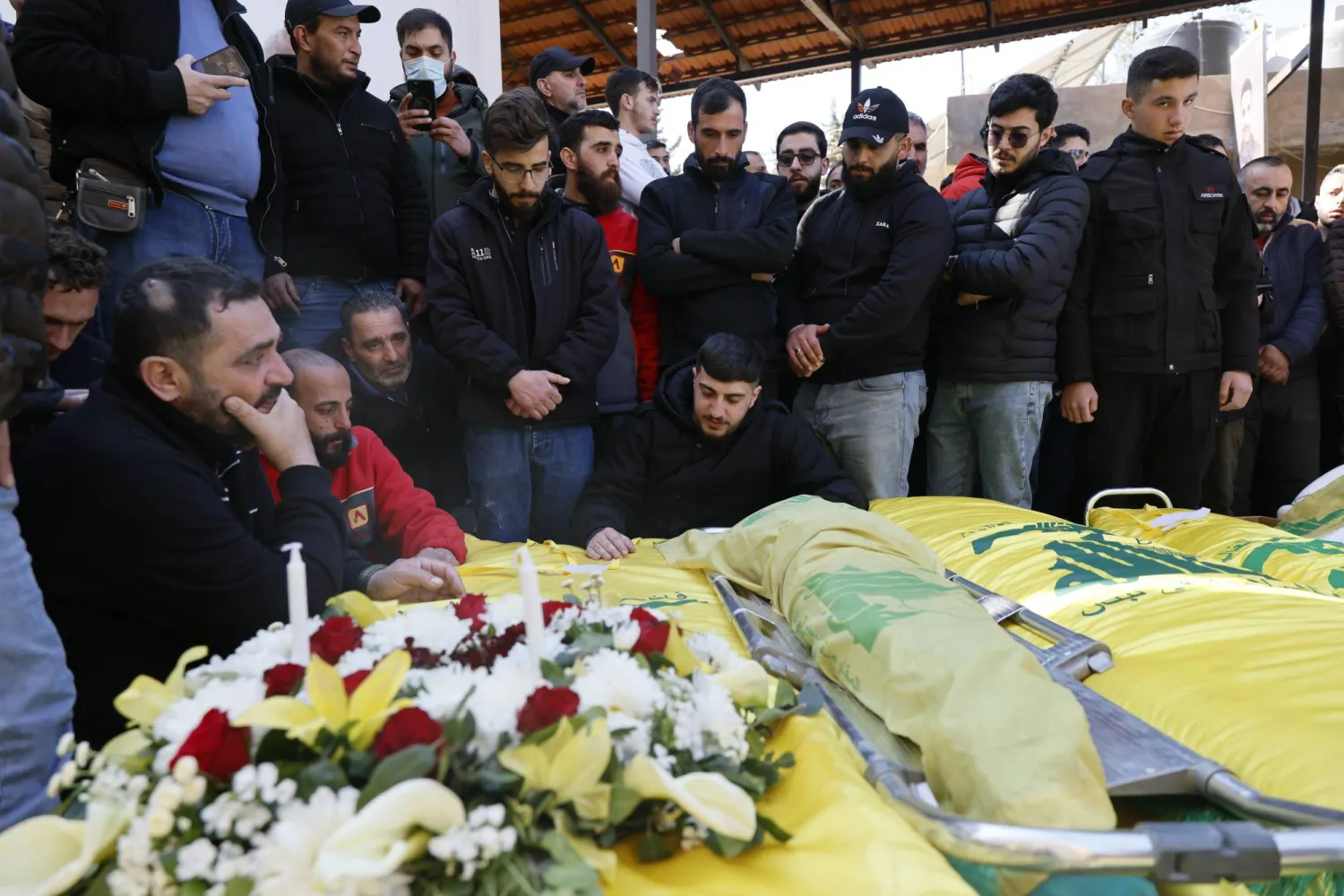
Mourners gather around the Hezbollah-draped coffins of people killed in Israeli airstrikes on Baalbek, during their funeral in the city of Baalbek, in Bekaa valley, Lebanon, 05 March 2026. EPA/WAEL HAMZEH
TT

Lebanon: Security Forces Continue Crackdown on Individuals Carrying Unauthorized Arms

Mourners gather around the Hezbollah-draped coffins of people killed in Israeli airstrikes on Baalbek, during their funeral in the city of Baalbek, in Bekaa valley, Lebanon, 05 March 2026. EPA/WAEL HAMZEH

A judicial source said 23 people, including Hezbollah members and civilians, have been arrested so far following a government decision to ban military actions by the party.

The arrests have been made across Lebanon after individual weapons, machine guns, and various types of military equipment were found in their possession.

The detainees are being questioned by army intelligence and the military police, under the supervision of the government commissioner to the military court, Judge Claude Ghanem, the source told Asharq Al-Awsat.

Investigations with five suspects have concluded and they have been referred to the military judiciary ahead of legal proceedings.

The shift extends beyond the number of arrests to the procedures themselves. Before the government ban, courts often limited action to confiscating the weapon and leaving the armed individual under investigation or releasing him after a pledge not to repeat the violation.

That approach has now changed. Authorities confiscate the weapon and detain the person regardless of identity or political affiliation, which is a clear sign of official determination to enforce the government decision without exception, including for Hezbollah members.

Despite the tougher stance, the identity of those launching rockets and drones toward Israel remains unknown. Security agencies are working to identify those responsible for the launches, which constitute a direct breach of the cabinet decision.

No arrests have been announced in connection with rocket or drone launches so far, security sources told Asharq Al-Awsat. Arrests linked to the transportation of weapons, however, are occurring daily as part of a wide security plan covering all regions.

In recent hours, security agencies apprehended individuals transporting a Kornet anti-tank missile, a destructive weapon capable of striking armored targets with precision.

The seizures reflect growing official and public concern, highlighting the scale of the security challenge and the pressure on authorities to enforce the government’s strict decision.

Most of those detained were stopped while traveling with convoys of displaced people from the south and the Bekaa. Security sources said the presence of armed individuals among displaced civilians poses a risk to the safety of shelters and raises concern among host communities.

Authorities fear such individuals could be targeted by Israeli strikes inside shelters, while tensions could also arise with host communities in Beirut, Mount Lebanon and other areas.

Judicial and security agencies have intensified coordination at the highest levels. Sources from both sides say investigations are exploring every possible lead that could expose networks involved in transporting weapons or launching rockets.

The military prosecution is closely monitoring the preliminary investigations but is carefully reviewing reports before filing charges, the judicial source said.

Launching judicial proceedings requires evidence strong enough to support suspicions, a process that can delay the announcement of results and the full number of arrests.


Israel Far-right Minister Warns Beirut Suburb Faces Devastation Like Gaza

Fires erupt from buildings damaged in an early morning Israeli strike on Beirut's southern suburbs on March 3, 2026. (Photo by AFP)
TT

Israel Far-right Minister Warns Beirut Suburb Faces Devastation Like Gaza

Fires erupt from buildings damaged in an early morning Israeli strike on Beirut's southern suburbs on March 3, 2026. (Photo by AFP)

Israel's far-right Finance Minister Bezalel Smotrich warned Thursday that a southern Beirut suburb, a stronghold of Hezbollah, will face devastation similar to Gaza after the Israeli military told residents to evacuate.

"Very soon Dahiyeh will resemble Khan Yunis," Smotrich said, referring to a southern Gaza city which has been heavily damaged by Israeli bombardments during the two-year war with Hamas, AFP reported.

"Hezbollah made a mistake, and it will pay a heavy price. We are striking at the head of the octopus in Iran, and at the same time we will sever Hezbollah's arm," he said in a video statement as he visited Israel's northern border.


HRW Says Israel's Lebanon Evacuation Risks Violating Laws of War

Smoke rises after an Israeli strike on Beirut's southern suburbs, following an escalation between Hezbollah and Israel, amid the US-Israeli conflict with Iran, Lebanon, March 4, 2026. REUTERS/Khalil Ashawi
TT

HRW Says Israel's Lebanon Evacuation Risks Violating Laws of War

Smoke rises after an Israeli strike on Beirut's southern suburbs, following an escalation between Hezbollah and Israel, amid the US-Israeli conflict with Iran, Lebanon, March 4, 2026. REUTERS/Khalil Ashawi

Human Rights Watch said on Thursday that the Israeli military's call for residents of vast areas of southern Lebanon to evacuate raised "serious risks of violations of the laws of war".

Lebanon was drawn into the Middle East war when Iran-backed Hezbollah began firing rockets at Israel with Israel conducting air strikes across the country and its troops pushing into border towns.

On Thursday, Israel renewed its warning to residents of hundreds of square kilometres (miles) of southern Lebanon to evacuate because of military action, AFP reported.

"Calling on everyone who lives south of the Litani (River) to evacuate immediately raises serious legal and humanitarian red flags and fears for the safety of civilians," said Ramzi Kaiss, Lebanon researcher at Human Rights Watch.

"How are older people, the sick and people with disabilities going to be able to evacuate immediately? And how will their safety be guaranteed as they leave?" he said in a statement from the rights group.

HRW said "the sweeping nature" of Israel's call raised "concerns that their purpose is not to protect civilians", adding that the area was home to hundreds of thousands of people.

The evacuation call "raises serious risks of violations of the laws of war", it added.

Lebanese authorities said dozens of people have been killed and tens of thousands displaced from their homes since Monday.