


UN Chief Warns That Israel’s Rejection of Two-State Solution Threatens Global Peace 

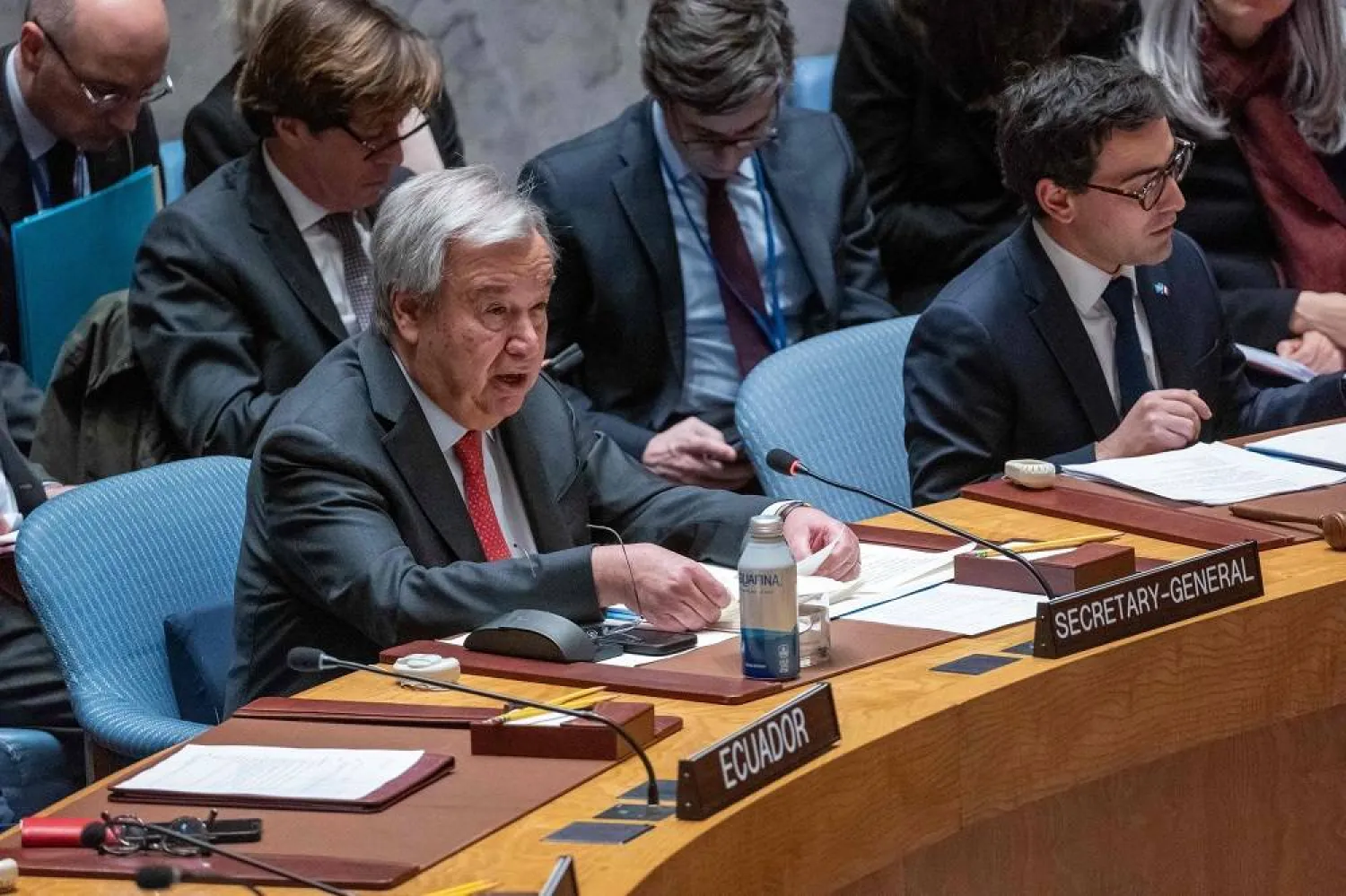
United Nations Secretary-General, Antonio Guterres speaks at a United Nations Security Council (UNSC) meeting on the Middle East, including the situation in Gaza and Israel on January 23, 2024 in New York City. (Getty Images via AFP)
TT

UN Chief Warns That Israel’s Rejection of Two-State Solution Threatens Global Peace 

United Nations Secretary-General, Antonio Guterres speaks at a United Nations Security Council (UNSC) meeting on the Middle East, including the situation in Gaza and Israel on January 23, 2024 in New York City. (Getty Images via AFP)

The United Nations chief warned Israel on Tuesday that Prime Minister Benjamin Netanyahu ’s rejection of a two-state solution will indefinitely prolong a conflict that is threatening global peace and emboldening extremists everywhere.

In his toughest language yet on the Israeli-Hamas war, Secretary-General Antonio Guterres told a ministerial meeting of the UN Security Council that “the right of the Palestinian people to build their own fully independent state must be recognized by all, and a refusal to accept the two-state solution by any party must be firmly rejected.”

The alternative of a one-state solution “with such a large number of Palestinians inside without any real sense of freedom, rights and dignity ... will be inconceivable,” he said.

Guterres also warned that the risks of regional escalation of the conflict “are now becoming a reality,” pointing to Lebanon, Yemen, Syria, Iraq and Pakistan. He urged all parties “to step back from the brink and to consider the horrendous costs” of a wider war.

Netanyahu’s rejection of a Palestinian state in any postwar scenario opened a wide rift with Israel’s closest ally, the United States, which says the war must lead to negotiations for a two-state solution where Israel and the Palestinians can live side-by-side in peace. That goal is supported by countries around the world, as ministers and ambassadors reiterated Tuesday.

Uzra Zeya, the State Department’s undersecretary for civilian security, democracy and human rights, told the council, “A key component of US diplomacy is to pursue a pathway both to a Palestinian state and normalization and integration between Israel and other regional states.”

“The goal is a future where Gaza is never again used as a platform for terror, and a future where Palestinians have a state of their own,” she said, reiterating the Biden administration’s call on Israel to do more to protect Palestinian civilians.

Russia’s Foreign Minister Sergei Lavrov countered that American diplomacy “oscillates between vetoing resolutions about the ceasefire and at the same time calling for a reduction in the intensity of hostilities in Gaza.”

“Without a doubt this serves as carte blanche for the ongoing collective punishment of Palestinians,” Lavrov told the council.

Secretary-General Guterres repeated his longstanding call for a humanitarian ceasefire — an appeal with overwhelming global support.

But Israel’s UN Ambassador Gilad Erdan again rejected a ceasefire, saying Hamas, which carried out a brutal attack on southern Israel on Oct. 7, is committed to attacking again and destroying Israel, and a halt to fighting will only allow the militants “to regroup and rearm.”

He urged the Security Council to “eliminate the root” of the conflict, which he said was Iran.

Erdan strongly criticized the presence of Iran’s foreign minister at the council meeting, saying the country provides weapons to Hamas, to Hezbollah fighters in Lebanon and Houthi militants in Yemen, “and soon these acts will be carried out under a nuclear umbrella” and “Iran’s terror will reach all of you.”

Iran has long denied seeking nuclear weapons and insists its nuclear program is entirely for peaceful purposes. But the UN nuclear watchdog has warned that Iran has enough enriched uranium for nuclear bombs if it chose to build them.

Iran’s Foreign Minister Hossein Amir-Abdollahian didn’t mention its nuclear program, but he warned Israel that it would not destroy Hamas, its stated goal.

“The killing of civilians in Gaza and the West Bank cannot continue on to the so-called total destruction of Hamas, because that time will never come,” he said. “Stopping the genocide in Gaza is the main key to security in the region.”

Riyad al-Maliki, the Palestinian foreign minister, said Israel is carrying out “the most savage bombing campaign” since World War II, which is leading to famine and the massive displacement of civilians. “This is an assault of atrocities,” which has destroyed countless innocent lives, he said.

The Health Ministry in Hamas-ruled Gaza says more than 25,000 Palestinians have been killed since the start of the war, which has caused widespread destruction, displaced an estimated 85% of Gaza’s 2.3 million people, and left one-quarter facing starvation.

Israel began its military campaign in response to the Oct. 7 attacks in which militants from the enclave killed around 1,200 people in Israel and took about 250 hostages.

Al-Maliki said Israel doesn’t see the Palestinians as a people and a “political reality to coexist with, but as a demographic threat to get rid of through death, displacement or subjugation.” He said those are the choices Israel has offered Palestinians, calling them tantamount to “genocide, ethnic cleansing or apartheid.”

Al-Maliki said there are only two future paths: One starts with Palestinian freedom and leads to Middle East peace and security, and the other denies freedom and “dooms our region to further bloodshed and endless conflict.”

France’s new foreign minister, Stéphane Séjourné, whose country holds the council presidency this month, presided at the meeting and warned that “a regional conflagration is real.”

He said the world should unite and deliver different messages to the warring parties.

Israel must be told that “there must be a Palestinian state” and that violence against Palestinians, including by West Bank settlers, must end, Séjourné said. And the Palestinians must be told that “there can be no ambiguity regarding Israel’s right to live in peace and security, and to exercise its right to self-defense against terrorism.”

But Türkiye's Foreign Minister Hakan Fidan said the argument that the war is about providing security for Israel “is far from being convincing.” He said supporters of this view never talk about the Palestinians’ right to security and self-defense.

Jordan’s Foreign Minister Ayman Safadi said the “ideology of hate embraced openly by Israeli ministers is normalizing the mass murder of Palestinians” and urged the council to stop it with a binding resolution.

Israel must be held accountable for war crimes and for blocking a Palestinian state, Safadi said. “The future of the region cannot be taken hostage to the political ambitions and the radical agendas of Israeli extremists, who described the Palestinians as human animals, unworthy of life, who enable settler terrorism against Palestinian people.”



Israel Permits 10,000 West Bank Palestinians for Friday Prayers at Al Aqsa

Palestinians attend Friday prayers in a mosque following an attack that local Palestinians said was carried out by Israeli settlers, in the village of Deir Istiya near Salfit in the Israeli-occupied West Bank November 14, 2025. REUTERS/Sinan Abu Mayzer
TT

Israel Permits 10,000 West Bank Palestinians for Friday Prayers at Al Aqsa

Palestinians attend Friday prayers in a mosque following an attack that local Palestinians said was carried out by Israeli settlers, in the village of Deir Istiya near Salfit in the Israeli-occupied West Bank November 14, 2025. REUTERS/Sinan Abu Mayzer

Israel announced that it will cap the number of Palestinian worshippers from the occupied West Bank attending weekly Friday prayers at the Al-Aqsa Mosque in east Jerusalem at 10,000 during the holy month of Ramadan, which began Wednesday.

Israeli authorities also imposed age restrictions on West Bank Palestinians, permitting entry only to men aged 55 and older, women aged 50 and older, and children up to age 12.

"Ten thousand Palestinian worshippers will be permitted to enter the Temple Mount for Friday prayers throughout the month of Ramadan, subject to obtaining a dedicated daily permit in advance," COGAT, the Israeli defense ministry agency in charge of civilian matters in the Palestinian territories, said in a statement, AFP reported.

"Entry for men will be permitted from age 55, for women from age 50, and for children up to age 12 when accompanied by a first-degree relative."

COGAT told AFP that the restrictions apply only to Palestinians travelling from the West Bank, which Israel has occupied since the 1967 Arab-Israeli war.

"It is emphasised that all permits are conditional upon prior security approval by the relevant security authorities," COGAT said.

"In addition, residents travelling to prayers at the Temple Mount will be required to undergo digital documentation at the crossings upon their return to the areas of Judea and Samaria at the conclusion of the prayer day," it said, using the Biblical term for the West Bank.

During Ramadan, hundreds of thousands of Palestinians traditionally attend prayers at Al-Aqsa, Islam's third holiest site, located in east Jerusalem, which Israel captured in 1967 and later annexed in a move that is not internationally recognized.

Since the war in Gaza broke out in October 2023, the attendance of worshippers has declined due to security concerns and Israeli restrictions.

The Palestinian Jerusalem Governorate said this week that Israeli authorities had prevented the Islamic Waqf -- the Jordanian-run body that administers the site -- from carrying out routine preparations ahead of Ramadan, including installing shade structures and setting up temporary medical clinics.

A senior imam of the Al-Aqsa Mosque, Sheikh Muhammad al-Abbasi, told AFP that he, too, had been barred from entering the compound.

"I have been barred from the mosque for a week, and the order can be renewed," he said.

Abbasi said he was not informed of the reason for the ban, which came into effect on Monday.

Under longstanding arrangements, Jews may visit the Al-Aqsa compound -- which they revere as the site of the first and second Jewish temples -- but they are not permitted to pray there.

Israel says it is committed to upholding this status quo, though Palestinians fear it is being eroded.

In recent years, a growing number of Jewish ultranationalists have challenged the prayer ban, including far-right politician Itamar Ben Gvir, who prayed at the site while serving as national security minister in 2024 and 2025.


EU Exploring Support for New Gaza Administration Committee, Document Says

Palestinians push a cart past the rubble of residential buildings destroyed during the two-year Israeli offensives, in Gaza City, February 17, 2026. REUTERS/Mahmoud Issa
TT

EU Exploring Support for New Gaza Administration Committee, Document Says

Palestinians push a cart past the rubble of residential buildings destroyed during the two-year Israeli offensives, in Gaza City, February 17, 2026. REUTERS/Mahmoud Issa

The European Union is exploring possible support for a new committee established to take over the civil administration of Gaza, according to a document produced by the bloc's diplomatic arm and seen by Reuters.

"The EU is engaging with the newly established transitional governance structures for Gaza," the European External Action Service wrote in a document circulated to member states on Tuesday.

"The EU is also exploring possible support to the National Committee for the Administration of Gaza," it added.

European foreign ministers will discuss the situation in Gaza during a meeting in Brussels on February 23.


Israel Military Says Soldier Killed in Gaza 

A drone view shows the destruction in a residential neighborhood, after the withdrawal of the Israeli forces from the area, amid a ceasefire between Israel and Hamas in Gaza, in Gaza City, October 21, 2025. (Reuters)
TT

Israel Military Says Soldier Killed in Gaza 

A drone view shows the destruction in a residential neighborhood, after the withdrawal of the Israeli forces from the area, amid a ceasefire between Israel and Hamas in Gaza, in Gaza City, October 21, 2025. (Reuters)

The Israeli military announced that one of its soldiers had been killed in combat in southern Gaza on Wednesday, but a security source said the death appeared to have been caused by "friendly fire".

"Staff Sergeant Ofri Yafe, aged 21, from HaYogev, a soldier in the Paratroopers Reconnaissance Unit, fell during combat in the southern Gaza Strip," the military said in a statement.

A security source, however, told AFP that the soldier appeared to have been "killed by friendly fire", without providing further details.

"The incident is still under investigation," the source added.

The death brings to five the number of Israeli soldiers killed in Gaza since a ceasefire took effect on October 10.