Lebanon's Displaced Celebrate Ramadan amid Fears that Border Conflict Might Become the 'New Normal'

A picture taken during a media tour organized by the Alma Research and Education Center shows a dog walking past a destroyed car in the deserted northern Israeli town of Metula, near the border with Lebanon, on March 19, 2024. (Photo by Jalaa MAREY / AFP)
TT

Lebanon's Displaced Celebrate Ramadan amid Fears that Border Conflict Might Become the 'New Normal'

A picture taken during a media tour organized by the Alma Research and Education Center shows a dog walking past a destroyed car in the deserted northern Israeli town of Metula, near the border with Lebanon, on March 19, 2024. (Photo by Jalaa MAREY / AFP)

Shortly before sunset on a recent evening, Mervat Reslan and a group of other women made french fries in vats of boiling oil to serve with that night's iftar — the meal that breaks the daily fasts Muslims observe during the holy month of Ramadan.
They belong to roughly 60 families who have been sheltering at an abandoned hotel in the southern Lebanon town of Marwanieh to escape the shelling and airstrikes that have made it too dangerous to stay in their homes in the country's border region with Israel. Although they've become a family of sorts to one another, many long to return home.
“Especially during Ramadan, you start thinking that your house is better — that you and your family all used to gather together, your children and their children, your in-laws and neighbors. And now you’re sitting by yourself in a room,” said Reslan.
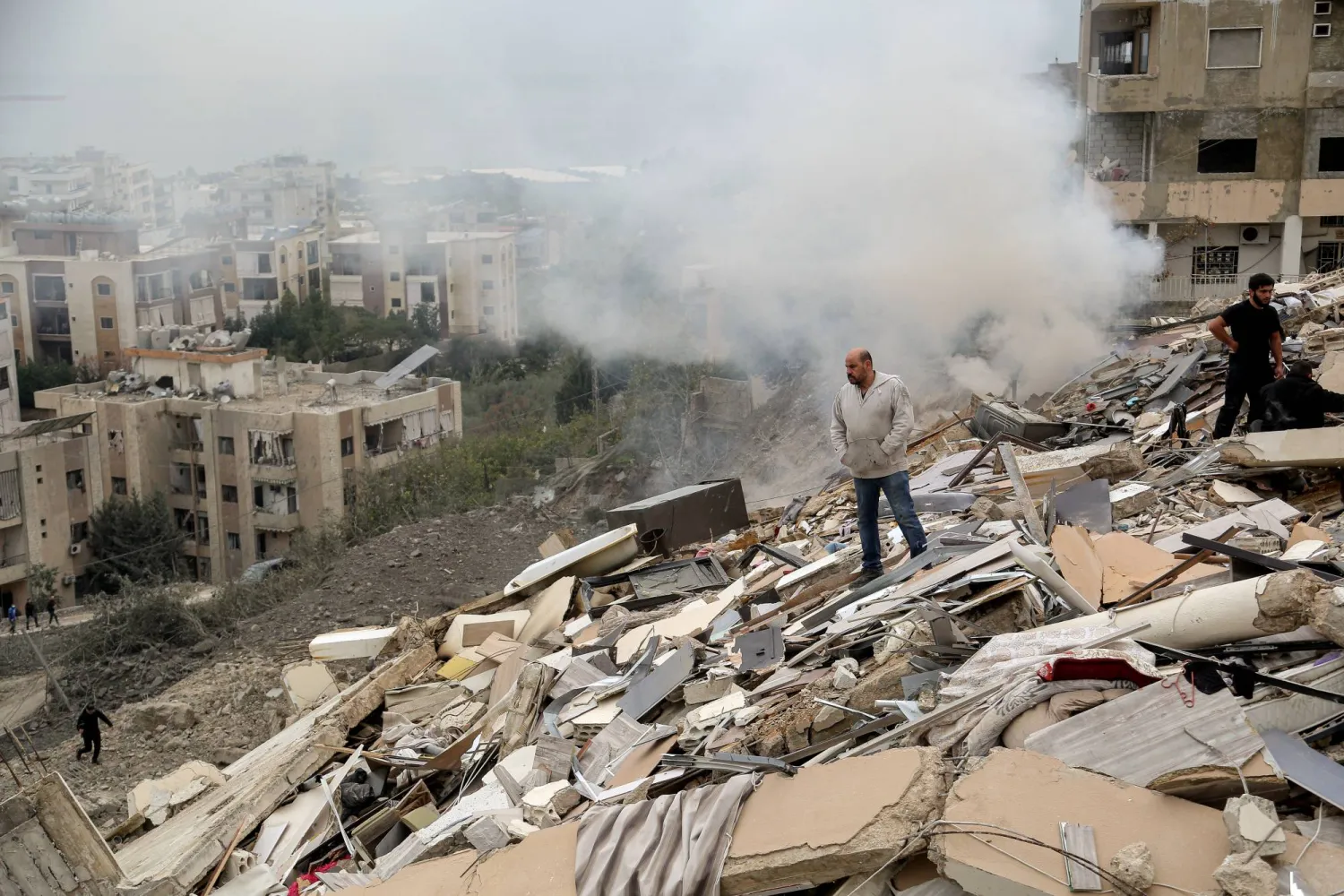
Those living at the Hotel Montana, which went out of business in 2005, are among an estimated 90,000 people from southern Lebanon who have been displaced by the near-daily clashes between the militant group Hezbollah and Israeli forces. Another 60,000 Lebanese civilians have decided to stay in the border zone and risk the danger, according to a United Nations agency.
The border clashes began with a few Hezbollah rockets fired across the frontier on Oct. 8, the day after Hamas' deadly incursion into southern Israel and Israel’s ensuing bombardment of the Gaza Strip. They quickly escalated to near-daily exchanges of rockets, shelling and airstrikes across the border and sometimes beyond, The Associated Press said.
Israeli strikes have killed more than 300 people in Lebanon. Most were militants from Hezbollah or allied groups, but more than 40 were civilians. Hezbollah strikes, meanwhile, have killed at least eight Israeli civilians and 11 soldiers, and displaced tens of thousands on that side of the border.
The cross-border attacks seem unlikely to end before a cease-fire is reached in Gaza — and possibly not even then. The prolonged state of limited conflict has left Lebanon, and particularly the displaced families, in limbo. School, work and farming in Lebanon's border region have been put on hold. For a while, many hoped that a cease-fire would coincide with the start of Ramadan, but half of the holy month has passed without clear prospects for a solution.
Most of the displaced Lebanese have moved in with relatives or found shelter in vacant houses or rooms offered up by residents farther north. Those with the means have relocated to their second homes or rented apartments.
Shelters like the Hotel Montana are a last resort.
“A person can deal with 10, 15, 20 days, a month (of displacement), but we’re now entering the sixth month and it looks like it will go on longer,” said Ali Mattar, who heads the union of municipalities for the Sahel al-Zahrani region, which includes Marwanieh.
The cash-strapped municipalities have been given much of the responsibility for dealing with the displacement, a task made more difficult by the four years of economic crisis the country has faced.
The Lebanese government has promised to compensate residents of the south whose homes have been damaged or destroyed. But the funding hasn't been secured, said Maj. Gen. Mohammad Kheir, who heads the country's Higher Relief Committee. A comprehensive survey hasn't been conducted to assess how many houses are damaged, though it is “in the thousands,” he said.
Hezbollah has been providing monthly payments to many of the displaced families, an official with knowledge of the situation said. The official, who was not allowed to brief journalists and spoke on condition of anonymity, did not give a precise amount, saying it depends on a family's size and needs.
Local and international nongovernmental organizations and religious charities have taken up much of the slack, but their resources are also strained. At the Hotel Montana, for instance, the Red Cross provides diesel to run a generator, but it can only be run for two hours in the morning and five in the evening because the supply is limited, said Salam Badreddine, who oversees disaster management for the union of municipalities.
The US and France, among other countries, have engaged in diplomatic missions to try to prevent the border conflict from escalating into full-scale war. But even if they succeed, some fear that a continuous state of low-level conflict could become the new normal.
“I think the risk of an all-out war still exists, and I would argue that it’s high,” said Emile Hokayem, director of regional security at the International Institute for Strategic Studies, a London-based think tank. But there is also a potential for a long-term simmering conflict that would “exhaust” the struggling Lebanese economy and society, he said.
“What I worry about is this ability to rationalize levels of violence and adjust to them, and (to think that) as long as we’ve avoided the big one, we’re fine,” he said.
Reslan said her family was briefly displaced during the brutal monthlong war between Hezbollah and Israel in 2006, but this time feels different. Shelling has already damaged her family’s house, and she is afraid that the extended displacement will become permanent.
“We’re afraid — not of Israel but that we won’t return to our houses and villages. That’s the only thing we’re afraid of,” she said.
Mohammed Issa, a construction worker and farmer, fled the village of Aitaroun with his wife and three children on Oct. 8, when shells began falling next to his house. They stayed for two months with another family before moving to the Hotel Montana. Now he's counting the days until they can go home.
“If there’s a cease-fire, we’ll be on the highway and at our house within an hour,” he said.
When displaced families do finally return home, they could face the grim reality of damaged homes, burned fields and a lack of resources to help, said Jasmin Lilian Diab, director of the Institute for Migration Studies at the Lebanese American University.
“It is not so much a conversation of whether or not they will eventually be able to go back, but what are they going back to," she said.



Hezbollah Chief Accuses Lebanese Authorities of Working ‘in the Interest of What Israel Wants’

Hezbollah leader Naim Qassem
TT

Hezbollah Chief Accuses Lebanese Authorities of Working ‘in the Interest of What Israel Wants’

Hezbollah leader Naim Qassem

Hezbollah leader Naim Qassem on Sunday said moves to disarm the group in Lebanon are an "Israeli-American plan,” accusing Israel of failing to abide by a ceasefire agreement sealed last year.

Under heavy US pressure and fears of expanded Israeli strikes, the Lebanese military is expected to complete Hezbollah's disarmament south of the Litani River -- located about 30 kilometers from the border with Israel -- by the end of the year.

It will then tackle disarming the Iran-backed movement in the rest of the country.

"Disarmament is an Israeli-American plan," Qassem said.

"To demand exclusive arms control while Israel is committing aggression and America is imposing its will on Lebanon, stripping it of its power, means that you are not working in Lebanon's interest, but rather in the interest of what Israel wants."

Despite a November 2024 ceasefire that was supposed to end more than a year of hostilities between Israel and Hezbollah, Israel has kept up strikes on Lebanon and has maintained troops in five areas it deems strategic.

According to the agreement, Hezbollah was required to pull its forces north of the Litani River and have its military infrastructure in the vacated area dismantled.

Israel has questioned the Lebanese military's effectiveness and has accused Hezbollah of rearming, while the group itself has rejected calls to surrender its weapons.

"The deployment of the Lebanese army south of the Litani River was required only if Israel had adhered to its commitments... to halting the aggression, withdrawing, releasing prisoners, and having reconstruction commence," Qassem said in a televised address.

"With the Israeli enemy not implementing any of the steps of the agreement... Lebanon is no longer required to take any action on any level before the Israelis commit to what they are obligated to do."

Lebanese army chief Rodolphe Haykal told a military meeting on Tuesday "the army is in the process of finishing the first phase of its plan.”

He said the army is carefully planning "for the subsequent phases" of disarmament.


Israel Army Ends Crackdown on West Bank Town after Attack

Smoke rises following an explosion detonated by the Israeli army, which said it was destroying buildings used by Palestinian militants in the West Bank Jenin refugee camp, Sunday, February 2, 2025. © Majdi Mohammed, AP
TT

Israel Army Ends Crackdown on West Bank Town after Attack

Smoke rises following an explosion detonated by the Israeli army, which said it was destroying buildings used by Palestinian militants in the West Bank Jenin refugee camp, Sunday, February 2, 2025. © Majdi Mohammed, AP

The Israeli military said on Sunday it had ended its operation in a town in the occupied West Bank that it had sealed off after a Palestinian from the area killed two Israelis.

Around 50 residents of Qabatiya were briefly detained during the two-day operation, the official Palestinian news agency Wafa reported, quoting the town's mayor Ahmed Zakarneh.

The attacker's father and two brothers remained in custody, it added.

The military launched the operation on Friday, shortly after a 34-year-old Palestinian fatally stabbed an 18-year-old Israeli woman and ran over a man in his sixties with his vehicle.

When contacted by AFP on Sunday morning, the military confirmed the end of its operation in the area.

Defense Minister Israel Katz previously said the army had completely sealed off the town.

Wafa also reported that Israeli troops had withdrawn from Qabatiya, near the city of Jenin.

Zakarneh said the town had been in a state of "total paralysis" during the military activity.

Israeli army bulldozers tore up pavement on several streets and erected roadblocks to halt traffic, he said, adding that around 50 houses were searched.

Wafa reported that a school had been turned into a detention and interrogation center.

AFPTV footage filmed on Saturday showed Israeli soldiers carrying automatic rifles and patrolling the streets, where several armoured vehicles were deployed.

Shops were closed, though men and children were seen walking through the village.

On Sunday, the Israeli army said it had sealed off the assailant's home and was finalising "the procedures required for its demolition".

Israeli authorities argue that demolishing the homes of Palestinians who carry out attacks against Israelis has a deterrent effect.

Critics, however, condemn the practice as collective punishment that leaves families homeless.


Arab League Council Holds Extraordinary Session on Latest Developments in Somalia

A general view shows the opening session of the meeting of Arab foreign ministers at the Arab League Headquarters (Reuters)
TT

Arab League Council Holds Extraordinary Session on Latest Developments in Somalia

A general view shows the opening session of the meeting of Arab foreign ministers at the Arab League Headquarters (Reuters)

At the request of the Federal Republic of Somalia and with the support of Arab League member states, the Arab League Council on Sunday began its extraordinary session at the league’s General Secretariat, at the level of permanent representatives and under the chairmanship of the United Arab Emirates, to discuss developments regarding the Israeli occupation authorities’ declaration on mutual recognition with the Somaliland region.

The Kingdom’s delegation to the meeting was headed by its Permanent Representative to the Arab League Ambassador Abdulaziz bin Abdullah Al-Matar, SPA reported.

The meeting is discussing ways to strengthen the unified Arab position in addressing this step, to affirm full solidarity with Somalia, and to support its legitimate institutions in a manner that contributes to preserving security and stability in the region.

The meeting also aims to reaffirm the Arab League’s categorical rejection of any unilateral measures or decisions that could undermine Somalia’s sovereignty and territorial integrity, and to emphasize commitment to the principles of international law and the relevant resolutions of the Arab League and the African Union.