
UN Refugee Agency Tells Cyprus to Stick to the Law in Its Efforts at Sea to Thwart Refugee Boats

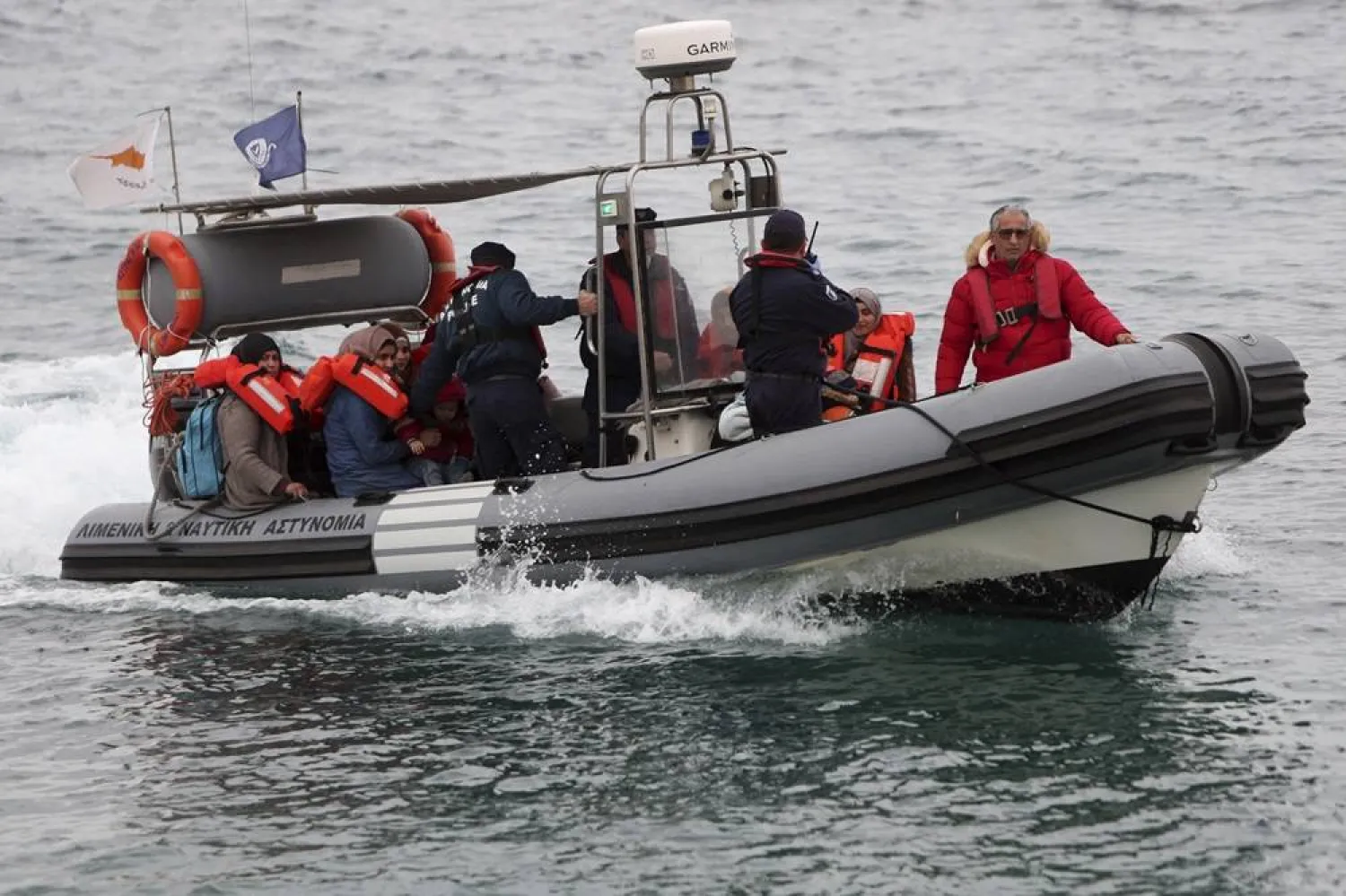
Migrants sit on a Cyprus marine police boat as they are brought to a harbor after being rescued from their own vessel off the Mediterranean island nation's southeastern coast of Protaras, Cyprus, on Jan. 14, 2020. (AP)
TT

UN Refugee Agency Tells Cyprus to Stick to the Law in Its Efforts at Sea to Thwart Refugee Boats

Migrants sit on a Cyprus marine police boat as they are brought to a harbor after being rescued from their own vessel off the Mediterranean island nation's southeastern coast of Protaras, Cyprus, on Jan. 14, 2020. (AP)

The United Nations' refugee agency said Friday that Cypriot efforts at sea to stop numerous Syrian refugee-laden boats departing Lebanon from reaching the European Union-member island nation mustn’t contravene international human rights laws or put passengers at risk.

Cypriot authorities have reportedly dispatched police patrol vessels just outside Lebanese territorial waters to thwart boat loads of Syrian refugees from reaching the island about 110 miles (180 kilometers) away.

The Cypriot government says a crumbling Lebanese economy coupled with the uncertainty brought on by the Israeli-Hamas war and the recent tit-for-tat strikes between Israel and Lebanon has resulted in a huge number of rickety boats overloaded with migrants – almost all Syrians – reaching the island.

Earlier this week, Cypriot patrol craft reportedly intercepted five boats carrying hundreds of Syrian refugees and migrants. The boats turned back and the passengers disembarked safely.

UNCHR spokesperson in Cyprus Emilia Strovolidou told The Associated Press that according to testimonies of passengers’ relatives, Cypriot authorities “forcibly pushed back” the boats using “violence” and “techniques to destabilize the boat.”

Strovolidou said the UN agency was “not in a position to confirm” those testimonies.

A Cypriot senior official strenuously denied that any coercion was used in any way to get the boats to return to Lebanon, insisting that the Cypriot government doesn’t engage in any pushbacks and acts “fully in accordance with international law.”

The official, who spoke on condition of anonymity because he cannot disclose details of ongoing operations, dismissed as “lies” allegations that Cypriot authorities resorted to using any type of force.

Strovolidou said Cyprus is also bound by international law not to return individuals to any country which could in turn deport them to their homeland where they could be at risk of harm or persecution.

The Lebanon office of UNHCR said in a statement that it was aware of more than 220 people who had disembarked from the returned boats in northern Lebanon on Wednesday. Of those, 110 were refugees registered with UNHCR and all of them were released, it said.

Saadeddine Shatila, executive director of the Cedar Center for Legal Studies, a Lebanon-based human rights organization that tracks migration issues, said his group had information that the Lebanese army had detained and possibly deported Syrians from at least one of the returning boats who weren’t registered with UNCHR.

The Lebanese army has in the past occasionally deported all Syrians aboard seized migrant boats, including registered refugees, a practice that drew an outcry from human rights organizations.

Lebanese political officials have been calling for years for the international community to either resettle the refugees in other countries or assist in returning them to Syria, and security forces have stepped up deportations of Syrians over the past year. Some of the deportees have reportedly faced detention and torture upon their return.

The Cypriot official said the Cyprus government in coordination with the European Commission is preparing an additional financial support package for Lebanon to help the country stop migrant boat departures. He said that support is conditional on Lebanon’s effectiveness in stopping migrant boat departures.

Cypriot President Nikos Christodoulides and European Commission Chief Ursula von der Leyen are due in Beirut May 2 to discuss the aid package.

The official said people smugglers are exploiting people’s fears over the ongoing conflicts in the region and are brazenly advertising in Lebanese coffee shops available seats on boats to Cyprus for $3,000 a head – a bargain compared to the $7,000 required for a trip to Italy.

Cyprus will convene a meeting of other EU countries next month to elicit additional support for its initiative for the bloc to formally redesignate some areas of Syria as safe zones. The Czech Republic and Denmark are behind the idea.

According to the Cypriot official, doing so wouldn’t mean that Syrians hailing from those safe zones are deported back to their country, but they would lose any allowances, benefits and the right to work, creating a disincentive to others to come to Cyprus.

He said Denmark is already implementing such a policy on its own and it’s a measure that the Cypriot government could consider if arrivals continue to increase.

Iraq Announces Complete Withdrawal of US-Led Coalition from Federal Territory

 US forces at the Taji camp, north of Baghdad. (AFP file)
US forces at the Taji camp, north of Baghdad. (AFP file)
TT

Iraq Announces Complete Withdrawal of US-Led Coalition from Federal Territory

 US forces at the Taji camp, north of Baghdad. (AFP file)
US forces at the Taji camp, north of Baghdad. (AFP file)

Iraq said on Sunday US-led coalition forces had finished withdrawing from bases within the country's federal territory, which excludes the autonomous northern Kurdistan region.

"We announce today... the completion of the evacuation of all military bases and leadership headquarters in the official federal areas of Iraq of advisers" of the US-led coalition, the military committee tasked with overseeing the end of the coalition's mission said.

With the withdrawal, "these sites come under the full control of Iraqi security forces", it said in the statement, adding that they would transition to "the stage of bilateral security relations with the United States".

The vast majority of coalition forces had withdrawn from Iraqi bases under a 2024 deal between Baghdad and Washington outlining the end of the mission in Iraq by the end of 2025 and by September 2026 in the Kurdistan region.

US and allied troops had been deployed to Iraq and Syria since 2014 to fight the ISIS group, which had seized large swathes of both countries.

The group was territorially defeated in Iraq in 2017 and in Syria in 2019, but continues to operate sleeper cells.

The vast majority of coalition troops withdrew from Iraq over previous stages, with only advisers remaining in the country.

The military committee on Sunday said Iraqi forces were now "fully capable of preventing the reappearance of ISIS in Iraq and its infiltration across borders".

"Coordination with the international coalition will continue with regards to completely eliminating ISIS's presence in Syria," it added.

It pointed to "the coalition's role in Iraq offering cross-border logistical support for operations in Syria, through their presence at an airbase in Erbil", the capital of Iraq's Kurdistan region.

In December, two US soldiers and a civilian interpreter were killed in Syria in an attack blamed on ISIS, sparking fears of a resurgence in the country.

The statement added that anti-ISIS operations would be coordinated with the coalition through the Ain al-Assad base in Anbar province in western Iraq.

ISIS attacks in Iraq have massively declined in recent years, but the group maintains a presence in the country's mountainous areas.

A UN Security Council report in August said: "In Iraq, the group has focused on rebuilding networks along the Syrian border and restoring capacity in the Badia region."


Jordan Says King Abdullah Received Invitation to Join Gaza Peace Board

Palestinian girls walk past the rubble of residential buildings destroyed during the war, in Gaza City, January 16, 2026. REUTERS/Dawoud Abu Alkas
TT

Jordan Says King Abdullah Received Invitation to Join Gaza Peace Board

Palestinian girls walk past the rubble of residential buildings destroyed during the war, in Gaza City, January 16, 2026. REUTERS/Dawoud Abu Alkas

Jordan's foreign ministry said on Sunday that King Abdullah received an invitation from ‌US President ‌Donald ‌Trump ⁠to join ‌the so-called "Board of Peace" for Gaza.

The foreign ministry said it was ⁠currently reviewing ‌related documents ‍within ‍the country's ‍internal legal procedures.

The board is set to supervise the temporary governance of Gaza, ⁠which has been under a shaky ceasefire since October.

On Friday, the White House announced some members of a so-called "Board of Peace" that is to supervise the temporary governance of Gaza, which has been under a fragile ceasefire since October.

The names include US Secretary of State Marco Rubio, President Donald Trump's special envoy Steve Witkoff, former British Prime Minister Tony Blair and Trump's son-in-law, Jared Kushner. Trump is the chair of the board, according to a plan his White House unveiled in October.

The White House did not detail the responsibilities of each member of the "founding Executive board." The names do not include any Palestinians. The White House said ⁠more members will be announced over the coming weeks.

The board will also include private equity executive and billionaire ‌Marc Rowan, World Bank President Ajay Banga and Robert Gabriel, ‍a Trump adviser, the White House ‍said, adding that Nickolay Mladenov, a former UN Middle East envoy, will be the ‍high representative for Gaza.

Army Major General Jasper Jeffers, a US special operations commander, was appointed commander of the International Stabilization Force, the White House said. A UN Security Council resolution, adopted in mid-November, authorized the board and countries working with it to establish that force in Gaza.

The White House also named an 11-member "Gaza Executive Board" that will include Turkish Foreign Minister Hakan Fidan, the UN special coordinator for the Middle East ⁠peace process, Sigrid Kaag, the United Arab Emirates minister for international cooperation, Reem Al-Hashimy, and Israeli-Cypriot billionaire Yakir Gabay, along with some members of the executive board.

This additional board will support Mladenov's office and the Palestinian technocratic body, whose details were announced this week, the White House said.


Türkiye’s Kurdish Leader Calls Syria Clashes 'Sabotage'

American soldiers from the U.S.-led coalition against the ISIS organization stand on alert during a meeting with the Syrian Democratic Forces in Deir Hafir, Syria, the day before yesterday (AP).
TT

Türkiye’s Kurdish Leader Calls Syria Clashes 'Sabotage'

American soldiers from the U.S.-led coalition against the ISIS organization stand on alert during a meeting with the Syrian Democratic Forces in Deir Hafir, Syria, the day before yesterday (AP).

Recent deadly clashes in Syria between government forces and Kurdish fighters seek to "sabotage" the peace process between Türkiye and the Kurdistan Workers' Party (PKK), the jailed leader of the Kurdish militant group said.

Abdullah Ocalan, who has led the unfolding Turkish peace process from prison, "sees this situation (in Syria) as an attempt to sabotage the peace process" in Türkiye, a delegation from the pro-Kurdish DEM party said after visiting him in jail on Saturday.

The PKK leader last year called for the group to lay down its weapons and disband, after more than four decades of conflict that claimed at least 50,000 lives.

The delegation that visited him at Imrali prison island near Istanbul, where he has been held in solitary confinement since 1999, said he had "reaffirmed his commitment to the process of peace and democratic society" and called to "take the necessary steps to move forward".

The PKK made a similar warning earlier this month, saying the Syria clashes "call into question the ceasefire between our movement and Türkiye ".

The clashes in Syria erupted after negotiations stalled on integrating the Kurds' de facto autonomous administration and forces into the country's new government, which took over after the fall of longtime ruler Bashar al-Assad in 2024.

The Syrian army has seized swathes of the country's north, dislodging Kurdish forces from territory where they had held effective autonomy for more than a decade.

Türkiye, which views Kurdish fighters in Syria as a terror group affiliated with the PKK, has praised Syria's operation as fighting "terrorist organizations".