Sudani Contains New Wave of Protests in Southern Iraq
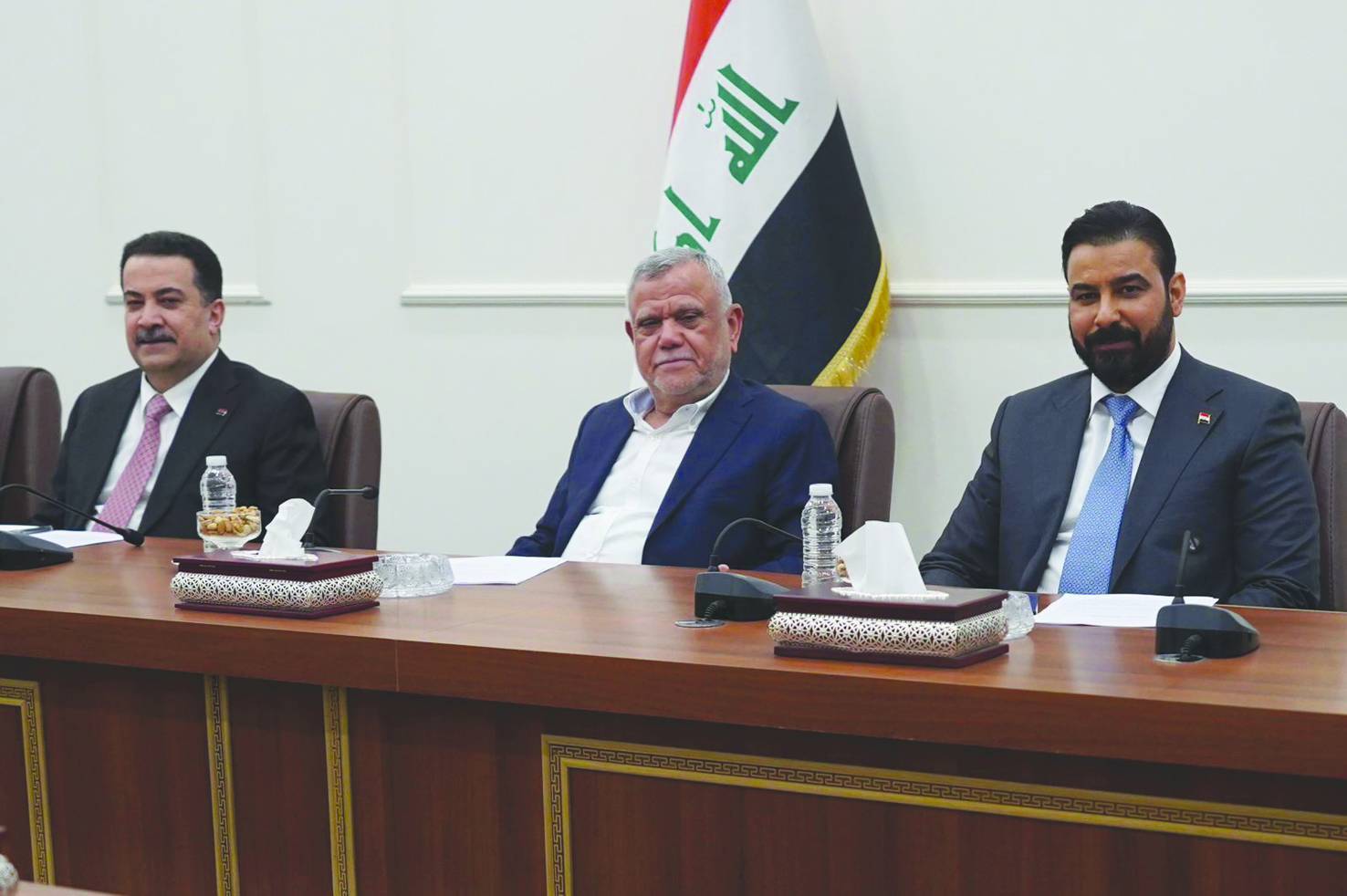
PM Sudani receives the delegation from the al-Muthanna province on Sunday. (Prime Minister’s Office)
Iraqi Prime Minister Mohammed Shia al-Sudani managed to avert a new wave of protests that were on the verge of erupting in central and southern provinces, said several local observers.
Leader of Iraq’s Ansar al-Marjaiya faction Hamid al-Yasiri had last week called for protests against corruption to be held in the city of Samawah in the southern al-Muthanna province.
He also called on Sudani to “dispatch” an honest military ruler to run al-Muthanna.
Iraqi people in under-serviced regions have started to complain of power cuts as temperatures start to soar in the country. Al-Muthanna is Iraq’s least populated and most impoverished, with nearly 50 percent of the population living in poverty, according to official figures.
Sudani received on Sunday Yasiri and 20 academic and tribal figures from al-Muthanna to discuss their concerns.
A statement from the PM’s office said the delegation explained the state of affairs in the province, the performance of the local government, rampant corruption and the high cost of projects.
Sudani stressed: “Restoring the trust of the people in the political process is among our most important challenges. The legitimacy of any political system lies in its ties to its people.”
In an apparent response to Yasiri’s request for the appointment of a military ruler in al-Muthanna, Sudani said: “The provincial councils were formed through elections and everyone must respect the choices of the people.”
The PM ordered the formation of a committee from the Commission of Integrity to visit al-Muthanna and follow up on complaints about corruption and the waste of public funds.
In his call for protests, Yasiri had demanded the “expulsion” of corrupt officials from office, namely the provincial governor and council, whom he said “don’t represent the masses and only work for their parties.”
In a statement after his meeting with Sudani, Yasiri said an agreement was reached to “form a committee from the PM’s office to oversee all projects in Samawah city and to prevent the governor and members of the provincial council from handling the funds.”
He said representatives of protests in al-Muthanna will oversee all projects in the provinces in line with an order that will be issued by the prime minister.
Suspension of General Amnesty Outrages Lebanon’s Roumieh Prison Inmateshttps://english.aawsat.com/arab-world/5318426-suspension-general-amnesty-outrages-lebanon%E2%80%99s-roumieh-prison-inmates
Suspension of General Amnesty Outrages Lebanon’s Roumieh Prison Inmates
A view of Roumieh Prison, east of Beirut, in October 2020. (Reuters file)
Islamist prisoners in Lebanon’s Roumieh Prison have launched an open-ended hunger and strike, including a total refusal to take medications, even by those with chronic illnesses, before being joined by all inmates of Building B.
The protest comes in response to the Constitutional Council's decision to suspend the general amnesty law pending a ruling on the appeal filed by the Strong Lebanon Bloc, headed by MP Gebran Bassil.
The inmates have held the political factions obstructing the general amnesty file fully responsible for their lives.
The hunger strike has thrust the prison file back to the forefront and placed an additional responsibility on the state, particularly the Internal Security Forces tasked with managing the facilities, raising fears of a return to unrest and riots.
Kicking off the hunger strike overnight on Monday, the prisoners issued a statement addressed to Lebanese public, saying they were taking their "escalatory step after seeing their humanitarian issues turned into a bargaining chip for political gains and partisan quota calculations."
They spoke of "long years of detention extending over many years, during which they were deprived of raising their children and caring for their families, while some of them passed away in captivity."
They expressed their gratitude to all officials and concerned parties who sought to grant them an opportunity for release and lashed out at those obstructing the general amnesty law.
They underlined their "complete refusal to be used as a scapegoat or pretext to execute political agendas at the expense of their suffering and the lives of their children."
They called for mass protests in Beirut and across Lebanon to support their cause. They also called on the Syrian people to join.
The prisoners reject the use of the amnesty law as a bargaining chip in political disputes and electoral grandstanding.
The spokesperson for the "Prisoners of Lebanon," Sheikh Omar Al-Atrash, said: "The hunger strike is a peaceful protest through which we seek to deliver a message to all officials."
He told Asharq Al-Awsat: "It is unacceptable for the general amnesty file to transform from a humanitarian issue addressing overcrowding in prisons and slow trials, into an issue used in a populist, sectarian manner."
He noted that this law "had achieved Sunni consensus, agreement from various Lebanese political forces, and the signatures of the three presidents, and it is entirely unacceptable for the Constitutional Council to be used to challenge it."
He viewed this as "a challenge to the political consensus and the Sunni consensus above anything else."
The strike is not limited to Islamist detainees, but includes other prisoners as well.
A security source explained to Asharq Al-Awsat that "all inmates of Building B in Roumieh Prison entered a hunger strike on Sunday evening."
The source pointed out that "the primary reason for the strike is the Constitutional Council's decision to suspend the general amnesty law, based on the appeal submitted by the Free Patriotic Movement, headed by Gebran Bassil," noting that the building houses around 420 prisoners, including 156 Islamists.
The strike did not extend to other buildings and sections at Roumieh, nor did the remaining prisons witness any similar movement.
The security source said that "the inmates of Building B are the primary beneficiaries of the general amnesty law, as the majority of them face death sentences or life imprisonment."
The security source revealed that prison officials are monitoring inmates with chronic illnesses, ensuring that they take their medications. They are prepared to handle any medical emergency.
Demonstrators block a road with flaming tires while protesting hikes to fuel prices in al-Bab, northeast of Aleppo in northern Syria, on September 14, 2026. (AFP)
TT
TT
Syrians Protest Fuel Price Hikes
Demonstrators block a road with flaming tires while protesting hikes to fuel prices in al-Bab, northeast of Aleppo in northern Syria, on September 14, 2026. (AFP)
Syrians on Monday held demonstrations in various parts of the country for the second consecutive day over the government's decision to increase fuel prices due to the Middle East war.
They mark the first such protest since the authorities seized power after ousting in December 2024 longtime ruler Bashar al-Assad, under whom demonstrations were strictly prohibited.
An AFP correspondent saw protesters gather in the city of Maarat al-Numan in the northwestern province of Idlib, briefly cutting off the main road with burning tires.
"We want them to bring fuel prices back to their previous level. Winter is coming, how are the poor going to live and keep warm?" said taxi driver Fateh Hamsho, 67.
Other protests took place in Hasakeh in the northeast, in Atarib and Azaz in the north and in Khan Sheikhoun in the west, according to AFP correspondents.
Syrian authorities on Sunday announced a hike on fuel prices amid global surges due to the Middle East war, which began with US-Israeli strikes on Iran in February and quickly engulfed other countries in the region.
The war has seen oil infrastructure damaged in Gulf countries, with key waterways choking imports.
The price of diesel in Syria went from 125 Syrian pounds ($1) per liter to 175, a 40 percent increase, while petrol prices saw a 26 percent increase.
The UN said 90 percent of Syrians lived below the poverty line by the end of 2024, with the minimum wage in the country standing at around 12,560 pounds ($103).
The Syrian parliament on Thursday will hold a hearing for Energy Minister Mohammad al-Bashir to explain the reasons behind the hike.
Protests were previously banned under Assad, whose violent crackdown on peaceful demonstrations against his rule in 2011 led to a 13-year civil war.
Speaking to state television, Abdul Hamid Salat, head of the energy ministry's media department, said on Sunday that the price hikes were "temporary" and linked to global markets and the Iran war.
He said Syria currently relies heavily on imports to meet its fuel needs, making these products more costly as prices rise on global markets.
Syria currently produces around 100,000 barrels of oil per day, well below domestic demand of between 300,000 and 325,000 barrels per day, Salat said.
Arsenal of Iraqi Armed Factions ‘Remaining Until 2028’https://english.aawsat.com/arab-world/5318393-arsenal-iraqi-armed-factions-%E2%80%98remaining-until-2028%E2%80%99
Arsenal of Iraqi Armed Factions ‘Remaining Until 2028’
Police academy graduates at a ceremony attended by PM Ali al-Zaidi in Baghdad on September 13. (Government media)
Following lengthy meetings in Baghdad, leaders within Iraq's ruling coalition believed they were capable of finalizing a settlement with representatives of pro-Iranian factions regarding post-US troop withdrawal arrangements, particularly the fate of weapons outside state control.
However, following attacks launched last Thursday from southern Iraq, near the border with Iran, against oil facilities in Saudi Arabia, these leaders likely found themselves functioning as "politicians searching for roles in a theater they do not control."
Private sources and officials speaking to Asharq Al-Awsat revealed that, prior to the recent attacks and with Iranian assistance, the factions succeeded in "hollowing out the weapons-containment plan after politically cornering Prime Minister Ali al-Zaidi and stripping him of his leverage and enforcement tools."
Indeed, despair is gripping officials across various authorities in Baghdad. During a meeting with an American official who recently visited Iraq, a senior Kurdish official addressed him saying: "The political system now resembles an old bus speeding down a slope without brakes."
‘Time bomb’
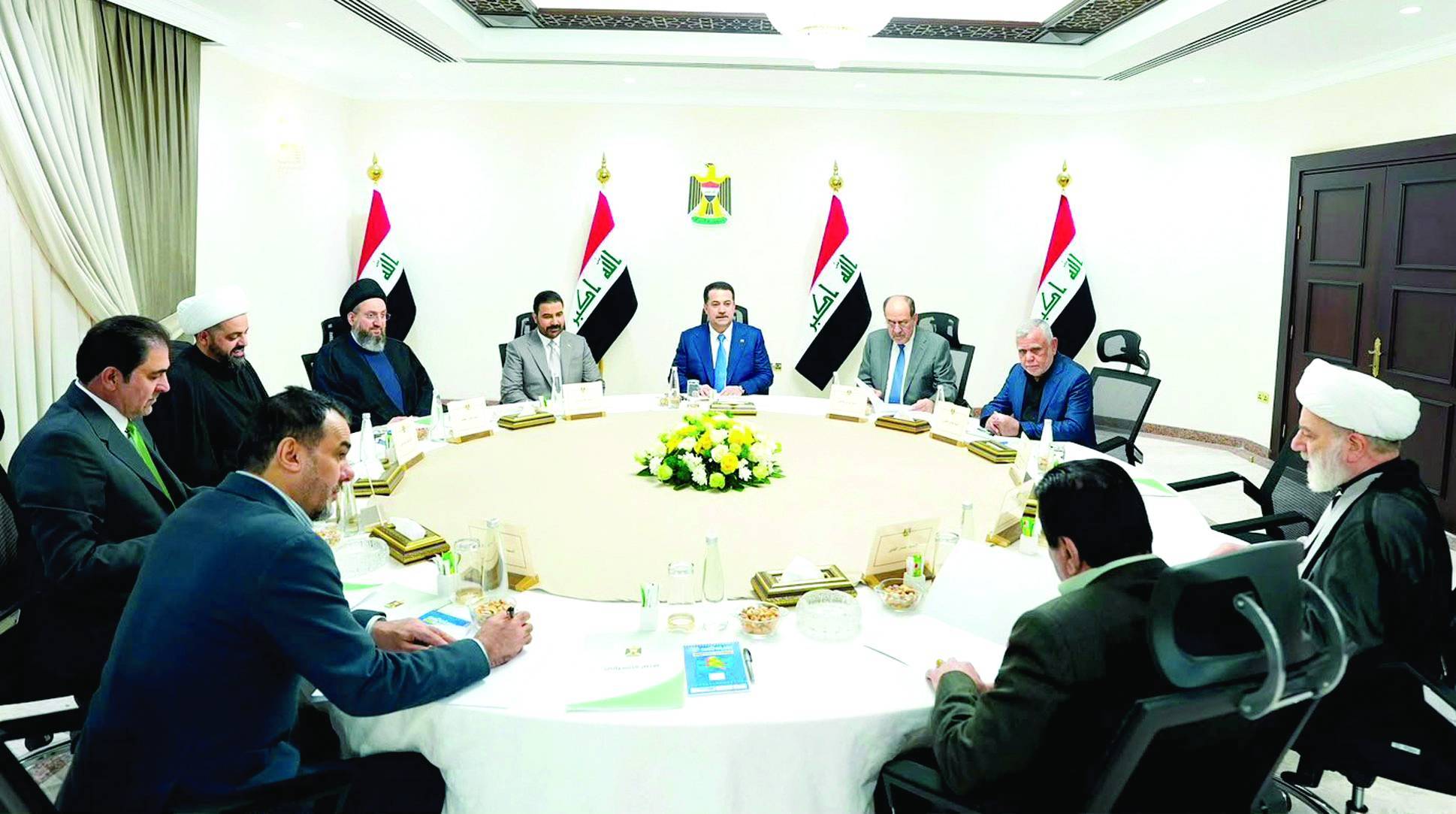
Over the past few weeks, members of the committee negotiating the containment of weapons - former PM Nouri al-Maliki, former PM Mohammed Shia al-Sudani, and Hadi al-Amiri, head of the Badr Organization - spent hours across at least four meetings negotiating a settlement based on the "non-use of weapons" on the condition that they are "not surrendered," according to sources.
Representatives of the factions planted - without objection from the senior negotiators - a "time bomb" within the settlement, which stipulates that "any agreement on the non-use of weapons shall be deemed void under specific circumstances."
Meanwhile, both sides reached a timeline extending until early 2028 for the factions to ultimately agree on laying down their arms.
Many believe that the timeline, initial details of which were obtained by Asharq Al-Awsat, reflects the vision of Iranian Parliament Speaker Mohammad Bagher Qalibaf, who requested that Iraqi factions "buy time" with the United States.
Against this backdrop, leaders within the Coordination Framework leapt back into the arena after months of losing political influence. This shift follows Iranian pressure spearheaded by Qalibaf and other Iranian officials who visited Baghdad last month to prevent the US from securing gains that had begun with its unprecedented support for the government of PM Ali al-Zaidi.
Following the formation of al-Zaidi's government, hopes were revived in Iraq and the region that it would be able to address one of the most complex issues within the Iraqi political system. However, over time, it became apparent that the factions possess "experience in taming successive governments in Baghdad."
The balance of power in Baghdad has shifted. September 30 has become "a date for a factional victory," as described by individuals from Shiite factions and parties, instead of a deadline for achieving state monopoly over arms.
Meanwhile, US forces are accelerating their departure without leaving air defense equipment, even with their closest Kurdish allies in Erbil, in the Kurdistan Region.
PM Ali al-Zaidi, Coordination Framework member Hadi al-Ameri and former PM Mohammed Shia al-Sudani. (Coordination Framework)
Deadline without guarantees
About a week before the attack on the East-West pipeline in Saudi Arabia, negotiators from the Coordination Framework, along with representatives of the factions, reached a timeline extending to the end of 2027.
This agreement has no guarantees, except that the Iraqi factions pledge - according to the draft reviewed by Asharq Al-Awsat - to integrate their fighters as brigades within the Popular Mobilization Forces without surrendering their weapons, in a process beginning September 30 and continuing until December 31, 2026.
The second phase of the agreement begins in early 2027 with scheduling the withdrawal of Turkish forces from Iraq, to be completed by July 1 of next year.
The third phase begins with the formation of a four-party committee comprising the PMF, Coordination Framework, factions, and government to monitor the implementation of the integration and the Turkish withdrawal until early 2028.
However, representatives of the factions approved the plan on the condition that it "be considered immediately void by one party" in the event that war against Iran resumes during any stage of implementation, or if "any party within the Coordination Framework or the factions faces an existential threat," according to two individuals briefed on the meeting.
One of them told Asharq Al-Awsat that "in return, the factions commit to not targeting foreign companies or other entities during the phases of the agreement."
Over the past months, Iraqi officials had been informing diplomatic and intelligence circles in the US that Baghdad had exited the "unity of the fronts" established by Iran across four regional capitals, but that they required "special treatment to resolve the issue of weapons outside state control."
In view of the recent draft agreement, the factions continue to tightly link the two tracks: regional war and restricting weapons to state control.
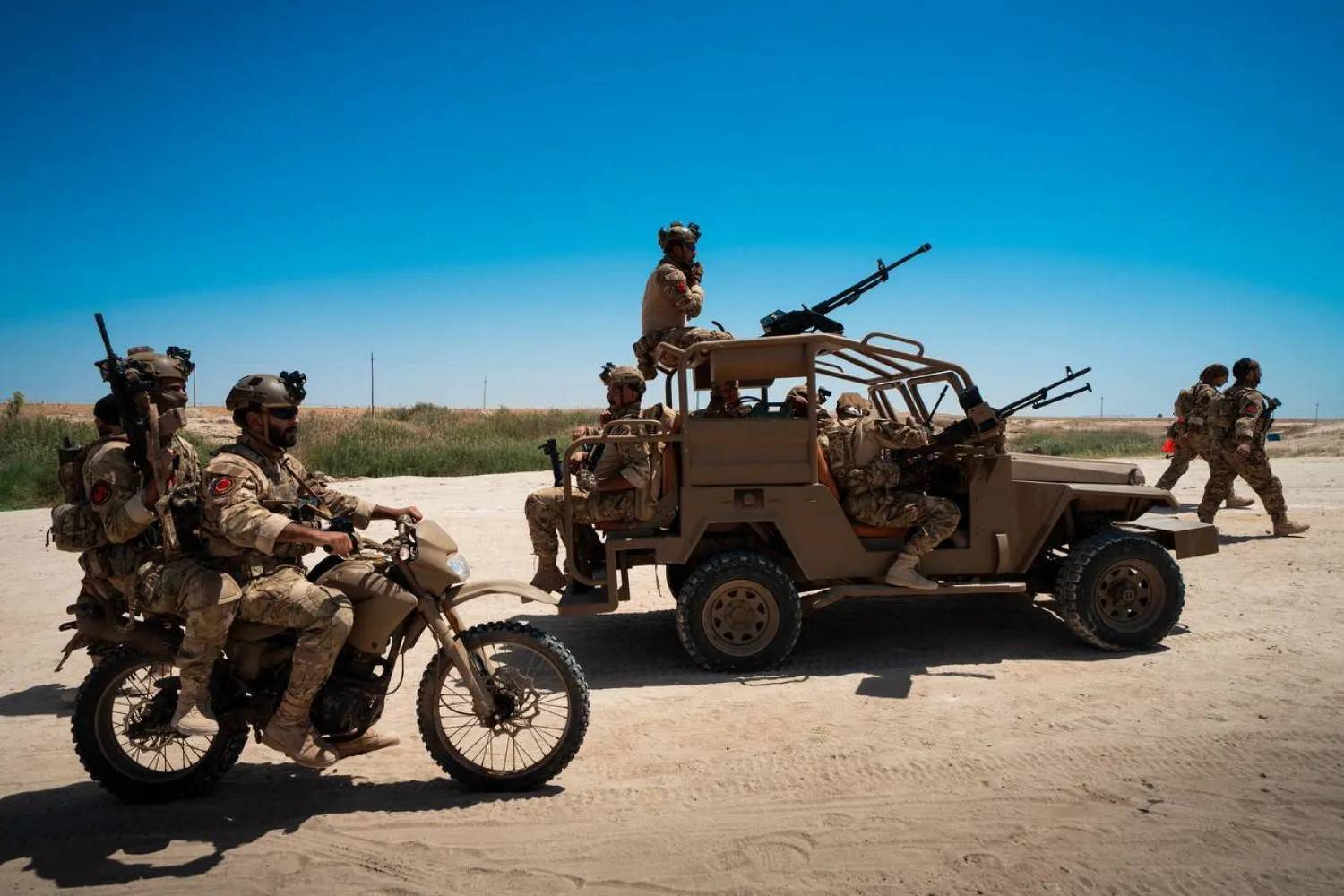
PMF fighters on patrol. (PMF)
‘Framework’ protects resistance fighters
A consensus was reached among the four leaders within the Framework and representatives of the factions on the necessity of "protecting the resistance fighters." During the final meeting, they drafted the agreement that outlines the post-September 30 phase "from the factions' perspective," according to a leader who was present at the meeting.
The leader, speaking on the condition of anonymity, stated that "the agreement may be announced early next October, depending on circumstances (...) as nothing is guaranteed."
In that meeting, held earlier this September, Haidar al-Gharawi, head of the Ansar Allah al-Awfiya faction, and Abu Alaa al-Walae, head of the Kataib Sayyid al-Shuhada, were in attendance. They were joined by a representative of Abu Hussein al-Humaidawi, head of Kataib Hezbollah, and another representing Akram al-Kaabi, head of the Harakat al-Nujaba. All of these factions are close to Iran and are also linked to shadow factions such as Awliya al-Dam and Ahl al-Kahf.
According to two individuals briefed on what transpired during the meeting, the representatives of the factions outlined "priorities" that entail "not surrendering weapons and avoiding any process that portrays the matter as a surrender to the US, while refraining from heading toward an escalation that would prompt the Americans to halt the support to al-Zaidi's government."
A senior political advisor within the ruling coalition believes that "the new approach, which tips the balance in favor of the factions over the government, received a strong boost after it leaked into the corridors of Shiite parties that the Americans would also not object to a proforma containment of weapons, on the condition that they are not used."
There is a growing impression regarding the futility of negotiating with the factions, and that a minimal agreement ensuring the freezing or regulation of weapons would be enough.
The advisor told Asharq Al-Awsat that "despair has begun creeping into the Americans and Iraqi officials tasked with weapons containment; in fact, some have stopped exerting pressure altogether to make the plan succeed and have abandoned the file out of sheer exhaustion from the factions," as he put it.
However, an Iraqi official speaking to Asharq Al-Awsat on the condition of anonymity, warned against "assuming a lenient American stance, as messages have recently arrived with the appointment of Steven Fagin as the new Chargé d'Affaires of the US Embassy."
The official stated: "It is being rumored in private meetings that Washington considers the factions' weapons to be the arsenal of a hostile state that Baghdad cannot keep, but must destroy."
PM Ali al-Zaidi attends a Coordination Framework meeting in Baghdad. (INA)
No neutral party
Al-Zaidi was less involved in the Coordination Framework negotiations with the factions, perhaps because he "does not feel that the negotiating party is sufficiently neutral," according to an advisor within the ruling coalition.
During a recent Framework meeting held in Baghdad, al-Zaidi told the leaders of Shiite parties: "I will be frank with you, the committee negotiating with the factions is biased... I do not feel that trusting it is a wise decision."
However, the PM himself slowed down the weapons containment process. Those close to him said that he "realized how much the momentum he began with following his meeting with US President Donald Trump (mid-last July) was far from reality."
Nevertheless, a prominent leader responded to him by saying: "The committee includes veteran and experienced figures who are undertaking a complex mission that they have not been, and will not be, able to accomplish."
According to a person close to the government palace in Baghdad "al-Zaidi decided to step back slightly, but in a calculated manner, without abandoning the project."
A senior official also quoted al-Zaidi during one of the meetings as saying: "There is no solution to the dilemma except by imposing state authority over weapons."
In parallel with the four meetings held between the factions and leaders of the Framework, al-Zaidi engaged in bilateral dialogues with Harakat al-Nujaba and Kataib Sayyid al-Shuhada, offering them what reliable sources described as "civilian privileges" in exchange for a reasonable formula for disarmament.
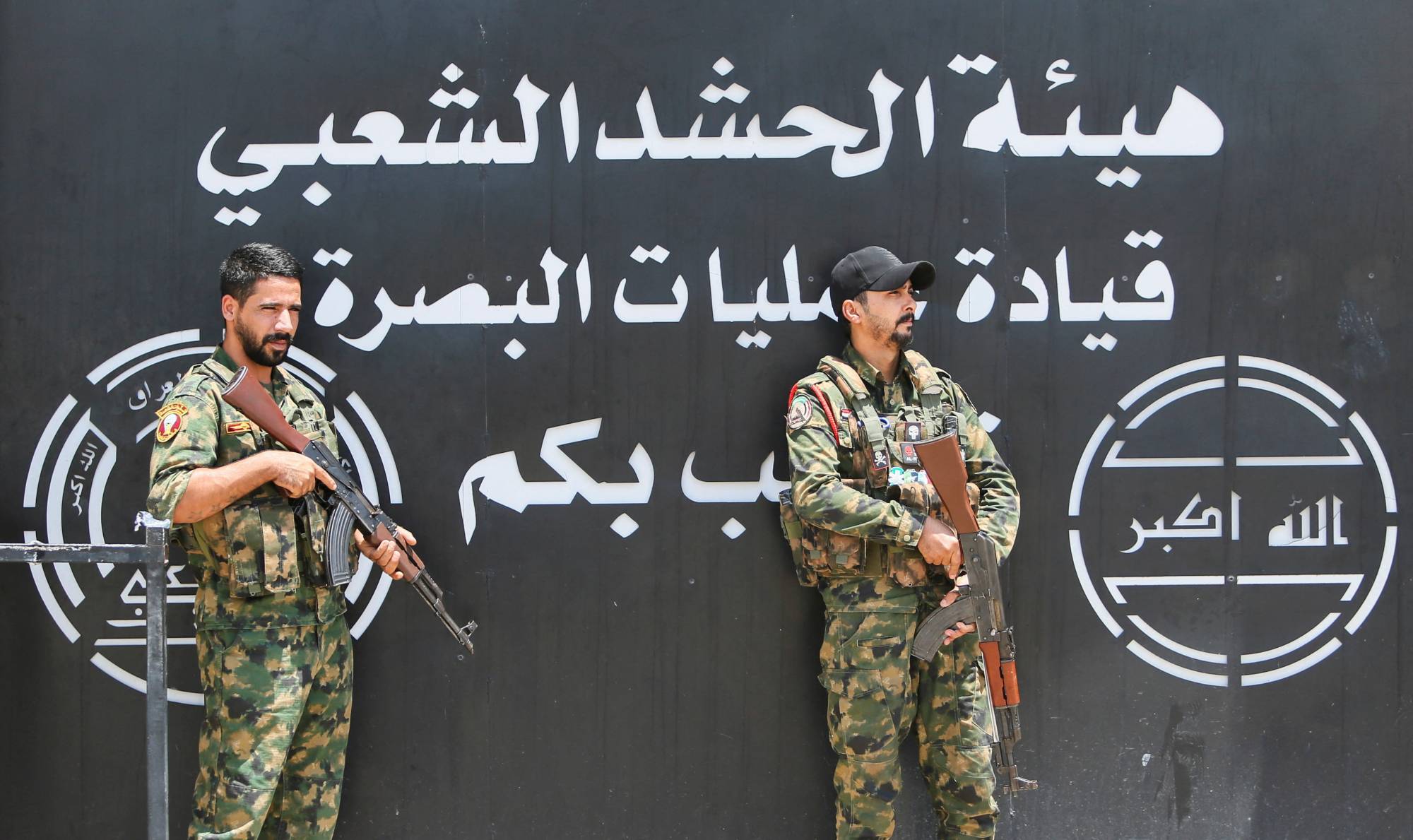
PMF members guard a PMF command base in Basra on July 29, 2026. (Reuters)
Factions want more
However, the factions are demanding more than that. A person close to the leader of one of the factions said they are "seeking guarantees against legal prosecution and a waiver on background checks for their members and leaderships."
He added: "Everyone knows that no one can grant these guarantees, but making them a condition is part of the process of buying time."
A person close to Al-Nujaba revealed that "the factions view civilian privileges (meaning positions within government institutions) as a natural entitlement resulting from their role in fighting ISIS."
They noted that Kataib Hezbollah was not part of the bilateral talks with the government due to "a deep crisis of trust that forces them to impose harsher conditions."
At most, the government's attempts to lure the factions into a settlement have failed. The American official told Asharq Al-Awsat that "the Iraqis he met feel that al-Zaidi stands alone without friends or allies," and that "the entire process (of weapons containment) has reached a dead end, and they do not know the way out of all this."
The official added that he heard a similar tone of despair from the Kurdish official in Erbil, saying: "The sound of a massive crash will echo from the dilapidated bus in Baghdad (...) the brothers in Baghdad cannot apply the brakes on the factions."
لم تشترك بعد
انشئ حساباً خاصاً بك لتحصل على أخبار مخصصة لك ولتتمتع بخاصية حفظ المقالات وتتلقى نشراتنا البريدية المتنوعة