Israel's Pledge to Guard an Aid Route into Gaza Falls Flat as Lawlessness Blocks Distribution

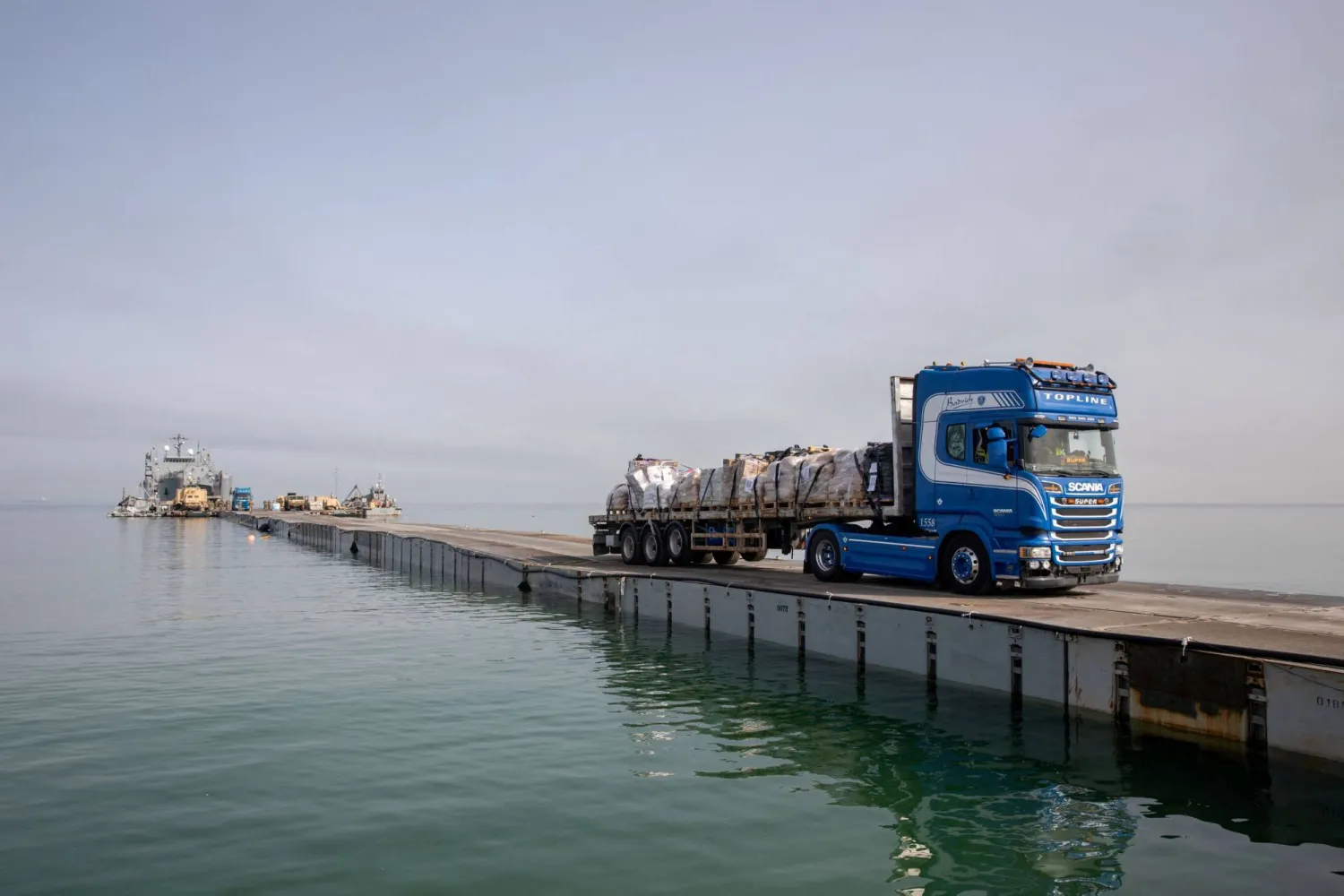
A truck carries humanitarian aid across Trident Pier, a temporary pier to deliver aid, off the Gaza Strip, amid the ongoing conflict between Israel and the Palestinian group Hamas, near the Gaza coast, May 19, 2024. US Army Central/Handout via REUTERS
TT

Israel's Pledge to Guard an Aid Route into Gaza Falls Flat as Lawlessness Blocks Distribution

A truck carries humanitarian aid across Trident Pier, a temporary pier to deliver aid, off the Gaza Strip, amid the ongoing conflict between Israel and the Palestinian group Hamas, near the Gaza coast, May 19, 2024. US Army Central/Handout via REUTERS

The Israeli military said Sunday that it was establishing a new safe corridor to deliver aid into southern Gaza. But days later, this self-declared “tactical pause” has brought little relief to desperate Palestinians.
The United Nations and international aid organizations say a breakdown in law and order has made the aid route unusable, The Associated Press reported.
With thousands of truckloads of aid piled up, groups of armed men are regularly blocking convoys, holding drivers at gunpoint and rifling through their cargo, according to a UN official who spoke on condition of anonymity because he was not authorized to brief the media on the issue.
The lawlessness is a major obstacle to aid distribution to southern and central Gaza — where an estimated 1.3 million Palestinians displaced from Rafah, or more than half of Gaza’s entire population, are now sheltering in tent camps and cramped apartments without adequate food, water, or medical supplies.
Here is a closer look at the security challenges facing the UN and aid organizations.
Israel's ‘tactical pause’ stymied Israel said Sunday it would observe daily pauses in combat along a route stretching from Kerem Shalom — the strip’s only operational aid crossing in the south — to the nearby city of Khan Younis. Before the pause, aid organizations had reported that the need to coordinate trucks’ movement with the Israelis in an active combat zone was slowing aid distribution.
The head of the UN’s World Food Program said Thursday that the pause has made “no difference at all” in aid distribution efforts. “We haven’t been able to get in,” said Cindy McCain in an interview with Al-Monitor. “We’ve had to reroute some of our trucks. They’ve been looted. As you know, we’ve been shot at and we’ve been rocketed.”
The UN official familiar with the aid effort said that there has been no sign of Israeli activity along the route. The UN tried to send a convoy of 60 trucks down the road Tuesday to pick up aid at Kerem Shalom. But 35 of the trucks were intercepted by armed men, the official said.
In recent days, the groups have moved closer to the crossing and set up roadblocks to halt trucks loaded with supplies, the UN official said. They have searched the pallets for smuggled cigarettes, a rare luxury in a territory where a single smoke can go for $25.
The surge in lawlessness is a result of growing desperation in Gaza and the power vacuum left by Hamas’s waning power over the territory, said Mkhaimar Abusada, an associate professor of political science at Al-Azhar University in Gaza who is now in Cairo.
With the enclave's police force targeted by Israel, he said, crime has reemerged as an untreated issue in Gaza.
“After Hamas came to power, one of the things that they brought under their control was the lawlessness of the so-called big clans,” said Abusada. “Now, that’s left for the Palestinians on their own to deal with it. So once again, we are seeing shootings between families, there are thefts, all the bad things are happening.”
UNRWA, the UN agency for Palestinian refugees, used to deploy local Palestinian police to escort aid convoys, but many refused to continue serving after airstrikes killed at least eight police officers in Rafah, the agency said.
Israel says the police are legitimate targets because they are controlled by Hamas.
Is any aid still getting into Gaza? The situation has largely paralyzed aid distribution to the south — particularly since Gaza’s nearby Rafah crossing was closed when Israel invaded the city early last month.
The UN official said that 25 trucks of flour used the route Tuesday. Some private commercial trucks also got through — many of which used armed security to deter groups seeking to seize their cargo. An AP reporter stationed along the road Monday saw at least eight trucks pass by, armed security guards riding on top.
Before Israel’s offensive into the city of Rafah, hundreds of fuel trucks routinely entered the area.
The UN has now begun rerouting some fuel trucks through northern Gaza. Farhan Haq, a UN spokesman, said five fuel trucks entered Gaza Wednesday. The UN humanitarian office reported that these were the first fuel deliveries since early June and supplies remain scarce.
Aid groups say only a ceasefire and a reopening of the Rafah crossing could significantly increase aid flow to the area.
The military body in charge of coordinating humanitarian aid efforts, COGAT, did not respond to multiple requests for comment.
Security concerns also afflict aid from the US pier project. The US installed a pier off Gaza’s coast last month, aiming to provide an additional route for aid to enter Gaza. But the ambitious project has suffered repeated logistical and security setbacks.
Cyprus and US officials said the pier was up and running again Thursday after being detached for a second time last week because of rough seas. COGAT said Thursday there were “hundreds of aid pallets awaiting collection and distribution by the UN aid agencies.”
But there, too, security concerns are hindering distribution of aid.
The UN suspended its cooperation with the pier on June 9 – a day after rumors swirled that the Israeli military had used the area in a hostage rescue operation that left over 270 Palestinians dead. Photos of the operation showed an Israeli military helicopter in what appeared to be the vicinity of the pier.
Both Israel and the US deny the pier was used in the operation. But the perception that the pier was used for military purposes could endanger humanitarian workers, and threaten humanitarian groups’ principles of neutrality, the UN says.
Aid workers said they are working with the Israelis to find a solution, but that the security burden falls squarely on Israel’s shoulders.
Officials from the UN and other humanitarian organizations, including Samantha Power, head of the US Agency for International Development, met with Israel’s military chief and COGAT officials this week to seek solutions.
USAID said afterward that the meeting ended with promises of specific actions, but gave no details.



Somali President to Visit Türkiye After Israeli Recognition of Somaliland

 Somalia's President Hassan Sheikh Mohamud delivers a joint press conference with the German Chancellor after talks at the Chancellery in Berlin, on November 5, 2024. (AFP)
Somalia's President Hassan Sheikh Mohamud delivers a joint press conference with the German Chancellor after talks at the Chancellery in Berlin, on November 5, 2024. (AFP)
TT

Somali President to Visit Türkiye After Israeli Recognition of Somaliland

 Somalia's President Hassan Sheikh Mohamud delivers a joint press conference with the German Chancellor after talks at the Chancellery in Berlin, on November 5, 2024. (AFP)
Somalia's President Hassan Sheikh Mohamud delivers a joint press conference with the German Chancellor after talks at the Chancellery in Berlin, on November 5, 2024. (AFP)

Somalia's president is to visit Türkiye on Tuesday following Israel's recognition of the breakaway territory of Somaliland, Türkiye’s presidency said.

Somali President Hassan Sheikh Mohamud will hold talks "on the current situation in Somalia in the fight against terrorism, measures taken by the federal Somali government towards national unity and regional developments", Burhanettin Duran, head of the Turkish presidency's communications directorate, said on X.

Türkiye on Friday denounced Israel's recognition of Somaliland, a self-proclaimed republic, calling it "overt interference in Somalia's domestic affairs".

Somaliland declared independence in 1991.

The region has operated autonomously since then and possesses its own currency, army and police force.

It has generally experienced greater stability than Somalia, where Al-Shabaab militants periodically mount attacks in the capital Mogadishu.

Diplomatic isolation has been the norm -- until Israel's move to recognize it as a sovereign nation, which has been criticized by the African Union, Egypt, the six-nation Gulf Cooperation Council and the Saudi-based Organization of Islamic Cooperation.

The European Union has insisted Somalia's sovereignty should be respected.

The recognition is the latest move by Israel that has angered Türkiye, with relations souring between the two countries in recent years.

Ankara has strongly condemned Israel's offensive in the Gaza Strip, and Israel has opposed Türkiye’s participation in a future stabilization force in the Palestinian territory.


Iraq's Parliament Elects Al-Halbousi as Its New Speaker

 The new speaker of parliament Haibet Al-Halbousi, center, looks on before the start of their first legislative session in Baghdad, Iraq, Monday, Dec. 29, 2025. (AP Photo/Hadi Mizban)
The new speaker of parliament Haibet Al-Halbousi, center, looks on before the start of their first legislative session in Baghdad, Iraq, Monday, Dec. 29, 2025. (AP Photo/Hadi Mizban)
TT

Iraq's Parliament Elects Al-Halbousi as Its New Speaker

 The new speaker of parliament Haibet Al-Halbousi, center, looks on before the start of their first legislative session in Baghdad, Iraq, Monday, Dec. 29, 2025. (AP Photo/Hadi Mizban)
The new speaker of parliament Haibet Al-Halbousi, center, looks on before the start of their first legislative session in Baghdad, Iraq, Monday, Dec. 29, 2025. (AP Photo/Hadi Mizban)

Iraq's parliament on Monday elected a new speaker following overnight talks to break a political deadlock.

Haibet Al-Halbousi received 208 votes from the 309 legislators who attended, according to The AP news. He is a member of the Takadum, or Progress, party led by ousted speaker and relative Mohammed al-Halbousi. Twenty legislators did not attend the session.

Iraq held parliamentary elections in November but didn’t produce a bloc with a decisive majority. By convention, Iraq’s president is always Kurdish, while the more powerful prime minister is Shiite and the parliamentary speaker is Sunni.

The new speaker must address a much-debated bill that would have the Hashd al-Shaabi, or Popular Mobilization Units become a formal security institution under the state. Iran-backed armed groups have growing political influence.

Al-Halbousi also must tackle Iraq’s mounting public debt of tens of billions of dollars as well as widespread corruption.

Babel Governor Adnan Feyhan was elected first deputy speaker with 177 votes, a development that might concern Washington. Feyhan is a member of the Asaib Ahl al-Haq, or League of the Righteous, a US-sanctioned, Iran-backed group with an armed wing led by Qais al-Khazali, also sanctioned by Washington.


Hamas Armed Wing Refuses to Surrender Weapons, Confirms Spokesman Killed by Israel in August

FILE Photo of Hamas now late spokesperson Abu Ubaida. (Screengrab from al-Qassam brigades video)
TT

Hamas Armed Wing Refuses to Surrender Weapons, Confirms Spokesman Killed by Israel in August

FILE Photo of Hamas now late spokesperson Abu Ubaida. (Screengrab from al-Qassam brigades video)

Hamas's armed wing reiterated on Monday that it would not surrender its weapons, a key issue expected to feature in talks later in the day between US President Donald Trump and Israeli Prime Minister Benjamin Netanyahu. 

In a video statement, the Ezzedine al-Qassam Brigades also confirmed the death of their longtime spokesperson, months after Israel announced he had been killed in an air strike in Gaza on August 30. 

"Our people are defending themselves and will not give up their weapons as long as the occupation remains," said the group's new spokesman, who has adopted the nom de guerre of his predecessor, Abu Obeida. 

The statement came just hours before Trump and Netanyahu were scheduled to meet in Florida. 

Israeli government spokeswoman Shosh Bedrosian said Netanyahu would discuss the second phase of the Gaza truce deal, which includes ensuring that "Hamas is disarmed, Gaza is demilitarized". 

Rejecting that demand, the new Abu Obeida instead called for Israel to be disarmed of its weapons. 

"We call on all concerned parties to work toward disarming the lethal weapons of the occupation, which have been and continue to be used in the extermination of our people," he said. 

In the same statement, he confirmed the death of his predecessor, and also announced the deaths of four other Hamas commanders in Israeli attacks during the war. 

"We pause in reverence before... the masked man loved by millions... the great martyred commander and spokesperson of the Qassam Brigades, Abu Obeida," he said. 

During the war, Abu Obeida, whose real name was Hudhayfa Samir al-Kahlout, emerged as a central figure eagerly awaited by Gazans, as well as by Arab and international media, for official statements from Hamas's military wing, particularly those related to hostage-prisoner swaps. 

Born on February 11, 1985, and raised in the Jabalia refugee camp in northern Gaza, Abu Obeida joined Hamas at an early age before becoming a member of the Ezzedine al-Qassam Brigades. 

He later became the group's spokesman, delivering video statements in military uniform with his face consistently concealed by a red keffiyeh. 

He survived multiple Israeli assassination attempts over the years. 

Hamas officials have described him as a symbol of "resistance", known for fiery speeches that often included threats against Israel or announcements of military operations. 

"For many years, only a very small circle of Hamas officials knew his true identity," a Hamas official told AFP. 

Israel has decimated Hamas's leadership, saying it seeks to eradicate the group following Hamas's October 7, 2023 attack on Israel, which triggered the war.