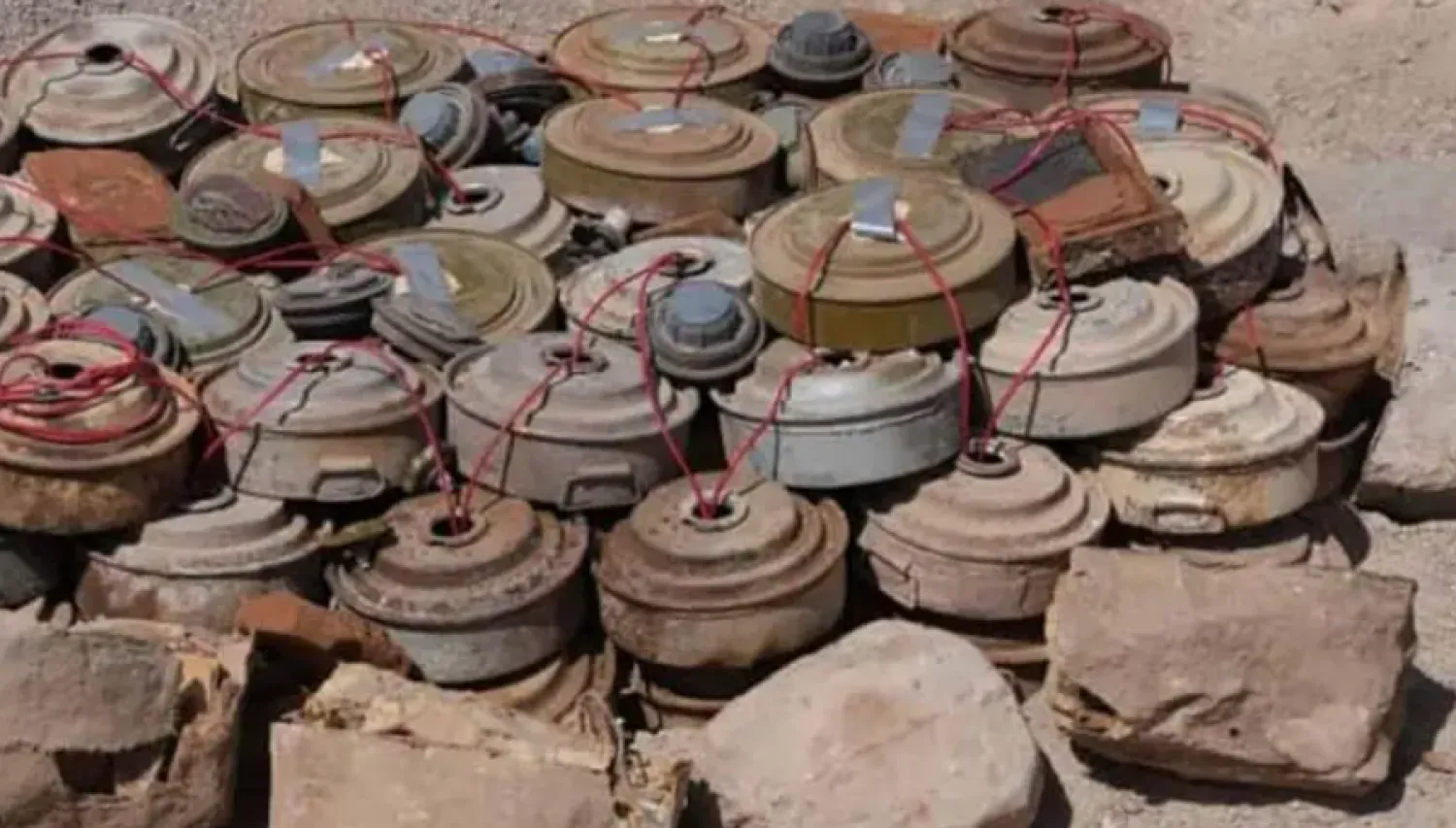
KSrelief Masam Project Dismantles 882 Explosives in Yemen Last Week

 The number of explosives removed during July rose to 1,851 - SPA
The number of explosives removed during July rose to 1,851 - SPA
TT

KSrelief Masam Project Dismantles 882 Explosives in Yemen Last Week

 The number of explosives removed during July rose to 1,851 - SPA
The number of explosives removed during July rose to 1,851 - SPA

the King Salman Humanitarian Aid and Relief Center (KSrelief) “Masam” project to clear Yemeni lands of unexploded ordnance dismantled 882 explosives in various regions of Yemen during the second week of July.

The operations cleared 841 unexploded ordnance, 29 anti-tank mines, nine anti-personnel mines, and three explosive devices.
According to SPA, the number of explosives removed during July rose to 1,851, bringing the number removed since the beginning of the Masam project to 450,919 explosives that fell or were planted randomly in various Yemeni lands to claim more innocent victims, including children, women and the elderly.


UN Says Israeli Actions Raising 'Ethnic Cleansing' Fears in West Bank, Gaza

A member of the Salhab family weeps as he sits on the on the rubble of apartment building after it was demolished by Israeli bulldozers near the Israeli settlement of Hagai, south of the occupied West Bank city of Hebron, on February 18, 2026. (Photo by HAZEM BADER / AFP)
TT

UN Says Israeli Actions Raising 'Ethnic Cleansing' Fears in West Bank, Gaza

A member of the Salhab family weeps as he sits on the on the rubble of apartment building after it was demolished by Israeli bulldozers near the Israeli settlement of Hagai, south of the occupied West Bank city of Hebron, on February 18, 2026. (Photo by HAZEM BADER / AFP)

Israel's increased attacks and forcible transfers of Palestinians "raise concerns over ethnic cleansing" in the Gaza Strip and the West Bank, the United Nations said Thursday.

The UN human rights office said the cumulative impact of Israel's military conduct during the war in Gaza, plus its blockade of the territory, had inflicted living conditions "increasingly incompatible with Palestinians' continued existence as a group in Gaza".

"Intensified attacks, the methodical destruction of entire neighborhoods and the denial of humanitarian assistance appeared to aim at a permanent demographic shift in Gaza", the office said in a report.

"This, together with forcible transfers, which appear to aim at a permanent displacement, raise concerns over ethnic cleansing in Gaza and the West Bank."

The report looked at November 1, 2024 to October 31, 2025.

In the occupied West Bank and annexed East Jerusalem, the report said the "systematic use of unlawful force" by Israeli security forces, "widespread" arbitrary detention and the "extensive unlawful demolition" of Palestinian homes was being carried out to "systematically discriminate, oppress, control and dominate the Palestinian people".

"These violations were "altering the character, status and demographic composition of the occupied West Bank, raising serious concerns of ethnic cleansing", it said.

- 'Inhumane choice' -

In Gaza, the report condemned the continued killing and maiming of "unprecedented numbers of civilians", the spread of famine, and destruction of the "remaining civilian infrastructure".

During the 12 months covered in the report, at least 463 Palestinians, including 157 children, starved to death in Gaza, it said.

"Palestinians faced the inhumane choice of either starving to death or risking being killed while trying to get food," said the report.

"The situation of famine and malnutrition was the direct result of actions taken by the Israeli government," with the deaths and suffering from hunger "foreseeable and repeatedly foretold".

Across the reporting period, Hamas and other Palestinian armed groups continued to hold Israeli and foreign hostages seized on October 7, 2023 -- dead or alive -- as "bargaining tools".

The rights office said the hostages' treatment amounted to war crimes.

"Israeli forces, Hamas, and other Palestinian armed groups committed serious violations of international humanitarian law in Gaza, gross violations and abuses of international human rights law, and atrocity crimes," the report concluded.

- Impunity 'kills' -

Last week, UN rights chief Volker Turk warned that the world was witnessing "rapid steps to change permanently the demography of the occupied Palestinian territory".

On Tuesday, Israel's far-right Finance Minister Bezalel Smotrich vowed to encourage "emigration" from the Palestinian territories.

And on Wednesday, UN Under-Secretary-General Rosemary DiCarlo warned the Security Council that steps by Israel to tighten control of areas of the West Bank administered by the Palestinian Authority amount to "gradual de facto annexation".

Thursday's rights office report concluded that considered together, Israeli practices "indicated a concerted and accelerating effort to consolidate annexation of large parts of the Occupied Palestinian Territory and to deny Palestinians' right to self-determination".

The report said there was a pervasive climate of impunity for serious violations of international law by the Israeli authorities in the Palestinian territories.

"Impunity is not abstract -- it kills. Accountability is indispensable. It is the prerequisite for a just and durable peace in Palestine and Israel," Turk said in a statement.



UN Probe: RSF Actions in Sudan's el-Fasher Point to Genocide

Forces affiliated with the Rapid Support Forces in the city of el-Fasher, Darfur region (AFP)
TT

UN Probe: RSF Actions in Sudan's el-Fasher Point to Genocide

Forces affiliated with the Rapid Support Forces in the city of el-Fasher, Darfur region (AFP)

Mass killings of non-Arab communities when the Rapid Support Forces captured the Sudanese city of el-Fasher bears hallmarks that point to genocide, an independent UN probe said in a new report on Thursday.

At the end of October last year, the RSF took over the city - which had been the last remaining stronghold of the Sudanese Armed Forces (SAF) in the Darfur region in the west of the country - with thousands of people killed and raped during three days of horror, the UN Independent International Fact-Finding Mission for Sudan said.

It followed an 18-month siege where the RSF imposed conditions of life calculated to bring about the physical destruction of non-Arab communities, in particular the Zaghawa and the Fur, ‌the report stated.

The ‌UN mission said it found evidence that the RSF carried out a pattern ‌of ⁠coordinated and repeated ⁠targeting of individuals based on ethnicity, gender and perceived political affiliation, including mass killings, rape and torture, as well as inflicting conditions of life calculated to bring about the group’s physical destruction - core elements of the crime of genocide under international law.

The final draft of the report was shared with the Government of Sudan but no response was received, while the RSF did not respond to the UN mission's request to meet with its leadership, the report stated. The RSF and SAF did not immediately respond to requests from Reuters for comment.

In the past, the RSF has ⁠denied such abuses - saying the accounts have been manufactured by its enemies and ‌making counter-accusations against them.

"The scale, coordination, and public endorsement of the operation ‌by senior RSF leadership demonstrate that the crimes committed in and around el-Fasher were not random excesses of war" said Mohamad ‌Chande Othman, Chair of the Fact-Finding Mission on Sudan.

"They formed part of a planned and organized operation ‌that bears the defining characteristics of genocide," he added.

Before its takeover el-Fasher's population mainly consisted of the Zaghawa, a non-Arab community, while displacement camps around the area were comprised of the Fur community, as well as Berti, Masalit and Tama, the report said.

"Survivors describe explicit threats to 'clean' the city," the report stated. Alongside attacking displacement camps, communal kitchens and medical centers ‌with drones and heavy weapons, the RSF also carried out killings, looting, beatings and sexual violence in el-Fasher, the report stated.

The RSF's "exterminatory rhetoric" and other violations indicated ⁠its intent to destroy ⁠the Zaghawa and Fur communities in whole or in part, the report said.

"Witnesses heard the Rapid Support Forces saying, 'Is there anyone Zaghawa among you? If we find Zaghawa, we will kill them all'," the report said.

Survivors recounted point-blank executions of civilians, as well as bodies of men, women and children filling roads, the report stated.

Women and girls aged 7 to 70 years old from non-Arab communities, particularly the Zaghawa were raped and subject to other acts of sexual violence, including whipping and forced nudity, the report stated.

British Foreign Secretary Yvette Cooper said the international response to the report and the situation in Sudan had to be emphatic and urged for a ceasefire.

"The findings of this UN report are truly horrific - atrocities including systematic starvation, torture, killings, rape and deliberate ethnic targeting used on the most horrendous scale during the Rapid Support Forces siege of el-Fasher," she said in a statement.

The UN mission was mandated by members of the Human Rights Council, following backing from countries that included Britain, to urgently investigate violations and abuses under international law in and around el-Fasher.


Sudanese Political, Civil Groups Propose Ramadan Truce

The war in Sudan, ongoing since mid-April 2023, has caused extensive destruction across the country (AFP)
TT

Sudanese Political, Civil Groups Propose Ramadan Truce

The war in Sudan, ongoing since mid-April 2023, has caused extensive destruction across the country (AFP)

A broad coalition of Sudanese political and civil forces has made an urgent appeal to the leadership of the Sudanese Armed Forces and the Rapid Support Forces (RSF), calling for a “comprehensive humanitarian truce” during the holy month of Ramadan.

The initiative calls for a temporary cessation of hostilities, guarantees for the protection of civilians, and unhindered humanitarian aid delivery, amid increasingly dire humanitarian conditions as Sudanese citizens observe their fourth consecutive Ramadan under gunfire and shelling.

More than ten Sudanese political parties made the appeal, some of which are part of the Civil Democratic Alliance of the Forces of the Revolution (“Sumoud”), led by former Prime Minister Abdalla Hamdok.

Prominent signatories include the National Umma Party, the Federal Gathering, and the Sudanese Congress Party.

The document was also endorsed by parties outside the “Sumoud” alliance, most notably the Arab Baath Socialist Party and the Democratic Unionist Party, alongside various civil and trade union groups.

The appeal urges both warring parties — the army and the RSF — to announce a humanitarian truce beginning on the first day of Ramadan. The proposal includes a ceasefire, the safeguarding of civilian facilities, the opening of safe corridors for relief organizations, the immediate release of civilian detainees, and the initiation of prisoner exchange arrangements under international supervision to ensure compliance with humanitarian law.

It also calls for clear monitoring and implementation mechanisms to prevent either side from exploiting the truce for military gains.

The signatories stressed that the initiative comes in response to the worsening humanitarian crisis, particularly among vulnerable groups such as women, children, and the elderly, and to the mounting threats to the lives of millions, which they say require urgent intervention.

This marks the second initiative put forward by political and civil forces to halt the war since its outbreak in 2023. The first resulted in the signing of what became known as the “Addis Ababa Declaration” between the Civil Democratic Forces Alliance (Taqaddum) and the RSF. The declaration was addressed to the army leadership, which neither rejected nor signed it.

Since the fall of the cities of El-Fasher and Babanusa, as well as the town of Heglig in West Kordofan State, clashes between the army and the RSF intensified in South and North Kordofan before subsiding in recent weeks and shifting into more “technical” warfare.

This phase has seen the increased use of combat drones, jamming devices, guided artillery, and aerial munitions, leading to a rise in civilian casualties and injuries.