


Knight Dragon Vice-President: Saudi Real Estate Market to Become Fastest Growing in the World

Photo of a recent real estate exhibition in Riyadh (Asharq Al-Awsat)
TT

Knight Dragon Vice-President: Saudi Real Estate Market to Become Fastest Growing in the World

Photo of a recent real estate exhibition in Riyadh (Asharq Al-Awsat)

Knight Dragon Real Estate Development Company has revealed plans to launch its business in Saudi Arabia by opening an office in Riyadh, during the last quarter of 2023.

Sammy Lee, founder and vice chairman of Knight Dragon, said that Saudi Arabia was a fast-growing country with ambitious plans to develop its infrastructure and real estate sector, which will create a huge demand for housing.

In an interview with Asharq Al-Awsat, he stressed that his company’s expertise could help meet this demand, given its proven record of developing successful real estate projects in other countries.

Asked about the added value that Knight Dragon will provide to the Saudi market and the region, he said that large-scale real estate development was complex and involved important factors that should be taken into consideration, such as the country’s young population and the government’s ambitious plans to develop its infrastructure based on the latest technological innovations.

Sammy Lee noted that the company used Blockchain technology to tokenize real estate assets, allowing small investors to participate in the real estate market. He explained that real estate tokenization involved converting the value of real estate into a token, based on Blockchain technology, allowing for digital ownership and transfer.

Moreover, Knight Dragon uses the technology of integrated modular construction, which saves time and money in construction.

The company’s vice-president noted that this technology allows projects to be completed in half the time or less, compared to traditional construction methods.

“Modular prefabricated building units... are shipped to the construction site for assembly. This process eliminates the need for on-site construction, which can save a significant amount of time,” he told Asharq Al-Awsat.

He continued: “In addition to saving time, the integrated modular building technology can also save money. This is because prefabricated units are often less expensive than materials that are purchased and transported to a construction site. In addition, the units can be built to exact specifications, which can reduce waste and improve efficiency.”

Sammy Lee stressed that the Middle East, especially Saudi Arabia, was the right place to expand the company’s business.

He pointed to the Kingdom’s rich potential, ambitious vision and major investments in infrastructure and development.

“Real estate constitutes a very important part of the Saudi economy, and reports indicate that the goal is to increase the sector’s contribution to the gross domestic product to 10 percent by 2030, as the Kingdom’s economy continues to diversify,” he remarked.

The vice-president of Knight Dragon said that youth in Saudi Arabia was a major driver of growth. With more than 30 million people under the age of 25, there is a huge demand for housing and other real estate, he emphasized.

He also noted that the Kingdom was the right place for real estate developers, thanks to the rapid growth of the real estate market, in addition to the availability of many investment opportunities.

Sammy Lee said that he was excited about the potential of new technologies, such as Blockchain and integrated modular construction, to revolutionize the real estate industry.

“I believe that these technologies can make the development and management of real estate assets easier and more efficient,” he underlined.

He added that estimates indicate that the population of Saudi Arabia was expected to grow from 6.8 million to 15-20 million by 2030, which would lead to an increase in demand for workplaces and housing units.

Thus, Sammy Lee expected the Saudi real estate market to be the fastest growing in the world in the next five to ten years, and said: “This is a wonderful opportunity for investors and developers, and I am excited to be a part of it.”


Saudi Arabia Leads Region in Women’s Empowerment, Records Strongest Global Progress

Saudi women working at the Ministry of Interior. (Ministry of Interior)
TT

Saudi Arabia Leads Region in Women’s Empowerment, Records Strongest Global Progress

Saudi women working at the Ministry of Interior. (Ministry of Interior)

Saudi Arabia has ranked first in the Middle East for women’s empowerment and recorded the highest global improvement in supportive frameworks, according to the World Bank’s Women, Business and the Law 2026 report.

The Kingdom posted the largest increase in points worldwide in the “supportive frameworks” pillar and also advanced in the legal frameworks category. The supportive frameworks indicator evaluates national policies, action plans and initiatives designed to ensure effective implementation of legislation related to women.

Women’s empowerment has been a central priority for the Saudi government, particularly the Ministry of Human Resources and Social Development, under Vision 2030. Expanding women’s participation in the labor market is one of the Vision’s core objectives.

A series of legislative reforms and regulatory changes in recent years has strengthened women’s position in Saudi society, enabling them to play a greater role in economic, social, scientific and cultural fields.

According to the World Bank report, Saudi Arabia achieved the highest score in the supportive frameworks pillar among Middle East countries and ranked first among Gulf Cooperation Council (GCC) states in overall performance across all indicators.

The Kingdom also outperformed several Group of Twenty (G20) economies, including the United States, China and Türkiye, in the same category, underscoring the scale of its recent reforms.

In 2023, Saudi Arabia raised its target for women’s labor force participation to 40 percent by 2030, after already surpassing its initial Vision 2030 goal of 30 percent. Female participation rose from 17 percent to 35.3 percent, exceeding expectations well ahead of schedule.

Momentum continued in 2025, with women’s labor force participation surpassing 36 percent. Female unemployment fell to its lowest levels on record, reaching 10.5 percent overall and 12.1 percent during the first half of the year.

These gains were driven by legislative reforms and targeted initiatives such as “Wusool,” which supports transportation for working women, and “Qurrah,” which provides childcare assistance.

Women’s representation in leadership and technology roles has also increased significantly, reinforcing their role as key contributors to Vision 2030.

More than 122,000 female job seekers have benefited from the Parallel Training Initiative, which offers specialized programs designed to boost sustainability in private-sector employment.

The initiative boasts more than 800 training modules covering both soft and technical skills, delivered through partnerships with over 70 training providers. To date, more than 280,000 certificates have been issued to participants, strengthening their qualifications and long-term career prospects.


GCC, India Launch Free Trade Agreement Negotiations  

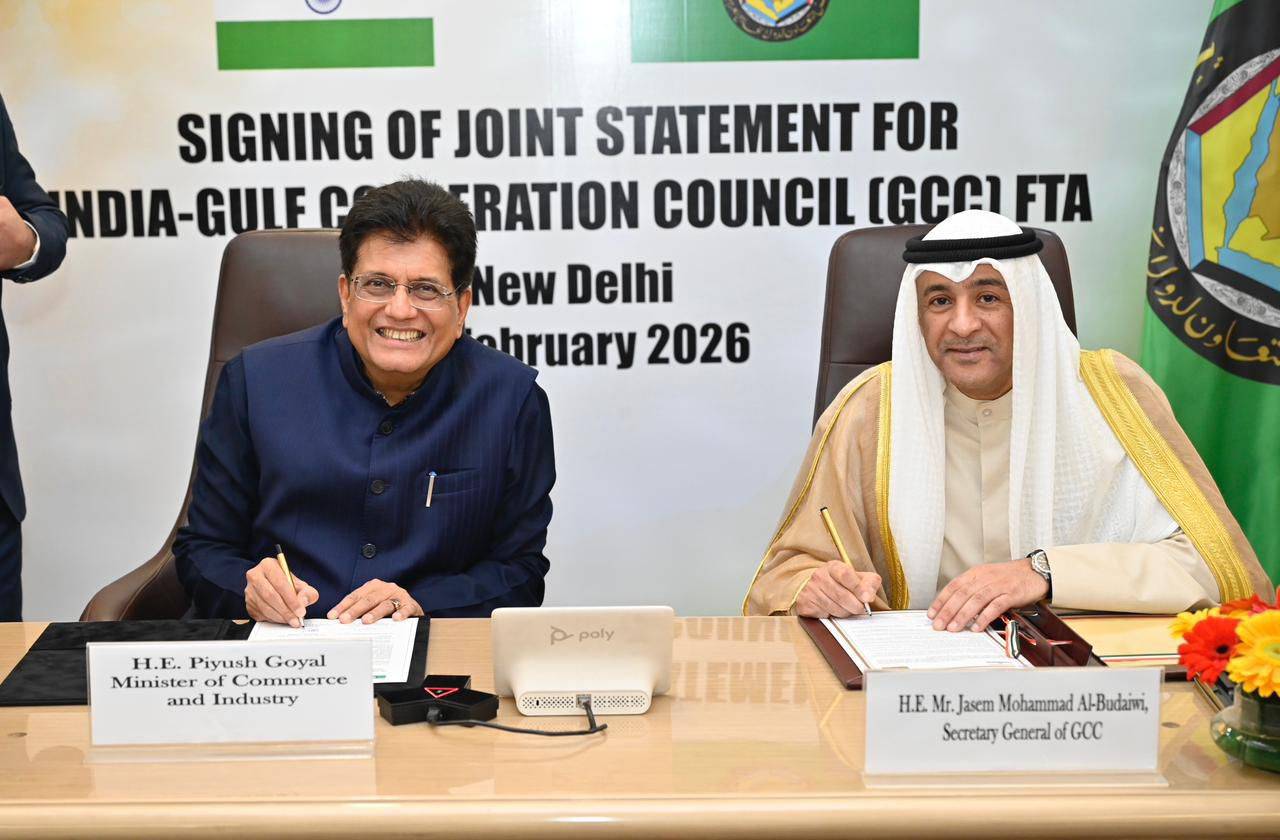
Officials pose for a photo following the signing of the agreement between the Gulf Cooperation Council and India. (Asharq Al-Awsat)
TT

GCC, India Launch Free Trade Agreement Negotiations  

Officials pose for a photo following the signing of the agreement between the Gulf Cooperation Council and India. (Asharq Al-Awsat)

The Gulf Cooperation Council (GCC) and India have formally launched negotiations for a free trade agreement (FTA), in a move officials described as a new chapter in their strategic partnership.

GCC Secretary-General Jasem Albudaiwi and India’s Minister of Commerce and Industry Piyush Goyal signed the joint statement initiating the talks during a meeting in New Delhi on Tuesday.

Albudaiwi said the launch of negotiations reflects the depth of ties between the Gulf states and India, stressing that the relationship extends beyond transient economic interests.

It is a longstanding partnership strengthened by centuries of cultural and social exchange and guided by a shared commitment to broad-based cooperation that serves mutual interests, he added.

India is one of the GCC’s most significant trading partners, Albudaiwi noted, pointing to steadily expanding trade volumes and growing integration in key sectors such as energy, food security and technology.

Deepening cooperation has become a strategic economic imperative, he remarked.

GCC Secretary-General Jasem Albudaiwi and India’s Minister of Commerce and Industry Piyush Goyal sign the agreement. (Asharq Al-Awsat)

“New Delhi is not only a vast and promising market, but also a global hub for innovation and industry,” he stated.

The terms of reference signed in February establish a comprehensive framework for the negotiations. The two sides agreed to explore cooperation across a wide range of areas, including trade in goods and services, customs procedures and digital trade.

The framework also addresses sanitary and phytosanitary standards, intellectual property rights, and support for micro, small and medium-sized enterprises, among other issues of mutual interest. Albudaiwi said the scope of the talks reflects an ambition to craft an agreement aligned with the evolving global economy.

He hoped that the negotiations would culminate in a comprehensive and forward-looking FTA that eliminates tariff and non-tariff barriers, facilitates investment flows in both directions and strengthens trade and investment liberalization between India and the GCC.

Such an agreement would create a more competitive business environment, expand private-sector opportunities, reinforce supply chains and accelerate economic growth in line with the Gulf states’ development strategies, he said.

The GCC General Secretariat is ready to host the first round of negotiations at its headquarters in Riyadh in the second half of this year, he added.


Saudi Telecom Sector Solidifies Leadership with $28 Billion in Revenue in 2025

The Saudi Telecom Company (stc) pavilion at the LEAP International Conference in Riyadh (Asharq Al-Awsat)
TT

Saudi Telecom Sector Solidifies Leadership with $28 Billion in Revenue in 2025

The Saudi Telecom Company (stc) pavilion at the LEAP International Conference in Riyadh (Asharq Al-Awsat)

Saudi Arabia’s telecommunications sector has reaffirmed the strength of its operating model and growth potential, reporting a solid rise in combined revenues in 2025.

The performance reflects continued customer growth and an expanding portfolio of digital solutions, underscoring the sector’s central role in advancing Vision 2030.

Companies listed on the Saudi Exchange (Tadawul) posted a 3.8 percent increase in total revenue, exceeding SAR108.4 billion ($28.9 billion) in 2025, compared with SAR104.46 billion ($24.9 billion) in 2024.

However, despite strong top-line growth, aggregate net profits for the sector fell by 33.4 percent. The three largest operators — Saudi Telecom Company (stc), Etihad Etisalat Company (Mobily), and Mobile Telecommunications Company Saudi Arabia (Zain KSA) — reported combined earnings of SAR18.9 billion ($5 billion), down from SAR28.39 billion ($7.6 billion) the previous year.

The sector comprises four listed firms. Three — stc, Mobily and Zain KSA — follow a December fiscal year-end, while Etihad Atheeb Telecommunication Company (GO Telecom) closes its fiscal year at the end of March.

The decline in profitability was largely driven by stc, which accounts for 78 percent of the sector’s earnings. Its net profit fell 39.9 percent to SAR14.83 billion. Analysts attributed the drop mainly to a high comparison base in 2024, when exceptional and non-recurring items boosted profits to unusually elevated levels.

By contrast, Mobily reported an 11.55 percent increase in profit to SAR3.47 billion in 2025, up from SAR3.1 billion in 2024, supported by revenue growth across all business segments and an expanding customer base.

Zain KSA recorded a 1.3 percent rise in profit to SAR604 million, compared with SAR596 million the previous year. The improvement was driven by higher revenues from consumer and wholesale segments, the expansion of 5G services, and growth in Tamam Finance’s operations.

Rising Costs and Investment Pressures

Dr. Sulaiman Al-Humaid Al-Khaldi, a financial market analyst and member of the Saudi Economic Association, said the sector’s results highlight a clear divergence between revenue growth and declining profits, pointing to mounting operational and financial pressures.

Revenue growth has not translated into higher profits, as costs have increased at a faster pace than income.

Al-Khalidi expects short-term pressure on margins to persist due to continued high capital expenditure and strong price competition. Over the medium term, however, he anticipates gradual improvement supported by growing demand for data services, digital solutions and cloud computing, as well as expansion into non-traditional areas such as fintech and data centers.

He noted that the sector is undergoing a strategic shift from traditional telecom services toward integrated digital offerings, which could strengthen profitability in the future.

Profit Normalization After an Exceptional Year

Mohamed Hamdy Omar, chief executive of G World, described 2025 as a year of profit normalization following an exceptional 2024, when non-recurring gains significantly lifted stc’s net income.

He added that fourth-quarter earnings were weighed down by a strong comparison base and higher seasonal, marketing and financing costs tied to capital investments in networks and infrastructure.

At the same time, improved operational performance at Mobily and Zain KSA helped partially offset stc’s earnings decline. Omar stressed that the pressure on profits reflects accounting and financing factors rather than weakening demand or structural challenges in the sector.

Looking ahead, he expects the medium-term outlook to remain positive, driven by sustained demand for data, continued digital expansion and growth in telecom-linked financial and technology services. Profitability is projected to stabilize further in 2026 as operational efficiency improves.
