Lebanon Deputy Central Bank Governors Could Resign if No New Chief Appointed

FILE PHOTO: A view shows Lebanon's Central Bank building in Beirut, Lebanon January 12, 2023. REUTERS/Mohamed Azakir/File Photo
TT

Lebanon Deputy Central Bank Governors Could Resign if No New Chief Appointed

FILE PHOTO: A view shows Lebanon's Central Bank building in Beirut, Lebanon January 12, 2023. REUTERS/Mohamed Azakir/File Photo

Lebanon's deputy central bank governors could all resign if no successor is appointed when current chief Riad Salameh's term ends this month, one of the deputies said Thursday, raising the prospect of a leaderless central bank amid a financial crisis.
Salameh, whose 30-year tenure as governor has been stained lately by charges at home and abroad of embezzlement of public funds in Lebanon, is expected to leave his post when his term ends in late July. He denies the charges.
Lebanese authorities have not named a successor, with political factions stuck in a stalemate that has also left the presidency unfilled for more than eight months and cabinet operating in a caretaker capacity for over a year.
"In the absence of a comprehensive plan which allows us as monetary policymakers to take the required actions to protect the best interest of the country, it becomes urgent to take difficult choices," deputy governor Salim Chahine told Reuters.
"Resignation is a possible outcome," he said. Another central bank source familiar with the thinking of Wassim Mansouri, the first deputy governor, told Reuters that all four would resign if there was no successor to Salameh.
That source said Mansouri, who would have been first to take over should a governor not be appointed, saw the job as "a ball of fire" given the prolonged economic meltdown.
Chahine and the source spoke to Reuters following a rare statement signed by all four deputy governors saying the central bank could not be run in a caretaker capacity at such a sensitive time and that authorities must appoint a new head.
"We see it as our duty to stress the necessity of appointing a governor... as soon as possible, otherwise we will be forced to take the action we deem appropriate for the public interest," the statement said, without explaining what the action may be.
Lebanon's economy began to unravel in 2019 following decades of corruption and profligate spending by ruling politicians.
The nearly four-year economic meltdown has cost the local currency roughly 98% of its value, seen GDP contract by 40%, pushed inflation into triple-digits and drained two-thirds of the central bank's foreign currency reserves, according to the International Monetary Fund.



Merz Says Germany, China Must Overcome Trade Gaps 'Together'

Chinese Premier Li Qiang welcomes German Chancellor Friedrich Merz with military honors in the Great Hall of the People in in Beijing, China, February 25, 2026. (Reuters)
TT

Merz Says Germany, China Must Overcome Trade Gaps 'Together'

Chinese Premier Li Qiang welcomes German Chancellor Friedrich Merz with military honors in the Great Hall of the People in in Beijing, China, February 25, 2026. (Reuters)

German Chancellor Friedrich Merz ended his two-day visit to China on Thursday in the tech hub of Hangzhou, identifying "challenges that we must overcome together" after meeting President Xi Jinping and announcing an Airbus deal.

Merz's first official visit to China came as Berlin and Beijing seek to build on decades-old economic ties to weather global uncertainty sparked by US President Donald Trump's tariff blitz and erratic foreign policies, said AFP.

China, the world's number two economy, overtook the United States last year to become Germany's biggest trade partner. At the same time, Berlin regards the Communist Party-run state as a systemic rival to the West.

The German leader was accompanied in China by a large delegation of business leaders, including executives of auto giants Volkswagen, BMW and Mercedes.

Merz visited a Mercedes plant in Beijing on Thursday morning, where he was shown a demonstration of self-driving vehicles.

He then travelled to Hangzhou, where he visited the sites of Germany's Siemens Energy and Chinese humanoid robot-maker Unitree.

The eastern city is home to several other major Chinese tech companies like AI unicorn DeepSeek and e-commerce giant Alibaba.

European business leaders, who broadly complain China is flooding the EU market with cheap goods, have urged Merz to keep a cavernous trade imbalance at the top of his agenda.

Germany's trade deficit with China hit a record 89 billion euros ($105 billion) last year.

"We have good cooperation in China. However, there are also some challenges that we must overcome together," Merz said Thursday, singling out "issues relating to competition" and "high capacity in China".

Merz said consultations between his government and Beijing -- interrupted by political developments in Berlin and the pandemic -- would take place "at the beginning of next year at the latest, possibly even this year", with China as host.

- 'New levels' -

Following talks with Xi and top Chinese leaders in the capital on Wednesday, Merz said that China had agreed to purchase up to 120 Airbus aircraft, adding that it "demonstrates how worthwhile such trips can be".

Other contracts were in the pipeline, Merz added.

The two leaders stressed their commitment to developing closer strategic relations, with Xi telling Merz he was willing to take relations to "new levels".

Merz said he had also touched on the sensitive topic of Taiwan, the self-ruled island China claims as its territory and which it has not ruled out the use of force to annex.

Any "reunification" must be done peacefully, Merz said.

He also discussed the Ukraine war with Xi, who, according to Chinese state news agency Xinhua, said diplomacy was "key to the issue".

Merz said he urged Beijing to use its influence over Moscow, such as choking off the supply of items with potential military uses.

"I hope that in my talks I was able to foster a little understanding for the fact that the leadership of this country should also contribute to ending the war in Ukraine," Merz told reporters on Thursday before departing for Berlin.

Merz was the latest in a string of Western leaders to court Beijing recently.

He follows Britain's Keir Starmer, France's Emmanuel Macron and Canada's Mark Carney, as they recoil from the mercurial policies of Trump, who is also expected to visit from March 31.


EBRD: Trump Tariff Turmoil Yet to Dent Emerging Countries' Growth

The headquarters of the European Bank for Reconstruction and Development in London (Reuters)
TT

EBRD: Trump Tariff Turmoil Yet to Dent Emerging Countries' Growth

The headquarters of the European Bank for Reconstruction and Development in London (Reuters)

US tariffs have rerouted trade, but not dented it as much as feared, allowing larger-than-expected economic growth in certain developing markets, the European Bank for Reconstruction and Development said on Thursday.

Growth in the 40 countries covered by the development finance institution rose by a larger-than-forecast 3.4%, but the bank warned that continued trade turmoil could yet derail growth in some of the economies.

"The picture is somewhat more optimistic than in the autumn...and we expect this year and next year to be even better than last year," the EBRD's chief economist Beata Javorcik told Reuters.

Slowing inflation and big ‌spending on infrastructure projects - ‌particularly in Europe - were helping, but the report also ‌showed ⁠that the impacts ⁠of US President Donald Trump's trade tariffs were not as stark as expected.

The bank now expects 3.6% growth this year and 3.7% in 2027 - both a 0.2 percentage point upward revision compared with its autumn projections.

Exports from some EBRD countries to the United States even grew, particularly those related to the AI boom, as those countries replaced China's exports.

Hungary, the ⁠Czech Republic and Poland all export AI-related products such as ‌servers, processors and computing systems that mean ‌they could benefit from the shift.

But Javorcik warned that the full impact ‌of the tariffs remained unclear; most of the trade tracked by the ‌report arrived in the US prior to the April 2025 "Liberation Day" tariffs, and there was added uncertainty following the US Supreme Court ruling that Trump had exceeded his authority in imposing the initial tariffs.

"This turbulence means that policymakers are forced ‌to focus on the urgent, on the shocks that arrive - weekly, if not daily," she said, adding it drained ⁠countries' abilities ⁠to tackle larger problems, such as the demographics "time bomb" and other factors threatening standards of living.

She also said that the "emergency mode" due to the ongoing war in Ukraine, and subsequent increases in defense spending, could drain money from other government priorities and said the ultimate impact would hinge on whether they spend that money on one-off equipment purchases or on infrastructure such as roads and hospitals that could also aid the economy.

The poly-crises, she said, emphasize the need for leaders to ensure that public investments are focused on projects that can drive economic growth.

"Global uncertainty turbulence is likely to persist, and...it's going to be a force detrimental to private investment, and that's why I have been stressing the role of public investment," Javorcik said.


Saudi Arabia Records Highest Quarterly Non-Oil Exports Since 2017

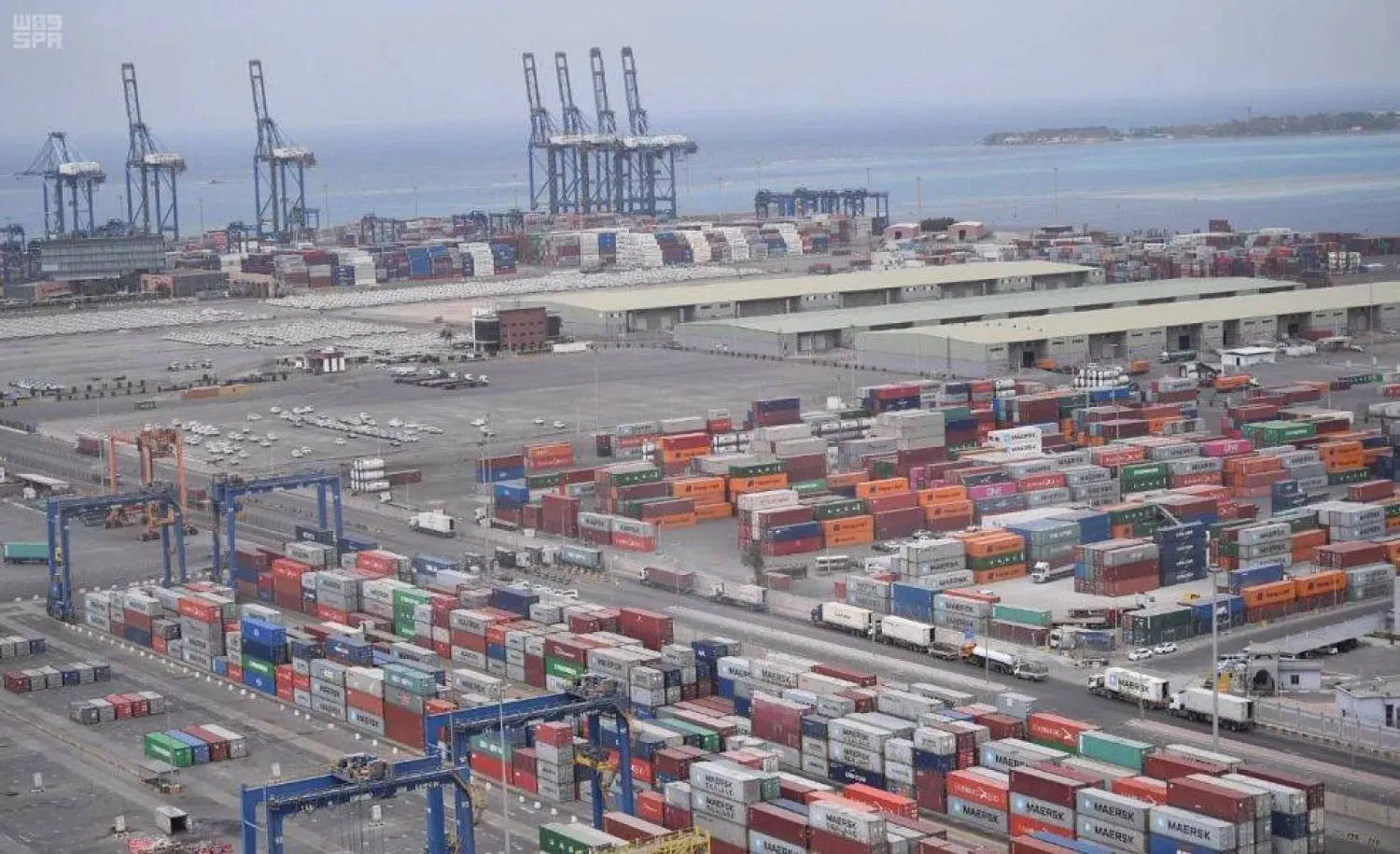
 Jeddah Islamic Port (SPA) 
 Jeddah Islamic Port (SPA) 
TT

Saudi Arabia Records Highest Quarterly Non-Oil Exports Since 2017

 Jeddah Islamic Port (SPA) 
 Jeddah Islamic Port (SPA) 

Saudi Arabia recorded its highest quarterly level of non-oil exports since 2017 in the fourth quarter of 2025, highlighting a significant structural shift in the Kingdom’s trade dynamics.

Data from the General Authority for Statistics (GASTAT) showed that the merchandise trade surplus rose 26.3 percent year on year in the fourth quarter, driven by strong growth in non-oil exports, which are playing an increasingly pivotal role in strengthening Saudi Arabia’s external balance.

Non-oil exports, including re-exports, climbed a record 18.6 percent to SAR 97 billion ($25.8 billion), marking their highest quarterly level in eight years. These exports covered 39.4 percent of total imports during the period. As a result, the trade surplus widened to SAR 52.5 billion (about $14 billion), its highest level in three years.

Re-exports were the standout performer, surging 67.4 percent to SAR 40 billion ($10.6 billion). The sharp increase was largely fueled by growth in machinery, electrical equipment and appliances, which expanded 79.2 percent and accounted for roughly half of total re-exports.

Overall merchandise exports reached SAR 300 billion ($80 billion) in the fourth quarter, up 7.9 percent compared with the same period in 2024. Oil exports rose 3.5 percent year on year to SAR 203 billion ($54.1 billion). Imports also increased, rising 4.7 percent to SAR 248 billion ($66.1 billion)

Trade data underscored the depth of Saudi Arabia’s commercial ties with major global economies. China remained the Kingdom’s largest trading partner, accounting for 13.1 percent of total exports and 27.2 percent of imports.

The United Arab Emirates ranked second among export destinations, receiving 11.2 percent of Saudi exports.

Other leading export markets included Japan (9.9 percent), followed by India, South Korea, the United States, Bahrain, Egypt, Singapore and Poland. Collectively, these ten countries accounted for 70.9 percent of total Saudi exports.

On the import side, the United States ranked second after China, representing 8.7 percent of total imports. It was followed by the UAE (5.7 percent), Germany, India, Japan, Italy, France, Switzerland and Egypt. Together, these ten countries accounted for 67 percent of the Kingdom’s total imports.

Vision 2030 Driving Diversification

The record performance reflects the goals of Saudi Vision 2030, which aims to position the Kingdom as a global logistics hub linking three continents. The exceptional expansion in re-exports and greater reliance on advanced air cargo infrastructure point to tangible progress in building a platform capable of attracting and redistributing high-tech goods and electrical equipment worldwide.

The figures also demonstrate growing economic resilience. Oil exports accounted for 67.5 percent of total exports in the fourth quarter of 2025, down from 70.4 percent a year earlier. This gradual diversification of the export base has helped reinforce trade stability, supporting the highest surplus recorded in three years.