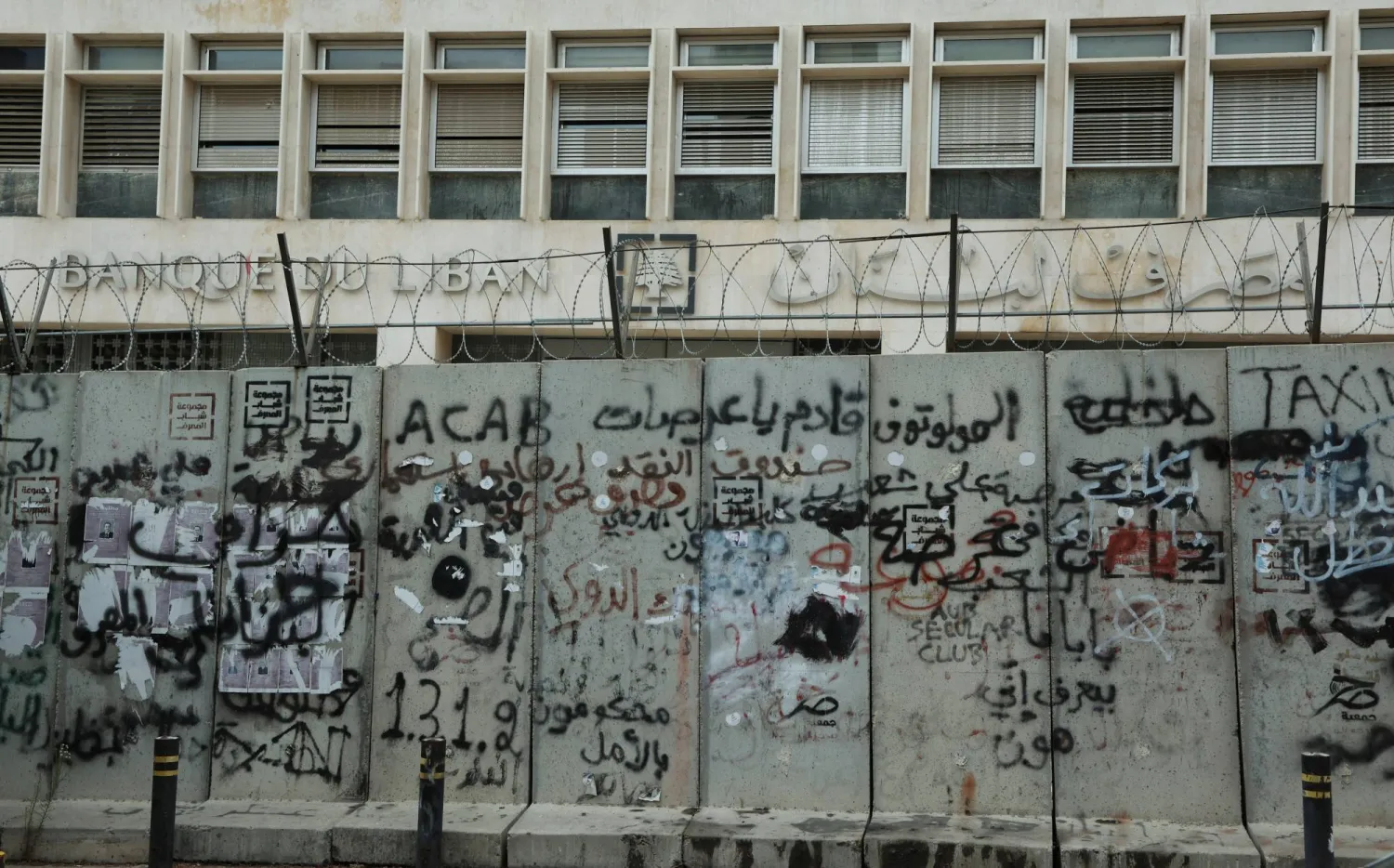
Chami: Deputy Lebanon Central Bank Governors' Threat to Collectively Resign 'Dangerous'

A view of Lebanon's Central Bank building in Beirut, Lebanon July 6, 2023. REUTERS/Mohamed Azakir
TT

Chami: Deputy Lebanon Central Bank Governors' Threat to Collectively Resign 'Dangerous'

A view of Lebanon's Central Bank building in Beirut, Lebanon July 6, 2023. REUTERS/Mohamed Azakir

Deputy premier Saade Chami said on Friday deputy governors of Lebanon's central bank should run it if no governor is appointed by the end of the month, calling their threat to collectively resign "dangerous".
Longtime governor Riad Salameh's term expires at the end of July and one of the deputy governors told Reuters on Thursday they were considering quitting together if no successor is named, raising the possibility of the central bank being left leaderless amid a deep financial crisis.
Lebanon's breakdown in governance and political tensions have hamstrung efforts to find a successor to Salameh, whose 30-year tenure has been stained by charges at home and abroad of embezzlement of public funds in Lebanon. He denies the charges.
In a statement to Reuters, Chami said the deputy governors should "assume their responsibility in case this appointment is not possible...The threat of resignation implied by the statement is quite dangerous at this critical juncture."
The central bank leadership is appointed according to the sectarian power-sharing system that governs other top posts.
The governor must be a Maronite Catholic, while the four deputies - a Shiite Muslim, a Sunni Muslim, a Druze and an Armenian Catholic - must have the approval of the political chiefs representing their respective sects.
Some analysts wondered whether the resignation threat would push the political elite, which worked closely with Salameh for decades, to consider prolonging his tenure. Salameh has said he will leave when his term ends.



Egypt Imposes Business Curfew to Counter Soaring Fuel Costs

Cairo was forced to raise fuel prices by more than 30 percent, after strikes on regional oil infrastructure and threats against the Strait of Hormuz (File Photo)
TT

Egypt Imposes Business Curfew to Counter Soaring Fuel Costs

Cairo was forced to raise fuel prices by more than 30 percent, after strikes on regional oil infrastructure and threats against the Strait of Hormuz (File Photo)

Egypt has ordered shops, restaurants and shopping malls to close from 9:00 pm from Saturday, hoping to curb energy bills that have more than doubled because of the Iran war.

Prime Minister Mostafa Madbouly announced the curfew and said it would last for a month initially.

"Shops, shopping centers, restaurants and cafes will all close at 9:00 pm on weekdays," he said, adding that on Thursdays and Fridays at the weekend they will be allowed to stay open until 10:00 pm, Reuters reported.

The premier said that before the war, Egypt's monthly energy bill was $560 million. Today, for the same quantity, he said Egypt is paying $1.650 billion.

Madbouly said Cairo must work on the "worst-case scenario" in the face of a war whose outcome is unpredictable.

Tourism Minister Sherif Fathy said the new restrictions "will not affect tourists" or flagship destinations, a statement from his office said.

At the beginning of March, Cairo was forced to raise fuel prices by more than 30 percent, after strikes on regional oil infrastructure and threats against the Strait of Hormuz, the crucial shipping route now virtually paralysed by the war.

Around a fifth of global crude oil and liquefied natural gas passes through the waterway in peacetime.

The rerouting of shipping away from the Suez Canal is also depriving Cairo of a vital source of foreign currency.


Turkish Central Bank Forex Sales since Start of Iran War Close to $45 Billion

Turkish Central Bank (official website)
TT

Turkish Central Bank Forex Sales since Start of Iran War Close to $45 Billion

Turkish Central Bank (official website)

The Turkish Central Bank's balance sheet for this week will show foreign exchange sales amounting to near $20 billion, bringing the total forex sales since the beginning of the Iran war to nearly $45 billion, bankers said, Reuters reported.

According to calculations made by four bankers, based on preliminary data for the first part of the week and their estimates for the rest of the week, the central bank's balance sheet will show $18-21 billion in foreign exchange sales.

Bankers said that although $8 billion of the total $20 billion was made before a public holiday last week, this figure will be reflected in the balance sheet on the first day of this week.

The central bank sold $26 billion in foreign exchange in the first three weeks of the war, using its gold reserves as well, resulting in a $35 billion decrease in its net reserves.


Mawani Adds Marsa Ocean Shipping's RSX Service to Jeddah Islamic Port

Mawani Adds Marsa Ocean Shipping's RSX Service to Jeddah Islamic Port
TT

Mawani Adds Marsa Ocean Shipping's RSX Service to Jeddah Islamic Port

Mawani Adds Marsa Ocean Shipping's RSX Service to Jeddah Islamic Port

The Saudi Ports Authority (Mawani) has announced the addition of the RSX service by Marsa Ocean Shipping to Jeddah Islamic Port, featuring a capacity of up to 372 TEUs and connecting Jeddah with the regional ports of Aden, Hodeidah, and Djibouti, SPA reported.

This expansion aligns with the National Transport and Logistics Strategy, aiming to enhance the Kingdom’s operational efficiency and its ranking in global performance indicators.

As a primary gateway, Jeddah Islamic Port utilizes its 62 multipurpose berths and specialized terminals to support a total capacity of 130 million tons, reinforcing Saudi Arabia’s position as a global logistics hub connecting three continents.