


IMF Chief Says Hamas-Israel Conflict Is ‘Darkening the Horizon’ for World Economy

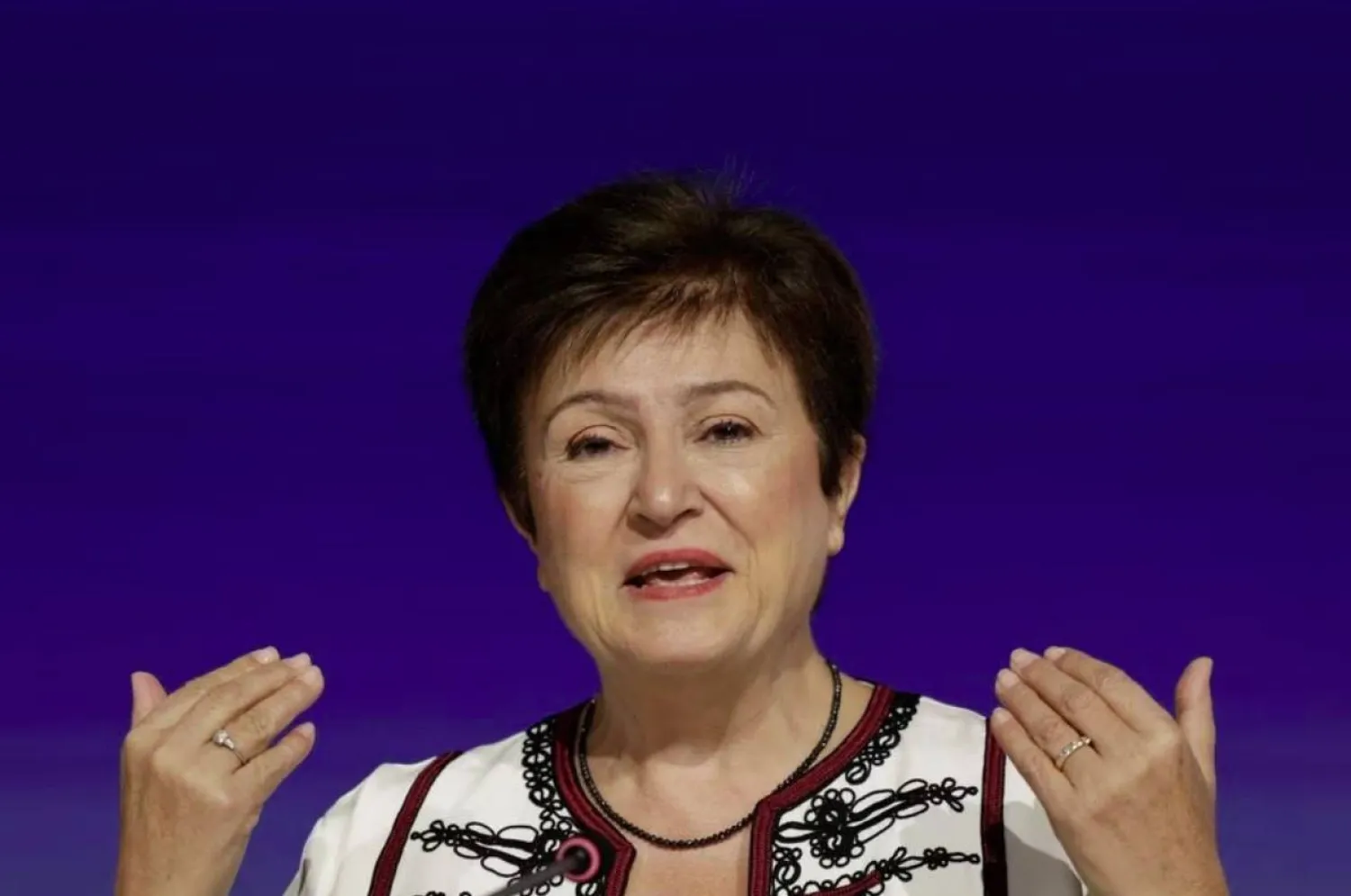
Managing Director of the International Monetary Fund (IMF), Kristalina Georgieva, addresses the media on the fourth day of the annual meeting of the IMF and the World Bank, following last month's deadly earthquake, in Marrakech, Morocco, October 12, 2023. REUTERS/Susana Vera Acquire Licensing Rights
TT

IMF Chief Says Hamas-Israel Conflict Is ‘Darkening the Horizon’ for World Economy

Managing Director of the International Monetary Fund (IMF), Kristalina Georgieva, addresses the media on the fourth day of the annual meeting of the IMF and the World Bank, following last month's deadly earthquake, in Marrakech, Morocco, October 12, 2023. REUTERS/Susana Vera Acquire Licensing Rights

International Monetary Fund managing director Kristalina Georgieva said on Thursday the Israel-Hamas conflict threatened to darken an already murky global economic outlook.

Georgieva said severe shocks were becoming "the new normal" in a global economy characterized by weak growth.

"Very clearly, this is a new cloud on not the safest horizon for the world economy, a new cloud darkening this horizon," she told a news conference at the annual meetings of the IMF and World Bank in Marrakech, Morocco.

The IMF has kept its growth forecast at 3.0 percent for this year but lowered it to 2.9 percent for 2024.

"It's heartbreaking to see innocent civilians dying," an emotional Georgieva told reporters.

"We do need to build our agility in terms of anticipating shocks and being quick to respond," she said.

"We are closely monitoring how the situation evolves, how it is affecting, especially oil markets," Georgieva said. There had been some fluctuations in oil prices and reactions in markets, but it was too early to predict the economic impact, she added.

Jihad Azour, IMF Director of the Middle East and Central Asia Department, said it is difficult to have a ‘clear reading’ about the conflict’s economic impact.

IMF research suggests that if there is something like a 10% increase in oil prices, this would weigh down on global output by about 0.15% in the following year and would increase global inflation by about 0.4 percentage point.

IMF chief economist Pierre-Olivier Gourinchas said it is "too early" to assess its impact on global economic growth.

A financial expert from one of the investment banks, speaking on condition of anonymity, told Asharq Al-Awsat that if this situation continues then prices will increase, including oil prices.

He added that it is impossible to predict any scenarios because they are linked to the updates of the war, like the Russian-Ukrainian war.



Saudi Arabia Reinforces Global Mining Leadership at PDAC 2026 in Canada

Al-Belushi noted that the Kingdom has offered over 46,000 km² for exploration - SPA
TT

Saudi Arabia Reinforces Global Mining Leadership at PDAC 2026 in Canada

Al-Belushi noted that the Kingdom has offered over 46,000 km² for exploration - SPA

Saudi Arabia participated in the Prospectors and Developers Association of Canada (PDAC) convention, held March 1–4, 2026, highlighting exploration and mining opportunities in the Kingdom built on vast geological data and supported by a reformed regulatory framework.

On the sidelines of the conference, Deputy Minister of Industry and Mineral Resources for Mineral Resources Management Abdulrahman Al-Belushi, delivered keynote remarks at the Saudi Showcase titled “KSA: The Future Hub for Global Mineral Processing,” highlighting the Kingdom’s transformation from an emerging jurisdiction to a top global mining destination.

Al-Belushi emphasized that Saudi Arabia’s $2.5 trillion mineral wealth, modern regulatory framework, transparent licensing rounds, large-scale geological mapping program covering 700,000 km² of the Arabian Shield, and its world-class mine-to-market facilities provide a strong foundation for global investors seeking long-term opportunities across the mining sector, SPA reported.

During his participation at the International Mines Ministers Summit (IMMS), Al-Belushi highlighted the importance of global partnerships to meet rising mineral demand and shared details of the Future Minerals Forum’s Ministerial Roundtable Initiative, which promotes economic development, responsible supply, and capacity building across the mining sector.

Al-Belushi noted that the Kingdom has offered over 46,000 km² for exploration and is actively addressing financing gaps through a suite of competitive incentives, including the Exploration Enablement Program to support early-stage investment.

He also highlighted ongoing talent development initiatives, such as the recently launched Saudi School of Mines at the fifth Future Minerals Forum in January, alongside more than 80 years of geological data made digitally accessible to investors through the National Geological Database (NGD).

Throughout PDAC 2026, the Saudi delegation engaged in a series of bilateral meetings with global mining executives, investors, and institutional partners to accelerate collaboration across exploration, mining services, processing, and downstream integration.

By combining governance reform, large-scale geological data, financial risk-sharing mechanisms, and integrated mine-to-market infrastructure, Saudi Arabia is positioning itself as a strategic partner in strengthening global mineral supply chains.

Saudi Arabia’s participation at PDAC affirms that the Kingdom’s mining sector has moved from an emerging market to a competitive global destination. Through a modernized regulatory framework, extensive geological data, and competitive incentives, the Kingdom continues to strengthen its position as a trusted and preferred destination for mining investment—a reliable partner in building resilient and sustainable mineral supply chains.


S&P Global: UK Consumers Hit by Worries Over War in Iran

A man shops in a supermarket in Chanverrie, France, October 16, 2024. REUTERS/Stephane Mahe
TT

S&P Global: UK Consumers Hit by Worries Over War in Iran

A man shops in a supermarket in Chanverrie, France, October 16, 2024. REUTERS/Stephane Mahe

British consumers have turned their least confident since the start of last year following the outbreak of war in the Middle East, financial data firm S&P Global said on Monday in an early sign of the potential impact of the conflict on the economy.

S&P Global's Consumer Sentiment Index - based on a survey conducted ⁠March 5-9 - dropped ⁠to 44.1 in March from 44.8 in February, its lowest since January 2025.

"A marked deterioration of consumer sentiment in March means we are seeing the first ⁠concrete signs of the war in the Middle East damaging the UK economy," Maryam Baluch, an economist at S&P Global Market Intelligence, said, according to Reuters.

Households were the most downbeat about their financial prospects since December 2023 and the wariest about making big purchases in 14 months, the firm said.

The Bank ⁠of ⁠England, along with private economists, is watching for the impact of the US-Israeli war with Iran on the economy, including any hit to consumer spending as the rise in global energy prices threatens to push up inflation.

The BoE is likely to delay a previously expected interest rate cut on Thursday.


Gold Falls as Inflation Fears Pressure Fed Rate-cut Outlook

AFP_96 Gold bars weighing 1000 grams each are displayed at the Austrian Gold and Silver Refinery _Oegussa_ in Vienna
TT

Gold Falls as Inflation Fears Pressure Fed Rate-cut Outlook

AFP_96 Gold bars weighing 1000 grams each are displayed at the Austrian Gold and Silver Refinery _Oegussa_ in Vienna

Gold prices dipped on Monday, pressured by concerns that surging oil costs could stoke inflation further and prompt a more hawkish policy stance by major central banks including the US Federal Reserve, dulling the appeal of the non-yielding asset.

Spot gold fell 0.7% to $4,983.17 per ounce, as of 0944 GMT. US gold futures for ‌April delivery ‌fell 1.5% to $4,987.30.

"The gold market has moved its ‌focus ⁠from looking at ⁠the implications of the Hormuz trade closure, and towards implications of longer-term inflation," said Bernard Dahdah, an analyst at Natixis.

"Higher oil prices mean higher inflation and this has repercussions on the Fed. The Fed could pivot, stop cutting rates and that puts downward pressure on gold prices."

Oil held above $100 a ⁠barrel, up more than 40% this month ‌to its highest levels since 2022, ‌after US-Israeli strikes on Iran prompted Tehran to halt shipments through ‌the Strait of Hormuz.

US President Donald Trump on Sunday pressed ‌allies to help secure the Strait of Hormuz as Iranian forces continue attacks on the vital waterway amid the US-Israeli war on Iran, now in its third week.

The Fed will meet this week ‌for a two-day policy meeting, where it is widely expected to hold interest rates steady.

Other ⁠central ⁠banks including the European Central Bank, the Bank of England and the Bank of Japan will also meet this week, with the focus on policymakers' assessment of the Iran war on inflation, growth and future policies.

"But we expect central banks to be watchful of inflation risks without making knee-jerk policy rate hikes," UBS said in a note.

"In addition, the longer the US-Iran conflict goes on, the higher the risk of negative economic impacts, which should support hedging demand for gold."

Elsewhere, spot silver fell 2.6% to $78.46 per ounce. Spot platinum held steady at $2,024.85 and palladium slid 0.5% to $1,542.92.