IAEA Chief Pushes Development Banks to Fund New Nuclear Energy Projects

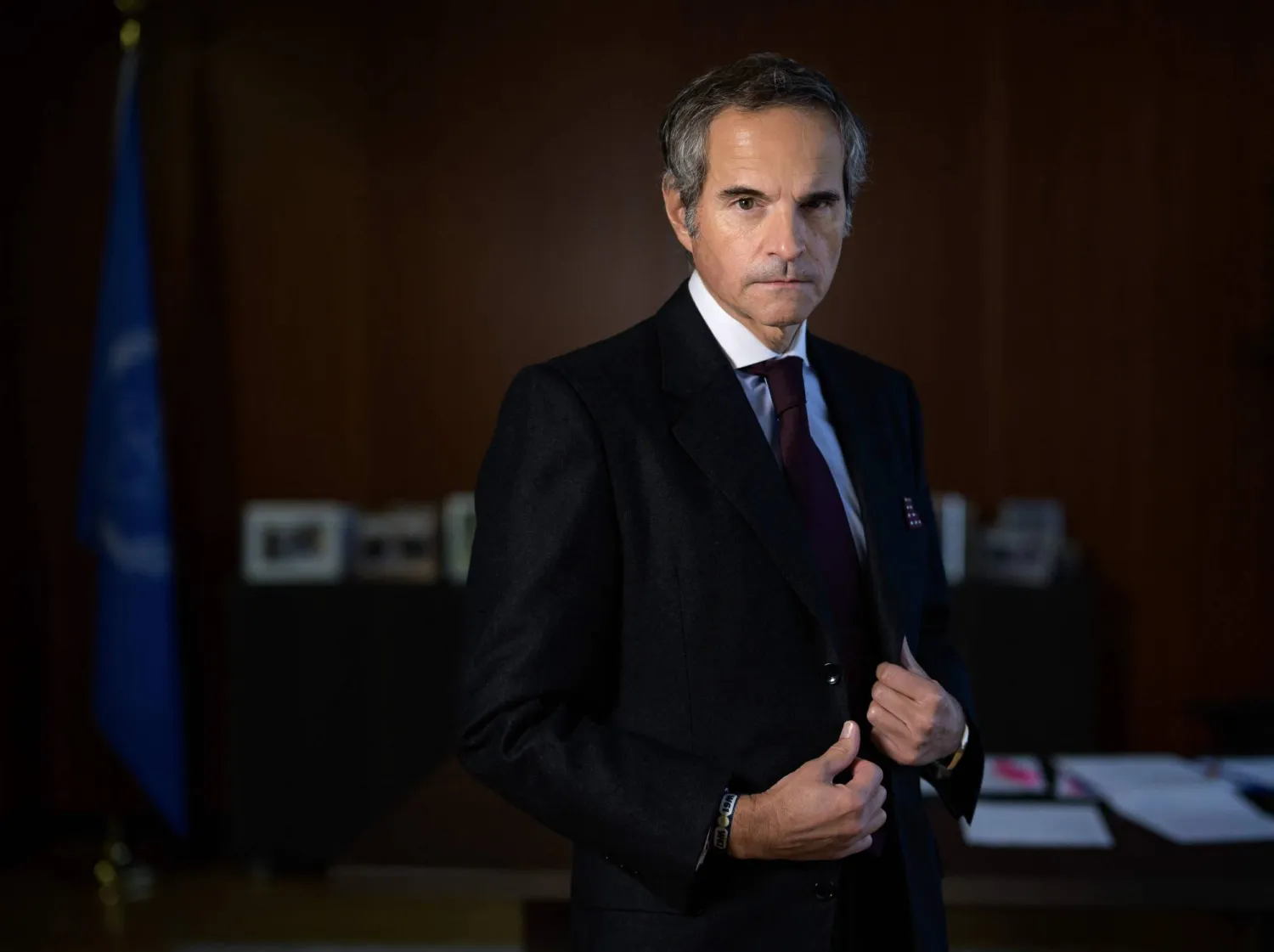
Rafael Grossi, Director General of the International Atomic Energy Agency (IAEA), poses for a picture in his office at the IAEA headquarters in Vienna, Austria on March 01, 2024, ahead of a board of governors of the UN nuclear watchdog to be held on March 4, 2024 in Vienna. (Photo by Joe Klamar / AFP)
TT

IAEA Chief Pushes Development Banks to Fund New Nuclear Energy Projects

Rafael Grossi, Director General of the International Atomic Energy Agency (IAEA), poses for a picture in his office at the IAEA headquarters in Vienna, Austria on March 01, 2024, ahead of a board of governors of the UN nuclear watchdog to be held on March 4, 2024 in Vienna. (Photo by Joe Klamar / AFP)

International Atomic Energy Agency chief Rafael Grossi has asked global development banks and their government shareholders to fund new nuclear energy projects, stating that failing to do so could delay the energy transition, the Financial Times reported on Monday.
The UN nuclear watchdog chief told the Financial Times in an interview that lack of funding for emissions-free nuclear energy by multilateral lenders such as the World Bank and Asian Development Bank was "out of step" with the wishes of most of their shareholders, adding that there has been a "sea-change" in the outlook on nuclear power due to the climate crisis and the war in Ukraine.
"All these development banks or international finance institutions are out of date, out of step with what is happening," Grossi told the newspaper. "The outlook of the banks seems to be a "post-Chernobyl sort of mantra, which does not correspond any more to the policy indication from countries and the ideas and projects we are seeing."
World leaders will attend a "first-of-its-kind" nuclear energy summit in Brussels later this month where they are expected to discuss how to overcome opposition from a small number of nations such as Germany to using development banks to fund nuclear projects, Grossi told FT.
The IAEA estimates annual nuclear investment will need to more than double to $100 billion by 2030, up from almost $50 million in 2022, to meet the Paris Agreement target of net zero carbon emissions by 2050, the report added.


EU and Mercosur Sign Trade Deal after 25 Years of Negotiations

Panama's President Jose Raul Mulino, from left, Bolivian President Rodrigo Paz, European Council President Antonio Costa, European Commission President Ursula von der Leyen, Paraguay's President Santiago Pena, Argentina's President Javier Milei, Uruguay's President Yamandu Orsi and Brazilian Minister of Foreign Affairs Mauro Vieira, pose for a group photo during a meeting to sign a free trade deal between the European Union and Mercosur in Asuncion, Paraguay, Saturday, Jan. 17, 2026. (AP Photo/Jorge Saenz)
TT

EU and Mercosur Sign Trade Deal after 25 Years of Negotiations

Panama's President Jose Raul Mulino, from left, Bolivian President Rodrigo Paz, European Council President Antonio Costa, European Commission President Ursula von der Leyen, Paraguay's President Santiago Pena, Argentina's President Javier Milei, Uruguay's President Yamandu Orsi and Brazilian Minister of Foreign Affairs Mauro Vieira, pose for a group photo during a meeting to sign a free trade deal between the European Union and Mercosur in Asuncion, Paraguay, Saturday, Jan. 17, 2026. (AP Photo/Jorge Saenz)

Top officials from the EU and the South American bloc Mercosur signed a free trade agreement on Saturday in Paraguay, ⁠paving the way for the European Union's largest ever trade accord after 25 years of negotiations.

The agreement, ⁠which has been highly contested in Europe, must now gain the consent of the European Parliament. It also must be ratified by legislatures of Mercosur members ⁠Argentina, Brazil, Paraguay and Uruguay, which is expected to be a smoother process.

The signing ceremony in Paraguay’s humid capital of Asunción marks a major geopolitical victory for the EU in an age of American tariffs and surging Chinese exports, expanding the bloc’s foothold in a resource-rich region increasingly contested by Washington and Beijing.

It also sends a message that South America cultivates diverse trade and diplomatic relations even as US President Donald Trump declares dominance in the Western Hemisphere.

European Commission President Ursula von der Leyen and European Council President Antonio Costa joined the presidents of Mercosur countries at Saturday's ceremony, with the exception of Brazilian President Luiz Inacio Lula da Silva, who sent his foreign minister.

The ⁠deal was signed after receiving the green light from most European nations last week, despite concerns from farmer and environmental groups, who fear a surge of inexpensive South American imports and increased deforestation.

Von der Leyen, who met with Lula before heading to Asuncion for the signing, said the deal would create the largest free trade zone in the world.

"This agreement sends a very strong message to the world. ⁠It reflects a clear and deliberate choice. We choose fair trade over tariffs. We choose a productive, long-term partnership over isolation," she said on Saturday.

Trade between the two blocs, which encompasses a market of 700 million people, reached a value of 111 billion euros in 2024. European Union exports mainly consist of machinery, chemical products, and transport equipment, whereas Mercosur's exports are concentrated in agricultural goods, minerals, wood pulp, and paper.


Trump: 8 EU Countries will be Charged 10% Tariff for Opposing US Control of Greenland

A military vessel HDMS Knud Rasmussen of the Royal Danish Navy docked in Nuuk, Greenland, on Saturday, Jan. 17, 2026. (AP Photo/Evgeniy Maloletka)
TT

Trump: 8 EU Countries will be Charged 10% Tariff for Opposing US Control of Greenland

A military vessel HDMS Knud Rasmussen of the Royal Danish Navy docked in Nuuk, Greenland, on Saturday, Jan. 17, 2026. (AP Photo/Evgeniy Maloletka)

President Donald Trump said Saturday that he would charge a 10% import tax starting in February on goods from eight European nations because of opposition to US control of Greenland.

He said in a social media post that Denmark, Norway, Sweden, France, Germany, the United Kingdom, the Netherlands, and Finland would face the tariff, which would be raised to 25% on June 1 if a deal is not in place for “the Complete and Total purchase of Greenland” by the United States.

Earlier Saturday, hundreds of people in Greenland's capital braved near-freezing temperatures, rain and icy streets to march in a rally in support of their own self-governance in the face of threats of an American takeover.

The Greenlanders waved their red-and-white national flags and listened to traditional songs as they walked through Nuuk's small downtown. Some carried signs with messages like “We shape our future,” “Greenland is not for sale” and “Greenland is already GREAT.” They were joined by thousands of others in rallies across the Danish kingdom.

Meanwhile, Danish Maj. Gen. Søren Andersen, leader of the Joint Arctic Command, told The Associated Press that Denmark doesn't expect the US military to attack Greenland, or any other NATO ally, and that European troops were recently deployed to Nuuk for Arctic defense training.

“I will not go into the political part, but I will say that I would never expect a NATO country to attack another NATO country,” he told the AP on Saturday aboard a Danish military vessel docked in Nuuk. “For us, for me, it’s not about signaling. It is actually about training military units, working together with allies.”

Trump has insisted for months that the US should control Greenland, a semiautonomous territory of NATO ally Denmark, and said earlier this week that anything less than the Arctic island being in US hands would be “unacceptable.”

During an unrelated event at the White House about rural health care, he recounted Friday how he had threatened European allies with tariffs on pharmaceuticals.

“I may do that for Greenland, too,” Trump said, before his announcement Saturday about his targeted tariffs. “I may put a tariff on countries if they don’t go along with Greenland, because we need Greenland for national security. So I may do that."

He had not previously mentioned using tariffs to try to force the issue.


High-Ranking Saudi Delegation to Attend World Economic Forum Meeting in Davos

FILED - 23 January 2020, Switzerland, Davos: The World Economic Forum logo is displayed on a board during a plenary session. Photo: Ciaran McCrickard/World Economic Forum/dpa
TT

High-Ranking Saudi Delegation to Attend World Economic Forum Meeting in Davos

FILED - 23 January 2020, Switzerland, Davos: The World Economic Forum logo is displayed on a board during a plenary session. Photo: Ciaran McCrickard/World Economic Forum/dpa

A high-ranking Saudi delegation led by Minister of Foreign Affairs Prince Faisal bin Farhan bin Abdullah will participate in the World Economic Forum (WEF) Annual Meeting 2026 in Davos, Switzerland, from January 19 to 23.

Alongside Prince Saisal, the delegation includes Saudi Ambassador to the US Princess Reema bint Bandar bin Sultan bin Abdulaziz, Minister of Commerce Majid Al-Kassabi, Minister of Tourism Ahmed Al-Khateeb, Minister of Investment Khalid Al-Falih, Minister of Finance Mohammed Aljadaan, Minister of Communications and Information Technology Abdullah Alswaha, Minister of Industry and Mineral Resources Bandar Alkhorayef, and Minister of Economy and Planning Faisal Alibrahim.

Prince Faisal affirmed that the Kingdom’s participation in the World Economic Forum 2026, themed "A Spirit of Dialogue," demonstrates its commitment to international cooperation in addressing economic challenges.

He stressed the importance of maintaining regional peace, supporting sustainable development, and enhancing global economic partnerships.

In a statement to the Saudi Press Agency (SPA), Prince Faisal also highlighted the importance of public-private collaboration to achieve prosperity and security.

He noted that the Kingdom is broadening cooperation with international partners to better confront economic and environmental challenges while focusing on building institutional and human capacities to adapt to rapid transformations.

Prince Faisal stated that the Kingdom views the Davos 2026 forum as a vital opportunity to strengthen cooperation in building institutional and human capacities, essential pillars for adapting to rapid global economic shifts.

Saudi Arabia is focused on developing innovative solutions in technology and scientific research, he said.

As for Aljadaan, he affirmed that Saudi Arabia's participation in the 56th World Economic Forum stems from its commitment to strengthening international cooperation and addressing global economic challenges.

In a statement to SPA, Aljadaan pointed to the Kingdom's growing influence in shaping global economic trends, driven by its robust economy and regional and international standing.

He emphasized that the Kingdom will use this platform, which brings together government, business, and academic leaders, to explore ways to promote global stability and growth.

The minister stated that this year's forum focuses on five key global challenges: building trust and cooperation, identifying new drivers for sustainable growth, investing in human capital, ensuring the responsible use of technology and innovation, and integrating environmental sustainability into economic models. Discussions will also cover the impacts of artificial intelligence, digital transformation, and cybersecurity on global industries.

Alibrahim said the Kingdom's participation reinforces Saudi Arabia's position as an active partner in advancing comprehensive development and innovative solutions to global challenges, ensuring sustainable growth and prosperity at the local, regional, and international levels.

He told SPA that the forum will spotlight key themes aimed at institutionalizing international cooperation through participatory economic models that sustain transformative growth. He highlighted the Kingdom's success in creating new growth engines and building a robust, productive base driven by investment in strategic sectors and activities with high-quality economic returns.

Alibrahim noted that over the past five years, 74 out of 81 non-oil economic activities recorded annual growth exceeding 5%, with 38 achieving growth of more than 10%, reflecting a genuine expansion of the Kingdom's productive base.

The minister emphasized that the Kingdom's participation goes beyond mere representation, involving active contribution to advancing cooperation and strengthening the resilience of the global economy, particularly by balancing development expansion with responsible innovation policies.

Al-Khateeb also affirmed that Saudi Arabia's participation in the 2026 World Economic Forum aligns with its leadership in strengthening international cooperation and building partnerships that translate dialogue into tangible results.

Al-Khateeb told SPA that this participation extends the Kingdom's approach to opening joint investment opportunities in vital sectors, particularly tourism. He noted that Saudi Arabia has become a new global tourism powerhouse and a rapidly developing model for creating competitive destinations, reflecting its growing prominence on the international map.

Participation in Davos will highlight the importance of developing tourism experiences and service quality to ensure sustainable growth that balances high demand with added value, while preserving cultural identity and natural resources, the minister added.

As for Alswaha, he said the Kingdom’s participation is supported and enabled by Custodian of the Two Holy Mosques King Salman bin Abdulaziz Al Saud and Prince Mohammed bin Salman bin Abdulaziz Al Saud, Saudi Crown Prince and Prime Minister, and embodies the Kingdom's leadership in fostering shared solutions and strengthening global dialogue on technological innovation and sustainable growth, in alignment with the objectives of Saudi Vision 2030.

In a statement to SPA, the minister explained that the Kingdom's participation aims to convey its national experience in transitioning to the smart era and showcase its notable achievements in building a competitive, technology- and AI-driven economy. It also seeks to broaden international cooperation and open new pathways for partnerships and investments with leading global technology companies and private-sector leaders.