


RCRC Shares Kingdom’s World Expo Vision with UNESCO World Heritage Committee

The logo of the Royal Commission for Riyadh City (RCRC)
TT

RCRC Shares Kingdom’s World Expo Vision with UNESCO World Heritage Committee

The logo of the Royal Commission for Riyadh City (RCRC)

Saudi Arabia’s Royal Commission for Riyadh City (RCRC) has held a reception for members of the UN Educational, Scientific, and Cultural Organization (UNESCO) World Heritage Committee and briefed them on the Kingdom’s bid to host World Expo 2030 in the capital Riyadh.

“Riyadh Expo 2030 is part of the Kingdom’s endeavor to enable all countries to make an impact on the international scale, with the aim of creating a bright future for the planet under the theme ‘Together for a Foresighted Tomorrow’,” said Eng. Abdulaziz Alghannam, the Technical Director of the Riyadh Expo 2030 bid, at the reception on Friday.

“The three sub-themes of Riyadh Expo 2030 represent the Kingdom’s vision to present the most impactful World Expo ever, collaborating for a better future, where ‘Prosperity for All’ seeks to achieve a prosperous and a peaceful planet in which science and innovation are accessible to all. Also, ‘Climate Action’ promotes creative solutions to climate change by uniting international efforts, and ‘A Different Tomorrow’ seeks to harness science, innovations, and technologies to develop new tools for individuals and societies,” he said.

Alghannam added: “Inspired by Saudi Vision 2030, Riyadh Expo 2030 pays great attention to the Kingdom’s civilization, rich heritage, ancient traditions, and cultural treasures, which we would be proud to showcase to the Riyadh Expo 2030 visitors through immersive experiences.”

He stressed that the capital city is fully prepared to host this international exhibition and present the most impactful and unprecedented edition in the history of World Expo.

The members of the UNESCO World Heritage Committee were briefed about the Kingdom's ambitious goals for Riyadh Expo 2030 and the major ongoing development projects which will be ready by 2030.

They were also briefed on Riyadh Expo 2030’s sustainability plans, including clean energy, high standards of resource efficiencies and detailed strategies to enhance and conserve biodiversity, eliminate food wastage, and green waste management and recycling.

The reception by RCRC was held on the sidelines of the Kingdom’s hosting of the meeting of the World Heritage Committee in Riyadh from September 10 to 25, in its capacity as the current chair of the UNESCO World Heritage Committee.



Ukraine Urges Venice Biennale to Exclude Russia

A firefighter extinguishes a blaze at a five-story residential building in Kharkiv on March 7, 2026, after it was partially destroyed by a Russian strike amid the Russian invasion of Ukraine. (Photo by SERGEY BOBOK / AFP)
TT

Ukraine Urges Venice Biennale to Exclude Russia

A firefighter extinguishes a blaze at a five-story residential building in Kharkiv on March 7, 2026, after it was partially destroyed by a Russian strike amid the Russian invasion of Ukraine. (Photo by SERGEY BOBOK / AFP)

Ukraine on Sunday called on the Venice Biennale to keep Russia out of the prestigious art event after organizers said it could participate for the first time since launching its all-out invasion in 2022.

"We call on the organizers of the Venice Biennale to reconsider their decision to allow the Russian Federation to return and to maintain the principled position demonstrated in 2022-2024," Ukraine's foreign minister, Andriy Sybiga, and culture minister, Tetyana Berezhna, said in a statement.

The organizers of the event said on Wednesday that they would allow Russia to take part in the exhibition this year, which runs from May 9 to November 22.

"La Biennale di Venezia is an open institution" and "rejects any form of exclusion or censorship of culture and art", they said in a statement.

Their decision was met with criticism, including from Italian Prime Minister Giorgia Meloni's government.

Lithuania's foreign minister called the move "abhorrent".

According to AFP, Italy's culture ministry said the move was made "entirely independently by the Biennale Foundation, despite the Italian government's opposition".

The Venice Biennale is an international cultural organization started in 1895 that presents major cultural festivals and runs its flagship art exhibition and architecture exhibition on alternating years.

Participating countries set up pavilions in Venice, and the art biennial typically attracts more than 600,000 visitors over its seven-month run.


Grabbing the Bull by the Tail: Venezuela’s Cowboy Sport

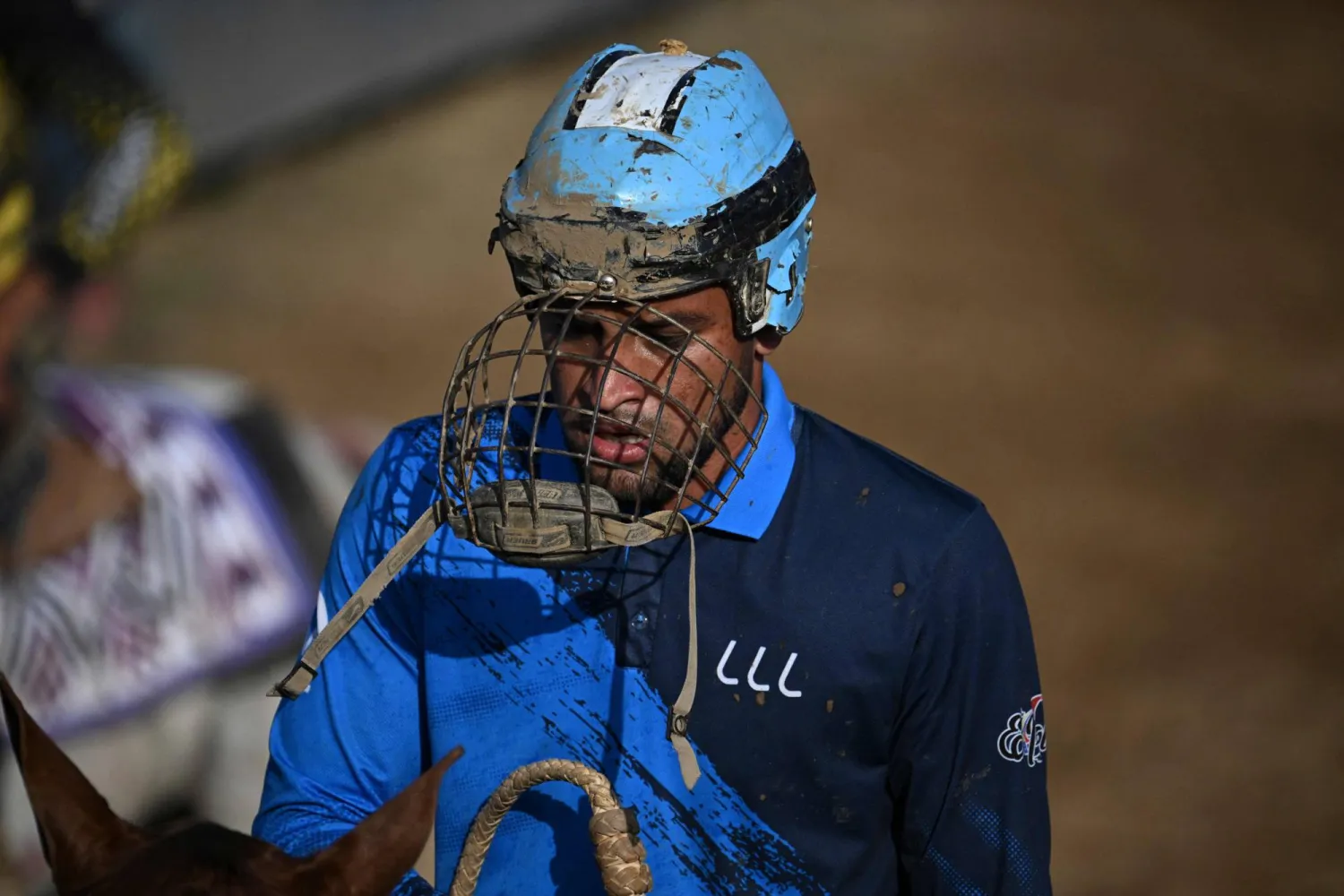
A cowboy gestures during a bull-tailing competition held as part of the "Fiestas del Alma Llanera" celebration in San Fernando de Apure, Apure State, Venezuela, on February 27, 2026. (AFP)
TT

Grabbing the Bull by the Tail: Venezuela’s Cowboy Sport

A cowboy gestures during a bull-tailing competition held as part of the "Fiestas del Alma Llanera" celebration in San Fernando de Apure, Apure State, Venezuela, on February 27, 2026. (AFP)

Four mounted cowboys jostle for position near the bull pen gate.

When the bull bolts out into the ring, a mad scramble begins as the riders vie to grab its tail and knock it to the ground.

Bull tailing, or "coleo" is to Venezuela's "llanos" (tropical grasslands) what rodeo is to Texas -- an integral part of popular culture that has survived opposition from animal welfare groups.

Unlike their Texan counterparts, "coleadores" don't try to ride the bull or grab it by the horns but rather chase its tail.

The coleo is one of the high points of the annual "llanera" fair in the central city of San Fernando de Apure, a three-day extravaganza of cowboy culture, including fast-paced, swirling "joropo" partner dancing listed on the UN's Intangible Cultural Heritage list.

Experts trace coleo to Spanish colonial times and link it to cattle herding work.

It is also practiced across the border in Colombia's "llanos," as well as in Brazil and Mexico, countries with strong cattle breeding traditions.

Most of the "coleadores" or bull tumblers learn the sport from their fathers or grandfathers. Women and children have also been known to compete.

For Neomar Sanoja, one of the judges, it's Venezuela's "national sport" -- a bold claim in a baseball mad nation.

- 'Feel the adrenaline' -

Rafael Delgado, 35, started competing at around 10, encouraged by his father, a ranch hand.

"It's part of our 'llanero' culture, part of being Venezuelan," he told AFP before entering the ring.

To reach the bull's tail, riders spur on their horses and when they draw alongside the animal's flanks, perform acrobatic maneuvers to try flip the beast.

The bull writhes, struggles back on its feet and tries to escape along the "manga de coleo," a 200-meter-long sand corridor, with the riders in hot pursuit.

Points vary depending on how the bull tumbles, with extra marks for those who manage to get all four legs in the air.

About 200 competitors took part in the four-minute bouts in San Fernando de Apure, wearing hockey helmets and padding on their arms and legs as armor.

Llanera music blared while a judge narrated the action with rapid-fire delivery.

Florelbis Linares told AFP she wanted to take up coleo despite the misgivings of her coleatero boyfriend, who she watched perform from the stands.

"You really feel the adrenaline watching from here," the 23-year-old said, her legs hanging over the guardrail around the ring.

- 'Defenseless animals' -

The bull's suffering is little cause for concern among aficionados of coleo.

Most of the animals who enter the ring are headed for the slaughterhouse.

Luis Garcia, a 32-year-old rider, accused critics of the sport of hypocrisy, noting that most show no outrage in the face of intensive cattle rearing and meat consumption.

The AnimaNaturalis animal rights NGO, which is active in Spain and Latin America, has called for the practice to be abolished.

"It is cruelty and an abuse of power by llaneros against defenseless animals," it argued on its website.

"Is this what you call culture?" the Napda Foundation, a Venezuelan animal rights foundation, asked, posting a video of coleo spectators kicking and throwing objects at a bull to force it to get back on its feet.

"The alleged 'humans' behave like beasts. This must stop now."


Michelangelo’s Works Hidden in ‘Secret Room’, Researcher Says

Pedestrians walk past the Basilica of Santa Agnese Outside the Walls as a marble bust is displayed inside after being identified as a work by Michelangelo Buonarroti after centuries without attribution, following a decade of archival research by Italian researcher Valentina Salerno in Rome on March 4, 2026. (AFP)
TT

Michelangelo’s Works Hidden in ‘Secret Room’, Researcher Says

Pedestrians walk past the Basilica of Santa Agnese Outside the Walls as a marble bust is displayed inside after being identified as a work by Michelangelo Buonarroti after centuries without attribution, following a decade of archival research by Italian researcher Valentina Salerno in Rome on March 4, 2026. (AFP)

Renaissance artist Michelangelo ordered many of his artworks to be hidden by his pupils in a secret room to protect them for posterity, an Italian researcher claimed Wednesday.

According to renowned art historian Giorgio Vasari, the Italian genius burned a large number of his own drawings and sketches before his death in Rome in 1564.

But researcher Valentina Salerno says she has unearthed unpublished archival documents that reveal a plot to squirrel away his works.

"One of these three unpublished documents I found in the archives speaks of a room" kept by students of the Michelangelo school, the origins of which "can be traced back" to the artist, Salerno told AFP on the sidelines of a press conference in Rome.

"Assets are hidden inside this room. These assets are locked away so tightly that they require a system of multiple keys, so that no one can access them without the permission of others," she said.

Salerno was researching a book on Michelangelo when she came across a document that showed the artist had in 1550 joined the Brotherhood of the Most Holy Crucifix. Those close to him in his final years were members too.

Over a decade of research, she followed the document trail between a series of archives in the Vatican, Italy and European cities including Paris.

As part of what she called a "maniacal plan" cooked up by Michelangelo, his works were to be hidden "because otherwise it would all end up with a nephew he detested".

"The goal was to pass on to his poor, vulnerable, non-noble descendants the material to be able to continue studying, to transmit his art to future generations," she said.

Those involved in the plan went on to form the famous art Academy of San Luca in the 16th century, she added. It still exists today.

Salerno believes the secret room designed to safeguard the artist's creations was likely somewhere inside the Saint Peter in Chains church in central Rome.

- Michelangelo bust -

During her research, she also stumbled across a reference to a bust at the Basilica of Sant'Agnese, also in Rome, currently attributed to an anonymous artist.

She found documents attributing the white bust to Michelangelo down the centuries.

In the 1930s it appears to disappear from documentation, only to reappear in the 1980s, attributed to a minor artist.

Italy's cultural authorities later declared it to be a work by an unknown sculptor instead.

But Salerno insists the bust is a genuine Michelangelo, not just due to the paper trail, but also because it shares a striking resemblance to Tommaso dei Cavalieri, a young nobleman.

Salerno's work has not yet been peer reviewed, but she is a member of the Vatican committee for the celebrations marking the 500th anniversary of Michelangelo's birth.