


Dragon Boat Races Return to Cambodian Capital for Water Festival

Pigeons fly past as participants row dragon boats during a competition as part of the Water Festival on the Tonle Sap river in Phnom Penh on November 26, 2023. (AFP)
TT

Dragon Boat Races Return to Cambodian Capital for Water Festival

Pigeons fly past as participants row dragon boats during a competition as part of the Water Festival on the Tonle Sap river in Phnom Penh on November 26, 2023. (AFP)

Tens of thousands of spectators thronged the riverfront in the Cambodian capital Phnom Penh Sunday for an annual dragon boat race -- the centerpiece of the kingdom's three-day water festival, cancelled during the Covid pandemic.

Around 300 boats, their crews dressed in matching bright T-shirts, strained for the win as they dipped their colorful paddles into the Tonle Sap river with the royal palace behind them.

Cambodian King Norodom Sihamoni, Prime Minister Hun Manet, his father Hun Sen and senior government officials looked on as the yearly extravaganza began, with crowds urging the canoes over the final line.

Concerts, parades of lantern floats bedecked with colorful neon lights -- each representing a government ministry -- and fireworks are all part of the three-day festival that will last until Tuesday.

"I am happy that we can meet to celebrate the water festival," 38-year-old rower Hom Phos told AFP.

"I am so excited because it is our national festival."

The festival was last held in 2019, after which it was halted during the pandemic.

"During the Covid pandemic, everyone was worried about it, and we were not happy. But now we are happy again," fellow rower Yorn Vorn, 45, told AFP.

The festival marks the end of the rainy season when the Tonle Sap river, which joins the mighty Mekong River in front of the Royal Palace, reverses flow.

The celebrations turned deadly on the last day of the festival in 2010, when more than 350 people were killed in a stampede on an overcrowded bridge after panic spread over rumors it was about to collapse.

Then Prime Minister Hun Sen described the disaster as Cambodia's worst tragedy since the Khmer Rouge's 1975-1979 reign of terror, which killed up to a quarter of the population.



Qassim Region Principality Illuminated in Green in Celebration of Founding Day

The Qassim Region Principality illuminated in green marking Founding Day - SPA
TT

Qassim Region Principality Illuminated in Green in Celebration of Founding Day

The Qassim Region Principality illuminated in green marking Founding Day - SPA

The Qassim Region Principality building was illuminated in green in celebration of Founding Day.

The scene reflected pride in the historical roots of the Saudi state and embodied feelings of belonging on this cherished national occasion, SPA reported.

The illumination affirms the deep historical significance of Founding Day, marking 299 years since the establishment of the First Saudi State by Imam Mohammed bin Saud.

It also reflects the enduring principles upon which it was founded, including unity, stability, and state-building. These foundations culminate in the security, stability, and prosperity that the Kingdom of Saudi Arabia enjoys today under its wise leadership.


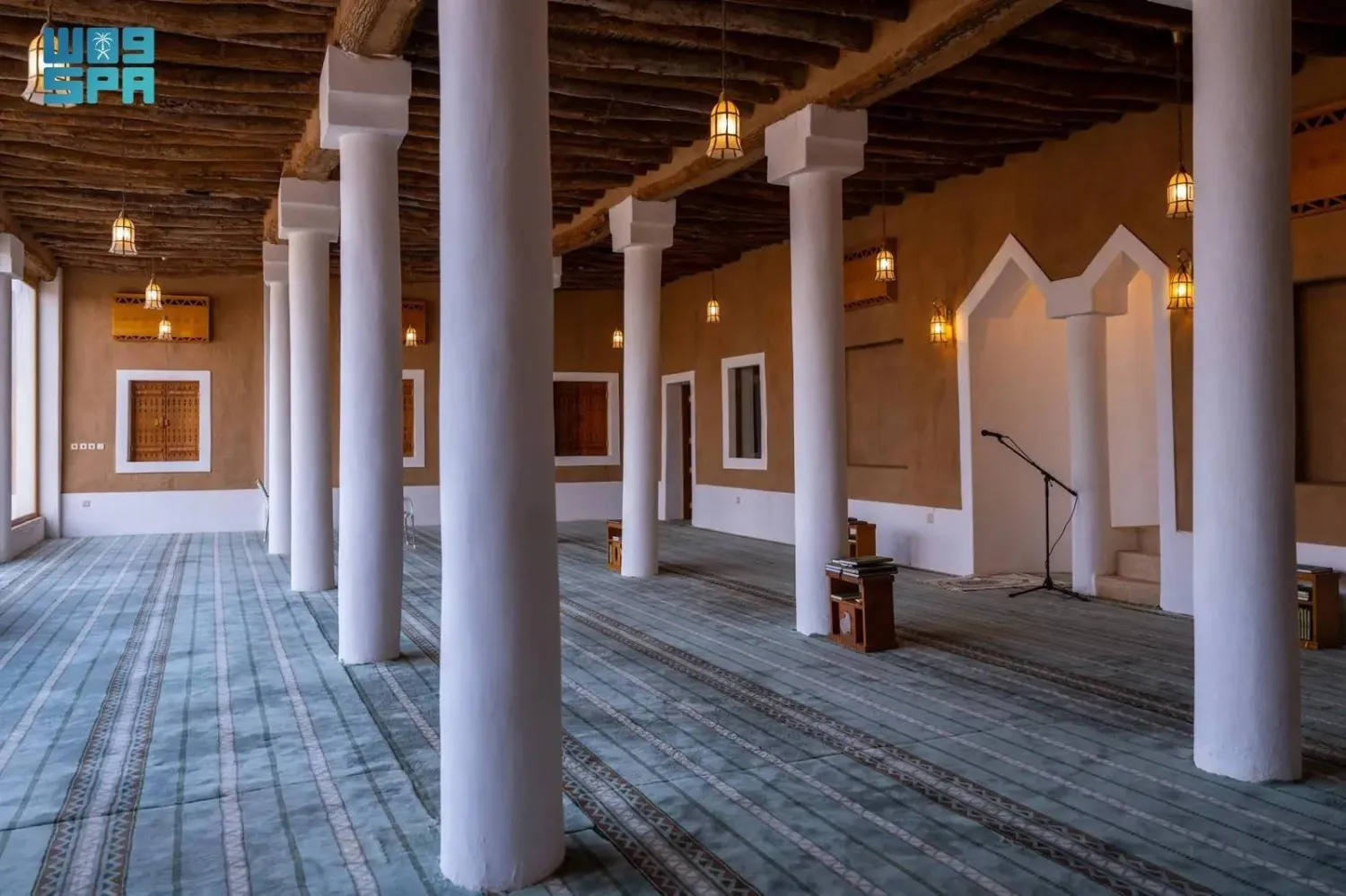
Prince Mohammed bin Salman Project Restores Century-Old Uqlat Al-Suqur Mosque in Qassim

The renovation utilized traditional mud, stone, and wood to preserve the mosque's authentic Najdi architectural style. (SPA)
TT

Prince Mohammed bin Salman Project Restores Century-Old Uqlat Al-Suqur Mosque in Qassim

The renovation utilized traditional mud, stone, and wood to preserve the mosque's authentic Najdi architectural style. (SPA)

The Prince Mohammed bin Salman Project for the Development of Historical Mosques has completed the restoration of the Uqlat Al-Suqur Mosque in Qassim Region, revitalizing a heritage landmark dating back to 1922, reported the Saudi Press Agency on Saturday.

Originally the only mosque in the area, it served as a vital religious and social hub for education and community governance.

The renovation, executed by specialized Saudi firms, utilized traditional mud, stone, and wood to preserve its authentic Najdi architectural style.

The project increased the mosque's area to 544 square meters, expanding its capacity to 250 worshippers while maintaining its historical identity.

The initiative aligns with Vision 2030 to preserve the Kingdom's urban heritage and boost the cultural and religious significance of its historical mosques for future generations.


Tomb More Than 1,000 Years Old Found in Panama

This handout picture released by Panama’s Ministry of Culture shows an archaeologist working inside a pre-Hispanic tomb approximately 1,200 years old, discovered at the El Cano Archaeological Park in Cocle, Panama, on February 20, 2026. (Handout / Panama’s Ministry of Culture / AFP)
TT

Tomb More Than 1,000 Years Old Found in Panama

This handout picture released by Panama’s Ministry of Culture shows an archaeologist working inside a pre-Hispanic tomb approximately 1,200 years old, discovered at the El Cano Archaeological Park in Cocle, Panama, on February 20, 2026. (Handout / Panama’s Ministry of Culture / AFP)

Archaeologists have discovered a tomb more than a thousand years old in Panama containing human remains alongside gold and ceramic artifacts, the lead researcher told AFP on Friday.

The discovery was made at the El Cano site in the Nata district about 200 kilometers (124 miles) southwest of Panama City.

Scientists and archaeologists have already unearthed other remains of pre-Hispanic cultures in the region that has been excavated for two decades.

The skeletal remains were found surrounded by gold objects and pottery decorated with traditional motifs, pointing to these being "high-ranking" individuals, archaeologist Julia Mayo told AFP, adding that the tomb was built between 800 and 1000 AD.

"The individual with the gold was the one with the highest social status in the group," she said.

That body was found with two bracelets, two earrings, and pectoral jewelry that featured bats and crocodiles, she added.

The El Cano archaeological site is linked to the societies that inhabited the central provinces of Panama between the 8th and 11th centuries.

"This is where they buried their dead for 200 years," said Mayo.

Nine other tombs "similar" to the one found on Friday had already been found at the site, she added.

Panama's Ministry of Culture said the discovery was "of great importance for Panamanian archaeology and the study of pre-Hispanic societies of the Central American isthmus," referring to the land that connects North and South America.

According to experts, these excavations demonstrate that death did not represent an end for these societies, but a transition to another phase where social status remained important.