


France Gets Ready to Say ‘Merci’ to World War II Veterans for D-Day’s 80th Anniversary This Year 

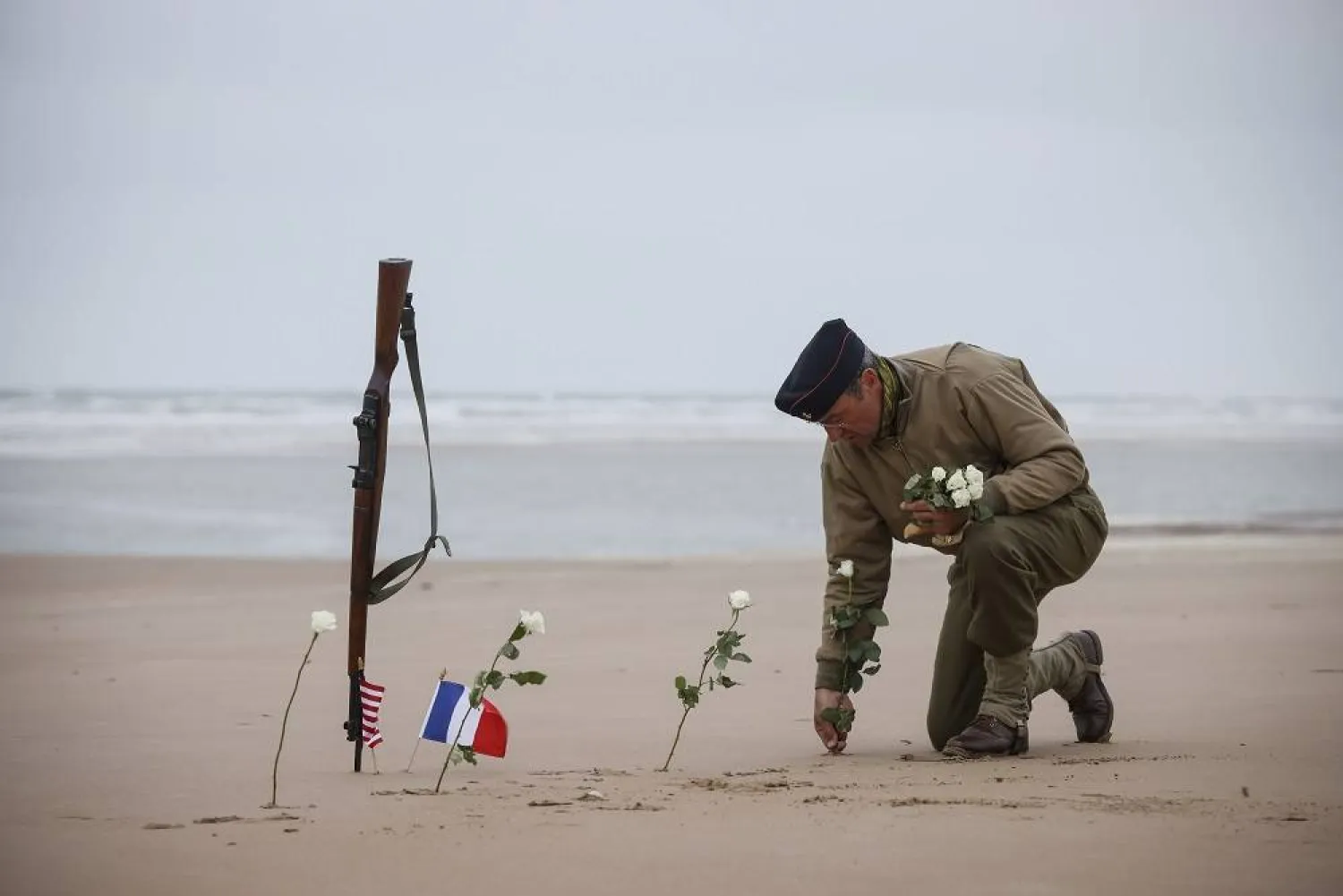
A World War II reenactor plants roses on Omaha Beach in Saint-Laurent-sur-Mer, Normandy, France, June 6, 2023. (AP)
TT

France Gets Ready to Say ‘Merci’ to World War II Veterans for D-Day’s 80th Anniversary This Year 

A World War II reenactor plants roses on Omaha Beach in Saint-Laurent-sur-Mer, Normandy, France, June 6, 2023. (AP)

France is getting ready to show its gratitude toward World War II veterans who will return, many for the last time, to Normandy beaches this year for 80th anniversary commemorations of D-Day to mark the defeat of the Nazis.

A ceremony at Omaha Beach, with many heads of state expected to be present, will be honoring the nearly 160,000 troops from Britain, the US, Canada and other nations who landed in Normandy on June 6, 1944.

French President Emmanuel Macron said Friday that D-Day celebrations, alongside the Paris Olympics, will be "France’s rendezvous with the world."

It will be an occasion for the French to say "merci," or "thank you," to veterans, some of whom will make a long trans-Atlantic journey, despite advanced age, fatigue and physical difficulties.

"We will never forget. And we have to tell them," Philippe Étienne, chairman of the Liberation Mission, the specially created body that organizes the 80th anniversary commemorations, told The Associated Press.

As a former ambassador of France to the United States, Étienne recalled his "strong emotion" when handing veterans the Legion of Honor, France’s highest distinction.

"They were 18, 20, 22 when they liberated our country, when they gave us back our freedom," he said. "Now 80 years later, they’re 100, 98, 102. It’s really incredible. Those are really courageous, humble people. They must feel our gratitude."

The link between the last witnesses of the war and the youth will also be at the heart of the anniversary.

"What we want above all, when the last witnesses, the last fighters, the last veterans are still with us, is to give their testimonies to our young people," Étienne added.

In the past couple of years, commemorations also have taken a special meaning as war is raging again in Europe since Russia’s full-scale invasion of Ukraine on Feb. 24, 2022.

Gen. Michel Delion, director-general of the Liberation Mission, said "that the message is more for the whole population than only for soldiers. Because the price of liberty is something that any citizen of any democratic nation needs to understand."

"The civilians were part of this (World War II) conflict because they suffered and they supported fighters. And we need to have this cohesion of our nations, of our populations to be able to answer to any question ... or any danger we could face tomorrow or today," he added.

Russian President Vladimir Putin, who had been present for the 70th anniversary of D-Day, wasn't expected to be invited this year. Putin didn't attend the 75th anniversary in 2019.

Countries like France that have signed and ratified the Rome Statute that created the International Criminal Court are obligated to arrest Putin, who was indicted for war crimes connected to the deportation of children from Ukraine, if he sets foot on their soil.

Étienne said that the commemorations, including some academic events, "will surely not ignore the sacrifices of everybody who ... was involved in the liberation of Europe, including in the East, because the Nazi regime was defeated both from the West and from the East."

He stressed the fact that "populations of the former Soviet Union, Russians in particular, but also Ukrainians and others, participated in this liberation."

Other key events will include celebrations of the Allied landing in Provence, in southern France, and the liberation of Paris, both in August, as well as the liberation of Strasbourg, at the border with Germany, in November, and the commemoration in May 2025 of the surrender of Nazi Germany to Allied forces.

Ceremonies will also allow France to pay tribute to Resistance fighters, to soldiers who came from its then colonial empire in Africa and to the civilians who suffered during the war.

Already across France, "we feel that there's a very strong mobilization to remember this very important period in history," said Fabien Sudry, deputy director-general of the Liberation Mission. "We feel it in the contacts we have, in the trips we make, with many local and regional authorities involved."

French authorities are notably considering launching a nationwide operation to collect family documents, objects and audiovisual material related to World War II that would help keep the memory alive.



Prince Mohammed bin Salman Project Restores Historic Al-Qalaah Mosque in Riyadh Region

The mosque is a prime example of traditional Najdi architecture - SPA
TT

Prince Mohammed bin Salman Project Restores Historic Al-Qalaah Mosque in Riyadh Region

The mosque is a prime example of traditional Najdi architecture - SPA

The Prince Mohammed bin Salman Project for the Development of Historical Mosques continues its mission to preserve the Kingdom’s architectural heritage by restoring Al-Qalaah Mosque in Hawtat Bani Tamim, Riyadh Region. Built in 1250 AH (1834 CE), this historic landmark is situated within the fortress of Second Saudi State founder Imam Turki bin Abdullah.

The mosque is a prime example of traditional Najdi architecture, featuring stone foundations, mud walls constructed using molded brick techniques, and a roof of tamarisk trunks and palm fronds supported by stone-bead cylindrical columns, SPA reported.

Through the current renovation, the mosque’s area has expanded from 608.68 to 625.78 square meters while maintaining a capacity for 180 worshippers. Executed by specialized Saudi firms under expert engineering supervision, the project balances traditional standards with modern sustainability to ensure the mosque remains a living testament to Islamic and national history.

This initiative aligns with Vision 2030 objectives to rehabilitate historical sites for worship, highlight cultural heritage, and preserve the Kingdom’s authentic architectural identity for future generations.


UNESCO Fears for Fate of Historical Sites during Iran War

Debris at the historical monument Golestan Palace after it was damaged in an Israeli and US strike, amid the US-Israeli conflict with Iran, in Tehran, Iran, March 3, 2026. Majid Asgaripour/WANA (West Asia News Agency) via REUTERS/File Photo
TT

UNESCO Fears for Fate of Historical Sites during Iran War

Debris at the historical monument Golestan Palace after it was damaged in an Israeli and US strike, amid the US-Israeli conflict with Iran, in Tehran, Iran, March 3, 2026. Majid Asgaripour/WANA (West Asia News Agency) via REUTERS/File Photo

UNESCO said it is deeply concerned about the fate of world heritage sites in Iran and across the region, after Tehran's Golestan palace, often compared to Versailles, and a historic mosque and palace in Isfahan were damaged in the war.

The United Nations' cultural agency on Wednesday urged all parties to protect the region's outstanding cultural sites, saying four of Iran's 29 world heritage sites had been damaged since the start of the US and Israeli war with Iran.

"UNESCO is deeply concerned by the first impact that the hostilities are already having on many world heritage sites," Lazare Eloundou Assomo, director of the World Heritage Centre, told Reuters, adding he was also concerned for sites in Israel, Lebanon and across the Middle East.

Tehran's Golestan palace, damaged in US–Israeli strikes, is testimony to the grandeur of Iran's civilization in the 19th century, he said.

The palace was chosen as the Persian royal residence and seat of power by the Qajar family and shows the introduction of European styles in Persian arts, according to the UNESCO website. The last Shah of Iran, Mohammad Reza Pahlavi, held a coronation ceremony there in 1969.

"We sometimes even compare it with the Versailles Palace in France, for instance, and it has suffered, unfortunately, some damage. We don't know the extent for the moment. But clearly, with the images that we have been able to receive, we can confirm ... it has been affected," Eloundou Assomo said.

Photos of the interior of the palace have shown piles of smashed glass and shards of wood on the floor, and shattered woodwork.

Isfahan was one of Central Asia's most important cities and a key point on the Silk Road trading route. Its Masjed-e Jame (Jameh Mosque) is more than 1,000 years old and shows the development of Islamic art through 12 centuries.

Buildings close to the buffer zone of the prehistoric sites of the Khorramabad Valley have also been damaged, UNESCO said.

UNESCO has shared coordinates of key cultural sites to all parties, Eloundou Assomo said, and was monitoring damage.

"We are calling for the protection of all sites of cultural significance ... everything that tells the history of all the civilisations of the 18 countries in the region," he said.


Coin Used to Pay for Bus Ticket in Leeds Found to Be Phoenician

The coin has been donated to Leeds Museums and Galleries. (Leeds City Council)
TT

Coin Used to Pay for Bus Ticket in Leeds Found to Be Phoenician

The coin has been donated to Leeds Museums and Galleries. (Leeds City Council)

An odd-looking coin used to pay for a bus fare in Leeds in the 1950s has been found to belong to an ancient civilization from more than 2,000 years ago, reported The Independent.

The coin, handed to a local bus driver decades ago, came into the hands of James Edwards, former chief cashier with Leeds City Transport, who gathered fares and counted them at the end of each day.

Since it couldn’t be spent, Edwards took it home and gifted the ancient coin to his young grandson, Peter, who kept it in a small wooden chest for more than 70 years.

Archaeologists from the University of Leeds have now found that it came from the Carthaginians, part of the Phoenician culture, in the Spanish city of Cadiz during the 1st century BC.

“My grandfather would come across coins which were not British and put them to one side, and when I went to his house, he would hand me a few,” the now 77-year-old grandson said.

“It was not long after the war, so I imagine soldiers returned with coins from countries they had been sent to. Neither of us were coin collectors, but we were fascinated by their origin and imagery – to me, they were treasure,” he said.

Peter attempted to uncover the coin’s origin, focusing on a particular inscription.

It bears the face of the god Melqart on one side, resembling the Greek hero Herakles and wearing his famed lionskin headdress.

Experts said it came from what was once a Carthaginian settlement on the Spanish coast.

“The coin always fascinated me because it was hard to decipher where it came from,” Peter said.

“My first thought when I found out its origin was that I would like to return it to an institute where it could be studied by all, and Leeds Museums and Galleries kindly offered to give it a good home,” he said.

The coin has been donated to Leeds Museums and Galleries and is now part of the Leeds Discovery Centre, which includes coins and currency from cultures around the world, spanning thousands of years of history.

“It’s incredible to imagine how this tiny piece of history created by an ancient civilization thousands of years ago has somehow made its way to Leeds and into our collection,” said Salma Arif, Leeds City Council’s executive member for adult social care, active lifestyles and culture.

“Museums like ours are not just about preserving objects, they’re also about telling stories like this one and inspiring visitors to think about the history that’s all around us, sometimes in the most unlikely of places,” Arif said.