Sultan bin Abdulaziz Al Saud Foundation, ICESCO to Promote Arabic Language in Chadhttps://english.aawsat.com/culture/5035724-sultan-bin-abdulaziz-al-saud-foundation-icesco-promote-arabic-language-chad
Sultan bin Abdulaziz Al Saud Foundation, ICESCO to Promote Arabic Language in Chad
TT
TT
Sultan bin Abdulaziz Al Saud Foundation, ICESCO to Promote Arabic Language in Chad
The Sultan bin Abdulaziz Al Saud Foundation and the Islamic World Educational, Scientific and Cultural Organization (ICESCO), through the latter's Regional Educational Center, are preparing to launch a project to promote the Arabic language in Chad.
The project aims to promote the language, boost its status at Arabic schools, and teach Arabic to non-native speakers in several primary schools in Chad.
This will be achieved by utilizing the "Arabic Language Learning Series for Non-Native Speakers," issued by the foundation through Umm Al-Qura University, and supporting it by providing the necessary educational tools to achieve its objectives, such computers, printers and projectors, along with developing an implementation plan to regulate the mechanisms of their use in the educational process, training teachers, and teaching students.
The project comes within the framework of the memorandum of understanding and cooperation signed between the foundation and the organization to support the project of teaching the Arabic language in non-Arabic-speaking countries.
It reflects the awareness of the cultural role of the Arabic language in preserving Arab and Islamic identity and bolstering cultural communication among various peoples and civilizations.
In its first phase, this project, which will be implemented at 20 primary schools in various regions of Chad, is expected to benefit 40 teachers and 600 students.
Riyadh Art Expands Collection with Works by Italian, Indian Artistshttps://english.aawsat.com/culture/5282477-riyadh-art-expands-collection-works-italian-indian-artists
Riyadh Art Expands Collection with Works by Italian, Indian Artists
Riyadh Art's permanent collection now comprises 75 artworks across the capital - SPA
Riyadh Art has announced the installation of two new works in its permanent collection: "Run Beyond" by Italian artist Angelo Bonello and "Family Tree" by Indian artist Subodh Gupta, reflecting Riyadh's continued transformation into an open-air museum woven into the fabric of daily life.
The two works carry complementary themes—the first exploring movement and progress, the second evoking memory and human connection, together expressing a city undergoing rapid transformation while preserving its human and cultural dimension, SPA reported.
Riyadh Art's permanent collection now comprises 75 artworks across the capital, with new works planned for 2026, featuring artists from 47 countries alongside Saudi artists, making it one of the largest public art initiatives globally.
Saudi Heritage Commission Uncovers 1,774 Archaeological Finds in Madinah Regionhttps://english.aawsat.com/culture/5282190-saudi-heritage-commission-uncovers-1774-archaeological-finds-madinah-region
The survey recorded 156 new archaeological sites. (SPA)
TT
TT
Saudi Heritage Commission Uncovers 1,774 Archaeological Finds in Madinah Region
The survey recorded 156 new archaeological sites. (SPA)
Saudi Arabia's Heritage Commission concluded the second season of archaeological survey work in Al Mahd Governorate, Madinah Region, documenting 1,774 archaeological discoveries across three survey areas: Al Suwayriqiyah, Al Muwayhiyah, and Hadhah, reported the Saudi Press Agency on Tuesday.
The survey recorded 156 new archaeological sites, yielding 461 Islamic inscriptions, 34 Thamudic inscriptions, 1,259 rock art panels, 11 stone structures, three historical palaces, two caravan routes, and four wells.
Among the most notable finds are rock inscriptions bearing the name of Omar bin Al-Khattab, alongside Arabic poetry engraved on rock faces, significantly elevating the site's cultural and historical value.
The commission stressed its commitment to continuing survey and documentation programs, in support of Saudi Vision 2030's objectives to preserve cultural heritage across the Kingdom.
Between Homer and Hollywood: Troy a Source of Turkish Pridehttps://english.aawsat.com/culture/5281967-between-homer-and-hollywood-troy-source-turkish-pride
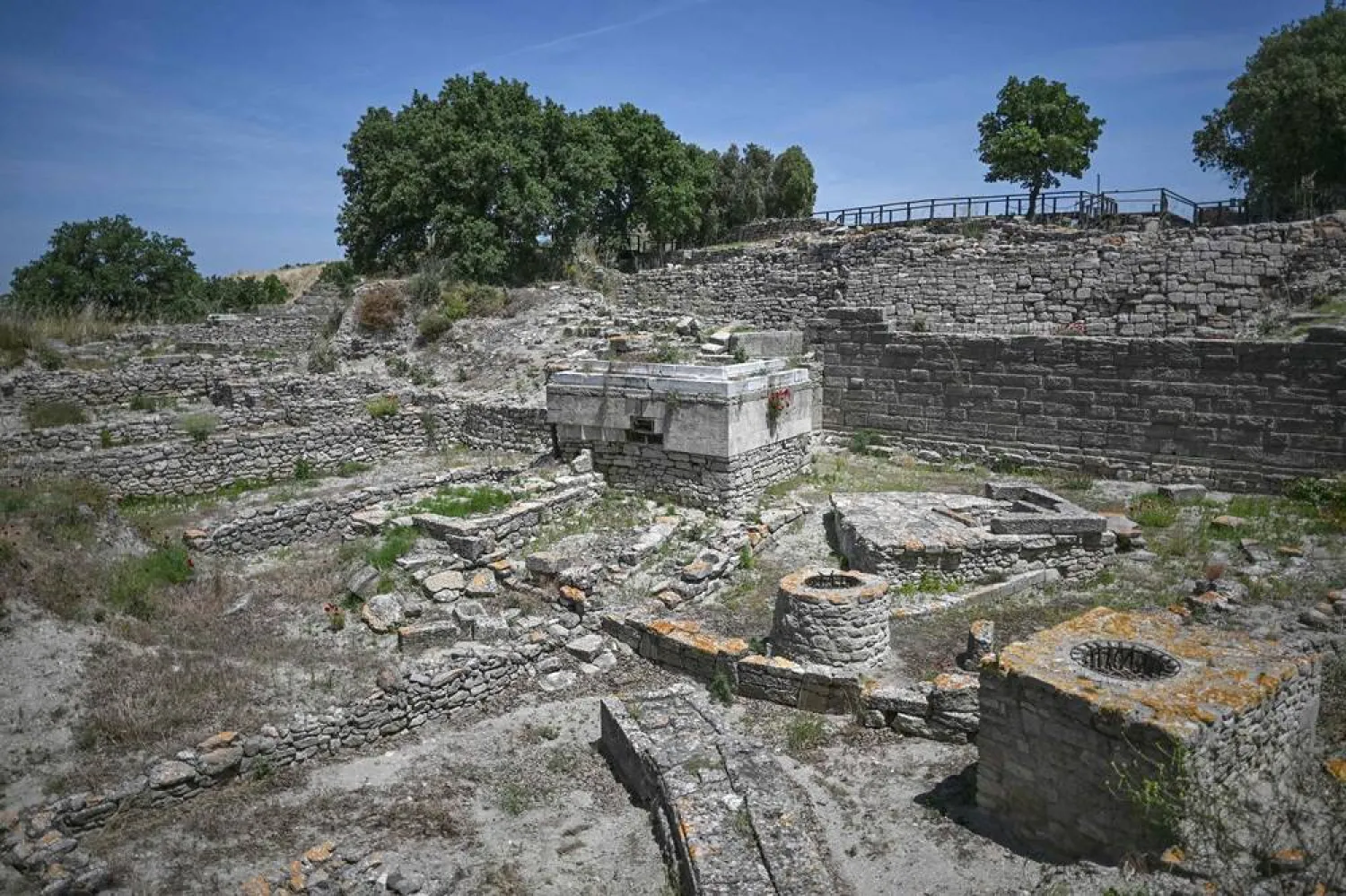
This photograph shows a general view of the ruins of the ancient city of Troy in Canakkale on June 2, 2026. (AFP)
TT
TT
Between Homer and Hollywood: Troy a Source of Turkish Pride
This photograph shows a general view of the ruins of the ancient city of Troy in Canakkale on June 2, 2026. (AFP)
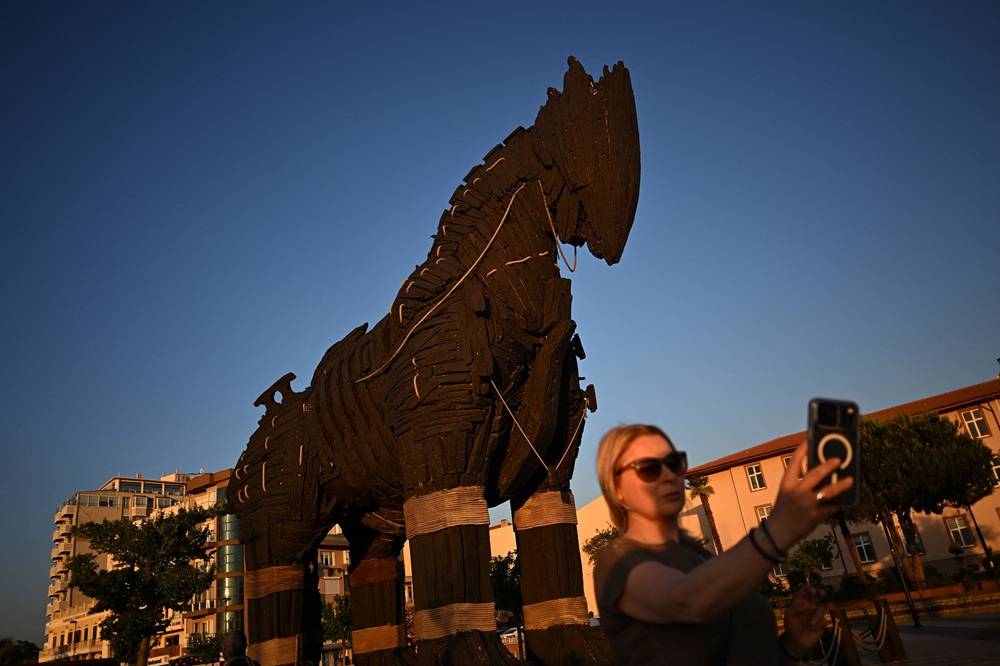
A gift from the film set of "Troy", a giant Trojan Horse replica looms over the port of Canakkale on the Dardanelles Strait in western Türkiye.
First related by Homer, then retold for the silver screen in 2004, with Brad Pitt as Achilles, the legend of the ancient city travels to Rome's Colosseum this week, where a major new exhibition opens on Friday.
Keen to showcase the city's Anatolian roots, Türkiye has loaned out more than 220 artifacts that will be on show at the exhibition, "Troy and Rome", which runs until mid-October.
"When you read Homer, you don't get a very clear idea of the Trojans' identity. But at the time of the Trojan War, they were certainly among the Anatolian peoples," said Reyhan Korpe, deputy head of the Troy excavations and an ancient history expert at Canakkale University.
Located on Türkiye's Aegean coastline, the remains of Troy are a UNESCO-listed World Heritage site comprising 185 hectares (457 acres) of stones and crumbling ramparts dotted with poppies and scampering squirrels.
For 30 years, Korpe has walked every inch of this huge site, whose layers tell the story of nine different settlements, the remains of their ramparts intertwined and layered on top of one another.
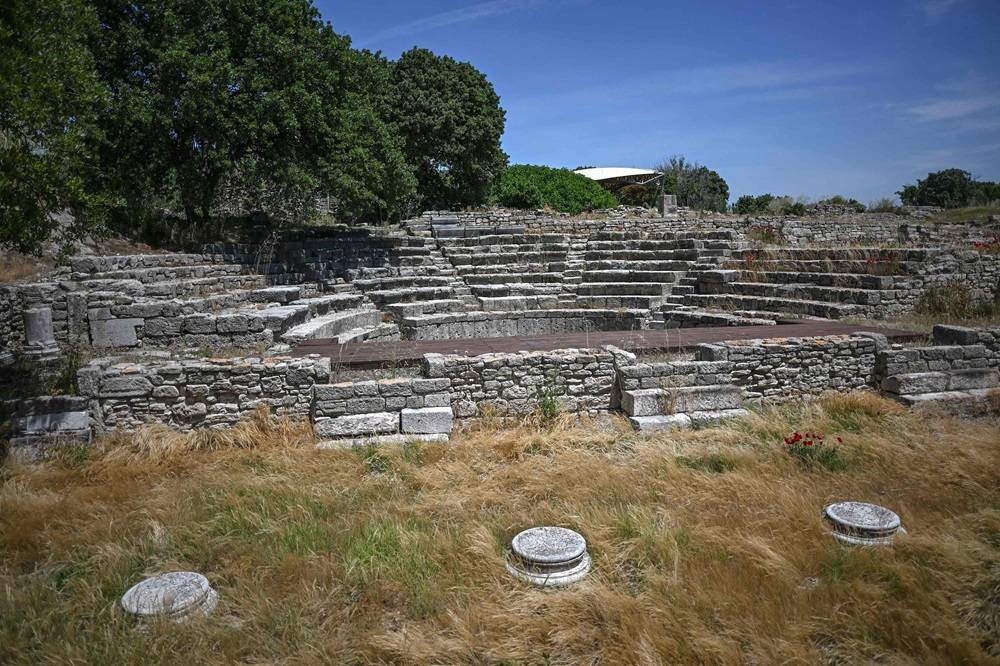
This photograph shows a view of the ancient theater in the ruins of the ancient city of Troy in Canakkale on June 2, 2026. (AFP)
- Western flank of the east -
"I spent a whole year just walking through the stones, maps in hand, trying to understand how they fit together," he told AFP.
His passion is evident for the site, which was founded in 3,000 BC and was constantly inhabited until being abandoned in the sixth century AD.
"It was the most western part of eastern civilization," which is what gave Troy its significance, Korpe said.
The Trojan War, which took place around 1,200 BC and lasted 10 years, until the siege and the city's defeat -- parts of which are recounted in the Iliad -- "was the first confrontation between the East and the West", he said of the Anatolian world and its Greek equivalent, referring to it as "the first world war".
It is an idea with strong resonance in these wooded hills, which several millennia later witnessed the World War I battles of 1915, when Allied troops suffered a bloody defeat trying to seize the Dardanelles from the Ottoman Empire.
A tourist takes a selfie photograph in front of the Trojan Horse, which was donated to be displayed at Canakkale Square following the release of the movie “Troy” in Canakkale on June 1, 2026. (AFP)
- Luwian hieroglyphics -
Of the hundreds of artifacts Türkiye has loaned to the Rome exhibition, more than 100 come from the Troy museum, some of which will be on display for the first time.
One piece is a bronze seal marked with hieroglyphics that was discovered in 1995, which offers important clues about the city's Anatolian roots.
"It's the only trace of writing found at Troy that was written in an Anatolian language, which proves that the first language spoken there was that of the Luwian peoples," explained museum director Sinem Duzgoren.
The Luwians were an ancient people who lived in western and southern Anatolia during the Bronze and early Iron Ages, whose language played a major role in the Hittite empire.
- From Wilusa to Ilion -
Although Troy was not a Hittite city, it was part of the Hittite empire, which referred to it as Wilusa. That became Ilion for the Greeks -- or Ilios for Homer.
"These pieces may not be the most spectacular, but they are the most important from a historical point of view, because they bear witness to the history of Troy," Duzgoren told AFP.
Also sent to Rome are a large number of weapons for use in war -- stones for use in a sling, knives, spears and arrowheads.
"These weapons are mentioned in the Iliad and date from the same period that they were mentioned by Homer," she said.
But it is a reality that is a far cry from the epic, romanticized fighting that plays out in Wolfgang Petersen's "Troy" (2004).
Apart from bequeathing the 12-ton replica of the Trojan Horse looming over Canakkale's waterfront, the film did a lot to fuel renewed interest in Troy, Korpe said.
"Neither the producers nor the director came here, even though that was when we made some of the most significant discoveries," he said sadly.
"But the number of tourists did grow, even if they were just looking for traces of Brad Pitt among the ruins!"
لم تشترك بعد
انشئ حساباً خاصاً بك لتحصل على أخبار مخصصة لك ولتتمتع بخاصية حفظ المقالات وتتلقى نشراتنا البريدية المتنوعة