Threatened by Israeli Airstrikes, Lebanon’s Cultural Sites Get Increased Protection from UN

Rubble lies at the site of the historic “Al-Manshiya” building damaged in the aftermath of Israeli strikes, near the Roman ruins of Baalbek, in the eastern city of Baalbek, Lebanon November 7, 2024. (Reuters)
TT

Threatened by Israeli Airstrikes, Lebanon’s Cultural Sites Get Increased Protection from UN

Rubble lies at the site of the historic “Al-Manshiya” building damaged in the aftermath of Israeli strikes, near the Roman ruins of Baalbek, in the eastern city of Baalbek, Lebanon November 7, 2024. (Reuters)

A specialized United Nations agency granted on Monday provisional enhanced protection to 34 cultural properties in Lebanon, including the World Heritage sites of Baalbek and Tyre, following recent Israeli strikes near them.

“Non-compliance with these clauses would constitute serious violations of the 1954 Hague Convention and would constitute potential grounds for prosecution,” the UN cultural and scientific agency UNESCO said in a statement. The decision also includes financial and technical assistance to safeguard Lebanon’s heritage.

The decision was made during an extraordinary session of the Committee for the Protection of Cultural Property that was held in Paris on Monday, at the request of Lebanese authorities.

This move comes amid mounting threats to Lebanon’s cultural sites. On Nov. 7, an Israeli airstrike destroyed an Ottoman-era building near the UNESCO-listed Roman temples of Baalbek in eastern Lebanon.

UNESCO Director-General Audrey Azoulay said: “UNESCO has a deep and long-standing cooperation with Lebanon. We will spare no effort to provide all the expertise and assistance needed to protect its exceptional heritage.”

In addition to legal protections, UNESCO said it has been implementing measures such as satellite monitoring, risk management training and emergency relocation of movable artifacts.


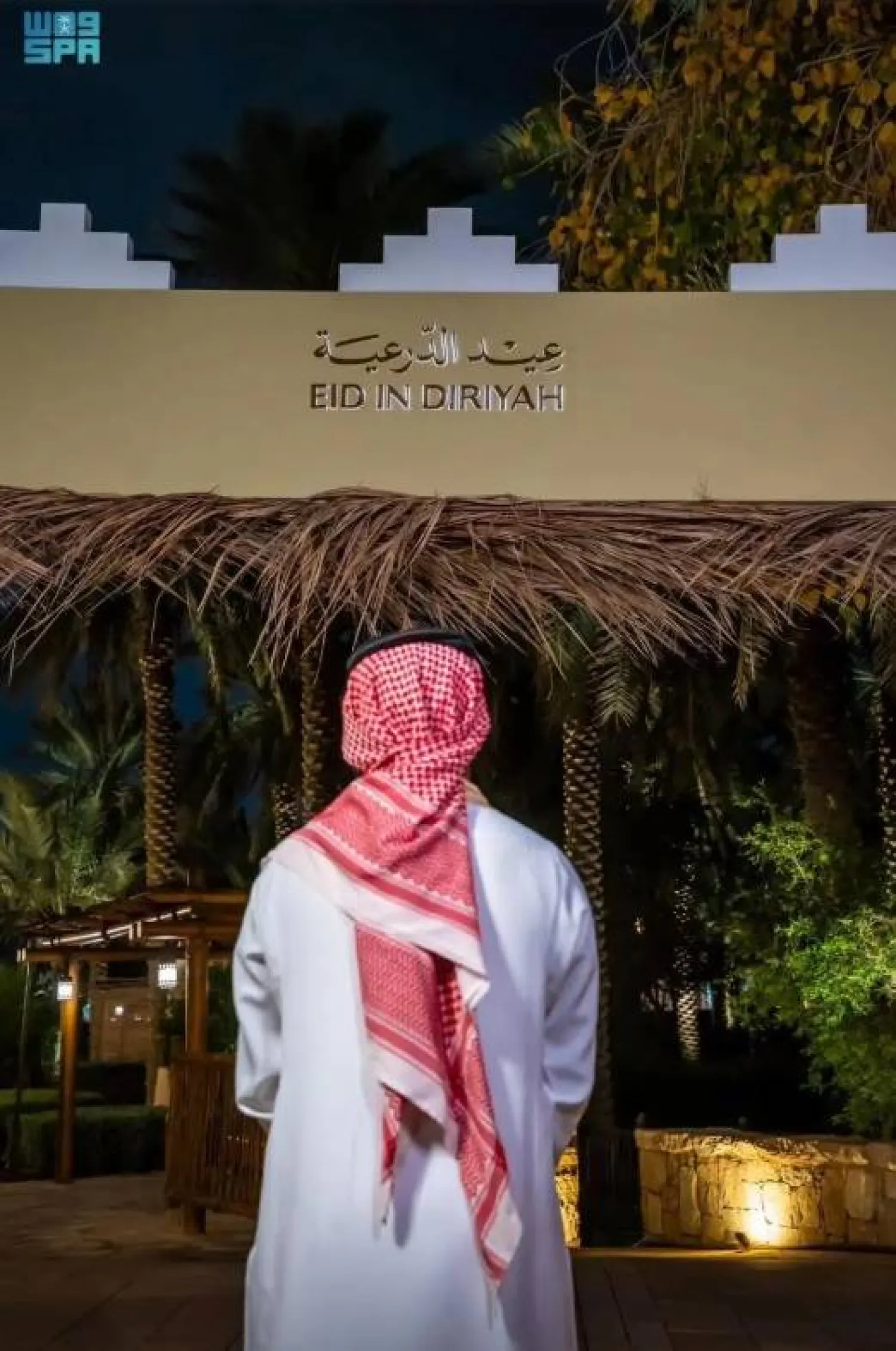
Saudi Arabia: DGDA Held Eid Cultural Program Across Diriyah

Diriyah Gate Development Authority (DGDA) held a three-day festive program. SPA
TT

Saudi Arabia: DGDA Held Eid Cultural Program Across Diriyah

Diriyah Gate Development Authority (DGDA) held a three-day festive program. SPA

The Diriyah Gate Development Authority (DGDA) held a three-day festive program celebrating Eid Al-Fitr from Friday to Sunday for residents and visitors of all ages.

The historic At Turaif District in Diriyah served as a central hub, featuring the Saudi Ardah dance at Salwa Palace and the “Hal Al-Qusoor” program, which uses interactive storytelling to highlight the history of the First Saudi State.

Festivities extended to Diriyah’s other districts, featuring traditional celebrations, folk performances, and family-friendly entertainment.

Children participated in specialized workshops focused on storytelling and creative writing, while family activities also highlighted Najdi heritage through play.

The programs focused on craftsmanship, offering workshops in arts and traditional trades such as accessory design, leather engraving, and the creation of custom oud mixtures, soap, and prayer beads.

These initiatives strengthen Diriyah’s position as a leading global cultural destination and align with Saudi Vision 2030 by enhancing the quality of life.


Matisse’s Last Years Cut Out -- But Not Pasted -- At Paris Expo

Artwork entitled "Autoportrait au chapeau de paille" by French artist Henri Matisse on display during the exhibition "Matisse 1941-1954" at the Grand Palais in Paris, France, 19 March 2026. (EPA)
TT

Matisse’s Last Years Cut Out -- But Not Pasted -- At Paris Expo

Artwork entitled "Autoportrait au chapeau de paille" by French artist Henri Matisse on display during the exhibition "Matisse 1941-1954" at the Grand Palais in Paris, France, 19 March 2026. (EPA)

The final years of Henri Matisse's artistic life, marked by the Nazi occupation of France and a brush with death and surgery, will light up a twilight retrospective opening next week.

From Tuesday, the Grand Palais in Paris will see a reunion of seminal series by the late French master, such as "Blue Nudes", "Jazz" or the monumental "La Gerbe" (The Sheaf), revealing the ageing painter's prolific work ethic despite his health woes.

The exhibition brings together 320 works, from media as varied as paintings, sketches, gouache cut-outs, textiles and stained glass, all drafted by the artist in the run-up to his death in 1954 at the age of 84.

Titled "Matisse 1941-1954", it chronicles a time when the Nazis considered Matisse a "degenerate" artist, during which he confessed to a friend that he came within a "whisker of death" after going under the surgeon's knife in 1941.

"At that time, he was therefore an elderly man, partially disabled and struggling to stand upright," said Claudine Grammont, the curator of the exhibition and a former director of the Matisse Museum in Nice.

Yet despite those woes, Matisse was about to embark on "the most prolific moment of his career", Grammont added.

"It's truly his apotheosis, meaning that the artist reaches a state of nonchalance, of detachment... in short, a moment of grace."

Grammont, who also heads the graphic art department at the French capital's famed Pompidou museum, bristles at the long-standing accusation that Matisse abandoned the art of painting for cut-outs in his old age.

"It has often been said, wrongly, that during this period Matisse stopped painting and did nothing but cut-out gouaches.

"Well, no: Matisse painted 75 paintings between 1941 and 1954."

Nonetheless, Matisse's supposed dotage was marked by an outbreak of inspiration.

"In 1950 alone, 40 works were produced. That's a lot for an 80-year-old man," Grammont said.

- 'Intimacy' -

Visitors will have until July 26 to catch the late Matisse's essential works, including the best part of his ornamentation for the Vence Chapel in southeastern France and its dozen paintings.

It also brings together four of his now-ubiquitous "Blue Nudes", which have become a modern cultural touchstone, visible on tourist-shop T-shirts and the walls of student bedsits alike, even despite criticism of the artist's supposed colonialism from his time in Tahiti.

Matisse would often work on pieces such as 1953's "La Gerbe", with its splash of vividly colored spiky cut-outs, at night, "because he was an insomniac", Grammont said.

For the curator, Matisse significantly altered his method in his final years, developing "a new iconographic vocabulary" through the cut-out to give his art a monumental scope.

Hence an exhibition on two floors, with spacious rooms capable of housing these large gouache cut-outs once pinned to the walls of his studio.

"What we wanted to recreate in the exhibition is this intimacy within the atelier," Grammont said.

"It's about being able to enter Matisse's studio and find yourself face to face with the artworks."


Türkiye in Cultural Diplomacy Push to Bring History Home

Türkiye's is waging an increasingly assertive campaign to recover antiquities illegally taken abroad. Ozan KOSE / AFP
TT

Türkiye in Cultural Diplomacy Push to Bring History Home

Türkiye's is waging an increasingly assertive campaign to recover antiquities illegally taken abroad. Ozan KOSE / AFP

When an ancient bronze statue of Roman Emperor Marcus Aurelius landed back on Turkish soil after decades abroad, it was more than a symbolic homecoming.

It marked the latest victory in Türkiye's increasingly assertive push to recover antiquities illegally taken abroad -- a campaign supported by a newly-developed AI tool for identifying cultural assets of Turkish origin.

The life-sized bronze, which dates back to the second- or third-century, was taken in the 1960s from the ancient city of Bubon near Türkiye's southwestern Antalya resort.

After a years-long investigation involving research, scientific testing and statements from now elderly witnesses, the headless statue arrived back in Türkiye last year.

Its repatriation from an Ohio museum involved cooperation with the US Department of Homeland Security and the Manhattan District Attorney's Office.

For Zeynep Boz, director of Türkiye's department for combating the illicit trafficking of cultural property, one moment stands out.

"I clearly remember when the computer finally processed the data and we saw the match come together. It was an exciting moment," she told AFP at Istanbul's archaeology museum.

That the statue survived at all is exceptional: in antiquity, bronze was a valuable raw material routinely melted down for weapons, coins or everyday objects.

"For this reason, bronze statues of this scale have rarely been preserved until today," she said.

For years, Cleveland's Museum of Art had dragged its feet, claiming there was insufficient evidence to prove where it came from, Boz said.

But that changed after archaeometry expert Professor Ernst Pernicka concluded there was "no doubt whatsoever" the statue came from Bubon, where an imperial shrine housed bronze sculptures of Roman emperors.

Soil and lead samples provided crucial scientific evidence which convinced the museum, Boz said.

"It was a long struggle. We were determined and patient and we won," Culture Minister Mehmet Nuri Ersoy said when the statue returned in July.

Türkiye has stepped up efforts to combat illicit antiquities trading and in 2025 alone secured the repatriation of 180 cultural artefacts.

- AI to identify trafficked objects -

Although its newly-developed AI-powered "TraceART" system was not involved in recovering the Marcus Aurelius statue, the tool helped identify two 16th-century Iznik tiles that were recovered from Britain this month.

Developed by the culture ministry, it scans images on sales platforms, auctions and social media to identify any cultural assets of Turkish origin that may have been trafficked, with flagged items sent for expert assessment.

TraceART went operational in 2025 and has since identified hundreds of objects for review, Boz said.

In January, Türkiye recovered an Anatolian-style marble head from Denver Art Museum in Colorado, said Burcu Ozdemir of the antiquities trafficking unit.

The museum contacted Ankara because the piece "had been donated by the wife of a US consul general who served in Istanbul in the 1940s", she said.

Türkiye's campaign also involves returning items to countries like Iran, China and Egypt.

"We returned two of the artefacts stolen from temples in China," Boz told AFP.

Türkiye also returned "a key of the Kaaba to Egypt" after realizing it had ended up in Türkiye illegally, she said of the cube-shaped stone structure at Makkah’s Grand Mosque.

- Ottoman tiles at the Louvre -

Türkiye is now seeking the repatriation of other antiquities taken during the Ottoman era: an ancient marble torso called the "Old Fisherman" from Berlin, and dozens of Iznik tiles held at France's Louvre museum.

"There's an assumption that artefacts taken in the 18th-19th centuries were acquired legally. We don't share that view," Boz said.

The illegal tile swap came to light in 2003 when one fell from the wall of an Ottoman-era library and on the back was the French manufacturer's mark.

The original and others were taken in the late 1800s by a Frenchman who claimed to be restoring them, then replaced them with fakes.

"We have repeatedly shared evidence with France and talked with the Louvre but no resolution has been reached," she said.

The tiles were on a panel by the tomb of Ottoman Sultan Selim II in the garden of the Hagia Sophia.

Today it bears a plaque in English, French and Turkish reading: "The tiles before us are replicas."

The originals are currently on display at a branch of the Louvre in Lens, 200 kilometers north of Paris, which says they were "bought in 1895".

The museum did not respond to several requests for comment from AFP.