


French Montana Chronicles Mom’s Sacrifice after Emigrating from Morocco in Doc Film ‘for Khadija’

French Montana arrives at the BET Awards on Sunday, June 26, 2022, at the Microsoft Theater in Los Angeles. (AP)
TT

French Montana Chronicles Mom’s Sacrifice after Emigrating from Morocco in Doc Film ‘for Khadija’

French Montana arrives at the BET Awards on Sunday, June 26, 2022, at the Microsoft Theater in Los Angeles. (AP)

If French Montana’s father never abandoned him as a teenager, the rapper believes he would not have grown into a popular figure who has earned three Grammy nominations.

Montana and his family left Morocco more than two decades ago in hopes of a better life in the US, but when times got tough, his father returned to their native country. Montana turned to New York City’s street life in the South Bronx for manly guidance while his mother served as the faithful backbone. It was his mother’s sacrifice to raise her sons as a single parent that inspired him to become a better man.

The “Pop That’’ rapper is telling that story in the documentary film “For Khadija,” a project named after his mother that recently premiered at the Tribeca Film Festival. The project touches on his rise as a successful recording artist and the plight of his single immigrant mother raising three sons.

“This is a story about the grind, the losses and the sacrifices,” said Montana about the documentary, which is executive produced by Drake and Sean “Diddy” Combs.

“That father figure left, and I had no guidance, so the streets became my father,” Montana said. “But my father didn’t’ have the right guidance himself. I think Allah moved him out of my life, because he had his own destiny for me. I’m sure (my father) wanted me to do a lot of things that he sees in his eyes. But I feel like when he left, French Montana took over.”

Montana’s music career includes several hits, including “Unforgettable” featuring Swae Lee. The Moroccan-born rapper earned his Grammy nominations through his songwriting endeavors on Kanye West’s “All Day” and being featured on “All the Way Up” with Fat Joe, Remy Ma and Infared. He’s also been actively fighting for global healthcare efforts in Uganda as a Global Citizen rap ambassador.

Montana feels no bitterness toward his father for leaving them during their stressful circumstances. His father wanted to return to Morocco for good after a couple opportunities didn’t pan out, but his mother was against taking the family back. She believed there were better opportunities in the United States.

“I ... respect the move he made, than if he would’ve stayed with us and we all suffered in New York,” he said. “I’m happy that he found his peace. If he stayed, I would have never been French Montana. Why would I be mad at him? That was the best thing he ever did for me as a man. He left me and I became a man. That’s how it’s supposed to be. The right way.”

With his mother having no work experience and unable to speak English, Montana said his father thought they would only last maybe a year or two before they too would return to Morocco. Instead, their time in America ultimately lasted 25 years.

In the documentary, Montana said he and his mother shared a heartfelt moment – which symbolized how her enduring faith helped them overcome a plethora of financial obstacles while she worked multiple jobs and prayed daily.

“When you see my mother kiss me on the forehead, it was us sacrificing, us going through the trials and tribulations,” he said. “It was really making the impossible come true. It was a miracle. It was no support except for the man upstairs.”

Director Mandon Lovett said he first became intrigued about Montana’s story after reading a 2012 article about him traveling to Morocco and seeing his father for the first time since the elder man left New York. Lovett was compelled by Montana’s story and wanted to one day work with him.

That moment came in 2017 when Montana took a trip to Morocco to film a music video for his song “Famous.” Through mutual acquaintances, the director was able to tag along and create a short sizzle reel.

After viewing all the material, Lovett said the story was strong enough to turn into a full-length project.

“From Morocco to New York, this story spans the globe,” said Lovett, who mentioned that Montana’s father has photos of all his sons through his apartment. “It’s a big, broad story. As French and I got to know each other, it took an even more of a turn which turned into a story that paid homage to his mother.”

Montana said naming the documentary after his mother was an easy decision after seeing Lovett’s finished product. The rapper said no accomplishment in his music career was greater than seeing his mother return to Morocco and hug her sister who she hadn’t seen in more than two decades.

“When we watched the film, I said to myself ‘This is bigger than me,’” he said. “When my mother hugged my aunt at the end, it was just a full circle moment. I came back to Morocco before my mother did. But the real warrior here, and the real struggle was her.”



Bad Bunny Positioned to Consolidate His Popularity in Brazil with First-Ever Performances

 Puerto Rican singer Bad Bunny performs during his "Debí Tirar Más Fotos" world tour at the Allianz Parque stadium in Sao Paulo, Brazil, on February 20, 2026. (AFP)
Puerto Rican singer Bad Bunny performs during his "Debí Tirar Más Fotos" world tour at the Allianz Parque stadium in Sao Paulo, Brazil, on February 20, 2026. (AFP)
TT

Bad Bunny Positioned to Consolidate His Popularity in Brazil with First-Ever Performances

 Puerto Rican singer Bad Bunny performs during his "Debí Tirar Más Fotos" world tour at the Allianz Parque stadium in Sao Paulo, Brazil, on February 20, 2026. (AFP)
Puerto Rican singer Bad Bunny performs during his "Debí Tirar Más Fotos" world tour at the Allianz Parque stadium in Sao Paulo, Brazil, on February 20, 2026. (AFP)

While Bad Bunny has dominated global charts, the superstar has not had quite the same success in Brazil, a country notoriously hard for foreign stars to win over due to a devotion to national artists.

But a shift that began with his Grammy-winning album "Debí Tirar Más Fotos" may accelerate further after his first-ever gigs in Brazil on Friday and Saturday in Sao Paulo.

Bad Bunny has come to Brazil at the peak of his career so far, following the phenomenal hype around his performance at the Super Bowl halftime show.

"It’s the best time to try and unlock a country like Brazil, at a time when he’s managed to dominate practically the entire world," said Felipe Maia, an ethnomusicologist who is pursuing a doctoral degree on popular music and digital technologies at Paris Nanterre University.

For years, the Puerto Rican artist born Benito Antonio Martínez Ocasio has been one of the most-streamed artists on the planet.

But neither the singer, nor his album, nor his songs were among the most played last year in Brazil, according to Spotify. The most streamed artists in the country on the platform in 2025 were all Brazilian.

In the land of samba, funk, bossa nova, choro, sertanejo, forro and pagode, among other Brazilian music genres, 75% of streaming consumption in Brazil focuses on national artists, according to the 2025 midyear music report of Luminate, a company specializing in entertainment industry data. Brazil is the country that most listens to its own music, it said.

Still, particularly since "Debí Tirar Más Fotos," the fever around Bad Bunny has made headway in Brazil. Only one performance was initially scheduled at the Allianz Parque arena, but it sold out so quickly the artist added an extra date, which also sold out.

By mid-afternoon on Friday, long queues had formed. Brazilian fans mixed with people from El Salvador, Colombia and Venezuela. Many came wearing straw hats — used by Bad Bunny and traditionally worn by jíbaros, rural Puerto Rican farmers.

Tickets on Ticketmaster, the official vendor, ranged from $50 to $210, but resellers on Friday were selling tickets for that same night for more than $830 — more than 2.5 times the minimum monthly wage in Brazil.

Flávia Durante, a Sao Paulo -based DJ who specializes in Latin American music, said that some Brazilians have a tendency to see Spanish-language music as corny due to the association with Mexican telenovelas, but that Bad Bunny pierced a bubble with his latest album.

"Nowadays everyone knows all the songs, they sing along and really get into it. I normally play him at the peak of the night. People request him, even at rock or 80s pop themed parties," Durante said.

Since the half-time Super Bowl show, that popularity has grown. Bad Bunny’s average streams grew by 426% on Spotify in Brazil in the following week compared with the previous one. Many songs experienced massive streaming surges, with "Yo Perreo Sola" leading the growth with a 2,536% increase.

‘Latino resistance’

During Brazil’s Carnival celebrations, Bad Bunny themed costumes were a fixture in Rio’s raucous, dazzling street parties.

Nicole Froio, a Colombian Brazilian writer specializing in Latin American cultural issues, went kitted out in a straw hat and plastic, tropical plants that echo the background of his latest album. It was the third Carnival in which Froio — who has two Bad Bunny tattoos and a third one planned — wore attire that evoked the Puerto Rican artist.

For a long time, Froio was the sole person among her Brazilian friendship group who liked Bad Bunny. She believes that Brazilians in general have trouble identifying themselves as Latino.

"There’s a lot of prejudice around Hispanic music and there were preconceptions against him because of his Puerto Rican accent, because people don’t understand him," she said.

Brazil’s Latino identity exists but it is diffuse and difficult to seize due to the variety within the continent-sized country, said Maia. But Bad Bunny succeeds in giving it emphasis, particularly in cosmopolitan cities such as Sao Paulo and Rio de Janeiro, he said.

Brazil, like other countries in the Americas, was listed by Bad Bunny in the Super Bowl halftime show, when he reminded the world that while "America" is used as a synonym for the US in the US, it is the name used across two continents.

Bad Bunny’s global success, including in Brazil, "reinforces that we’re part of this — that we belong," said 22-year-old Diogo da Luz, a longtime fan of the Puerto Rican ahead of Friday's concert. "He reinforces that we are one people and that we’re very united."

For Froio, who has been waiting to see him live for six years and will see him on Saturday, Bad Bunny "represents a Latino resistance."

She pointed to the fact that other Latin American superstars, including Anitta, Shakira, and Ricky Martin, have recorded full songs in other languages, while Bad Bunny has kept his music almost entirely in Spanish.

"For me, there’s a great authenticity in his sound that inspires me to be who I am and let everyone else deal with it," Froio said.


Political Drama Overshadows Berlin Film Festival Finale

Jury president Wim Wenders at the opening of the Berlin Film Festival which has been rocked by political controversy. Ronny HARTMANN / AFP
TT

Political Drama Overshadows Berlin Film Festival Finale

Jury president Wim Wenders at the opening of the Berlin Film Festival which has been rocked by political controversy. Ronny HARTMANN / AFP

The 76th Berlin Film Festival draws to a close on Saturday after 10 days in which the 22 films in competition were often overshadowed by a row over the role politics should play in filmmaking.

The controversy erupted at the beginning of the festival when jury president Wim Wenders answered a question about the German government's support for Israel by saying: "We cannot really enter the field of politics."

At the same press conference, he had earlier said that films had the power to "change the world" but in a different way from party politics.

"No movie has ever changed the ideas of a politician, but we can change the idea that people have of how they should live," Wenders, 80, said.

But his comments in response to the question on Israel prompted a storm of outrage.

Award-winning Indian novelist Arundhati Roy, who had been due to present a restored version of a 1989 film she wrote, pulled out of the event, branding Wender's words "unconscionable" and "jaw-dropping".

On Tuesday, a letter signed by dozens of film industry figures, including Javier Bardem, Tilda Swinton and Adam McKay, condemned the Berlin festival's "silence on the genocide of Palestinians".

- Films overshadowed -

The letter, drafted by the Film Workers for Palestine collective, accused the Berlinale of being involved in "censoring artists who oppose Israel's ongoing genocide against Palestinians in Gaza and the German state's key role in enabling it".

Director Tricia Tuttle, in her second year at the helm of the Berlinale, has firmly rejected the accusations, describing some of the claims in the letter as "misinformation" and "inaccurate".

She called for "cool heads in hot times" and expressed fears that the controversy was crowding out conversation about the films.

Among the standout entries in the official competition was "We Are All Strangers" by Anthony Chen.

Set in Chen's native Singapore, the film is a moving family drama which playfully satirizes the yawning social disparities to be found in the city-state's glittering skyscrapers.

German actress Sandra Hueller, who gained international acclaim for her roles in "The Zone of Interest" and "Anatomy of a Fall", received audience plaudits for her turn as the title character in "Rose" by Austrian director Markus Schleinzer.

The black-and-white drama tells the story of a woman passing herself off as a man in rural 17th-century Germany to escape the constraints of patriarchy.

- Repression in Iran -

Juliette Binoche, playing a woman caring for her mother with dementia, also moved cinemagoers in "Queen at Sea" by American director Lance Hammer, who had not made a feature film since 2008.

Sensitively, the film portrays the devastation Alzheimer's disease inflicts on a patient's loved ones.

"My husband's got dementia, so I have had a lot of background," a visibly moved actress Anna Calder-Marshall, who plays the ailing mother in the film, told a press conference.

The first major event of the film calendar also provided a platform for Iranian filmmakers to address the deadly crackdown on anti-government protests in their home country.

Director Mahnaz Mohammadi, who has spent time in Tehran's notorious Evin prison, presented "Roya", a searing portrayal of conditions in the jail and the traces they leave on prisoners' psyches.

Dissident director Jafar Panahi, who won the Cannes Palme d'Or for "It Was Just An Accident", also spoke from the Berlinale to denounce the Iranian government's repression of protestors, which international organizations say has left thousands dead.

"An unbelievable crime has happened. Mass murder has happened. People are not even allowed to mourn their loved ones," Panahi told a talk organized as part of the festival.

"People do not want violence. They avoid violence. It is the regime that forces violence upon them," Panahi said.

In December he was sentenced to one year in prison and a travel ban in Iran but has expressed his intention to return nevertheless.


Eric Dane, who Played 'McSteamy' on 'Grey's Anatomy', Dies at 53

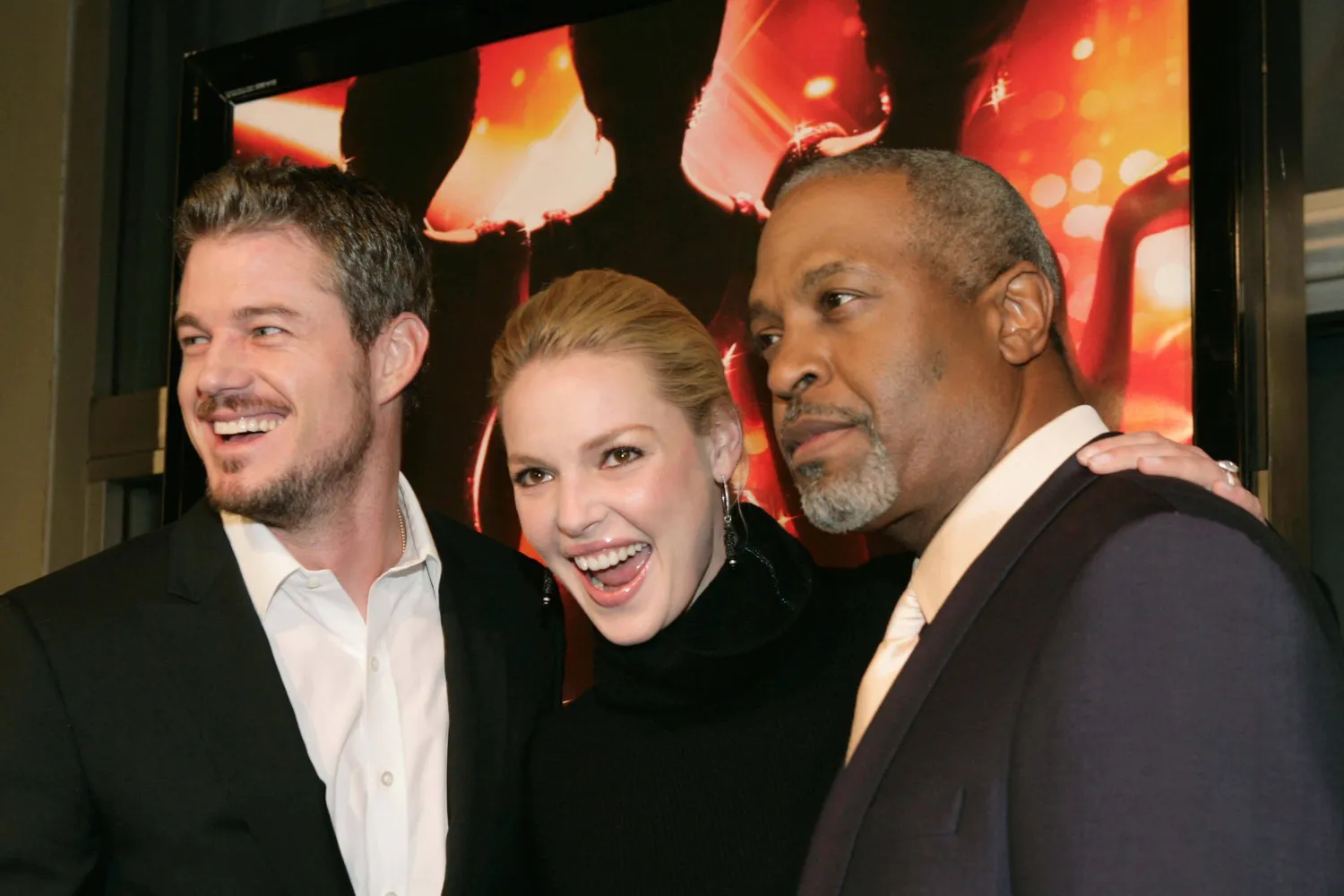
FILE - Actor Eric Dane, left, Katherine Heigl, center, and James Pickens Jr. from the show "Grey's Anatomy" arrive at the premiere of "Dreamgirls," in Beverly Hills, Calif., Dec. 11, 2006. (AP Photo/Matt Sayles, File)
TT

Eric Dane, who Played 'McSteamy' on 'Grey's Anatomy', Dies at 53

FILE - Actor Eric Dane, left, Katherine Heigl, center, and James Pickens Jr. from the show "Grey's Anatomy" arrive at the premiere of "Dreamgirls," in Beverly Hills, Calif., Dec. 11, 2006. (AP Photo/Matt Sayles, File)

Actor Eric ‌Dane, who played the handsome Dr. Mark Sloan on the hit television series "Grey's Anatomy," died on Thursday aged 53, his family said, less than a year after revealing that he suffered from amyotrophic lateral sclerosis, or ALS.

For 15 years, Dane played a plastic surgeon nicknamed "McSteamy" by female characters in the show. He also starred in the series "Euphoria," and said after the diagnosis he would still return to the set for ‌its third ‌season.

"Eric Dane passed on Thursday afternoon ‌following ⁠a courageous battle with ⁠ALS," his family said in a statement, according to People magazine and other media.

"He spent his final days surrounded by dear friends, his devoted wife, and his two beautiful daughters, Billie and Georgia, who were the center of his world."

ALS is a progressive ⁠disease in which a person’s brain ‌loses connection with the muscles. ‌It is also known as Lou Gehrig's disease after the ‌Hall of Fame baseball player who died from ‌it in 1941 at age 37.

"Throughout his journey with ALS, Eric became a passionate advocate for awareness and research, determined to make a difference for others facing the same ‌fight," Dane's family added, according to Reuters.

Dane and his wife, actor Rebecca Gayheart, the mother of their two ⁠children, ⁠separated in 2018 after 14 years of marriage.

But last March, just before Dane announced his diagnosis, Gayheart sought to dismiss her petition for divorce, People said, citing court documents.

Eric William Dane, the older of two brothers, was born on November 9, 1972, in San Francisco, to an architect father and homemaker mother, his biography on IMDB.com shows.

His first television role was in "The Wonder Years" in 1993, while 2005 brought his big break with "Grey's Anatomy." His big screen credits include "Marley & Me" and "X-Men: The Last Stand."