


McCartney’s Street Fare: High-Octane Fashion with a Playful, Eco Twist

A model presents a creation from the Spring/Summer 2025 Womenswear collection by British designer Stella McCartney during the Paris Fashion Week, in Paris, France, 30 September 2024. (EPA)
TT

McCartney’s Street Fare: High-Octane Fashion with a Playful, Eco Twist

A model presents a creation from the Spring/Summer 2025 Womenswear collection by British designer Stella McCartney during the Paris Fashion Week, in Paris, France, 30 September 2024. (EPA)

On an ordinary Parisian market street on an ordinary rainy fall day, Stella McCartney’s high-octane show on Monday was anything but. Guests gasped as the drizzle ceased, the clouds parted, and the sun emerged moments before the show — a heavenly metaphor, perhaps, for McCartney’s optimistic and nature-inspired display.

Here are some highlights of spring-summer 2025 ready-to-wear shows in Paris:

McCartney’s street fare

The designs were dazzling, fusing sparkle, wit, and sharp tailoring to capture a disco-ready sense of fun.

VIPs including Natalie Portman, Greta Gerwig, and Paris Jackson couldn’t resist tapping their feet amid the most infectious soundtrack of Paris Fashion Week thus far. Models strutted with clever hairstyles swaying theatrically, reminiscent of Gerwig’s own film, Barbie, adding another playful element to the spectacle.

Savile Row tailoring was reimagined in true Stella style — strong-shouldered jackets paired with slimline blazers and exaggerated belt loops, while voluminous trousers and cheeky boxer culottes kept things playful. This isn’t new territory for McCartney, who often reworks classic tailoring with an edge.

Pinstripe suits got a glamorous upgrade with clean satin lines and shimmering lead-free crystals, paired with cropped sporty jumpers — another of her signature juxtapositions of high fashion with an easygoing vibe.

Fluid draping was another runway star, from gravity-defying asymmetric silk gowns to vegan leather skirts folding over themselves. Cream bombers with wing-like cutouts and sheer dresses injected an ethereal flair.

Cloud-like creations were a showstopper.

“We had some of these clouds in the knitwear (made of) a yarn that’s made out of recycled plastic bottles, which is amazing,” McCartney said backstage.

Bird motifs took flight, literally and figuratively. Doves painted across silk and origami-inspired details were visual treats — harking back to McCartney’s years-long message to remember to protect nature.

‘Stella Times’ newspaper and Helen Mirren

McCartney’s show kicked off with Helen Mirren delivering a “Save What You Love” manifesto—more a direct punch than a gentle plea. Inspired by Jonathan Franzen’s “The End of the End of the Earth,” Mirren’s voice rang out, urging action before it’s too late. Birds, which are disappearing, were the symbol, a reminder of what’s at stake if we don’t get our act together.

Guests were also each given a newspaper made for the show humorously called the “Stella Times” that spelled out a tongue-in-cheek, yet serious, message about sustainability. McCartney's advice to readers to spur on positive action: “Read! Because I don’t think people read anymore.” And “get a copy of our newspaper. I’ll give you all of the information you need to know. Be more conscious, be more curious, and find out the facts of fashion to be more the future of fashion.”

McCartney has long been ahead of the game regarding eco-conscious fashion. She was one of the first designers to champion sustainability, well before it was on anyone else’s radar. With fashion being one of the world’s biggest polluters, her 91% conscious materials and animal-free production were another sign that the designer is taking the message seriously.

Sacai’s raw construction and deconstruction

A giant wooden structure of a house — just raw beams on display — set the scene for Sacai. It wasn’t just a striking venue, rather it served as a metaphor for Chitose Abe’s ethos: deconstruction and reconstruction in the most unexpected of ways. Like Abe’s clothing, the exposed beams represented an unfinished, yet powerfully architectural take on form and structure.

An urban T-shirt dress was paired with a black leather jacket sporting a ruffled, leg-of-mutton arm, a detail more often reserved for historical gowns. It was the embodiment of Abe’s dualities: urban biker meets historical drama, masculine melds into the overtly feminine.

Throughout the collection, the clever fusion of seemingly incongruent parts was front and center. A crisp white shirt was fused with a dark pleated skirt, set just under the bust. It was all one garment, and this mash-up exemplified Abe’s inventive approach to pattern-making. Her concept of hybridization — combining garments so they look like one thing from the front and another from the back — is more than a gimmick. It’s Abe’s groundbreaking way of challenging the very fabric of what fashion can be.

Another look was simplicity at first glance: a white toggled hoodie. But in true Sacai fashion, the back featured a floor-length, floppy skirt insert, transforming what could have been mundane into something extraordinary.

Volume and silhouettes were in abundance as well, with flattened, boxy shapes taking center stage.

The modest pieces — like the long black skirt fused into a white shirt — were emblematic of her recent exploration in monochrome and shifting her dissected garments into elevated territory.

Isabel Marant embraces crafty Amazonian spirit

Isabel Marant blended South American craftsmanship with the raw energy of an Amazonian warrior, her craft-heavy aesthetic on full display in a powerful celebration of femininity. There’s no “quiet luxury” here. Marant has always been unafraid to explore new territories, and this season she ventured into the tribalist punk influences of the early 1980s, blending it seamlessly with her love craft.

The runway was ablaze with sunset hues: rust, mauve, pink, and purple rippled across tasseled skirts and knot-constructed dresses, evoking the warmth of a Latin dusk. Marant is celebrated for embracing authenticity, and here she let her heritage sing loud and proud, with flat moccasin boots and suede satchel bags that harked back to the bohemian spirit she has championed for decades.

Marant’s strength lies in her ability to craft looks that marry accessibility with audacity, and the embellishments told this story well. Heavy gold bangles adorned models’ wrists as they strode in braided and embroidered silk dresses. The weathered black-gray denim blousons and studded black leather shorts hinted at a rebellious streak.

This season marked another chapter in Marant’s evolution as she leaned even further into craftsmanship — embroidered leather, blanket-stitched suede, and intricate knotting that felt deeply personal. The weighty, luxurious materials were balanced with slouchy, relaxed silhouettes. There’s an unpretentious ease here, a reminder that while Marant’s designs are fiercely statement-making, they are made to be lived in. It’s not about loud for the sake of loud, but about a woman standing confidently in her own skin.



A Nonprofit in France Is Fighting Fast-Fashion Waste, One Sneaker at a Time

 Mohamed Boukhatem, co-founder and director of SneakCoeurZ, a nonprofit organization giving used footwear a second life, poses in Champs-sur-Marne, east of Paris, Wednesday, March 25, 2026. (AP)
Mohamed Boukhatem, co-founder and director of SneakCoeurZ, a nonprofit organization giving used footwear a second life, poses in Champs-sur-Marne, east of Paris, Wednesday, March 25, 2026. (AP)
TT

A Nonprofit in France Is Fighting Fast-Fashion Waste, One Sneaker at a Time

 Mohamed Boukhatem, co-founder and director of SneakCoeurZ, a nonprofit organization giving used footwear a second life, poses in Champs-sur-Marne, east of Paris, Wednesday, March 25, 2026. (AP)
Mohamed Boukhatem, co-founder and director of SneakCoeurZ, a nonprofit organization giving used footwear a second life, poses in Champs-sur-Marne, east of Paris, Wednesday, March 25, 2026. (AP)

Hundreds of used sneakers arrive each week at a workshop east of Paris, where workers inspect them and ask a simple question: Can a shoe be saved?

The nonprofit SneakCœurZ is in the business of sorting the shoes to check which ones can be resold or redistributed, and which have to be rejected. It says it collected 30,000 pairs of used sneakers last year and resold 2,000 pairs, and wants to scale up that process.

“Today, there is no project of this scale in the sneaker sector,” said Mohamed Boukhatem, the organization's director general and co-founder. “We are the only ones able to industrialize both the processes and the collection of sneakers for reuse.”

The group's work underscores a growing waste problem in France, where the capital Paris is long one of the world’s fashion and luxury hubs.

The stakes are huge: the textile industry is among the world’s most polluting, and the fashion and textiles sector accounts for up to 8% of global greenhouse gas emissions, according to the United Nations. The European Parliament has said textiles were the third-largest source of water degradation and land use in the European Union in 2020.

Refashion, the French government-approved eco-organization for clothing, household linen and footwear, says 259 million pairs of shoes were sold in France in 2024.

It says only about a third of used textiles and footwear are separately collected, with much of the rest left in cupboards or thrown away with household waste.

At its workshop in Champs-sur-Marne, workers for SneakCœurZ inspect the used shoes and check which can be salvaged.

“The structural elements of the shoe are what determine whether we can refurbish it or not,” workshop manager Paul Defawes Abadie said.

“A damaged Velcro strap isn’t a deal breaker. A lace isn’t a deal breaker. Dirt is never a deal breaker,” he said. “What really matters is the wear of the structural materials, especially the outsole.”

Pairs that make the cut are cleaned from the sole upward, disinfected inside and, in some cases, whitened under UV light before being put back into circulation.

The nonprofit says it redistributed more than 7,000 pairs to people in need and helped create 19 jobs.

“Over the next three years, the goal is to triple or even quadruple these volumes and move to an industrial scale,” Boukhatem said.

France has tried to respond to the issue of fast-fashion waste with law, as well as rhetoric.

Its 2020 anti-waste law requires unsold nonfood goods to be reused, donated or recycled instead of destroyed.

Authorities introduced a state-backed repair bonus for clothing and shoes in November 2023. Separately, lawmakers are still working on a bill aimed at reducing the textile industry’s environmental impact.

The bill passed the National Assembly in March 2024 and the Senate in June 2025, and the government said in February that it was still aiming for a joint parliamentary committee this spring.


H&M's Q1 Profit Grows More Than Expected, Sees March Sales Up 1%

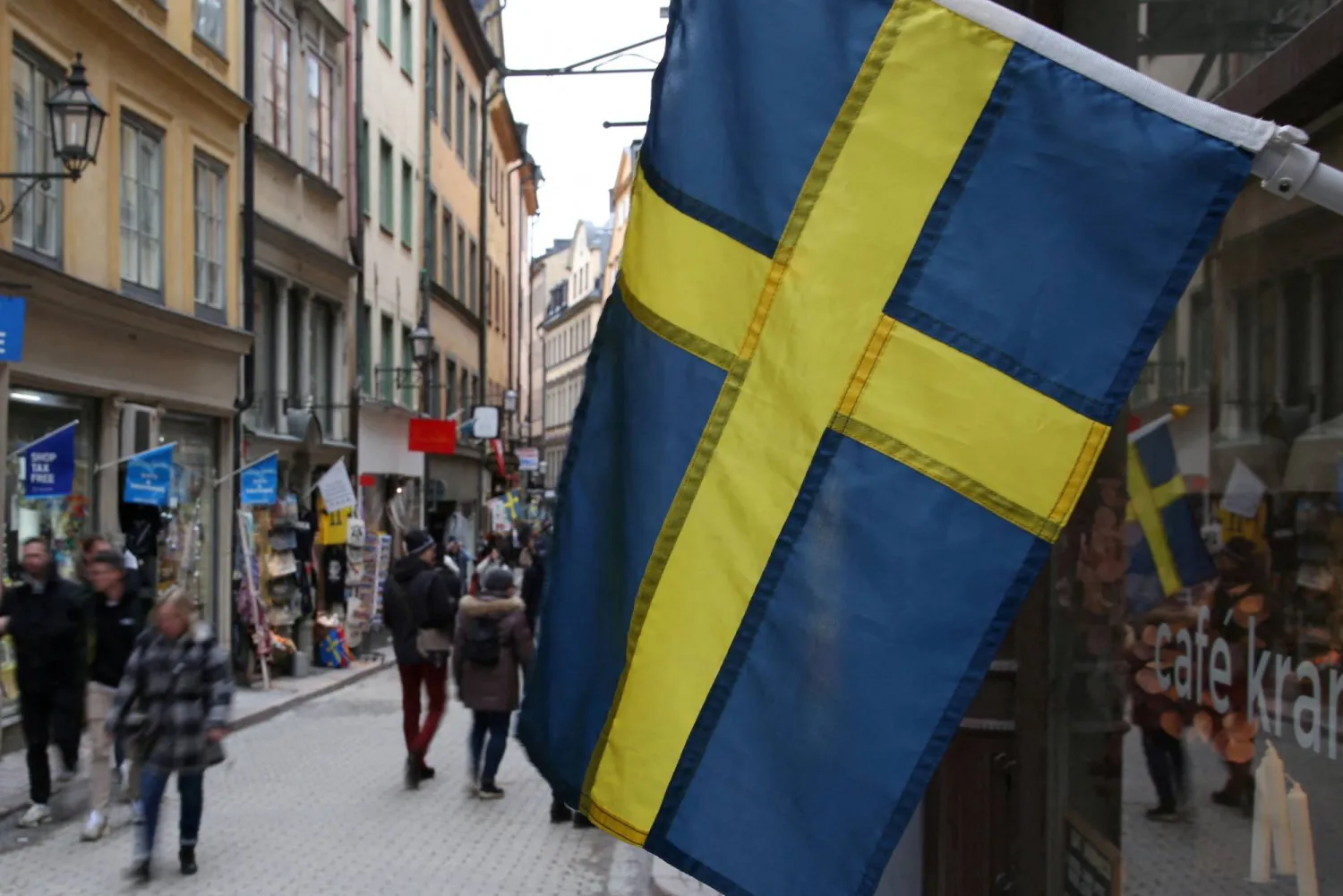
FILE PHOTO: A Swedish flag hangs outside a business on a street of the old city of Stockholm, Sweden, February 24, 2024. REUTERS/Tom Little/File Photo
TT

H&M's Q1 Profit Grows More Than Expected, Sees March Sales Up 1%

FILE PHOTO: A Swedish flag hangs outside a business on a street of the old city of Stockholm, Sweden, February 24, 2024. REUTERS/Tom Little/File Photo

Swedish fashion retailer H&M reported on Thursday a slightly bigger rise than expected in December-February operating profit, and predicted March sales would be up 1% in local currencies.

"Towards the end of the quarter our well-received spring collections contributed to a positive sales trend, which also continued into March," CEO Daniel Erver said in a statement.

Operating profit in H&M's fiscal first quarter, ⁠which includes the key ⁠Christmas shopping period, rose for a third consecutive quarter to 1.51 billion crowns ($162 million) from a year-earlier 1.20 billion and a mean forecast in an LSEG poll of analysts of 1.39 billion, on an organic sales decrease of 1%.

The rival ⁠to Inditex in January flagged that local-currency sales in the first two months of the quarter were down 2%.

According to Reuters, H&M said it is closely monitoring developments in the Middle East and the implications for global trade.

"With good flexibility in the supply chain and a low proportion of air freight, there are opportunities to adapt the flow of goods to changed conditions," it said. "Middle Eastern markets account for a ⁠small portion ⁠of the company’s total sales and the markets are operated through franchise partners."

On February 28, the United States and Israel launched coordinated strikes against Iran. Iran has in response launched strikes against Israel, US bases and Gulf states.

It has attacked vessels and infrastructure throughout the Gulf region and effectively closed the Strait of Hormuz, hitting global supply chains and causing soaring energy costs, raising concern over war-driven inflation and potential impact on consumer demand.


Next Says UK Sales Have Held Up Since Iran War Started

Women tour a popular outdoor shopping mall in Beijing, China, Sunday, March 8, 2026. (AP Photo/Andy Wong)
TT

Next Says UK Sales Have Held Up Since Iran War Started

Women tour a popular outdoor shopping mall in Beijing, China, Sunday, March 8, 2026. (AP Photo/Andy Wong)

British clothing retailer Next has not seen a noticeable drop off in UK sales since the US-Israeli war on Iran started at the end of February, its boss said on Thursday.

"Eight weeks, ⁠including the war ⁠weeks, have been good in the UK," CEO Simon Wolfson told Reuters after Next published full-year ⁠results.

He said sales in the Middle East, which account for about 6% of the group's annual turnover, fell "dramatically" in the first few days of the war and demand remains "suppressed.”

Wolfson said if ⁠Next ⁠did have to raise prices around June or July to make up for higher costs caused by the war, the increases would only be 1% to 2%.