
At 28, Bardella Could Become Youngest French Prime Minister at Helm of Far-Right National Rally

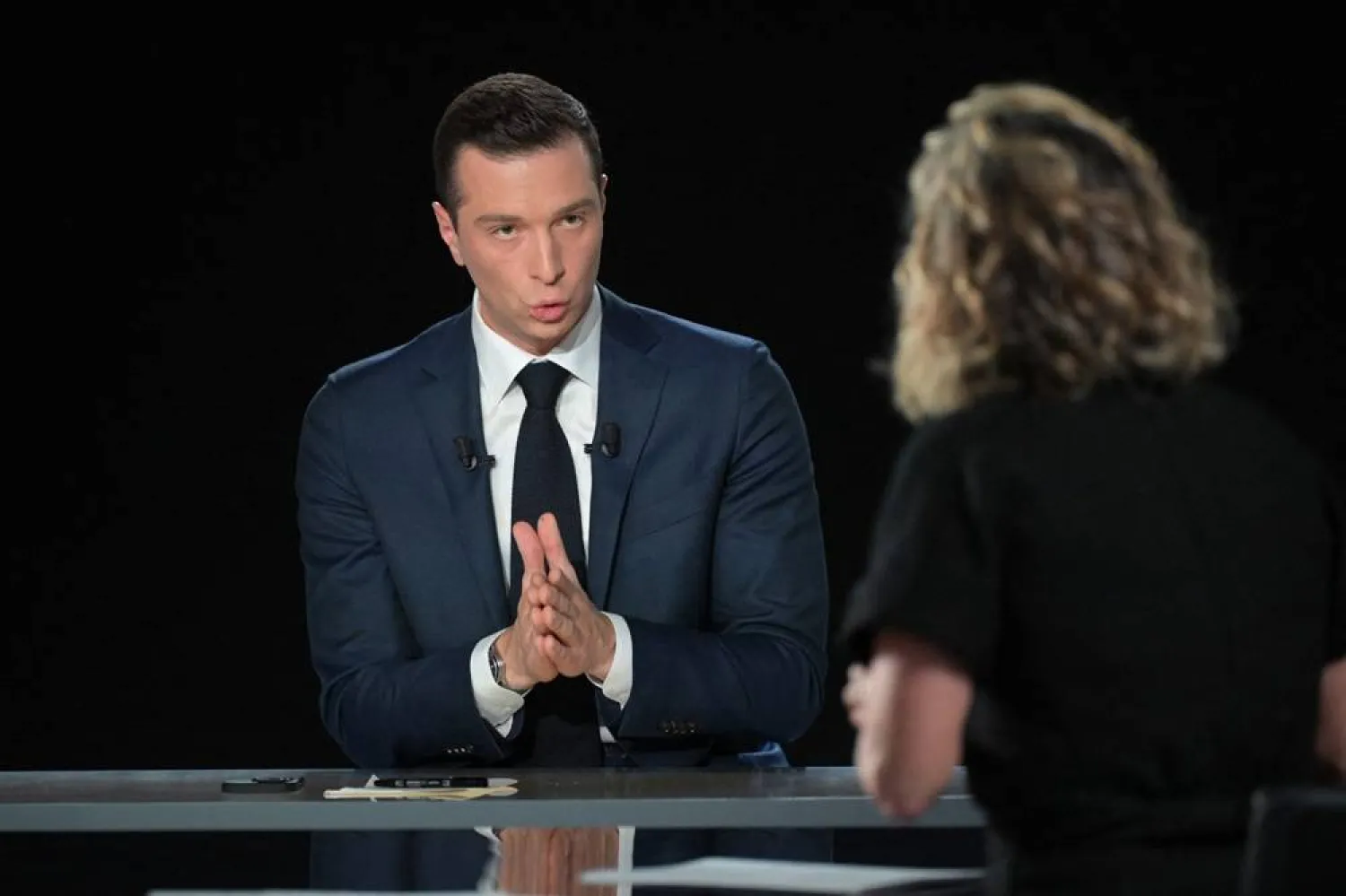
 French far-right Rassemblement National (RN) political party President and lead MEP Jordan Bardella (L) answers to French journalist Caroline Roux during the TV show "L'Evenement" broadcasted on French TV channel France 2 in Paris on July 4, 2024, ahead of the second round of the legislative elections. (AFP)
French far-right Rassemblement National (RN) political party President and lead MEP Jordan Bardella (L) answers to French journalist Caroline Roux during the TV show "L'Evenement" broadcasted on French TV channel France 2 in Paris on July 4, 2024, ahead of the second round of the legislative elections. (AFP)
TT

At 28, Bardella Could Become Youngest French Prime Minister at Helm of Far-Right National Rally

 French far-right Rassemblement National (RN) political party President and lead MEP Jordan Bardella (L) answers to French journalist Caroline Roux during the TV show "L'Evenement" broadcasted on French TV channel France 2 in Paris on July 4, 2024, ahead of the second round of the legislative elections. (AFP)
French far-right Rassemblement National (RN) political party President and lead MEP Jordan Bardella (L) answers to French journalist Caroline Roux during the TV show "L'Evenement" broadcasted on French TV channel France 2 in Paris on July 4, 2024, ahead of the second round of the legislative elections. (AFP)

At just 28 years old, Jordan Bardella has helped make the far-right National Rally the strongest political force in France. And now he could become the country's youngest prime minister.

After voters propelled Marine Le Pen’s National Rally to a strong lead in the first round of snap legislative elections on June 30, Bardella turned to rallying supporters to hand their party an absolute majority in the decisive round on Sunday. That would allow the anti-immigration, nationalist party to run the government, with Bardella at the helm.

Who is the National Rally president?

When Bardella replaced his mentor, Marine Le Pen, in 2022 at the helm of France’s leading far-right party, he became the first person without the Le Pen name to lead it since its founding a half-century ago.

His selection marked a symbolic changing of the guard. It was part of Le Pen’s decadelong effort to rebrand her party, with its history of racism, and remove the stigma of antisemitism that clung to it in order to broaden its base. She has notably distanced herself from her now-ostracized father, Jean-Marie Le Pen, who co-founded the party, then called the National Front, and who has been repeatedly convicted of hate speech.

Bardella is part of a generation of young people who joined the party under Marine Le Pen in the 2010s but likely wouldn't have done so under her father.

Since joining at age 17, he has risen quickly through the ranks, serving as party spokesperson and president of its youth wing, before being appointed vice president and becoming the second-youngest member of the European Parliament in history, in 2019.

“Jordan Bardella is the creation of Marine Le Pen,” said Cécile Alduy, a Stanford University professor of French politics and literature, and an expert on the far right. “He has been made by her and is extremely loyal.”

On the campaign trail, Le Pen and Bardella have presented themselves as American-style running mates, with Le Pen vying for the presidency while pushing him to be prime minister, Alduy said. “They are completely in line politically."

How did he become the movement’s poster child?

It wasn’t only having a different last name that made Bardella an attractive prospect for a party seeking to widen its appeal beyond its traditionally older, rural voter base.

Bardella was born in the north Parisian suburb of Seine-Saint-Denis in 1995 to parents of Italian origin, with Algerian roots on his father’s side — and far from seeking to deny these roots, he has used them to soften the tone (if not the content) of his party’s anti-immigration stance and its hostility to France’s Muslim community.

Although Bardella attended a semi-private Catholic school and his father was fairly well-off, party-sanctioned accounts have stressed his upbringing in a rundown housing project beset by poverty and drugs. Never having finished university, Bardella’s relatively modest background set him apart from the establishment.

What’s more, he could tell people directly — and crucially young voters — about it. With over 1.7 million followers on TikTok and 750,000 on Instagram, Bardella has found an audience for his slick social media content, which ranges from more traditional campaign material to videos mocking Macron and seemingly candid glimpses into the life of the National Rally’s would-be prime minister.

With a neat, clean-shaven look and social media savvy, he has posed for selfies with screaming fans. While his rhetoric is strong on hot-button issues like immigration — “France is disappearing” is his tagline — he has been relatively blurry on specifics.

What is he proposing for France?

It was Bardella who in a post on X called on Macron to dissolve the parliament and call early elections after the president’s centrist group suffered a crushing defeat by the National Rally at European elections in June.

When Macron did just that, Bardella, often wearing a suit and tie, hit the campaign trail, toning down his popstar image to seem more statesman-like despite his lack of experience in government.

In recent months, the National Rally has softened some of its most controversial positions, including pedaling back some of its proposals for more public spending and protectionist economic policies, and taking France out of NATO’s strategic military command.

Laying out the party's new program, Bardella said that as prime minister he would promote law and order, tighter regulation of migration and restricting certain social benefits, such as housing, to French citizens only. He said that dual citizens would be barred from some specific key jobs, such as state employees in the defense and security field.

He promised to cut taxes on fuel, gas and electricity, and pledged a rollback of Macron’s pension changes. His law-and-order minded government would also extend to the nation’s public schools, extending the ban on cellphones to high schools.

Rivals say his policies could do lasting damage to the French economy and violate human rights.

On the international front, Bardella has aimed to counter allegations that Le Pen’s party has long been friendly toward Russia and President Vladimir Putin. He said he regards Russia as “a multidimensional threat both for France and Europe,” and said he would be “extremely vigilant” of any Russian attempts to interfere with French interests.

Although he supports continued deliveries of French weaponry to Ukraine, he would not send French troops to help the country defend itself. He would also not allow sending long-range missiles capable of striking targets within Russia.

For voters with low incomes or who feel left out of economic successes in Paris or the globalized economy, Bardella offers an appealing choice, Alduy said.

“The feeling of vulnerability people have to factors that are beyond their control, calls for a radical change in the minds of many voters,” she said. “He has a clean slate and comes with no baggage of the past.”

Thousands Flock to Bethlehem to Revive Christmas Spirit after 2 Years of War in Gaza

 Palestinian scout bands parade toward the Manger Square near the Church of the Nativity, traditionally believed to be the birthplace of Jesus, on Christmas Eve, in the West Bank city of Bethlehem, Wednesday, Dec. 24, 2025. (AP Photo/Mahmoud Illean)
Palestinian scout bands parade toward the Manger Square near the Church of the Nativity, traditionally believed to be the birthplace of Jesus, on Christmas Eve, in the West Bank city of Bethlehem, Wednesday, Dec. 24, 2025. (AP Photo/Mahmoud Illean)
TT

Thousands Flock to Bethlehem to Revive Christmas Spirit after 2 Years of War in Gaza

 Palestinian scout bands parade toward the Manger Square near the Church of the Nativity, traditionally believed to be the birthplace of Jesus, on Christmas Eve, in the West Bank city of Bethlehem, Wednesday, Dec. 24, 2025. (AP Photo/Mahmoud Illean)
Palestinian scout bands parade toward the Manger Square near the Church of the Nativity, traditionally believed to be the birthplace of Jesus, on Christmas Eve, in the West Bank city of Bethlehem, Wednesday, Dec. 24, 2025. (AP Photo/Mahmoud Illean)

Thousands of people flocked to Bethlehem's Manger Square on Christmas Eve as families heralded a much-needed boost of holiday spirit. The giant Christmas tree that was absent during the Israel-Hamas war returned on Wednesday, overlooking a parade of scouts playing songs on bagpipes.

The city where Christians believe Jesus was born cancelled Christmas celebrations for the past two years. Manger Square had instead featured a nativity scene of baby Jesus surrounded by rubble and barbed wire in homage to the situation in Gaza, The AP news reported.

Cardinal Pierbattista Pizzaballa, the top Catholic leader in the Holy Land, kicked off this year's celebrations during the traditional procession from Jerusalem to Bethlehem, calling for “a Christmas full of light.”

Arriving in Manger Square, Pizzaballa said he came bearing greetings from Gaza's tiny Christian community, where he held a pre-Christmas Mass on Sunday. Among the devastation, he saw a desire to rebuild.

“We, all together, we decide to be the light, and the light of Bethlehem is the light of the world,” he told thousands of people, Christian and Muslim.

Despite the holiday cheer, the impact of the war in the Israeli-occupied West Bank is acute, especially in Bethlehem, where around 80% of the Muslim-majority city’s residents depend upon tourism-related businesses, according to the local government.

The vast majority of people celebrating were residents, with a handful of foreigners in the crowd. But some residents said they are starting to see signs of change as tourism slowly returns.

Loss of tourism devastates Bethlehem “Today is a day of joy, a day of hope, the beginning of the return of normal life here,” said Bethlehem resident Georgette Jackaman, a tour guide who has not worked in more than two years.

She and her husband, Michael Jackaman, another guide, are from established Christian Bethlehem families that stretch back generations. This is the first real Christmas celebration for their two children, aged 2 1/2 and 10 months.

During the war, the Jackamans pivoted to create a website selling Palestinian handicrafts to try to support others who have lost their livelihoods.

During the Gaza war, the unemployment rate in the city jumped from 14% to 65%, Bethlehem Mayor Maher Nicola Canawati said earlier this month.

A visitor from France, Mona Riewer, said that “I came because I wanted to better understand what people in Palestine are going through, and you can sense people have been through a very hard time."

Although friends and family cautioned her against coming due to the volatile situation, Riewer said being in Bethlehem helped her appreciate the meaning of the holiday.

“Christmas is like hope in very dark situations, a very vulnerable child experiencing harshness,” she said.

Despite the Gaza ceasefire that began in October, tensions remain high across much of the West Bank.

Israel’s military continues to carry out frequent raids in what it says is a crackdown on militants. Attacks by Israeli settlers against Palestinians have reached their highest level since the United Nations humanitarian office started collecting data in 2006. Israel captured the West Bank in the 1967 Mideast war.

The internationally recognized Palestinian Authority has limited autonomy in parts of the territory, including Bethlehem. Palestinian President Mahmoud Abbas is expected to attend midnight Mass for the first time in two years, the mayor said.

As poverty and unemployment have soared, about 4,000 people have left Bethlehem in search of work, the mayor said. It’s part of a worrying trend for Christians, who are leaving the region in droves.

Christians account for less than 2% of the West Bank’s roughly 3 million residents. Across the Middle East, the Christian population has steadily declined as people have fled conflict and attacks.

The beginning of a return to normal life Fadi Zoughbi, who previously worked overseeing logistics for tour groups, said his children were ecstatic to see marching bands streaming through Bethlehem's streets.

The scouts represent cities and towns across the West Bank, with Palestinian flags and tartan draped on their bagpipes, drummers spinning mallets adorned with pompoms. For the past two years, the scouts marched silently as a protest against the war.

Irene Kirmiz, who grew up in Bethlehem and now lives in Ramallah, said the scout parade is among her favorite Christmas traditions. Her 15-year-old daughter plays the tenor drum with the Ramallah scouts.

But her family had to wake up at 5 a.m. to arrive in time for the parade and waited upwards of three hours at Israeli checkpoints. The drive previously took 40 minutes without the checkpoints that have increasingly made travel difficult for Palestinians, she said.

“It's very emotional seeing people trying to bounce back, trying to celebrate peace and love,” Kirmiz said.

The Israeli Ministry of Tourism estimates 130,000 tourists will visit Israel by the end of December, including 40,000 Christians. In 2019, a banner year for tourism before the pandemic, the tourism ministry said 150,000 Christian tourists visited during Christmas week alone.

During the previous two years, the heads of churches in Jerusalem urged congregations to forgo “any unnecessarily festive activities.” They encouraged priests and the faithful to focus on Christmas’ spiritual meaning and called for “fervent prayers for a just and lasting peace for our beloved Holy Land.”


Israel Planning to Exploit Druze File to Weaken Sharaa’s Rule in Syria

Head of the Military Council, Tareq al-Shoufi, is seen with his fighters.
TT

Israel Planning to Exploit Druze File to Weaken Sharaa’s Rule in Syria

Head of the Military Council, Tareq al-Shoufi, is seen with his fighters.

After the ouster of former president Bashar al-Assad, Israel supported Druze fighters in the south, in an effort to weaken Syria’s new government under the rule of President Ahmed Al-Sharaa and thus complicate his efforts to unify the country after its long civil war, according to a Washington Post report on Tuesday.

Current and former Israeli officials said this policy was not an immediate reaction to developments, but rather the result of a pre-planning that began months before the collapse of the Assad regime.

Since 2024, Druze leaders in Israel sought out a Syrian Druze counterpart who could help lead the 700,000 Druze in Syria in case the Assad regime collapsed, two former Israeli officials directly involved in the effort said.

Tareq al-Shoufi

Israeli officials told the Washington Post that Israel turned to Tareq al-Shoufi, a former colonel in Assad’s army.

A former Israeli official recalled tapping “20 men with military experience, dishing out ranks and tasks, and beginning to work on what was called the ‘Military Council’” in the Druze stronghold of Sweida province in southern Syria.

At the time, the Military Council, led by Shoufi, enjoyed the support of Sheikh Hikmat al-Hijri, a fiery, 60-year-old Venezuelan-born Druze cleric who has called for the establishment of a self-governing Druze state backed by Israel, a founding member of the council said.

One the former Israeli officials said that to help Shoufi renovate an old building as a command center and buy uniforms and basic equipment, Druze members of the Israeli security establishment funneled him $24,000 via the Syrian Democratic Forces (SDF).

The official added that the money was meant to tide over the Council until the Assad regime fell.

SDF role

The Post revealed that the SDF played a pivotal role in supporting Druze fighters.

The former Israeli official and two Druze commanders in Syria said up to half-million dollars were separately sent by the SDF to Hijri’s forces.

The SDF also trained Druze fighters, including women, in Kurdish-controlled areas in northern Syria, with that training reportedly continuing to this day, according to a senior Kurdish official.

Arms confiscated from Hezbollah, Hamas

The Washington Post report said when the Assad regime fell on December 8, 2024, Israel sprang directly into action.

Weapons supplied to the Druze by Israel included arms previously seized by fighters from Hezbollah and Hamas. A Druze commander told the Post that they also received sniper rifles, night vision equipment and machine gun ammunition.

Israelis are also providing monthly payments between $100 to $200 to about 3,000 Druze fighters from Hijri’s forces, two Druze officials said, further demonstrating that it continues to maintain a counterweight to the central Syrian government.

‘Fluid’ situation

The report also revealed that Israel provided Druze fighters with anti-tank missiles and satellite imagery that were used during battles against Syrian government forces, giving them a clear field advantage.

Today, Israeli officials and others briefed on their thinking say the situation in Syria — and Israel’s policy toward the Druze — remain fluid, according to the Washington Post report.

Backing an independent state would create a situation where “Israel needs to now defend a population that’s 100 kilometers away from the border,” an Israeli adviser said. “If we have an interest here, it’s not to create an independent Druzistan.”

Israeli officials have also grown wary of the internal power struggles that emerged among the Syrian Druze.

In August, Hijri sought to be recognized as the sole legitimate military authority among the Syrian Druze, and the “National Guard,” a new militia led by Hijri and his son Suleiman, replaced the Military Council as the recipient of weapons from Israel, according to a Syrian Druze commanders and the two former Israeli officials directly involved.

The move led to schisms among Druze commanders.

After US President Donald Trump first shook hands with Sharaa in May, Israel in August halted the flow of weapons to the Druze, Israeli and Druze officials revealed.

Therefore, Israel’s support for the Druze is carefully calibrated.

Israeli analysts warned that propping up an autonomous Druze state or proxy militia would represent a far different mandate than cooperating with them to secure Israel’s border.

One government adviser noted that Israel did not have a “good experience in south Lebanon,” where it supported a pro-Israel militia called the South Lebanon Army for two decades before the group crumbled in the face of Hezbollah advances in 2000.

Druze state stretching to Iraq

A Western official told the Post that Hijri prepared maps of a proposed future Druze state stretching all the way to Iraq and pitched it to at least one major Western government in early 2025.

The newspaper revealed that Israel is using the Druze paper in South Syria to undermine Sharaa’s ability to centralize power.

It said Israel is practicing a “shadow” policy in Syria: planned support for minorities, limited military intervention and tactical openness to negotiation, without a clear commitment to a final political path.

The report shows that the future of Israel’s policy towards Druze in south Syria remains dependent on the ability of Sharaa’s government to consolidate its power over the entire territory, and how willing Washington is to balance its bets on Sharaa to restore stability in Syria and respond to Israeli security concerns.


‘No Male Visitors’: Gaza Rents Soar Under Tight Restrictions

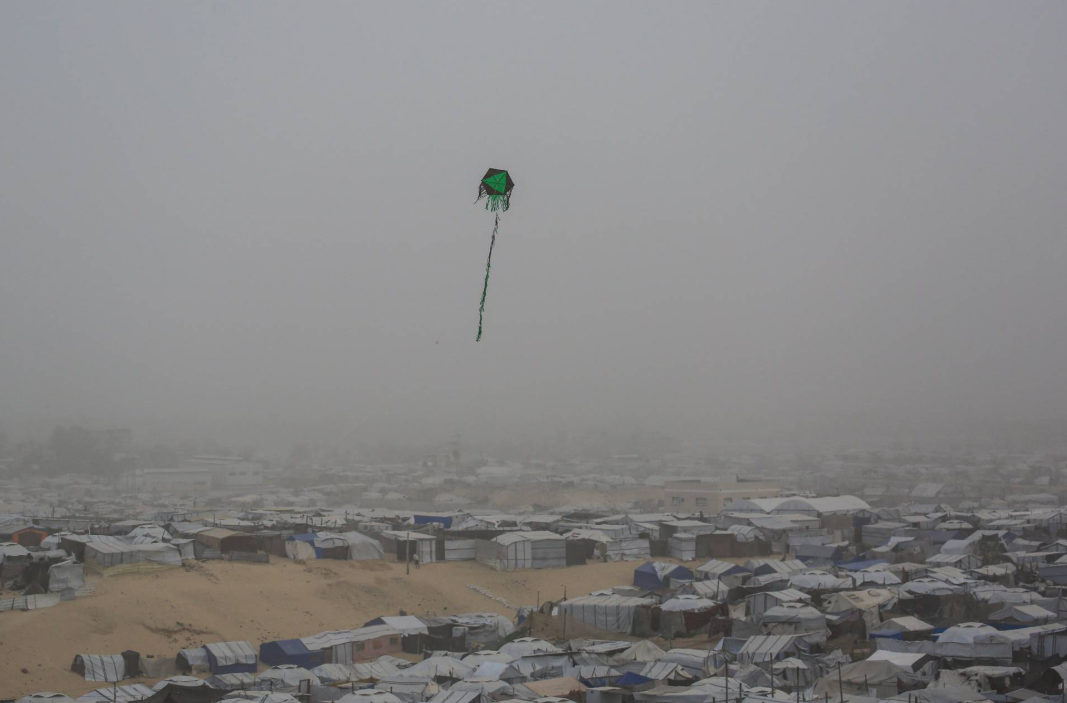
A woman sits next to her tent on an alley of a makeshift tent camp for displaced Palestinians in Deir al-Balah, central Gaza Strip, Tuesday, Dec. 23, 2025. (AP)
TT

‘No Male Visitors’: Gaza Rents Soar Under Tight Restrictions

A woman sits next to her tent on an alley of a makeshift tent camp for displaced Palestinians in Deir al-Balah, central Gaza Strip, Tuesday, Dec. 23, 2025. (AP)

For weeks, Nafez al-Ghorani has moved from one lead to another, spending long, punishing days searching for an apartment to rent, clinging to the hope of finding a roof for his family until they can return to their own home in Gaza.

A resident of Sheikh Radwan in the city’s north, al-Ghorani is now displaced in Khan Younis in the south, where his search has collided with a stark reality, as widespread destruction has left most homes and residential buildings uninhabitable.

Finding an apartment was not the only challenge facing al-Ghorani and hundreds of others each day. More difficult still are the complex conditions imposed by landlords when someone is fortunate enough to find a vacant unit.

Al-Ghorani, who currently lives in a tent in Khan Younis, told Asharq Al-Awsat that whenever he finds an apartment suitable for rent, the owner asks for a copy of his identity card to conduct background checks, either in his original neighborhood before his home was destroyed or through other parties, before approving the lease.

He said his requests were rejected several times for reasons he could not understand.

In one instance, after agreeing on rent with a landlord, al-Ghorani was surprised by a condition barring him from receiving any male visitors in the apartment, even his brothers, over fears that one of them might belong to a Palestinian faction, which could expose the building to an Israeli strike.

Al-Ghorani said he rejected the condition, and the landlord, in turn, refused to rent the apartment.

Al-Ghorani said that finding an apartment for rent, even at exorbitant prices, has become nearly impossible amid the complications imposed by homeowners who fear for their properties and their own safety.

While he considers such concerns a legitimate right, he pointed to what he described as excessive and sometimes unjustified conditions, including those that prevented him from renting despite the fact that neither he nor any of his five children belongs to any faction.

Forced choices

With only a small number of homes and apartments left standing in Gaza after widespread destruction across large parts of the enclave, residents fear being targeted by Israeli strikes as ceasefire violations continue following the truce that took effect on Oct. 10.

In a report published early this year, the United Nations Office for the Coordination of Humanitarian Affairs said 92 percent of housing units in Gaza have been destroyed or damaged.

The office said 436,000 housing units were affected by the war, with 160,000 completely destroyed and 276,000 partially damaged, some severely.

The report stated that more than 1.8 million people are in urgent need of emergency shelter and basic household essentials.

Fadl al-Shanti, who owns a six-story residential building in western Gaza City, said he cannot rent to anyone without first inquiring about them, calling it a fundamental right to protect his building and the lives of his family members who live in one of its apartments.

Speaking to Asharq Al-Awsat, he said Israel does not wait for permission when it decides to strike a suspected militant and has committed dozens of massacres against entire families and buildings to kill a single person.

“The lives of my family and those living in the building are a trust I carry as part of my responsibilities,” he said.

He added that as a building owner, he is not against his own people, whether they belong to a Palestinian faction or not, but said there are compelling circumstances and harsh conditions that cannot be ignored.

“I cannot sacrifice the lives of several families for one person who can find an alternative place,” he said.

Al-Shanti acknowledged that some landlords have sharply raised rents, yet demand among those forced to seek housing remains high. He said he personally raised the rent from prewar levels to about $800 from $500 previously, while most landlords now demand between $1,000 and $1,500 for apartments ranging from 130 to 170 square meters.

Before the war, rents ranged from $200 to $500, while furnished apartments rented for up to $700 per month.

A citizen without a homeland

Conditions imposed by landlords do not stop there. Some landlords refuse to rent to families with more than six members or impose conditions related to water, such as requiring tenants to share the landlord’s limited water allocation due to severe shortages.

It has also been noted that most apartment owners refuse to rent to people working in certain professions, such as journalists, medical staff and university professors, due to their repeated targeting by Israel during the war.

Haitham Omar, who was also searching for an apartment, said he was shocked by the excessive price hikes and the onerous conditions, in addition to payments demanded by brokers and intermediaries who market the apartments.

Speaking to Asharq Al-Awsat, he stated that a landlord demanded $1,300 per month for a two-room apartment with a kitchen and living room.

“I am a simple citizen working in a private sector company, and all I earn monthly is $550,” he said.

Even damaged units have not escaped high rents. Omar said the owner of a damaged apartment demanded about $600 a month, even though parts of it were covered with tarpaulins, describing the situation as unjust.

With bitterness in his voice, he added, “They were right to say that a home is a homeland, and today we are without a homeland.”

Even women are barred from visiting

Iman al-Attar, a young woman who works as an online intermediary between landlords and tenants, noted that some conditions are viewed by many as normal, adding that apartment owners fear that tenants may host displaced relatives in the same unit, which can affect building services.

She recounted an incident in which a landlord imposed a condition banning the tenant from receiving any guests, men or women, claiming that Israel had struck women because their husbands were faction members. She said the tenant rejected the condition outright.

As for banning male visitors, al-Attar said it has become a frequent practice and is now often included as a clause in rental contracts.

She did not deny that most apartment owners are exploiting the current situation, with no clear vision for reconstruction or a definitive end to the war, to impose their conditions and raise rents to excessive levels.