

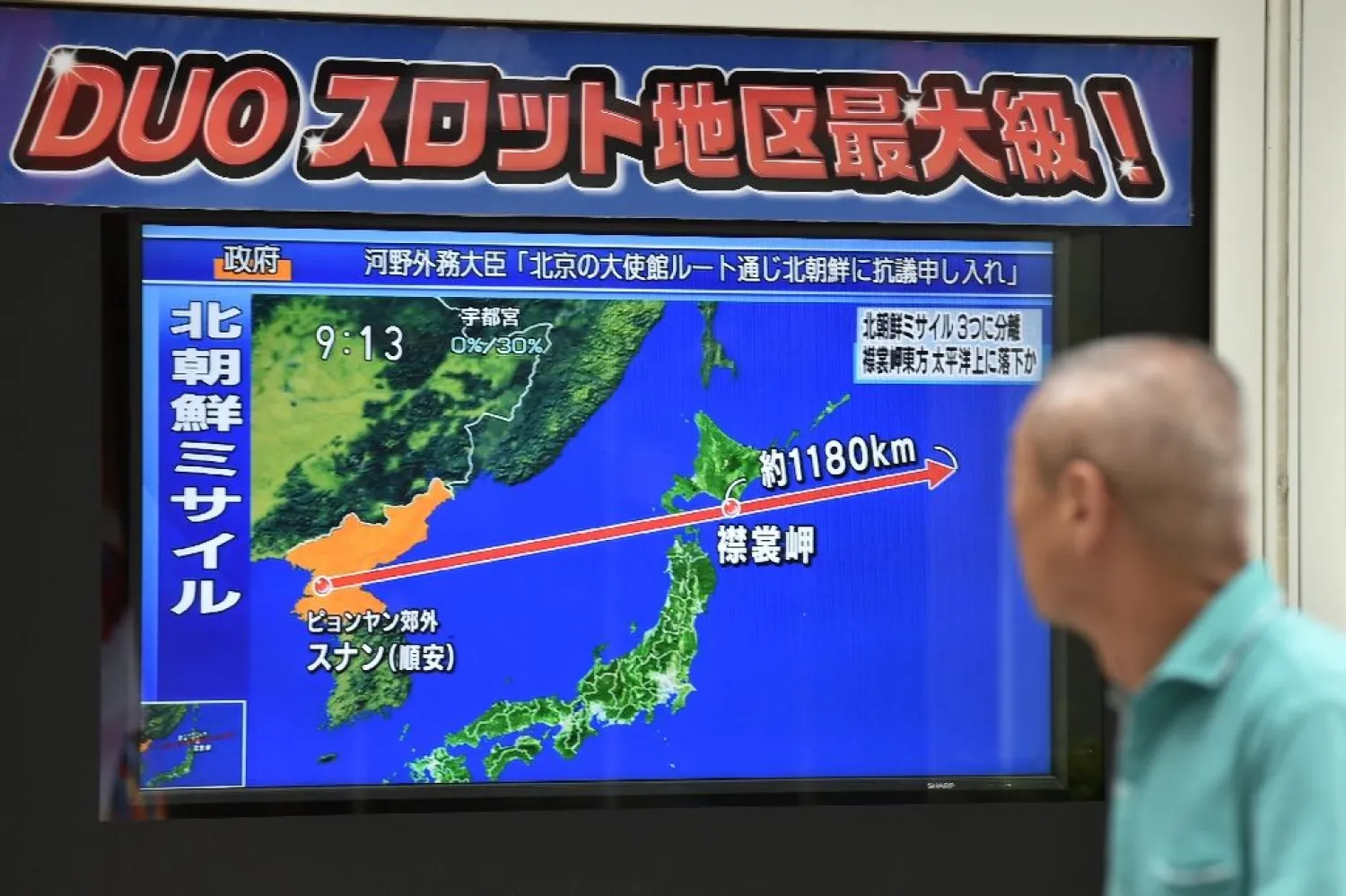

N.Korea Escalates Tensions by Launching Missile over Japan

A television screen displays a map of Japan and the Korean Peninsula, in Tokyo, on August 29, 2017, following a North Korean missile test that passed over Hokkaido island. (AFP)
TT

N.Korea Escalates Tensions by Launching Missile over Japan

A television screen displays a map of Japan and the Korean Peninsula, in Tokyo, on August 29, 2017, following a North Korean missile test that passed over Hokkaido island. (AFP)

In an unprecedented move, North Korea fired on Tuesday a mid-range ballistic missile over Japan’s northern Hokkaido island that landed into the northern Pacific Ocean and that sparked a critical reaction from Prime Minister Shinzo Abe.

The launch came as US and South Korean forces conduct annual military drills on the peninsula, to which North Korea strenuously objects.

The test, one of the most provocative ever from the reclusive state, appeared to have been of a recently developed intermediate-range Hwasong-12 missile, experts said. Japan’s Chief Cabinet Secretary Yoshihide Suga said the latest missile fell into the sea 1,180 km (735 miles) east of Cape Erimo on Hokkaido.

North Korea has conducted dozens of ballistic missile tests under young leader Kim Jong Un, the most recent on Saturday, but firing projectiles over mainland Japan is rare.

“North Korea’s reckless action is an unprecedented, serious and a grave threat to our nation,” Abe told reporters.

Abe said he spoke to Trump on Tuesday and they agreed to increase pressure on North Korea. Trump also said the United States was “100 percent with Japan”, Abe told reporters.

The United Nations Security Council would meet later on Tuesday to discuss the test, diplomats said.

South Korea’s military said the missile was launched from near the North Korean capital, Pyongyang, just before 6 a.m. (2100 GMT Monday) and flew 2,700 km (1,680 miles), reaching an altitude of about 550 km (340 miles). The length and type of the missile test seemed designed to show that North Korea can back up a threat to target the US territory of Guam, if it chooses to do so, while also establishing a potentially dangerous precedent of sending future missile tests over Japan.

“We will respond strongly based on our steadfast alliance with the United States if North Korea continues nuclear and missile provocations,” the South’s foreign ministry said in a statement.

In an unusual move, South Korea's military released footage of its own missile tests it says were conducted last week. The videos showed two types of new missiles with ranges of 800 kilometers (497 miles) and 500 kilometers (310 miles) being fired from truck-mounted launchers during three tests conducted on August 24.

South Korea's Agency for Defense Development said the launches represented the last flight test for the longer-range missile before it is operationally deployed. Such missiles, which would be the latest additions to South Korea's Hyumoo family of missiles, are considered key components of the so-called "kill chain" preemptive strike capability that the South is pursuing to counter the North's nuclear and missile threat.

South Korea also said its air force conducted a live-fire drill involving four F-15 fighters dropping eight MK-84 bombs that accurately hit targets at a military field near the country's eastern coast. Park Su-hyun, spokesman of South Korean President Moon Jae-in, said the exercise was conducted after Moon directed the military to "display a strong capability to punish" the North if need be.

South Korea and the United States had discussed deploying additional “strategic assets” on the Korean peninsula, the presidential Blue House said in a statement, without giving any more details.

North Korea remained defiant.

“The US should know that it can neither browbeat the DPRK with any economic sanctions and military threats and blackmails nor make the DPRK flinch from the road chosen by itself,” North Korea’s official Rodong Sinmun said later on Tuesday, using the initials of the North’s official name, the Democratic People’s Republic of Korea.

North Korea fired what it said was a rocket carrying a communications satellite into orbit over Japan in 2009 after warning of its plans. The United States, Japan and South Korea considered it a ballistic missile test.

Television and radio broadcasters broke into their regular programming with a “J-Alert” warning citizens of the missile launch. Bullet train services were temporarily halted and warnings went out over loudspeakers in towns in Hokkaido.

“I was woken by the missile alert on my cellphone,” said Ayaka Nishijima, 41, an office worker from Morioka, the capital of Iwate prefecture, 300 km (180 miles) south of Cape Erimo.

“I didn’t feel prepared at all. Even if we get these alerts there’s nowhere to run. It’s not like we have a basement or bomb shelter, all we can do is get away from the window,” she told Reuters by text message.

Earlier this month, North Korea threatened to fire four Hwasong-12 missiles into the sea near the US. Pacific territory of Guam after US President Donald Trump warned Pyongyang would face “fire and fury” if it threatened the United States.

Also in early August, the 15-member Security Council unanimously imposed new sanctions on North Korea in response to two long-range missile launches in July.

Some experts said Kim was trying to pressure Washington to the negotiating table with its latest test.

“(North Korea) think that by exhibiting their capability, the path to dialogue will open,” Masao Okonogi, professor emeritus at Japan’s Keio University, said by phone from Seoul.

“That logic, however, is not understood by the rest of the world, so it’s not easy,” he said.

The Japanese military did not attempt to shoot down the missile, which passed over Japanese territory around 6:07 a.m. local time (2107 GMT), Japanese Minister of Defense Itsunori Onodera said. The missile broke into three pieces and fell into waters off Hokkaido, he said.

Experts say defenses in Japan and South Korea that are designed to hit incoming missiles would struggle to bring down a missile flying high overhead.

In Washington, the Pentagon confirmed the missile flew over Japan but said it did not pose a threat to North America and that it was gathering further information.

The United States and South Korea are technically still at war with the North because their 1950-53 conflict ended in a truce, not a peace treaty. The North routinely says it will never give up its ballistic missile and nuclear weapons programs, saying they are necessary to counter perceived hostility from the United States and its allies.



US Judge Blocks Deportation of Columbia University Palestinian Activist

Mohsen Mahdawi at a press conference in Vermont last year - Photo by Alex Driehaus/AP
TT

US Judge Blocks Deportation of Columbia University Palestinian Activist

Mohsen Mahdawi at a press conference in Vermont last year - Photo by Alex Driehaus/AP

A US immigration judge has blocked the deportation of a Palestinian graduate student who helped organize protests at Columbia University against Israel's war in Gaza, according to US media reports.

Mohsen Mahdawi was arrested by immigration agents last year as he was attending an interview to become a US citizen.

Mahdawi had been involved in a wave of demonstrations that gripped several major US university campuses since Israel began a massive military campaign in the Gaza Strip.

A Palestinian born in the occupied West Bank, Mahdawi has been a legal US permanent resident since 2015 and graduated from the prestigious New York university in May. He has been free from federal custody since April.

In an order made public on Tuesday, Judge Nina Froes said that President Donald Trump's administration did not provide sufficient evidence that Mahdawi could be legally removed from the United States, multiple media outlets reported.

Froes reportedly questioned the authenticity of a copy of a document purportedly signed by Secretary of State Marco Rubio that said Mahdawi's activism "could undermine the Middle East peace process by reinforcing antisemitic sentiment," according to the New York Times.

Rubio has argued that federal law grants him the authority to summarily revoke visas and deport migrants who pose threats to US foreign policy.

The Trump administration can still appeal the decision, which marked a setback in the Republican president's efforts to crack down on pro-Palestinian campus activists.

The administration has also attempted to deport Mahmoud Khalil, another student activist who co-founded a Palestinian student group at Columbia, alongside Mahdawi.

"I am grateful to the court for honoring the rule of law and holding the line against the government's attempts to trample on due process," Mahdawi said in a statement released by his attorneys and published Tuesday by several media outlets.

"This decision is an important step towards upholding what fear tried to destroy: the right to speak for peace and justice."


Fire Breaks out Near Iran's Capital Tehran, State Media Says

Smoke rises from a fire caused by an explosion in Tehran (File photo - Reuters)
TT

Fire Breaks out Near Iran's Capital Tehran, State Media Says

Smoke rises from a fire caused by an explosion in Tehran (File photo - Reuters)

A fire broke out in Iran's Parand near the capital city Tehran, state media reported on Wednesday, publishing videos of smoke rising over the area which is close to several military and strategic sites in the country's Tehran province, Reuters reported.

"The black smoke seen near the city of Parand is the result of a fire in the reeds around the Parand river bank... fire fighters are on site and the fire extinguishing operation is underway", state media cited the Parand fire department as saying.


Pakistan PM Sharif to Seek Clarity on Troops for Gaza in US Visit

US President Donald Trump looks at Pakistan's Prime Minister Shehbaz Sharif speaking following the official signing of the first phase of the Gaza ceasefire agreement between Israel and Hamas, during a world leaders' summit on ending the Gaza war, in Sharm El-Sheikh, Egypt, October 13, 2025. REUTERS/Evelyn Hockstein/File Photo
TT

Pakistan PM Sharif to Seek Clarity on Troops for Gaza in US Visit

US President Donald Trump looks at Pakistan's Prime Minister Shehbaz Sharif speaking following the official signing of the first phase of the Gaza ceasefire agreement between Israel and Hamas, during a world leaders' summit on ending the Gaza war, in Sharm El-Sheikh, Egypt, October 13, 2025. REUTERS/Evelyn Hockstein/File Photo

Before Pakistan commits to sending troops to Gaza as part of the International Stabilization Force it wants assurances from the United States that it will be a peacekeeping mission rather than tasked with disarming Hamas, three sources told Reuters.

Pakistan's Prime Minister Shehbaz Sharif is set to attend the first formal meeting of President Donald Trump's Board of Peace in Washington on Thursday, alongside delegations from at least 20 countries.

Trump, who will chair the meeting, is expected to announce a multi-billion dollar reconstruction plan for Gaza and detail plans for a UN-authorized stabilization force for the Palestinian enclave.

Three government sources said during the Washington visit Sharif wanted to better understand the goal of the ISF, what authority they were operating under and what the chain of command was before making a decision on deploying troops.

"We are ready to send troops. Let me make it clear that our troops could only be part of a peace mission in Gaza," said one of the sources, a close aide of Sharif.

"We will not be part of any other role, such as disarming Hamas. It is out of the question," he said.

Analysts say Pakistan would be an asset to the multinational force, with its experienced military that has gone to war with arch-rival India and tackled insurgencies.

"We can send initially a couple of thousand troops anytime, but we need to know what role they are going to play," the source added.

Two of the sources said it was likely Sharif, who has met Trump earlier this year in Davos and late last year at the White House, would either have an audience with him on the sidelines of the meeting or the following day at the White House.

Initially designed to cement Gaza's ceasefire, Trump sees the Board of Peace, launched in late January, taking a wider role in resolving global conflicts. Some countries have reacted cautiously, fearing it could become a rival to the United Nations.

While Pakistan has supported the establishment of the board, it has voiced concerns against the mission to demilitarize Gaza's militant group Hamas.