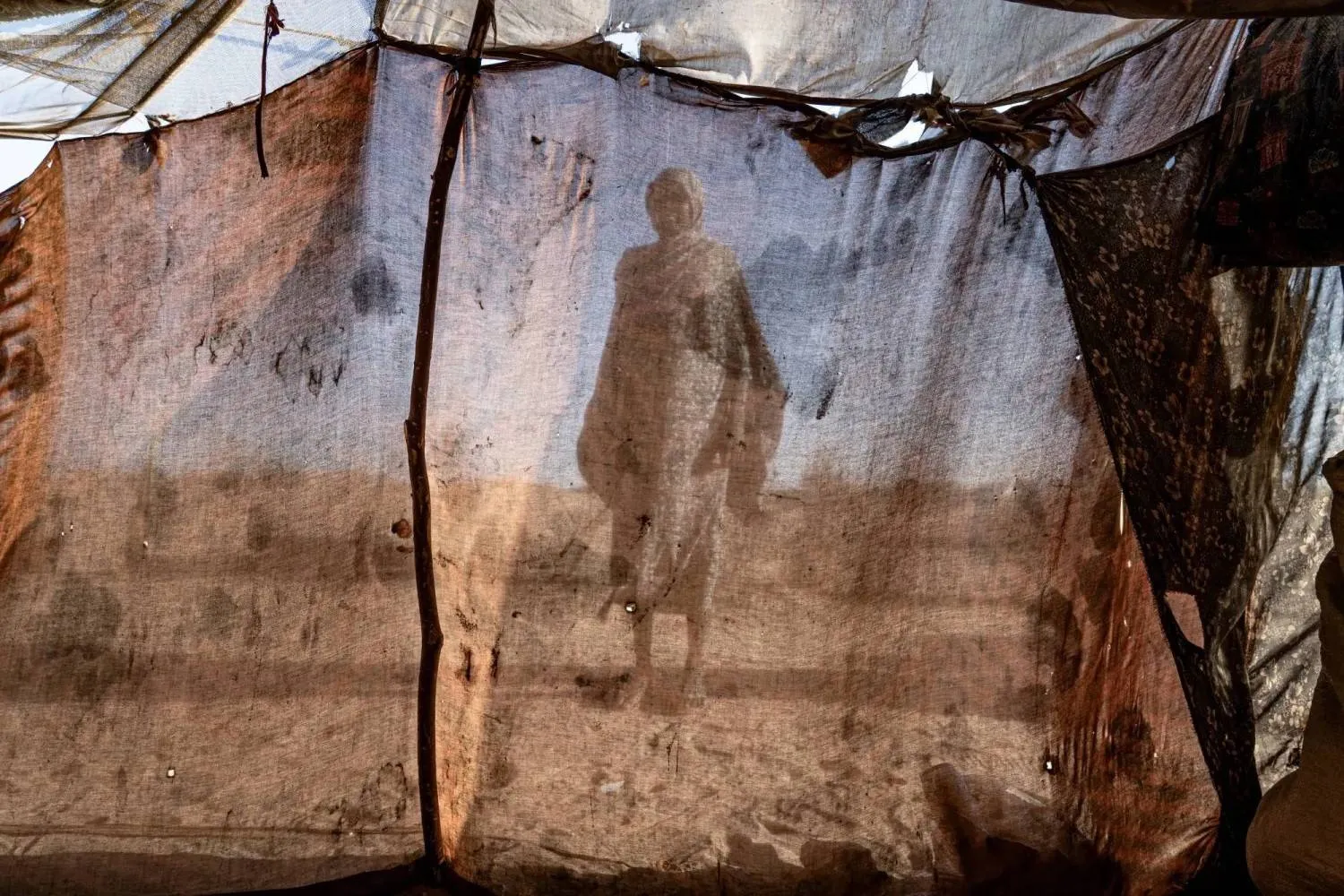
As Sudan’s war enters its fourth year, the stories of women and girls who survived sexual violence remain hidden behind the walls of shattered homes and overcrowded displacement camps. But survival has not meant recovery.
Between trauma, stigma, and silence, survivors’ suffering has stretched far beyond the moment of assault, becoming a long ordeal of pain, isolation, and instability.
This investigation is based on interviews conducted by Asharq Al-Awsat with survivors of conflict-related sexual violence, alongside a review of UN reports and documents issued by international organizations, legal experts, and psychologists. The names of survivors and some identifying details have been withheld to protect their safety and privacy.
In a country where war has hollowed out health care and mental health support, the chances of recovery are limited and often nonexistent. Survivors are left to face layered wounds that reach from body to mind, from the individual to the family, and into the wider social fabric.
Sexual violence has therefore become more than an act committed in wartime. It has become a prolonged crisis in which crime meets silence, and violation meets the failure of justice, leaving survivors trapped between what happened to them and a society that has yet to fully acknowledge or contain it.
“My mother barely recognized me”
One testimony begins in El-Azhari, south of Khartoum, where the survivor had lived with her family since the war began. Like thousands of families, they were forced to move between several areas before settling temporarily in Dar al-Salam in Omdurman.
During that period, the woman helped support the family by selling goods brought from Sabrin Market. Her father also sold goods, giving the family a reasonable income.
Her life changed when she was stopped on her way back from the market with her brother during Ramadan 2024. On the way back, they boarded a vehicle heading toward their residential area. Some passengers began questioning them about where they lived and what their father did for work.
The young woman said the group later took them to Dar al-Salam for questioning. She tried to deny some information, but her brother had already given details about the family. She was then taken to the prosecution office in the Libya Market area, where she was questioned by a commander from the Rapid Support Forces, who ordered her detention.
She was held for two days. On the third day, she was transferred to the commander’s house, where she was raped for the first time. A few days later, she was moved to another site and forced to work, cleaning, ironing clothes and doing other tasks, while sexual assaults continued repeatedly.
“They used to come to us at night, and when we refused, we were beaten,” she said. “The marks of torture are still visible on my body today. They put out cigarette butts on our bodies, and my legs now carry permanent scars and disfigurement.”
She said the assaults were not isolated incidents. They were repeated almost daily for months. “Some victims were raped several times a day, sometimes by more than one person,” she said, adding that there was no point in complaining or seeking help when there was no authority to turn to.
According to the young woman, she was held for about four months, during which she did not know what had happened to her brother. She eventually came across a man known to her family.
At first, he did not recognize her because her appearance and physical condition had changed so dramatically. She managed to get his attention and asked him to contact her family. He helped her reach the last RSF security point, from where she was able to return to the Souq al-Hur area and then to her family.
Her family had believed they had lost her forever.
“Even my mother barely recognized me at first because of how thin I had become and the huge changes in my appearance and mental state,” she said.
After a few days of rest, her mother took her to the hospital for medical tests. She also found a way to tell the father what had happened, fearing the shock would overwhelm him.
The young woman ended her testimony by saying her story was not an exception. It resembled the stories of other girls who had been detained, she said. The experience had not only stripped her of freedom and security but also damaged her future. She had been engaged before she was abducted and has still not been able to meet her fiancé or speak to him about what she endured.
What stands out in this testimony is not only the scale of the violations, but the structure behind them: arbitrary arrest, movement between informal detention sites, lack of oversight, and then transfer to semi-official locations where systematic abuses took place inside a sealed space. That structure recurs in other accounts, reinforcing the impression of a pattern rather than an exception.
Nor does this account appear isolated. It overlaps with several testimonies gathered by Asharq Al-Awsat from different areas, revealing similar patterns of detention and abuse against women during Sudan’s war.
“A woman handed me over, and my pregnancy did not protect me”
A woman from Bant East in Omdurman recounted a harsh ordeal during the first months of the war, when she was living with her husband while their child was receiving treatment at the Military Medical Corps hospital.
She said living conditions were extremely difficult. The family suffered shortages of food and basic necessities, while the journey to the Libya Market in far western Omdurman was dangerous because of checkpoints and incidents of arrest, beating and humiliation targeting civilians on the move.
Her pregnancy did not protect her. She was accompanying her sick child to the hospital while two months pregnant. There, she met a woman who appeared to share the family’s circumstances. That woman informed on her and handed her over to the RSF, exploiting her knowledge that the victim’s husband was an officer in the Sudanese army.
“That woman handed me over to RSF members at the Al-Rashideen section and told them I was the wife of an officer,” the survivor said. “I was held there for about a full month.”
She said she told them from the beginning that she was married and pregnant, pleading with them not to torture or beat her. They told her they would take action after she gave birth.
After a period of detention, she was moved to another section known as “Section 18,” where she was held with about 15 wives of military personnel and 12 other civilian women, most of them from Bant.
She said pregnant women were sometimes spared direct beatings, while others were repeatedly abused. The mistreatment included sexual assaults and violations against young girls. Fear, she said, prevented the detainees from objecting or even asking what was happening.
She said the wives of military personnel were pressured and forced to marry RSF members without witnesses or legal procedures. Those in charge of their detention told them openly that since they had not been able to kill their husbands with weapons, they would hurt them this way.
The woman said she repeatedly tried to convince them that she was already married. Each attempt was rejected. In the end, she was forced to marry an RSF commander, who moved her to Dar al-Salam in western Omdurman.
During her time in Dar al-Salam, she was held in a room and denied food and water. She was also regularly drugged, leaving her unable to move or focus and making that period blurred in her memory. Even after she escaped her captors and returned to her family, she still lives with doubt and anxiety over whether she was sexually assaulted during her long detention. She said the drugs and injections she was forced to take left her unaware of much of what happened around her.
The justice gap and the struggle for support
Sexual violence is difficult to document for many reasons. Still, official statistics recorded since the start of the war in Sudan have reached about 2,200 cases, according to State Minister for Human Resources and Social Development Salima Ishaq. She said the figure does not reflect the true scale of the problem, especially in Darfur, where victims are difficult to reach.
Speaking to Asharq Al-Awsat, Ishaq said such cases are handled through partnerships with national and international organizations and UN agencies.
She said only three cases had reached the courts. All members of the Sudanese army were involved, after their immunity was lifted. Verdicts were issued in Al-Obeid and White Nile.
As for violations attributed to the RSF, Ishaq said legal prosecution is not currently possible. She called for violations to be documented to ensure that perpetrators do not escape punishment in the future.
A UN report said the Office of the High Commissioner for Human Rights documented more than 500 cases of sexual violence in 2025, including rape, gang rape, sexual torture and sexual slavery. Some of the violations led to death.
The latest report by Médecins Sans Frontières said the organization provided care to more than 3,396 survivors of sexual violence in North and South Darfur between January 2024 and November 2025.
The report cited officials working to combat gender-based violence as saying incidents had increased in several forms, including domestic violence, harassment, and sexual exploitation.
MSF has described these crimes as a “hallmark” of Sudan’s conflict. The World Health Organization has warned that available figures probably represent only the “tip of the iceberg.”
Ishaq said the Health Ministry provides medical and psychological support protocols as much as possible, while legal support is provided in coordination with the public prosecution. She said services and responses vary from state to state, especially as weak funding remains one of the main challenges, “although issues of violence against women are a matter of saving lives, not a secondary issue,” as she put it.
Ishaq also disclosed a plan to establish new protection and shelter centers by integrating services without exposing survivors to stigma or loss of privacy, in an attempt to avoid the failures of earlier efforts.
She said going to court remains a personal choice for survivors, amid social and security fears that obstruct reporting. She stressed the need to provide a safe environment that guarantees confidentiality and protection, especially in a conservative society such as Sudan.
“I will not give up my child”
At the heart of these fears is the story of a survivor from Bahri. She was arrested during the first months of the war and endured a brutal experience of detention, torture and mistreatment that ended in pregnancy and intense social pressure.
In her testimony, the survivor said her suffering did not end when she left detention. A new phase of psychological and social pressure began after she returned to her family. Her mother repeatedly demanded that she give up the child and hand the baby over to care homes. She refused, insisting on her right to keep her child and saying the child bore no blame for what had happened.
“How can I give up a piece of myself?” she said. “I will face my problem and defend my child with all the strength I have.”
The young woman said her decision to keep her child placed her in constant confrontation with her family, society and hurtful attitudes from some people close to her, at a time when she was trying to recover from the ordeal she had survived.
She said what weighs on her most is not only the memory of detention and violations, which keeps returning to her, but also the constant, desperate need to defend her child’s right to life and to stay beside her, while she herself continues trying to recover from a catastrophic war that has destroyed her life.
Sexual violence as a weapon of war
Asharq Al-Awsat asked Ahmed Togod Lisan, spokesman for the Sudan Founding Alliance, known as Tasis, about the rape of women in areas under RSF control and the alliance’s position on accusations that sexual violence has been used as a weapon of war.
The spokesman said he had “reviewed the question, but found no material evidence supporting these accusations and sees no reason to comment on them.”
According to an official definition on the website of the political alliance known as Tasis, the Sudan Founding Alliance is a coalition of Sudanese political factions, armed movements, professionals, trade unions and civil society organizations united by a firm common will to achieve lasting peace, establish democratic rule and build genuine and comprehensive unity across Sudan.
Legal expert Moez Hadra, however, said the four Geneva Conventions of 1949 clearly provide for the protection of civilians during armed conflicts and criminalize the use of sexual violence as a grave violation of international humanitarian law. He said these principles were also included in Sudan’s 1991 Criminal Act, which criminalizes sexual assaults and violations committed against civilians as war crimes and crimes against humanity.
Speaking to Asharq Al-Awsat, he said Sudan faces a real crisis in the path to justice, with no effective justice system capable of holding perpetrators accountable, alongside the collapse of judicial institutions and weak national justice tools. He also said the Human Rights Council had formed a fact-finding committee on violations, but the Sudanese government did not approve its entry, complicating prospects for investigation and accountability.
Hadra said current national and international mechanisms appear unable to fully perform their accountability role, while the domestic justice system is undergoing a broad collapse.
He said the jurisdiction of the International Criminal Court is currently limited to crimes committed in Darfur, calling for it to be expanded to cover all of Sudan so perpetrators of grave violations can be pursued wherever the crimes occurred.
The limited number of cases that have reached the courts, compared with the scale of reported violations, reflects the gap between documenting crimes and prosecuting perpetrators, amid the security, legal and institutional challenges imposed by the continuing war.
Shocking statistics
UN Women has estimated that 12.7 million people, most of them women and girls, will need support related to sexual and gender-based violence in 2026 alone. That is up from 3.1 million in 2023, an increase of more than 500,000 people since 2025. It is also nearly twice the number recorded in 2024 and four times the level before the conflict erupted in Sudan.
According to a study by the UN Population Fund in Sudan, 76% of women aged 25 to 49 feel unsafe, whether inside displacement sites or outside them.
In April, UN Women said sexual violence, which had risen steadily in 2025, had escalated sharply this year, amid rising incidents of harassment, exploitation and domestic violence.
The agency published an alert highlighting the disproportionate impact of three years of war on women and girls. It was based on survey data from 85 women-led and women’s rights organizations, along with two focus groups and reports from UN and other international agencies.
The agency said in its report that “two-thirds of women working on the front lines reported a noticeable increase in sexual violence during 2025, while half of participants said it had escalated during 2026.”
No sense of safety
“Women and girls across Sudan recount stories of constant danger. Gender-based violence has become part of their daily lives, whether along roads as they try to flee the ongoing conflict or when they arrive in displacement camps.”
That was the assessment of Fabrizia Falcioni, UNFPA’s representative in Sudan, during a briefing to reporters in New York on April 17, 2026, by video link from Khartoum. She highlighted the deteriorating conditions facing women and girls in the country, saying women “feel unsafe wherever they are.”
The assessment is based on a UNFPA study involving about 1,000 women and girls in 16 of Sudan’s 18 states. The findings showed that 76% of women aged 25 to 49 feel unsafe, whether inside or outside displacement sites, including in markets, at water points, in firewood collection areas and on roads, especially at night.
The UN official said insecurity also reaches into daily life, noting that the “sense of insecurity” is compounded by power cuts and cities going dark at night. She said reporting of gender-based violence remains limited because of stigma, fear of retaliation, financial constraints and the distance to service centers.
Deep psychological wounds
Psychologist Khadija Mohammed al-Obeid said survivors of sexual violence in armed conflicts and wars face strong and complex psychological effects. Trauma does not end with the assault itself. It is worsened by displacement, war, and the loss of safety.
Speaking to Asharq Al-Awsat, she said one of the most serious psychological effects survivors may suffer is post-traumatic stress disorder, marked by repeated flashbacks of the painful event, nightmares and disturbing dreams, as well as avoidance of people, places or situations that recall the incident.
Survivors may also suffer constant hypervigilance, fear and anxiety, directly affecting their daily lives and social relationships.
Al-Obeid stressed the importance of providing psychosocial support to survivors of sexual violence through safe spaces that preserve privacy and human dignity.
She said survivors must be connected to support networks and specialized services to ensure they receive appropriate care and treatment, helping them recover and resume normal life.
The void in mental health support
Conflict-related sexual violations are not passing incidents. They are lasting wounds that reshape survivors’ lives amid continuing struggles for support, protection and justice.
The testimonies reveal not only the scale of the violations, but the depth of the void they leave behind: a void in mental health support, legal protection and social response, which in many cases still leans toward silence rather than confrontation. While the actors in the war multiply, women remain at its most vulnerable center, and among those least able to reach justice.
Continued impunity does not threaten survivors alone. It entrenches the cycle of violence and turns the crime into a pattern that can be repeated. Confronting these violations is therefore not only about the past. It is also about the future: the future of justice, the credibility of institutions, and society’s ability to recover from the effects of war.
As the war continues to reshape the lives of millions of Sudanese, the suffering of survivors of sexual violence remains one of its harshest consequences, and one of the least visible to the public.