
Iran, Iraq and Turkey Seek Triple Military Alliance

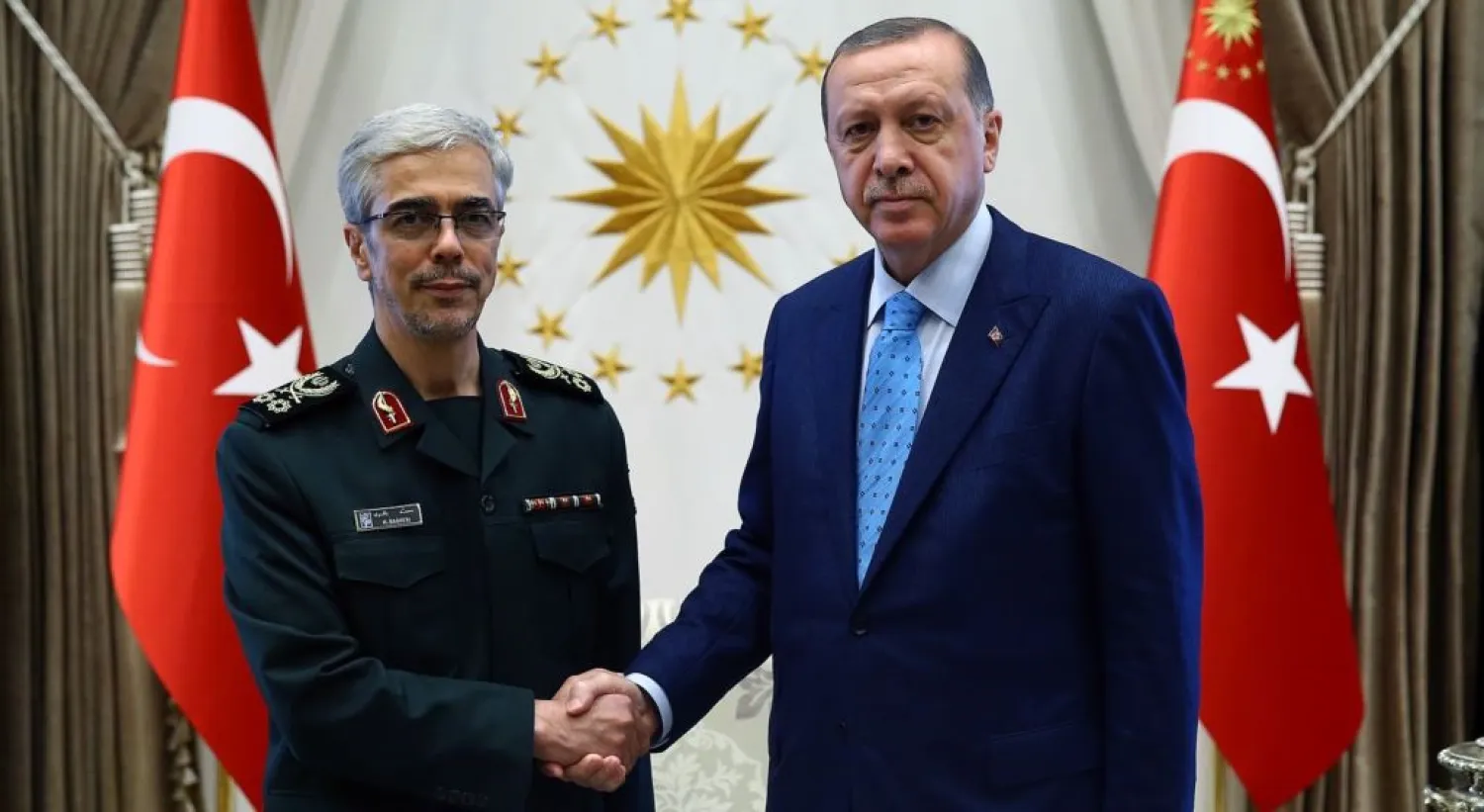
Turkish President Recep Tayyip Erdogan greets the chief of staff of Iran’s armed forces, Muhammad Hussein Baqeri, in Ankara on August 16. (Reuters)
TT

Iran, Iraq and Turkey Seek Triple Military Alliance

Turkish President Recep Tayyip Erdogan greets the chief of staff of Iran’s armed forces, Muhammad Hussein Baqeri, in Ankara on August 16. (Reuters)

Iran, Iraq and Turkey have agreed to create a triple military alliance as the first step towards growing cooperation in mutual defense and regional security.

The creation of the “military triangle” was highlighted yesterday in a report published by Fars News Agency, the principal news outlet for the Islamic Revolutionary Guard Corps (IRGC).

According to the report the idea of alliance was raised in the recent trip to Ankara by Iran’s Chief of Staff of Armed Forces General Muhammad Hussein Baqeri at the head of a 40-man delegation, during high-level meetings with Turkish leaders including President Recep Tayyip Erdogan.

Baqeri’s visit was the first of its kind by the highest Islamic Republic military commander to a member-state of the North Atlantic Treaty Organization (NATO). Its historic importance was subsequently highlighted by the visit to Tehran of the Turkish Chief of Staff Gen. Hulusi Akar followed by President Erdogan himself. Within a few days of Baqeri’s visit to Ankara, his Iraqi counterpart Gen. Othman al-Ghanimi came to Tehran to discuss Baghdad’s role in the emerging alliance project.

According to sources, Iranian, Iraqi and Turkish senior commanders held a series of meetings to set out the rules for join staff conversation, exchange of military intelligence and targeted joint operations.

Since then, the three neighbors have held coordinated military exercises along their respective borders.
Initially, the composition of Baqeri’s team in his Ankara visit was kept confidential.

Now, however, Fars has revealed the names of some of those who accompanied the Chief of Staff in his historic visit. They included General Muhammad Pakpur, Commander of the Ground Forces of the IRGC, Gen. Qassem Rezai, Commander of the Border Forces and the deputy head of the regular army’s planning division. Gen. Rahim-Zadeh.

Also present in Baqeri’s team was Gen. Mehrabi, who heads the Khatam al-Anbia base, a conglomerate that runs the IRGC’s economic and business enterprises, indicating that the “triple alliance” may also include the sale of certain categories of weapons by Iran to Turkey and Iraq, as well as joint construction projects in border areas.

The presence in Gen. Baqeri’s team of Gen. Hassan Baqeri, in charge of the army’s training programs, indicated the intention to extend military cooperation into educational and academic domains.

The fact that Baqeri also met the Turkish Prime Minister Binali Yildrim, Defense Minister Nurettin Canikli and Security Chief Hakan Fidan underlined the broader political dimensions of his high profile role in reshaping Iran’s defense and foreign policies.

The “triple alliance” also envisages cooperation in training of the security forces of the three neighbors.

In talks with his Turkish and Iraqi counterparts, Gen. Baqeri proposed the development of plans for academic level “joint action” in the field of defense and security. That could allow for an exchange of students seeking military careers at higher academic levels.
Such an exchange would enable Iranian trainee officers to get familiar with the military culture of NATO, something that was available to Iran before the Islamic Revolution in 1979. At the same time, the program would enable the military in Iraq and Turkey to obtain direct understanding of Iran’s military doctrine, mindset, methods and practices.

It is not clear how many trainee officers would be exchanged among the three members of the proposed alliance.

However, according to Gen. Baqeri the putative allies would also organize joint courses for trainee officers from all three countries. That would allow the gradual emergence of a new generation of officers who have studied together and thus know each other’s way of thinking more closely, fostering an esprit de corps that could strengthen neighborly ties.

According to Fars, it was the Kurdish secessionist referendum in Iraq that speeded up a process that had been “in gestation at thought level for some time”.

In an unusually frank statement, Gen. Baqeri has asserted that Iran, Iraq and Turkey will not allow Iraqi Kurds to secede.

Iran and Turkey have a long history of alliance treaties.

The first came in 1639 when the two neighbors divided Mesopotamia on the basis of the Qasr-e-Shirin Treaty, ending centuries of conflict and war over who controls what is now Iraq. That ended centuries of wars between the Ottoman Empire and Iran in which, at times, Iranians allied themselves with European powers against the Turks.

After the collapse of the Caliphate in Constantinople, Iran and Turkey went through a period of “national redefinition” and in 1933 concluded the Saadabad Pact which even envisaged the creation of joint military units.

That was interrupted in 1941 when the Allies, Great Britain and Russia, invaded and occupied Iran for almost five years.

In 1955 Iran and Turkey created a new alliance with Iraq. Known as the Baghdad Pact it also included the United Kingdom.

The Baghdad Pact collapsed in 1959 when the new Iraqi pro-Soviet regime of Col. Abdul-Karim Qassem denounced it. That forced Iran and Turkey to create a new alliance known as the Central Treat Organization (CENTO) with Pakistan added as a new member and the UK retaining the place it had in the Baghdad Pact. The United Sates was included as an associate member, emphasizing CENTO’s close ties to NATO.

Right now Iran, Iraq and Turkey have a number of major concerns.

The Kurdish secessionist bid is highlighted as a major threat. In reality, however, such a threat could be no more than marginal in military-security terms. More urgent is the need to fully cleanse the region from the remnants of ISIS and find a way out of the quagmire that is Syria.

Iran and Turkey have been on opposite sides in Syria for seven years.

Now, however, Tehran is beginning to realize that it is losing its dominant role in Syria as Russia assumes the role of big power there. An alliance with Turkey and Iraq could help Iran regain part of its lost influence in Syria without risking a direct clash with Russia.

The forging of the triple alliance also boosts the prestige and authority of Gen. Baqeri as a top-level player in Iran’s macro-politics, eclipsing that of President Hassan Rouhani and his Cabinet who have been excluded from the entire process.

The 56-year old two-star general, whose full surname is Afshordi-Baqeri, took over as Chief of Staff last June and has hit the road running. Holder of a PhD, Baqeri is regarded in Iranian military circles as an intellectual soldier as opposed to his long-serving predecessor Gen. Hassan Firuzababadi, who was more of a bureaucratic figure.

Gen. Baqeri has also established direct contact with his Pakistani counterpart Gen. Qamar Javed Bajwa, who is visiting Tehran next week. According to sources Gen. Baqeri wants Pakistan to join the emerging "triple alliance" or, at least, to revive aspects of military cooperation it had with Iran and Turkey before the mullahs seized power in Tehran in 1979.

In a gesture of goodwill toward Baqeri, Gen. Bajwa ordered the deployment additional Pakistani military units on the border with Iran to prevent infiltration of "terrorists" and smugglers into Iranian territory.

Gen. Baqeri is also sending an indirect message to the United Sates at a time that President Donald Trump is reportedly pondering whether or not he should declare the IRGC a “terrorist organization.”

Gen. Baqeri’s message is clear: The IRGC and the Iranian armed forces are really important players in the nation's politics. Antagonizing them would be bad policy on the part of the US, especially at a time that the new commanders, under Baqeri, are trying to establish links with NATO via Turkey.

“Iran has already entered a post-Khamenei transition period,” says Nasser Zamani, an analyst in Tehran.

“What is certain is that the mullahs cannot handle that transition and that gives the military an opening to offer an alternative narrative of the revolution, paving the way for normalization with the outside world.”

Gen. Baqeri’s efforts to make the “triple alliance” possible is an indication, albeit indirect, that his priority is national security and regional military cooperation rather than “exporting revolution”, a project that has already failed.


Khartoum Markets Back to Life but 'Nothing Like Before'

Men walk along a street past destroyed high-rise building, as efforts to restore the city's infrastructure resumes after nearly three years of devastation caused by war, in the Sudanese capital Khartoum on January 17, 2025. (AFP)
TT

Khartoum Markets Back to Life but 'Nothing Like Before'

Men walk along a street past destroyed high-rise building, as efforts to restore the city's infrastructure resumes after nearly three years of devastation caused by war, in the Sudanese capital Khartoum on January 17, 2025. (AFP)

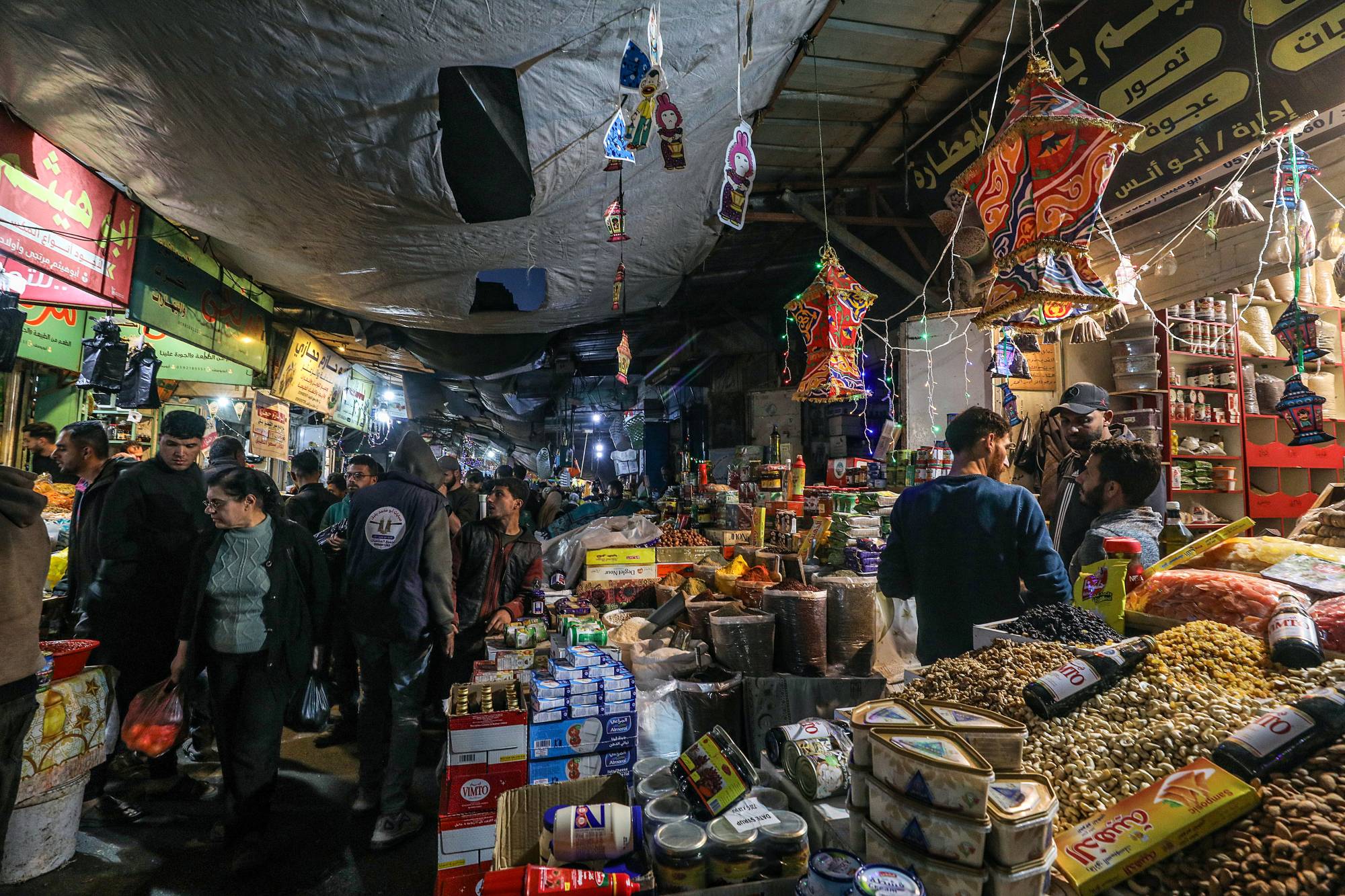
The hustle and bustle of buyers and sellers has returned to Khartoum's central market, but "it's nothing like before," fruit vendor Hashim Mohamed told AFP, streets away from where war first broke out nearly three years ago.

On April 15, 2023, central Khartoum awoke to battles between the Sudanese army and the paramilitary Rapid Support Forces, who had been allies since 2021, when they ousted civilians from a short-lived transitional government.

Their war has since killed tens of thousands and displaced millions. In greater Khartoum alone, nearly 4 million people -- around half the population -- fled the city when the RSF took over.

Hashim Mohamed did not.

"I had to work discreetly, because there were regular attacks" on businesses, said the fruit seller, who has worked in the sprawling market for 50 years.

Like him, those who stayed in the city report living in constant fear of assaults and robberies from fighters roaming the streets.

Last March, army forces led an offensive through the capital, pushing paramilitary fighters out and revealing the vast looting and destruction left behind.

"The market's not what it used to be, but it's much better than when the RSF was here," said market vendor Adam Haddad, resting in the shade of an awning.

In the market's narrow, dusty alleyways, fruits and vegetables are piled high, on makeshift stalls or tarps spread on the ground.

- Two jobs to survive -

Khartoum, where entire neighborhoods were once under siege, is no longer threatened by the mass starvation that stalks battlefield cities and displacement camps elsewhere in Sudan.

But with the economy a shambles, a good living is still hard to provide.

"People complain about prices, they say it's too expensive. You can find everything, but the costs keep going up: supplies, labor, transportation," said Mohamed.

Sudan has known only triple-digit annual inflation for years. Figures for 2024 stood at 151 percent -- down from a 2021 peak of 358.

The currency has also collapsed, going from trading at 570 Sudanese pounds to the US dollar before the war to 3,500 in 2026, according to the black market rate.

One Sudanese teacher, who only a few years ago could provide comfortably for his two children, told AFP he could no longer pay his rent with a monthly salary of 250,000 Sudanese pounds ($71).

To feed his family, pay for school, and cover healthcare, he "works in the market or anywhere" on his days off.

"You have to have another job to pay for the bare minimum of basic needs," he said, asking for anonymity to protect his privacy.

For Adam Haddad, the road to recovery will be a long one.

"We don't have enough resources or workers or liquidity going through the market," he said, adding that reliable electricity was still a problem.

"The government is striving to restore everything, and God willing, in the near future, the power will return and Khartoum will become what it once was."


Trump Heads into Davos Storm, with an Eye on Home

FILE - President Donald Trump is illuminated by a camera flash as he gestures while walking across the South Lawn of the White House, Nov. 2, 2025, in Washington, after returning from a trip to Florida. (AP Photo/Mark Schiefelbein, File)
TT

Trump Heads into Davos Storm, with an Eye on Home

FILE - President Donald Trump is illuminated by a camera flash as he gestures while walking across the South Lawn of the White House, Nov. 2, 2025, in Washington, after returning from a trip to Florida. (AP Photo/Mark Schiefelbein, File)

Donald Trump returns to the Davos ski resort next week after unleashing yet another avalanche on the global order. But for the US president, his main audience is back home.

Trump's first appearance in six years at the gathering of the world's political and global elite comes amid a spiraling crisis over his quest to acquire Greenland.

Fellow leaders at the mountain retreat will also be eager to talk about other shocks from his first year back in power, from tariffs to Venezuela, Ukraine, Gaza and Iran.

Yet for the Republican president, his keynote speech among the Swiss peaks will largely be aimed at the United States.

US voters are angered by the cost of living despite Trump's promises of a "golden age," and his party could be facing a kicking in crucial midterm elections in November.

That means Trump will spend at least part of his time in luxurious Davos talking about US housing.

A White House official told AFP that Trump would "unveil initiatives to drive down housing costs" and "tout his economic agenda that has propelled the United States to lead the world in economic growth."

The 79-year-old is expected to announce plans allowing prospective homebuyers to dip into their retirement accounts for down payments.

Billionaire Trump is keenly aware that affordability has become his Achilles' heel in his second term. A CNN poll last week found that 58 percent of Americans believe his first year back in the White House has been a failure, particularly on the economy.

Trump's supporters are also increasingly uneasy about the "America First" president's seemingly relentless focus on foreign policy since his return to the Oval Office.

But as he flies into the snowy retreat, Trump will find it impossible to avoid the global storm of events that he has stirred since January 20, 2025.

Trump will be alongside many of the leaders of the same European NATO allies that he has just threatened with tariffs if they don't back his extraordinary quest to take control of Greenland from Denmark.

Those threats have once again called into question the transatlantic alliance that has in many ways underpinned the western economic order celebrated at Davos.

- 'Economic stagnation' -

So have the broader tariffs Trump announced early in his second term, and he is set to add to the pressure on Europe in his speech.

Trump will "emphasize that the United States and Europe must leave behind economic stagnation and the policies that caused it," the White House official said.

The Ukraine war will also be on the cards.

Ukrainian President Volodymyr Zelensky is hoping for a meeting with Trump to sign new security guarantees for a hoped-for ceasefire deal with Russia, as are G7 leaders.

But while the largest-ever US Davos delegation includes Secretary of State Marco Rubio, special envoy Steve Witkoff and son-in-law Jared Kushner, who have all played key roles on Ukraine, no meeting is assured.

"No bilateral meetings have been scheduled for Davos at this time," the White House told AFP.

Trump is meanwhile reportedly considering a first meeting of the so-called "Board of Peace" for war-torn Gaza at Davos, after announcing its first members in recent days.

Questions are also swirling about the future of oil-rich Venezuela following the US military operation to topple its leader Nicolas Maduro, part of Trump's assertive new approach to his country's "backyard."

But Trump may also pause to enjoy his time in the scenic spot he called "beautiful Davos" in his video speech to the meeting a year ago.

The forum has always been an odd fit for the former New York property tycoon and reality TV star, whose brand of populism has long scorned globalist elites.

But at the same time, Trump relishes the company of the rich and successful.

His first Davos appearance in 2018 met occasional boos but he made a forceful return in 2020 when he dismissed the "prophets of doom" on climate and the economy.

A year later he was out of power. Now, Trump returns as a more powerful president than ever, at home and abroad.


Russia, China Unlikely to Back Iran Against US Military Threats

A man stands by the wreckage of a burnt bus bearing a banner (unseen) that reads "This was one of Tehran’s new buses that was paid for with the money of the people’s taxes,” in Tehran's Sadeghieh Square on January 15, 2026. (AFP)
TT

Russia, China Unlikely to Back Iran Against US Military Threats

A man stands by the wreckage of a burnt bus bearing a banner (unseen) that reads "This was one of Tehran’s new buses that was paid for with the money of the people’s taxes,” in Tehran's Sadeghieh Square on January 15, 2026. (AFP)

While Russia and China are ready to back protest-rocked Iran under threat by US President Donald Trump, that support would diminish in the face of US military action, experts told AFP.

Iran is a significant ally to the two nuclear powers, providing drones to Russia and oil to China. But analysts told AFP the two superpowers would only offer diplomatic and economic aid to Tehran, to avoid a showdown with Washington.

"China and Russia don't want to go head-to-head with the US over Iran," said Ellie Geranmayeh, a senior policy expert for the European Council on Foreign Relations think tank.

Tehran, despite its best efforts over decades, has failed to establish a formal alliance with Moscow and Beijing, she noted.

If the United States carried out strikes on Iran, "both the Chinese and the Russians will prioritize their bilateral relationship with Washington", Geranmayeh said.

China has to maintain a "delicate" rapprochement with the Trump administration, she argued, while Russia wants to keep the United States involved in talks on ending the war in Ukraine.

"They both have much higher priorities than Iran."

- Ukraine before Iran -

Despite their close ties, "Russia-Iranian treaties don't include military support" -- only political, diplomatic and economic aid, Russian analyst Sergei Markov told AFP.

Alexander Gabuev, director of Carnegie Russia Eurasia Center, said Moscow would do whatever it could "to keep the regime afloat".

But "Russia's options are very limited," he added.

Faced with its own economic crisis, "Russia cannot become a giant market for Iranian products" nor can it provide "a lavish loan", Gabuev said.

Nikita Smagin, a specialist in Russia-Iran relations, said that in the event of US strikes, Russia could do "almost nothing".

"They don't want to risk military confrontation with other great powers like the US -- but at the same time, they're ready to send weaponry to Iran," he said.

"Using Iran as a bargaining asset is a normal thing for Russia," Smagin said of the longer-term strategy, at a time when Moscow is also negotiating with Washington on Ukraine.

Markov agreed. "The Ukrainian crisis is much more important for Russia than the Iranian crisis," he argued.

- Chinese restraint -

China is also ready to help Tehran "economically, technologically, militarily and politically" as it confronts non-military US actions such as trade pressure and cyberattacks, Hua Po, a Beijing-based independent political observer, told AFP.

If the United States launched strikes, China "would strengthen its economic ties with Iran and help it militarize in order to contribute to bogging the United States down in a war in the Middle East," he added.

Until now, China has been cautious and expressed itself "with restraint", weighing the stakes of oil and regional stability, said Iran-China relations researcher Theo Nencini of Sciences Po Grenoble.

"China is benefiting from a weakened Iran, which allows it to secure low-cost oil... and to acquire a sizeable geopolitical partner," he said.

However, he added: "I find it hard to see them engaging in a showdown with the Americans over Iran."

Beijing would likely issue condemnations, but not retaliate, he said.

Hua said the Iran crisis was unlikely to have an impact on China-US relations overall.

"The Iranian question isn't at the heart of relations between the two countries," he argued.

"Neither will sever ties with the other over Iran."