


Abyar Crime Heats up Political Dispute in Libya

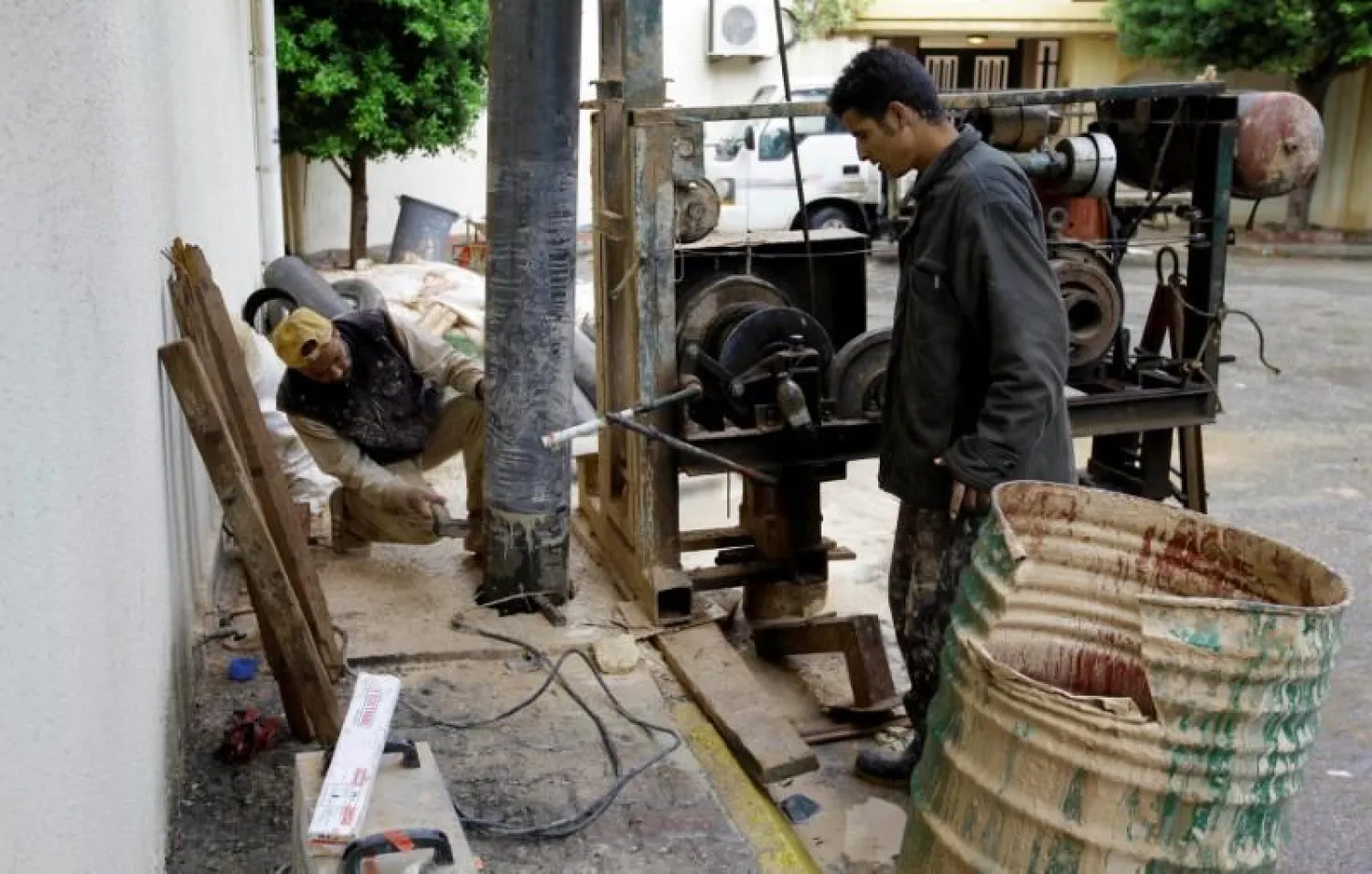
Workers dig a water well in Tripoli, Libya October 25, 2017 REUTERS/Ismail Zitouny
TT

Abyar Crime Heats up Political Dispute in Libya

Workers dig a water well in Tripoli, Libya October 25, 2017 REUTERS/Ismail Zitouny

The bodies of 36 people which have been found shot dead in al-Abyar, east of Benghazi, which became a heated political issue between commander of Libyan National Army (LNA) Khalifah Haftar and his opponents, especially the UN-backed Government of National Accord (GNA) and the ousted Mufti.

Haftar had directed the military general prosecutor to investigate the incident, meanwhile, the presidential council of GNA chaired by Fayiz al-Sarraj also stated that an investigation began into this crime to identify the victims and apprehend the criminals to be brought before the court.

“This is a crime, and all crimes will not pass without any earned punishment no matter how long it takes,” Sarraj announced.

The Presidential Council has issued a statement condemning the "heinous crime" and the horrifying act that led to the wholesale killing of 36 persons after being tortured then tossed on the road in al-Abyar district in Benghazi.

The statement issued on Sunday said that this act is only committed by inhuman individuals and those who are stripped of their ethics, morals and manners as well as religious teachings and social values.

The council added that such an act is against Libyans’ aspirations and efforts to build a democratic country where human rights are respected.

"There will be a thorough investigation in coordination with the Attorney General's office to bring the criminals to justice." The Presidential Council added.

For his part, ousted Libyan Mufti al-Sadeq al-Gharyani held Haftar the responsibility for the crime saying that anyone who supports criminals or justifies their actions is also responsible for what happened.

Justice and Construction Party, political arm of Muslim Brotherhood, considered the dozens of dead bodies in Abyar a war crime and a blatant violation of the UN Charter, international laws, and human rights’ principles.

The party issued a statement demanding the presidential council takes the necessary and immediate measures to begin an official investigation into this crime and bring the perpetrators to justice.

In a letter circulating in his office, Haftar confirmed that the investigation will include identifying the criminals responsible for killing the innocents and apprehending them for trial.

United Nations Support Mission in Libya (UNSMIL) condemned the criminal act discovered in Abyar area and tweeted on its official account: "UNSMIL condemns in the strongest terms the heinous crime resulting in the killing of at least 36 whose bodies found in Al-Abyar area," calling for immediate investigation to bring perpetrators to justice.

In addition, UN Sec-Gen Special Representative and Head of UNSMIL Ghassan Salame condemned in the strongest terms the killings of 36 men, who were found handcuffed, reportedly bore gunshot wounds, and showed injuries consistent with torture.

“I am appalled by this heinous crime. I call for a prompt, impartial and effective investigation to bring perpetrators to Justice,” Salame said.

“There have been many cases of this nature in the last two years, yet no accountability,” he added.

The Special Representative reminded that committing, ordering or permitting the killing of captives is a crime under domestic and international law.

Likewise, the Italian Embassy in Tripoli, tweeted: "Horrified at the sight of the bodies discovered in Al-Abyar. Such a heinous crime must not go unpunished."

In other news, Great Man-Made River Authority (GMMRA) has announced that water has been re-pumped into Tripoli that long suffered from lack of drinking water.

The authority published a statement on its official Facebook page stating that water will gradually be reaching most cities as of Tuesday. The statement said that the authority’s inability to pump water previously was due to what it described as “causes beyond its control.”

The authority asked the Libyan people to follow a code of conduct through which the GMMR will not be part of any tensions.

Across Tripoli, residents have started drilling through pavements to access wells in a desperate search for water after the taps ran dry.

GMMR workers turned off the water to do urgent maintenance earlier this month after years of neglect, cutting water supply to many Tripoli households.

For Libyans the chaos has meant power cuts and crippling cash shortages which are made worse by battles between armed groups aiming to control the oil-rich country and its poorly-maintained infrastructure.

Early last week an armed faction in the south said it had turned off water supplies from GMMR prolonging Libyans’ misery. A manager at GMMR, Tawfiq Shwehdi said the group is seeking the release of a leader imprisoned by a rival faction in Tripoli.

“We had started maintenance work on the 16th (of October) and cut supplies to Tripoli,” he told Reuters, adding that: “afterwards an armed group... set one power plant on fire which closed three other plants and shut down 24 wells.”

The incident deprived residents of water while boosting the business of drillers who are paid between 4,000-6,000 Libyan dinars to access groundwater.

In 2014, the escalated situations put extra pressure on Tripoli residents who reached about three million with the arrival of displaced families from other Libyan cities.

Head of the Libyan Water Authority Naji al-Saed declared that no budget has been transferred to the authority since 2011 except the emergency budget, which is the result of the financial difficulties.

Desalination plants dropped its production sharply, with output at a plant in Zuwara, west Libya, reaching 80,000 cubic liters from an annual rate of 16,000 cl.



Hezbollah Chief Accuses Lebanese Authorities of Working ‘in the Interest of What Israel Wants’

Hezbollah leader Naim Qassem
TT

Hezbollah Chief Accuses Lebanese Authorities of Working ‘in the Interest of What Israel Wants’

Hezbollah leader Naim Qassem

Hezbollah leader Naim Qassem on Sunday said moves to disarm the group in Lebanon are an "Israeli-American plan,” accusing Israel of failing to abide by a ceasefire agreement sealed last year.

Under heavy US pressure and fears of expanded Israeli strikes, the Lebanese military is expected to complete Hezbollah's disarmament south of the Litani River -- located about 30 kilometers from the border with Israel -- by the end of the year.

It will then tackle disarming the Iran-backed movement in the rest of the country.

"Disarmament is an Israeli-American plan," Qassem said.

"To demand exclusive arms control while Israel is committing aggression and America is imposing its will on Lebanon, stripping it of its power, means that you are not working in Lebanon's interest, but rather in the interest of what Israel wants."

Despite a November 2024 ceasefire that was supposed to end more than a year of hostilities between Israel and Hezbollah, Israel has kept up strikes on Lebanon and has maintained troops in five areas it deems strategic.

According to the agreement, Hezbollah was required to pull its forces north of the Litani River and have its military infrastructure in the vacated area dismantled.

Israel has questioned the Lebanese military's effectiveness and has accused Hezbollah of rearming, while the group itself has rejected calls to surrender its weapons.

"The deployment of the Lebanese army south of the Litani River was required only if Israel had adhered to its commitments... to halting the aggression, withdrawing, releasing prisoners, and having reconstruction commence," Qassem said in a televised address.

"With the Israeli enemy not implementing any of the steps of the agreement... Lebanon is no longer required to take any action on any level before the Israelis commit to what they are obligated to do."

Lebanese army chief Rodolphe Haykal told a military meeting on Tuesday "the army is in the process of finishing the first phase of its plan.”

He said the army is carefully planning "for the subsequent phases" of disarmament.


Israel Army Ends Crackdown on West Bank Town after Attack

Smoke rises following an explosion detonated by the Israeli army, which said it was destroying buildings used by Palestinian militants in the West Bank Jenin refugee camp, Sunday, February 2, 2025. © Majdi Mohammed, AP
TT

Israel Army Ends Crackdown on West Bank Town after Attack

Smoke rises following an explosion detonated by the Israeli army, which said it was destroying buildings used by Palestinian militants in the West Bank Jenin refugee camp, Sunday, February 2, 2025. © Majdi Mohammed, AP

The Israeli military said on Sunday it had ended its operation in a town in the occupied West Bank that it had sealed off after a Palestinian from the area killed two Israelis.

Around 50 residents of Qabatiya were briefly detained during the two-day operation, the official Palestinian news agency Wafa reported, quoting the town's mayor Ahmed Zakarneh.

The attacker's father and two brothers remained in custody, it added.

The military launched the operation on Friday, shortly after a 34-year-old Palestinian fatally stabbed an 18-year-old Israeli woman and ran over a man in his sixties with his vehicle.

When contacted by AFP on Sunday morning, the military confirmed the end of its operation in the area.

Defense Minister Israel Katz previously said the army had completely sealed off the town.

Wafa also reported that Israeli troops had withdrawn from Qabatiya, near the city of Jenin.

Zakarneh said the town had been in a state of "total paralysis" during the military activity.

Israeli army bulldozers tore up pavement on several streets and erected roadblocks to halt traffic, he said, adding that around 50 houses were searched.

Wafa reported that a school had been turned into a detention and interrogation center.

AFPTV footage filmed on Saturday showed Israeli soldiers carrying automatic rifles and patrolling the streets, where several armoured vehicles were deployed.

Shops were closed, though men and children were seen walking through the village.

On Sunday, the Israeli army said it had sealed off the assailant's home and was finalising "the procedures required for its demolition".

Israeli authorities argue that demolishing the homes of Palestinians who carry out attacks against Israelis has a deterrent effect.

Critics, however, condemn the practice as collective punishment that leaves families homeless.


Arab League Council Holds Extraordinary Session on Latest Developments in Somalia

A general view shows the opening session of the meeting of Arab foreign ministers at the Arab League Headquarters (Reuters)
TT

Arab League Council Holds Extraordinary Session on Latest Developments in Somalia

A general view shows the opening session of the meeting of Arab foreign ministers at the Arab League Headquarters (Reuters)

At the request of the Federal Republic of Somalia and with the support of Arab League member states, the Arab League Council on Sunday began its extraordinary session at the league’s General Secretariat, at the level of permanent representatives and under the chairmanship of the United Arab Emirates, to discuss developments regarding the Israeli occupation authorities’ declaration on mutual recognition with the Somaliland region.

The Kingdom’s delegation to the meeting was headed by its Permanent Representative to the Arab League Ambassador Abdulaziz bin Abdullah Al-Matar, SPA reported.

The meeting is discussing ways to strengthen the unified Arab position in addressing this step, to affirm full solidarity with Somalia, and to support its legitimate institutions in a manner that contributes to preserving security and stability in the region.

The meeting also aims to reaffirm the Arab League’s categorical rejection of any unilateral measures or decisions that could undermine Somalia’s sovereignty and territorial integrity, and to emphasize commitment to the principles of international law and the relevant resolutions of the Arab League and the African Union.