


Puigdemont Criticizes European Passivity in Showing Solidarity with Catalonia

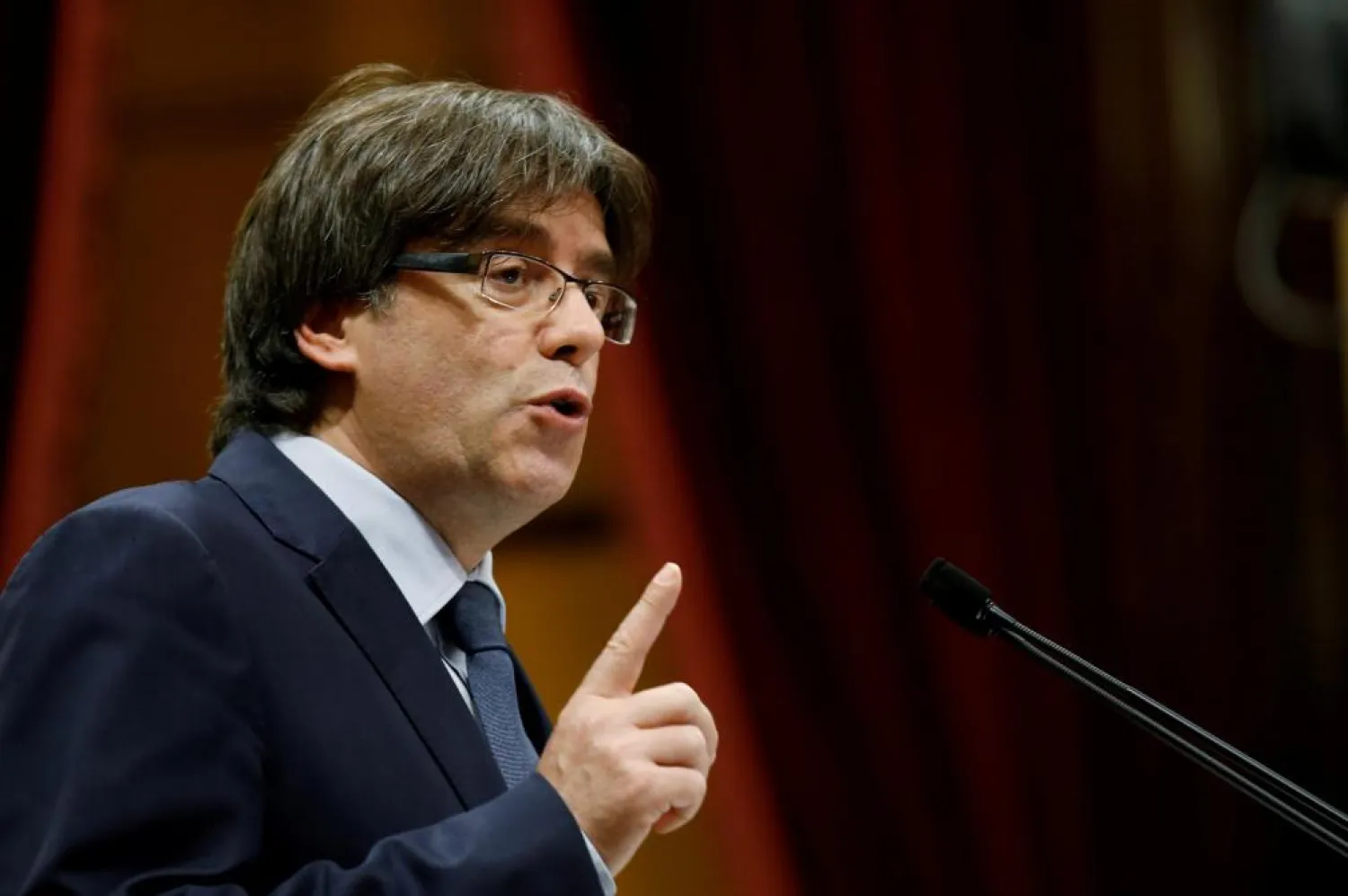
Sacked Catalan leader Carles Puigdemont. (Reuters)
TT

Puigdemont Criticizes European Passivity in Showing Solidarity with Catalonia

Sacked Catalan leader Carles Puigdemont. (Reuters)

The ousted leader of Catalonia said on Tuesday there was an “absolute” disconnect by European officials towards the independence drive of the northeastern Spanish region.

In an interview in Brussels with Catalan public radio, Carles Puigdemont criticized the passivity of European politicians in showing solidarity with the deposed and jailed government of Catalonia.

He spoke of an "absolute disconnect between the interests of the people and the European elites" and that Catalonia's problem is an "issue of human rights that requires maximum attention."

Puigdemont is fighting extradition to Spain, where other members of the ousted cabinet have been sent to jail while awaiting the results of a probe for allegedly weaving a strategy to secede from Spain.

The Spanish central authorities are now in direct control of the northeastern region, where early polls on December 21 are shaping into an electoral battle between separatists and unionists.

Puigdemont himself was spared custody on Monday when a Brussels court ruled he could remain at liberty in Belgium until it had heard Spanish charges against him of rebellion.

The court’s decision means Puigdemont, who left Spain last month, is free to campaign for independence in the December 21 elections.

Puigdemont said on Monday his government’s actions were legitimate and criticized the Spanish judicial system for a “clear lack of independence and neutrality”.

The December vote is shaping up to be a de facto independence referendum.

Puigdemont’s PDeCAT and another secessionist party said at the weekend they might run on a combined ticket, but would need to make a decision on any formal alliance - which might also include other parties - by a deadline of Tuesday.

Alliances could however also form after the election.

The independence push has dragged Spain into its worst political crisis since its return to democracy four decades ago. It has deeply divided the country, fueling anti-Spanish feelings in Catalonia and nationalist tendencies elsewhere.

Puigdemont turned himself in to Belgian police on Sunday along with four of his ex-ministers, after Spain issued a European arrest warrant on charges of rebellion as well as misuse of public funds.

All five are barred from leaving Belgium without a judge’s consent.

They will appear before a Belgian court on November 17 for a hearing to discuss the arrest warrant, prosecutors in Brussels said in a statement.

Puigdemont, writing in Britain’s Guardian newspaper, called for scrutiny of the Spanish judicial system and said the crisis could be solved only with a political and not a judicial solution.

“Does anyone think that the sacked Catalan government can expect a fair and independent hearing, uninfluenced by political and media pressure? I do not,” he wrote.

Spain’s central government took control of Catalonia, which accounts for a fifth of the national economy, after local leaders held an independence referendum on October 1 despite a Constitutional Court ban.

The region’s parliament then passed a unilateral declaration of independence. In response, Spain’s Prime Minister Mariano Rajoy fired the government and called the snap regional elections.

On Sunday, the first part of a GAD3 survey showed that pro-independence parties would win the election in Catalonia but may not gain the parliamentary majority needed to continue with secession.

On Monday, the second part showed just one in seven people in the region believe the current standoff between Barcelona and Madrid will end in independence, while more than two thirds think the process has been bad for the economy.

Published in La Vanguardia newspaper, that survey polled 1,233 people between October 30 and Nov. 3.

Optimism that a negotiated solution would be found was low, with just over a fifth of respondents thinking the crisis would lead to talks between regional authorities and Madrid.

The uncertainty has prompted more than 2,000 companies to relocate their legal headquarters out of the region since October 1. The Bank of Spain has said that if the conflict persists it could lead to slower growth and job creation.



Türkiye Says Greece-Chevron Activity off Crete Unlawful 

A Chevron gas station sign is pictured at one of their retain gas stations in Cardiff, California October 9, 2013. REUTERS/Mike Blake/File Photo
TT

Türkiye Says Greece-Chevron Activity off Crete Unlawful 

A Chevron gas station sign is pictured at one of their retain gas stations in Cardiff, California October 9, 2013. REUTERS/Mike Blake/File Photo

Türkiye said on Thursday it opposed Greece's "unilateral activities" in energy fields south of Crete with a consortium led by US major Chevron as a violation of international law and good neighbourly relations.

Athens responded that its policies abide international law.

The Chevron-led consortium signed exclusive lease agreements on Monday to look for natural gas off southern Greece, expanding US presence in the eastern Mediterranean.

"We oppose this unlawful activity, which is being attempted in violation of the 2019 Memorandum of Understanding on Maritime Jurisdiction between Libya and our country," the Turkish Defense Ministry said at a press briefing.

It said the activity, while not directly impacting Türkiye's continental shelf, also violated Libya's maritime jurisdiction that was declared to the United Nations in May last year.

"We continue to provide the necessary support to the Libyan authorities to take action against these unilateral and unlawful activities by Greece," the ministry said.

A 2019 agreement signed by Türkiye and Libya set out maritime boundaries in the Mediterranean Sea. It was rejected by Greece as it ignored the presence of the Greek island of Crete between the coasts of Türkiye and Libya. The Chevron deal doubles the amount of Greek maritime acreage available for exploration and is the second in months involving a US energy major, as the European Union seeks to phase out supplies from Russia and the US seeks to replace them.

Asked about the Turkish objections later on Thursday, Greek government spokesman Pavlos Marinakis told a press briefing that Athens followed an "active policy" and "exercises its rights in accordance with international law and respects international law steadfastly - and I think no one questions that, period."

There was no immediate comment from Chevron.

Neighbors and NATO members Türkiye and Greece have been at odds over a range of issues for decades, primarily maritime boundaries and rights in the Aegean, an area widely believed to hold energy resources and with key implications for airspace and military activity.

A 2023 declaration on friendly relations prompted a thaw between the sides and leaders have voiced a desire to address remaining issues.


Andrew Mountbatten-Windsor Arrested on Suspicion of Misconduct in Public Office

FILE - Britain’s Andrew Mountbatten-Windsor, formerly known as Prince Andrew, looks round as he leaves after attending the Easter Matins Service at St. George's Chapel, Windsor Castle, England, April 20, 2025. (AP Photo/Kirsty Wigglesworth, File)
TT

Andrew Mountbatten-Windsor Arrested on Suspicion of Misconduct in Public Office

FILE - Britain’s Andrew Mountbatten-Windsor, formerly known as Prince Andrew, looks round as he leaves after attending the Easter Matins Service at St. George's Chapel, Windsor Castle, England, April 20, 2025. (AP Photo/Kirsty Wigglesworth, File)

UK police arrested Andrew Mountbatten-Windsor on Thursday on suspicion of misconduct in public office.

The Thames Valley Police, an agency that covers areas west of London, including Mountbatten-Windsor’s former home, said it was “assessing” reports that the former Prince Andrew sent trade reports to convicted sex offender Jeffrey Epstein in 2010. The assessment followed the release of millions of pages of documents connected to a US investigation of Epstein.

The police force did not name Mountbatten-Windsor, as is normal under UK law. But when asked if he had been arrested, the force pointed to a statement saying that they had arrested a man in his 60s. Mountbatten-Windsor is 66.

“Following a thorough assessment, we have now opened an investigation into this allegation of misconduct in public office,’’ the statement said. “It is important that we protect the integrity and objectivity of our investigation as we work with our partners to investigate this alleged offence."

“We understand the significant public interest in this case, and we will provide updates at the appropriate time,” the statement added.

Pictures circulated online appearing to show unmarked police cars at Wood Farm on the Sandringham Estate in Norfolk, with plainclothes officers appearing to gather outside the home of Mountbatten-Windsor.


Georgia Arrests Two Foreigners Trying to Purchase Uranium

FILE PHOTO: A block with the symbol, atomic number and mass number of Uranium (U) element, in this illustration taken January 21, 2026. REUTERS/Dado Ruvic/Illustration/File Photo
TT

Georgia Arrests Two Foreigners Trying to Purchase Uranium

FILE PHOTO: A block with the symbol, atomic number and mass number of Uranium (U) element, in this illustration taken January 21, 2026. REUTERS/Dado Ruvic/Illustration/File Photo

Georgia has ‌detained two people who attempted to purchase $3 million worth of uranium and a cache of a radioactive isotope found in nuclear weapons testing programs, the national security service said on Thursday.

Two foreign nationals from unspecified countries were arrested in the city of Kutaisi, the State Security Service said in a statement.

"They were planning to ‌illegally purchase ‌nuclear material uranium and radioactive ‌substance ⁠Cesium 137 for $3 ⁠million and illegally transport it to the territory of another country," Reuters quoted it as saying.

It said other foreigners had been arriving in Georgia in recent weeks with the aim of purchasing and transporting the nuclear and ⁠radioactive materials, without elaborating further.

The ‌statement did ‌not specify the quantity of materials the individuals were ‌attempting to procure. There were ‌no details on the substances' origin or potential destination.

Cesium 137 is a radioactive isotope present primarily in the aftermath of nuclear weapons testing ‌and nuclear power plant accidents such as the Chernobyl disaster in ⁠then-Soviet ⁠Ukraine in 1986.

The security of nuclear materials was one of the biggest concerns after the 1991 fall of the Soviet Union, of which Georgia was part. There have been several serious incidents involving the illicit trade in nuclear materials in Georgia over recent decades.

Most recently, three Chinese citizens were arrested in the capital Tbilisi for attempting to purchase two kilograms of "nuclear material" uranium.