


If The Premier League is So Strong, Why Are the Promoted Sides Doing So Well?

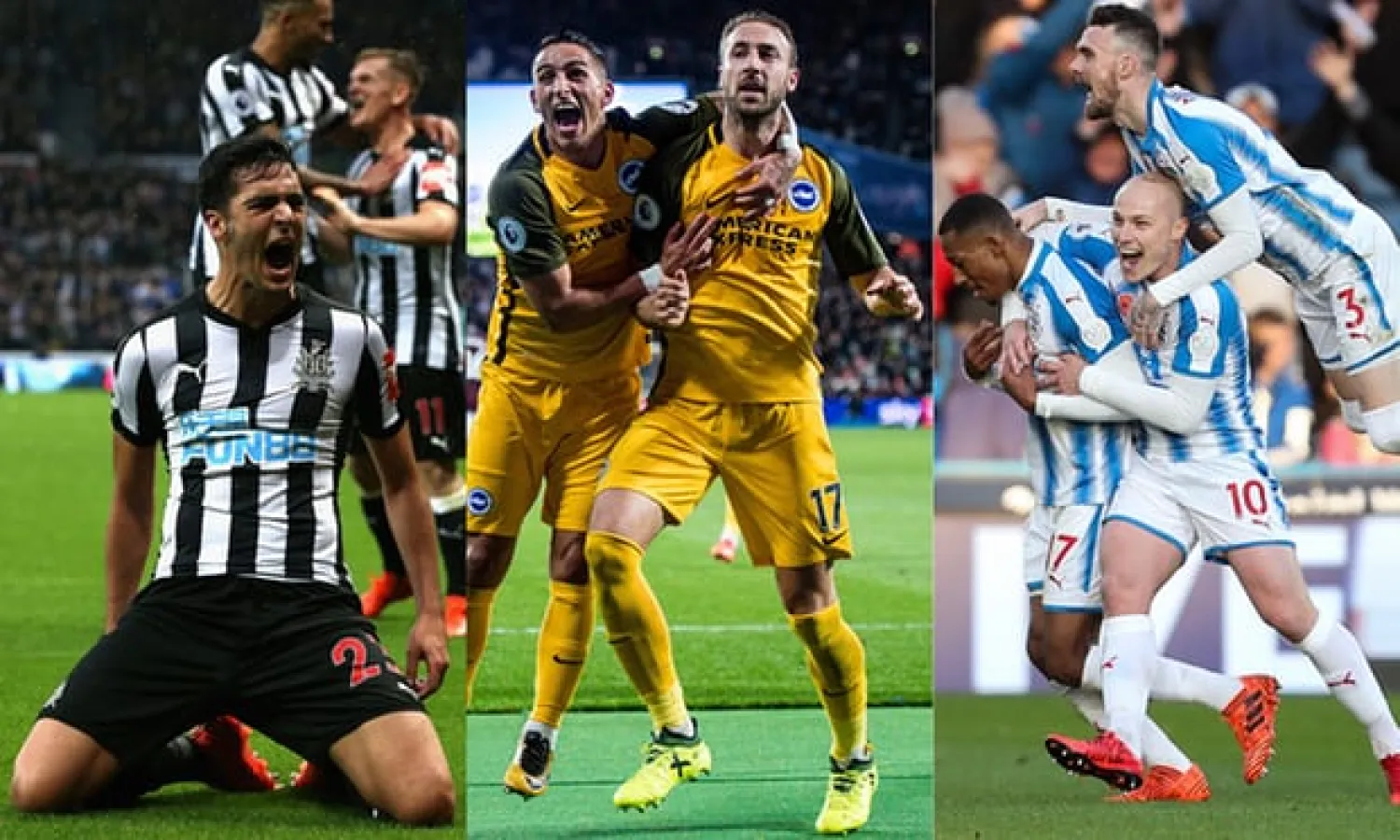
 Newcastle, Brighton and Huddersfield have all started the season solidly. Composite: Rex, Getty Images, PA
Newcastle, Brighton and Huddersfield have all started the season solidly. Composite: Rex, Getty Images, PA
TT

If The Premier League is So Strong, Why Are the Promoted Sides Doing So Well?

 Newcastle, Brighton and Huddersfield have all started the season solidly. Composite: Rex, Getty Images, PA
Newcastle, Brighton and Huddersfield have all started the season solidly. Composite: Rex, Getty Images, PA

When Pep Guardiola suggested an English team could win the Champions League the other day he was asked if he did not consider the intensity of the Premier League a potential problem. Intensity being the word normally used to promote the idea that the English league is somehow tougher and more demanding than other leagues around Europe, with more competitive fixtures each weekend and a festive programme that usually sets out to be as gruelling as possible when other countries’ footballers are quite sensibly having a rest.

“No,” Guardiola said. “I don’t believe in that. I think the best team will win; it’s nothing to do with intensity.”

The Manchester City manager has actually maintained a consistent view on this since arriving in England 18 months ago. The easy way to get on the wrong side of him at a press conference is to ask whether City finishing empty-handed last season was not proof that winning titles in England is tougher than in Spain or Germany. Guardiola maintains all the major leagues are equally tough or, if you look at it the opposite way, equally negotiable.

The standard comeback here would be to point out that four or five teams in England can be billed as genuine title contenders, maybe even six if you were to stretch a point by including Arsenal. That is not a situation that applies in Spain or Germany most seasons, so, QED, the Premier League must be tougher.

Fair enough, but take a look at the Premier League table at the moment, and see if you think that represents a situation likely to scare many other leagues around Europe. If the English league is so strong, how come two of the sides promoted last season, neither of whom had reached the Premier League before, reside in the top half? Brighton and Huddersfield featured in a lot of pre-season forecasts as instant relegation candidates, and although there is plenty of time still left for a slide down the table, it is fair to say they have both made more solid starts than even their own supporters might have hoped. The same applies to Newcastle, the other promoted side, who were in the top half of the table until recently but now sit in 11th on 14 points, a single point behind Brighton and Huddersfield.

Eleven games in, more than a quarter of the season has already been played, and after a couple more games a third of the fixtures will have been completed. Last season Hull were relegated in 18th place on 34 points, so the minimum required for survival was 35. All three promoted sides, therefore, are already almost half way to that total. Burnley, the new Everton this season in terms of knocking on the door of the top six, are past half way. Even if 40 points is accepted as the traditional target for survival, Sean Dyche’s side have done exceptionally well to pick up 19 from 11 games. It is the clubs who usually survive without much trouble, West Bromwich and West Ham, for instance, who are bumping along at less than a point per game. Everton would have been in the same boat but for the near-miraculous three points they picked up against Watford on Sunday, while Stoke have 12 points from 11 games but are hardly covering themselves in glory.

Burnley are on the same number of points as Arsenal and Liverpool, only goal difference is keeping them out of the top six, which given the disparity in available resources is either a testament to the ingenuity of Dyche or an indictment of the shortcomings of Jürgen Klopp and Arsène Wenger.

The top six at the moment is the top six most people would have predicted at the start of the season, and while it would be great to see Burnley or Watford move a little higher and really introduce the cat to the pigeons, the likelihood is that the greater squad strength and deeper pockets of the bigger clubs will have kept the established order intact by the end of the season.

Only the managers are likely to move significantly upwards, Dyche and Marco Silva having deservedly attracted attention this season, yet upwards in this case is unlikely to mean a chance at a club in the Champions League bracket. The gears of English football grind too slowly for that, and the reward for working minor miracles at Burnley or Watford is likely to be an invitation to produce more of the same at somewhere like Everton or West Ham. Dyche and Silva seem to be staying with their clubs for the time being, and there is nothing wrong with loyalty in mid-season, though the flip-side of the coin is the sheer lack of imagination in having to pursue the likes of David Moyes and Sam Allardyce simply because they are available.

Everton seem to be cooling on the latter now, though one instinctively doubts Diego Simeone is a realistic mid-season target. There was a point earlier in the week which seemed to sum up the hopelessness of the situation. Everton fans suddenly had to stop sympathising with West Ham fans over their club’s choice of manager when it became apparent that one of the Irons’ least favourite former employees might be under consideration at Goodison.

The point about all this, as Guardiola is doubtless too polite to elaborate, is that none of it matters. Beneath the top six in the Premier League is a survival system; nothing more, nothing less. Allardyce’s services will always be in demand because he is a proven master at getting teams out of trouble. The only drawback for a club as proud as Everton is that sending for him is as sure a sign as a rocket flare that trouble is what you are in.

This is not how things were supposed to turn out when Ronald Koeman was hired for £6m per year with a view to cracking the top six. Moyes’s firefighting credentials are less well-established after his disastrous spell at Sunderland, where some of the things he said and did contributed to a sense of impending doom around the club, though at minimum he ought to be able marshall the defence a little better and stop West Ham throwing away goals and points. That said, Tony Pulis is struggling to do the same thing at West Bromwich, and Moyes has rarely shown the same sort of organisational nous the Welshmen has demonstrated at his various clubs.

The bottom line is that West Ham have just appointed a manager with survival in mind, as have Leicester, while Everton still seem to be making up their mind about whether they need a manager to keep them in the division or take them higher than seventh.

As their unhappy recent experience with Koeman indicated, it cannot be automatically assumed that one man can do both, or indeed either.

Meanwhile, almost laughably, managers such as Dyche, Silva, Chris Hughton and David Wagner are proving both adept and upwardly mobile at some of the smallest clubs in the division. That, surely, is where progress lies. Anyone with true ambition would pick their man, pay the compensation, and give him a chance at a bigger club with better resources. Instead, because there is no real ambition beyond survival for most clubs in the lower two-thirds of the table, the same managerial careers and the same unimaginative football keep being reheated.

Where, it seems reasonable to ask, is the intensity in that?

The Guardian Sport


Shakhtar Boss Pays Ukrainian Racer $200,000 After Games Disqualification

Ukrainian President Volodymyr Zelenskiy holds helmet as he meets with a Ukrainian skeleton racer Vladyslav Heraskevych , who was disqualified from the Olympic skeleton competition over his "helmet of remembrance" depicting athletes killed since Russia's invasion and his father and coach, Mykhailo Heraskevych, amid Russia's attack on Ukraine, in Munich, Germany February 13, 2026. (Ukrainian Presidential Press Service/Handout via Reuters)
TT

Shakhtar Boss Pays Ukrainian Racer $200,000 After Games Disqualification

Ukrainian President Volodymyr Zelenskiy holds helmet as he meets with a Ukrainian skeleton racer Vladyslav Heraskevych , who was disqualified from the Olympic skeleton competition over his "helmet of remembrance" depicting athletes killed since Russia's invasion and his father and coach, Mykhailo Heraskevych, amid Russia's attack on Ukraine, in Munich, Germany February 13, 2026. (Ukrainian Presidential Press Service/Handout via Reuters)

The owner of ‌Ukrainian football club Shakhtar Donetsk has donated more than $200,000 to skeleton racer Vladyslav Heraskevych after the athlete was disqualified from the Milano Cortina Winter Games before competing over the use of a helmet depicting Ukrainian athletes killed in the war with Russia, the club said on Tuesday.

The 27-year-old Heraskevych was disqualified last week when the International Bobsleigh and Skeleton Federation jury ruled that imagery on the helmet — depicting athletes killed since Russia invaded Ukraine in 2022 — breached rules on athletes' expression at ‌the Games.

He ‌then lost an appeal at the Court ‌of ⁠Arbitration for Sport hours ⁠before the final two runs of his competition, having missed the first two runs due to his disqualification.

Heraskevych had been allowed to train with the helmet that displayed the faces of 24 dead Ukrainian athletes for several days in Cortina d'Ampezzo where the sliding center is, but the International Olympic Committee then ⁠warned him a day before his competition ‌started that he could not wear ‌it there.

“Vlad Heraskevych was denied the opportunity to compete for victory ‌at the Olympic Games, yet he returns to Ukraine a ‌true winner," Shakhtar President Rinat Akhmetov said in a club statement.

"The respect and pride he has earned among Ukrainians through his actions are the highest reward. At the same time, I want him to ‌have enough energy and resources to continue his sporting career, as well as to fight ⁠for truth, freedom ⁠and the remembrance of those who gave their lives for Ukraine," he said.

The amount is equal to the prize money Ukraine pays athletes who win a gold medal at the Games.

The case dominated headlines early on at the Olympics, with IOC President Kirsty Coventry meeting Heraskevych on Thursday morning at the sliding venue in a failed last-minute attempt to broker a compromise.

The IOC suggested he wear a black armband and display the helmet before and after the race, but said using it in competition breached rules on keeping politics off fields of play. Heraskevych also earned praise from Ukraine President Volodymyr Zelenskiy.


Speed Skating-Italy Clinch Shock Men’s Team Pursuit Gold, Canada Successfully Defend Women’s Title

 Team Italy with Davide Ghiotto, Andrea Giovannini, Michele Malfatti, celebrate winning the gold medal on the podium of the men's team pursuit speed skating race at the 2026 Winter Olympics, in Milan, Italy, Tuesday, Feb. 17, 2026. (AP)
Team Italy with Davide Ghiotto, Andrea Giovannini, Michele Malfatti, celebrate winning the gold medal on the podium of the men's team pursuit speed skating race at the 2026 Winter Olympics, in Milan, Italy, Tuesday, Feb. 17, 2026. (AP)
TT

Speed Skating-Italy Clinch Shock Men’s Team Pursuit Gold, Canada Successfully Defend Women’s Title

 Team Italy with Davide Ghiotto, Andrea Giovannini, Michele Malfatti, celebrate winning the gold medal on the podium of the men's team pursuit speed skating race at the 2026 Winter Olympics, in Milan, Italy, Tuesday, Feb. 17, 2026. (AP)
Team Italy with Davide Ghiotto, Andrea Giovannini, Michele Malfatti, celebrate winning the gold medal on the podium of the men's team pursuit speed skating race at the 2026 Winter Olympics, in Milan, Italy, Tuesday, Feb. 17, 2026. (AP)

An inspired Italy delighted the home crowd with a stunning victory in the Olympic men's team pursuit final as

Canada's Ivanie Blondin, Valerie Maltais and Isabelle Weidemann delivered another seamless performance to beat the Netherlands in the women's event and retain their title ‌on Tuesday.

Italy's ‌men upset the US who ‌arrived ⁠at the Games ⁠as world champions and gold medal favorites.

Spurred on by double Olympic champion Francesca Lollobrigida, the Italian team of Davide Ghiotto, Andrea Giovannini and Michele Malfatti electrified a frenzied arena as they stormed ⁠to a time of three ‌minutes 39.20 seconds - ‌a commanding 4.51 seconds clear of the ‌Americans with China taking bronze.

The roar inside ‌the venue as Italy powered home was thunderous as the crowd rose to their feet, cheering the host nation to one ‌of their most special golds of a highly successful Games.

Canada's women ⁠crossed ⁠the line 0.96 seconds ahead of the Netherlands, stopping the clock at two minutes 55.81 seconds, and

Japan rounded out the women's podium by beating the US in the Final B.

It was only Canada's third gold medal of the Games, following Mikael Kingsbury's win in men's dual moguls and Megan Oldham's victory in women's freeski big air.


Lindsey Vonn Back in US Following Crash in Olympic Downhill 

Milano Cortina 2026 Olympics - Alpine Skiing - Women's Downhill 3rd Official Training - Tofane Alpine Skiing Centre, Belluno, Italy - February 07, 2026. Lindsey Vonn of United States in action during training. (Reuters)
TT

Lindsey Vonn Back in US Following Crash in Olympic Downhill 

Milano Cortina 2026 Olympics - Alpine Skiing - Women's Downhill 3rd Official Training - Tofane Alpine Skiing Centre, Belluno, Italy - February 07, 2026. Lindsey Vonn of United States in action during training. (Reuters)

Lindsey Vonn is back home in the US following a week of treatment at a hospital in Italy after breaking her left leg in the Olympic downhill at the Milan Cortina Games.

“Haven’t stood on my feet in over a week... been in a hospital bed immobile since my race. And although I’m not yet able to stand, being back on home soil feels amazing,” Vonn posted on X with an American flag emoji. “Huge thank you to everyone in Italy for taking good care of me.”

The 41-year-old Vonn suffered a complex tibia fracture that has already been operated on multiple times following her Feb. 8 crash. She has said she'll need more surgery in the US.

Nine days before her fall in Cortina d'Ampezzo, Italy, Vonn ruptured the ACL in her left knee in another crash in Switzerland.

Even before then, all eyes had been on her as the feel-good story heading into the Olympics for her comeback after nearly six years of retirement.
