


Bahraini Documents Reveal Historic Al-Khalifa Rule of Qatar Peninsula

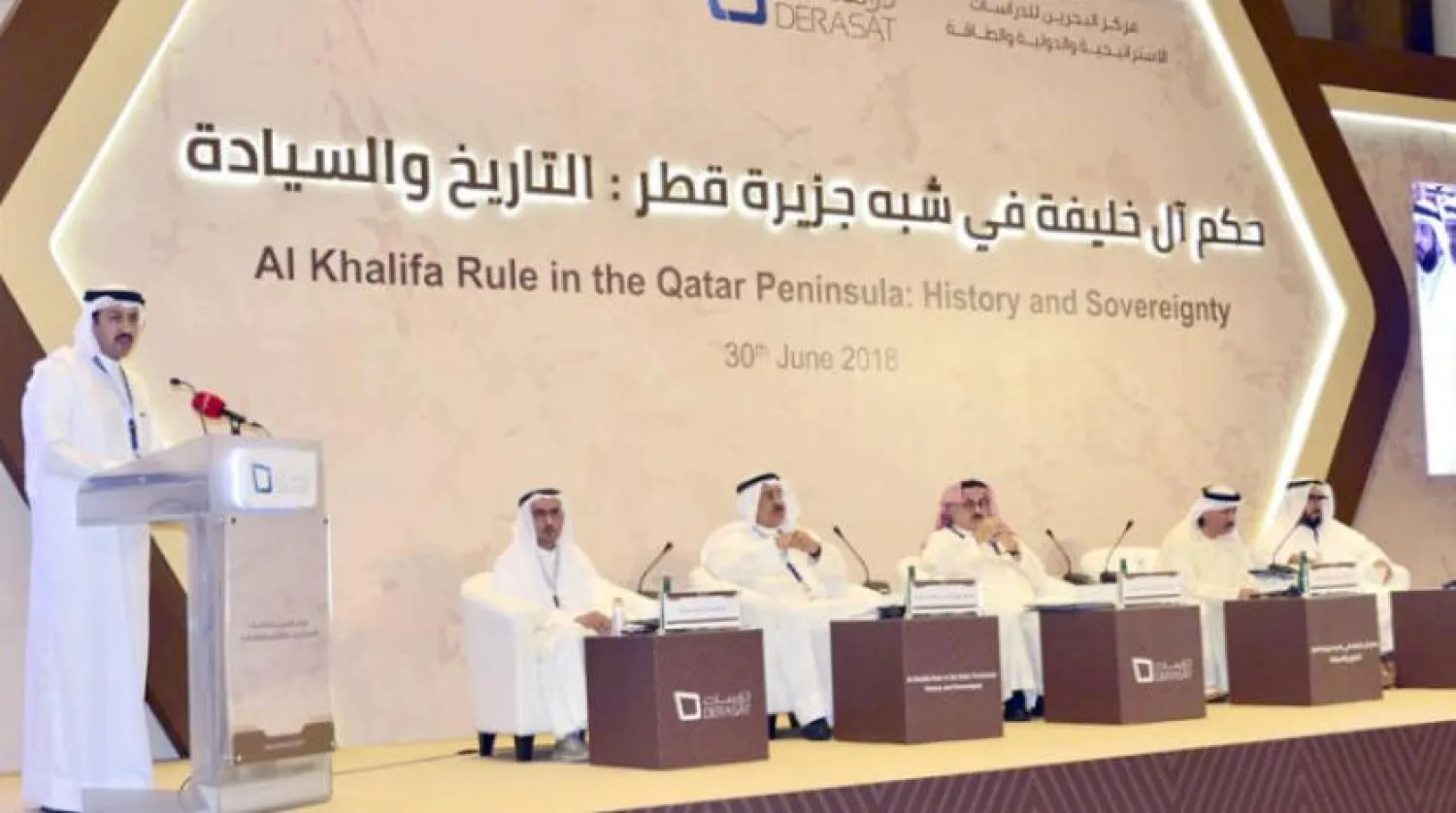
A Manama conference highlighted the Al-Khalifa family’s historic rule of the Qatari Peninsula. (Asharq Al-Awsat)
TT

Bahraini Documents Reveal Historic Al-Khalifa Rule of Qatar Peninsula

A Manama conference highlighted the Al-Khalifa family’s historic rule of the Qatari Peninsula. (Asharq Al-Awsat)

Documents revealed for the first time on Saturday detailed the rule of the Al-Khalifa family of the Qatari Peninsula throughout history.

This history was traced during a conference, entitled “Al-Khalifa’s Rule in the Qatari Peninsula … History and Sovereignty.” The event was organized by the Bahrain Institute for Strategic, International and Energy Studies (DERASAT) and held in the Bahraini capital Manama.

The conference focused on Al-Zubarah, capital of Al-Khalifa in the Qatari Peninsula and the islands of Bahrain, the rebellion against the Al-Khalifa’s legitimate rule of the peninsula and the Qatari invasion of the al-Dibal in 1986.

The conference highlighted the significant historical period of the Al-Khalifa’s rule and sovereignty on the peninsula since the establishment of the Al-Khalifa State in the Al-Zubarah in 1762, reported the Bahrain News Agency (BNA).

“The Al-Khalifa State, with Al-Zubarah as its capital, fulfilled crucial internal and international duties and made history whose echoes still reverberate now and will always be present”, said DERASAT board of trustees’ chairman Dr. Sheikh Abdullah bin Ahmed Al-Khalifa.

Al-Khalifa’s emergence in 1762 was a changing point in the modern history of the region. They presented an exemplary model of trade, marine navigation, rule of law and security.

They also respected international treaties on the Qatari Peninsula and Bahrain islands.

As a result of Al-Khalifa’s just rule, Al-Zubarah was transformed into a prosperous political and trade hub.

Al-Zubarah’s rule by Al-Khalifa represented the unity of the peninsula and Bahrain islands.

This was underlined by Bahrain King Hamad bin Issa Al-Khalifa when he declared: “The people of Qatar are our own and they were part of us before the Al-Thani’s rule.”

Sheikh Abdullah stressed that Bahrain never abandoned Al-Zubarah and it and other Bahraini regions, have long been at the heart of demands at the International Criminal Court.

The current borders were drawn up by foreign powers to reap energy resources, he explained.

Bahrain has also been a victim of a series of conspiracies, he added.

The Al-Thani rule, on the other hand, has long been a symbol of rebellion and conspiracies, he continued.

He accused it of stoking strife and division to achieve expansionist goals through all illegitimate means, including resorting to force and forced displacement as demonstrated in the military invasion of Al-Zubarah in 1937.

The same scenario was repeated in 1986 with the invasion of al-Dibal.

Qatar’s hostile acts have continued, with its meddling in Bahrain’s internal affairs through its support of terrorist groups and fueling of media incitement, said Sheikh Abdullah.

The conference presented before the gatherers documents on Al-Zubarah’s history and the Al-Khalifa’s ties to the region.

They explain the demographics that existed at the time, as well as the political and historical geography of the Gulf region.



Saudi Arabia Urges Yemen’s STC to 'Urgently’ Withdraw from Hadhramaut and al-Mahra

Saudi Arabia Urges Yemen’s STC to 'Urgently’ Withdraw from Hadhramaut and al-Mahra
TT

Saudi Arabia Urges Yemen’s STC to 'Urgently’ Withdraw from Hadhramaut and al-Mahra

Saudi Arabia Urges Yemen’s STC to 'Urgently’ Withdraw from Hadhramaut and al-Mahra

The Saudi Ministry of Foreign Affairs issued a statement on Thursday expressing concern over the recent military movements witnessed in the governorates of Hadhramaut and al-Mahra.

It noted that “the actions carried out by the Southern Transitional Council were taken unilaterally, without the approval of the Presidential Leadership Council or coordination with the coalition leadership”.

The Kingdom described the moves as an “unjustified escalation” that has harmed the interests of the Yemeni people across all segments of society, undermined the Southern cause, and weakened the coalition’s efforts.

The Kingdom further emphasized that, in recent months, it has focused on maintaining unity and has undertaken intensive efforts to reach peaceful solutions to address the situation in the two governorates, as part of its ongoing endeavors to restore stability.

The statement added that these efforts were “coordinated with the brethren United Arab Emirates, the Chairman of the Presidential Leadership Council, and the Yemeni government to contain the situation”.

It said that a “joint Saudi–Emirati military team was dispatched to coordinate with the Southern Transitional Council in Aden, ensuring the withdrawal of its forces from the two governorates and the handover of camps to the National Shield Forces and local authorities under the coalition’s supervision”.

The Foreign Ministry stressed that efforts are still underway to restore the situation to its previous state, expressing the Kingdom’s hope that the public interest will prevail and that the Southern Transitional Council will take the initiative to de-escalate tensions and urgently and peacefully withdraw its forces from the two governorates.

Saudi Arabia also underscored the importance of cooperation among all Yemeni forces and components, exercising restraint, and avoiding actions that could undermine security and stability.

The Kingdom reiterated its position that the “Southern cause is a just issue with historical and social dimensions and can only be resolved through dialogue that brings all Yemeni parties together at one table, within a comprehensive political process that ensures a lasting solution in Yemen”.

The statement concluded by affirming the Kingdom’s “support for the Chairman and members of the Presidential Leadership Council and the Yemeni government, in a manner that achieves security, stability, development, and peace in the sisterly Republic of Yemen”.


MWL Condemns Attack Targeting Pakistani Police

The Muslim World League (MWL) logo
TT

MWL Condemns Attack Targeting Pakistani Police

The Muslim World League (MWL) logo

The Muslim World League (MWL) strongly condemned the attack targeting police personnel in Pakistan’s Khyber Pakhtunkhwa Province, the Saudi Press Agency reported on Thursday.

In a statement issued by its General Secretariat, MWL Secretary-General and Chairman of the Organization of Muslim Scholars, Sheikh Mohammed Al-Issa, affirmed the League’s solidarity with the Islamic Republic of Pakistan in the face of all threats to its security and stability. He reiterated the MWL’s firm rejection and condemnation of violence and terrorism in all their forms and under any pretext.

He also extended his sincere condolences and sympathies to the families of the victims and to the Pakistani people.


Sultan of Oman Awards Military Order to Royal Saudi Air Force Commander

Commander of the Royal Saudi Air Force (RSAF) Lieutenant General Prince Turki bin Bandar bin Abdulaziz receives the Military Order of Oman (Second Class). (SPA)
TT

Sultan of Oman Awards Military Order to Royal Saudi Air Force Commander

Commander of the Royal Saudi Air Force (RSAF) Lieutenant General Prince Turki bin Bandar bin Abdulaziz receives the Military Order of Oman (Second Class). (SPA)

Oman’s Sultan Haitham bin Tarik awarded on Wednesday the Military Order of Oman (Second Class) to Commander of the Royal Saudi Air Force (RSAF) Lieutenant General Prince Turki bin Bandar bin Abdulaziz in recognition of his efforts and contributions to strengthening military cooperation between the two countries.

The order was presented to the RSAF commander by Omani Deputy Prime Minister for Defense Affairs Shihab bin Tarik Al Said, in the presence of Commander of the Royal Air Force of Oman (RAFO) Air Vice Marshal Khamis Al Ghafri, Saudi Ambassador to Oman Ibrahim bin Saad bin Bishan, and the accompanying delegation.

During the visit, the RSAF commander also met with Minister of the Royal Office of Oman General Sultan bin Mohammed Al Nomani for talks on issues of mutual interest.

Prince Turki bin Bandar bin Abdulaziz arrived in Oman on Tuesday on an official visit during which he met with the commander of RAFO. The discussions addressed issues of common interest, particularly in the field of joint training and exercises.

The visit included a tour of the Air Center for Specialized Training, where the delegation reviewed the advanced capabilities on display, reflecting the level of development achieved by the Royal Air Force of Oman.