

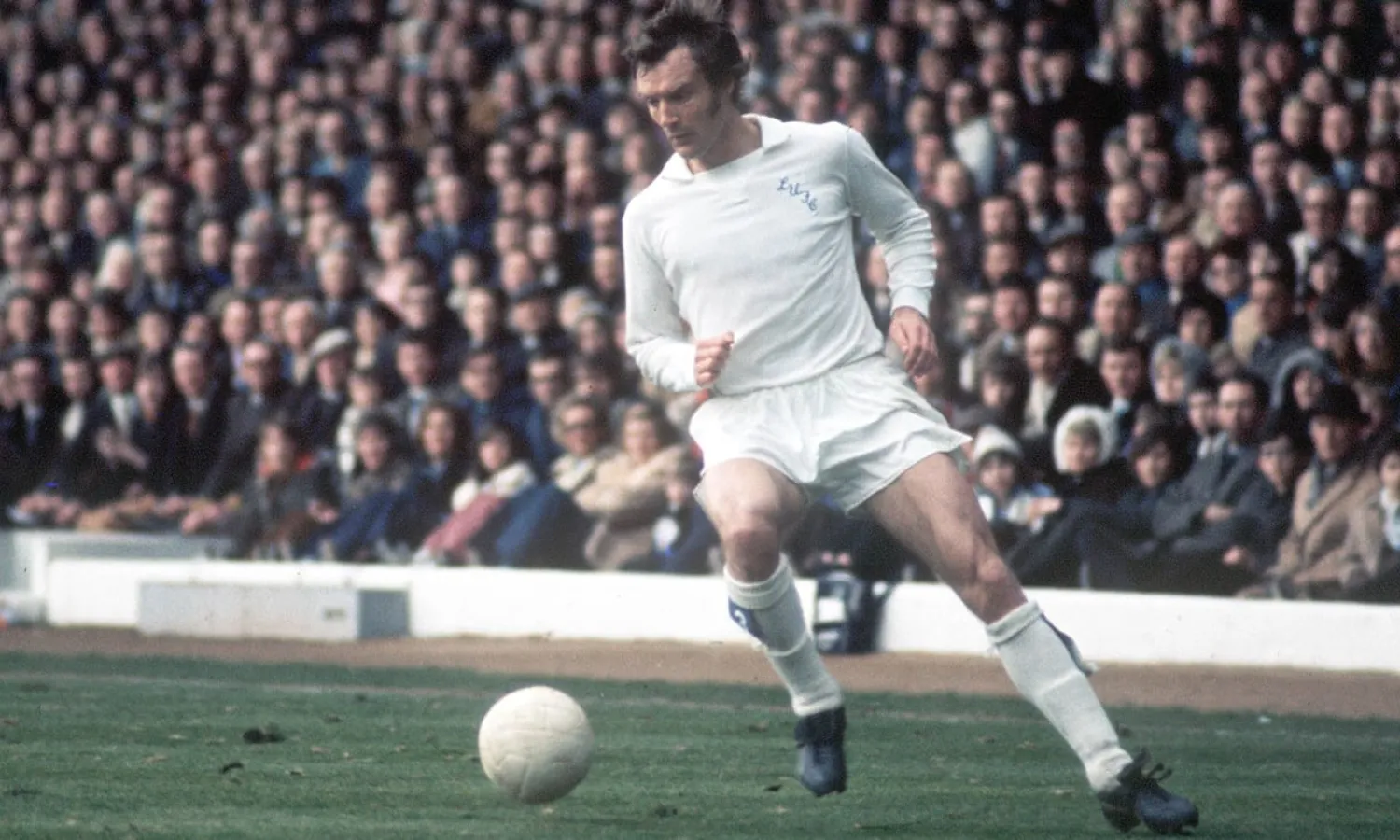

Paul Madeley... Seven Top-Class Players in One

 Paul Madeley appearing for Leeds Utd against Wolves in 1973. Photograph: Colorsport
Paul Madeley appearing for Leeds Utd against Wolves in 1973. Photograph: Colorsport
TT

Paul Madeley... Seven Top-Class Players in One

 Paul Madeley appearing for Leeds Utd against Wolves in 1973. Photograph: Colorsport
Paul Madeley appearing for Leeds Utd against Wolves in 1973. Photograph: Colorsport

So versatile was the footballer Paul Madeley that in his 18 years at Leeds United during the 1960s and 70s he played in every position bar goalkeeper, prompting his team-mate Johnny Giles to describe him as “seven top-class players in one”. The ultimate utility player, Madeley, who has died aged 73, also appeared in seven different roles for England, although in general he was best known as a defender, especially in his later years.

Madeley’s all-round prowess made him an indispensable fixture in Don Revie’s best Leeds sides, with whom he won two league titles, an FA Cup, a League Cup and two Fairs Cups during the glory years at Elland Road from 1965 to 1975. A staunch loyalist, he stayed on even when fortunes waned, and retired in 1980 having made 711 appearances for the club.

Revie’s Leeds were renowned for their hard, physical edge, but while Madeley never overlooked his duties in the tackling department he also brought a more cultured feel to the side with his neat, composed passing and intelligent reading of the game. Well balanced and rarely ruffled, he was a calming influence in a team of uncompromising characters.

Born in the Beeston area of Leeds, one of the three sons of Gladys (nee Nelson) and John Madeley, he left Parkside school in the city to work as an insurance clerk while playing as a defender for the local non-league club Farsley Celtic. He was signed by Second Division Leeds as a 17-year-old, making his debut at center-half two years later in 1964, the year Leeds won promotion to the top flight and began a period of high attainment over the next decade.

He rarely missed a game as Leeds became one of the most formidable teams in Europe – playing with ease at left- or right-back, as a center-half, sweeper, on either flank in midfield as well as in the center, or, for good measure, as an attacking midfielder or striker if required. He appeared as a forward in the League Cup final victory over Arsenal in 1968 and again in the two-legged 1971 Fairs Cup final win against Juventus in which he wore the No 11 shirt for both ties, scoring a crucial goal in the first.

Although a quiet, modest man, Madeley was certainly listened to within the Leeds hierarchy, and it was said to be his intervention, after the departure of Revie, that sealed the fate of Brian Clough during his famous 44-day reign as Leeds manager in 1974. During an emergency meeting to discuss Clough’s controversial start to his new position, various parties struggled to get their point across to the Leeds director Sam Bolton until Madeley stood up to announce, quite bluntly, that “what the players are trying to say, Mr Bolton, is that he’s no good”. That was enough for the club management, and Clough was on his way.

With England, Madeley showed a similarly quiet resolve. He made his debut for his country in 1971, but that was later than it might have been. He had turned down a request from Sir Alf Ramsey to join the 1970 World Cup squad in Mexico in place of his club-mate Paul Reaney, who had broken a leg. Madeley informed Ramsey that he would prefer to go on holiday with his family after a grueling season with Leeds. Yet, as some measure of Madeley’s stature, within the game, the England manager did not appear to hold it against him.

Playing mainly in defense, including as a center-half alongside Bobby Moore, he was capped 24 times thereafter, with the last of his appearances coming against Holland in 1977. It is possible that he regretted his decision to miss the 1970 finals, for England did not qualify for any major tournament during his time in the side.

Madeley retired from football during the 1980-81 season in his mid-30s and moved quickly into business, having already taken an interest in a paint and DIY enterprise with members of his family. The company flourished, and it was eventually sold for around £30m in 1987. From the early 1990s, however, he suffered from ill health in multiple guises. In 2003 he was diagnosed with Parkinson’s disease, and he died from complications associated with that condition.

He is survived by his wife, Ann (nee Telford), whom he married in 1969, and by their sons, Jason and Nick.

• Paul Edward Madeley, footballer, born 20 September 1944; died 23 July 2018

(The Guardian)


Shakhtar Boss Pays Ukrainian Racer $200,000 After Games Disqualification

Ukrainian President Volodymyr Zelenskiy holds helmet as he meets with a Ukrainian skeleton racer Vladyslav Heraskevych , who was disqualified from the Olympic skeleton competition over his "helmet of remembrance" depicting athletes killed since Russia's invasion and his father and coach, Mykhailo Heraskevych, amid Russia's attack on Ukraine, in Munich, Germany February 13, 2026. (Ukrainian Presidential Press Service/Handout via Reuters)
TT

Shakhtar Boss Pays Ukrainian Racer $200,000 After Games Disqualification

Ukrainian President Volodymyr Zelenskiy holds helmet as he meets with a Ukrainian skeleton racer Vladyslav Heraskevych , who was disqualified from the Olympic skeleton competition over his "helmet of remembrance" depicting athletes killed since Russia's invasion and his father and coach, Mykhailo Heraskevych, amid Russia's attack on Ukraine, in Munich, Germany February 13, 2026. (Ukrainian Presidential Press Service/Handout via Reuters)

The owner of ‌Ukrainian football club Shakhtar Donetsk has donated more than $200,000 to skeleton racer Vladyslav Heraskevych after the athlete was disqualified from the Milano Cortina Winter Games before competing over the use of a helmet depicting Ukrainian athletes killed in the war with Russia, the club said on Tuesday.

The 27-year-old Heraskevych was disqualified last week when the International Bobsleigh and Skeleton Federation jury ruled that imagery on the helmet — depicting athletes killed since Russia invaded Ukraine in 2022 — breached rules on athletes' expression at ‌the Games.

He ‌then lost an appeal at the Court ‌of ⁠Arbitration for Sport hours ⁠before the final two runs of his competition, having missed the first two runs due to his disqualification.

Heraskevych had been allowed to train with the helmet that displayed the faces of 24 dead Ukrainian athletes for several days in Cortina d'Ampezzo where the sliding center is, but the International Olympic Committee then ⁠warned him a day before his competition ‌started that he could not wear ‌it there.

“Vlad Heraskevych was denied the opportunity to compete for victory ‌at the Olympic Games, yet he returns to Ukraine a ‌true winner," Shakhtar President Rinat Akhmetov said in a club statement.

"The respect and pride he has earned among Ukrainians through his actions are the highest reward. At the same time, I want him to ‌have enough energy and resources to continue his sporting career, as well as to fight ⁠for truth, freedom ⁠and the remembrance of those who gave their lives for Ukraine," he said.

The amount is equal to the prize money Ukraine pays athletes who win a gold medal at the Games.

The case dominated headlines early on at the Olympics, with IOC President Kirsty Coventry meeting Heraskevych on Thursday morning at the sliding venue in a failed last-minute attempt to broker a compromise.

The IOC suggested he wear a black armband and display the helmet before and after the race, but said using it in competition breached rules on keeping politics off fields of play. Heraskevych also earned praise from Ukraine President Volodymyr Zelenskiy.


Speed Skating-Italy Clinch Shock Men’s Team Pursuit Gold, Canada Successfully Defend Women’s Title

 Team Italy with Davide Ghiotto, Andrea Giovannini, Michele Malfatti, celebrate winning the gold medal on the podium of the men's team pursuit speed skating race at the 2026 Winter Olympics, in Milan, Italy, Tuesday, Feb. 17, 2026. (AP)
Team Italy with Davide Ghiotto, Andrea Giovannini, Michele Malfatti, celebrate winning the gold medal on the podium of the men's team pursuit speed skating race at the 2026 Winter Olympics, in Milan, Italy, Tuesday, Feb. 17, 2026. (AP)
TT

Speed Skating-Italy Clinch Shock Men’s Team Pursuit Gold, Canada Successfully Defend Women’s Title

 Team Italy with Davide Ghiotto, Andrea Giovannini, Michele Malfatti, celebrate winning the gold medal on the podium of the men's team pursuit speed skating race at the 2026 Winter Olympics, in Milan, Italy, Tuesday, Feb. 17, 2026. (AP)
Team Italy with Davide Ghiotto, Andrea Giovannini, Michele Malfatti, celebrate winning the gold medal on the podium of the men's team pursuit speed skating race at the 2026 Winter Olympics, in Milan, Italy, Tuesday, Feb. 17, 2026. (AP)

An inspired Italy delighted the home crowd with a stunning victory in the Olympic men's team pursuit final as

Canada's Ivanie Blondin, Valerie Maltais and Isabelle Weidemann delivered another seamless performance to beat the Netherlands in the women's event and retain their title ‌on Tuesday.

Italy's ‌men upset the US who ‌arrived ⁠at the Games ⁠as world champions and gold medal favorites.

Spurred on by double Olympic champion Francesca Lollobrigida, the Italian team of Davide Ghiotto, Andrea Giovannini and Michele Malfatti electrified a frenzied arena as they stormed ⁠to a time of three ‌minutes 39.20 seconds - ‌a commanding 4.51 seconds clear of the ‌Americans with China taking bronze.

The roar inside ‌the venue as Italy powered home was thunderous as the crowd rose to their feet, cheering the host nation to one ‌of their most special golds of a highly successful Games.

Canada's women ⁠crossed ⁠the line 0.96 seconds ahead of the Netherlands, stopping the clock at two minutes 55.81 seconds, and

Japan rounded out the women's podium by beating the US in the Final B.

It was only Canada's third gold medal of the Games, following Mikael Kingsbury's win in men's dual moguls and Megan Oldham's victory in women's freeski big air.


Lindsey Vonn Back in US Following Crash in Olympic Downhill 

Milano Cortina 2026 Olympics - Alpine Skiing - Women's Downhill 3rd Official Training - Tofane Alpine Skiing Centre, Belluno, Italy - February 07, 2026. Lindsey Vonn of United States in action during training. (Reuters)
TT

Lindsey Vonn Back in US Following Crash in Olympic Downhill 

Milano Cortina 2026 Olympics - Alpine Skiing - Women's Downhill 3rd Official Training - Tofane Alpine Skiing Centre, Belluno, Italy - February 07, 2026. Lindsey Vonn of United States in action during training. (Reuters)

Lindsey Vonn is back home in the US following a week of treatment at a hospital in Italy after breaking her left leg in the Olympic downhill at the Milan Cortina Games.

“Haven’t stood on my feet in over a week... been in a hospital bed immobile since my race. And although I’m not yet able to stand, being back on home soil feels amazing,” Vonn posted on X with an American flag emoji. “Huge thank you to everyone in Italy for taking good care of me.”

The 41-year-old Vonn suffered a complex tibia fracture that has already been operated on multiple times following her Feb. 8 crash. She has said she'll need more surgery in the US.

Nine days before her fall in Cortina d'Ampezzo, Italy, Vonn ruptured the ACL in her left knee in another crash in Switzerland.

Even before then, all eyes had been on her as the feel-good story heading into the Olympics for her comeback after nearly six years of retirement.
