


Premier League Needs to Stop VAR Operating Like a Nitpickers’ Charter

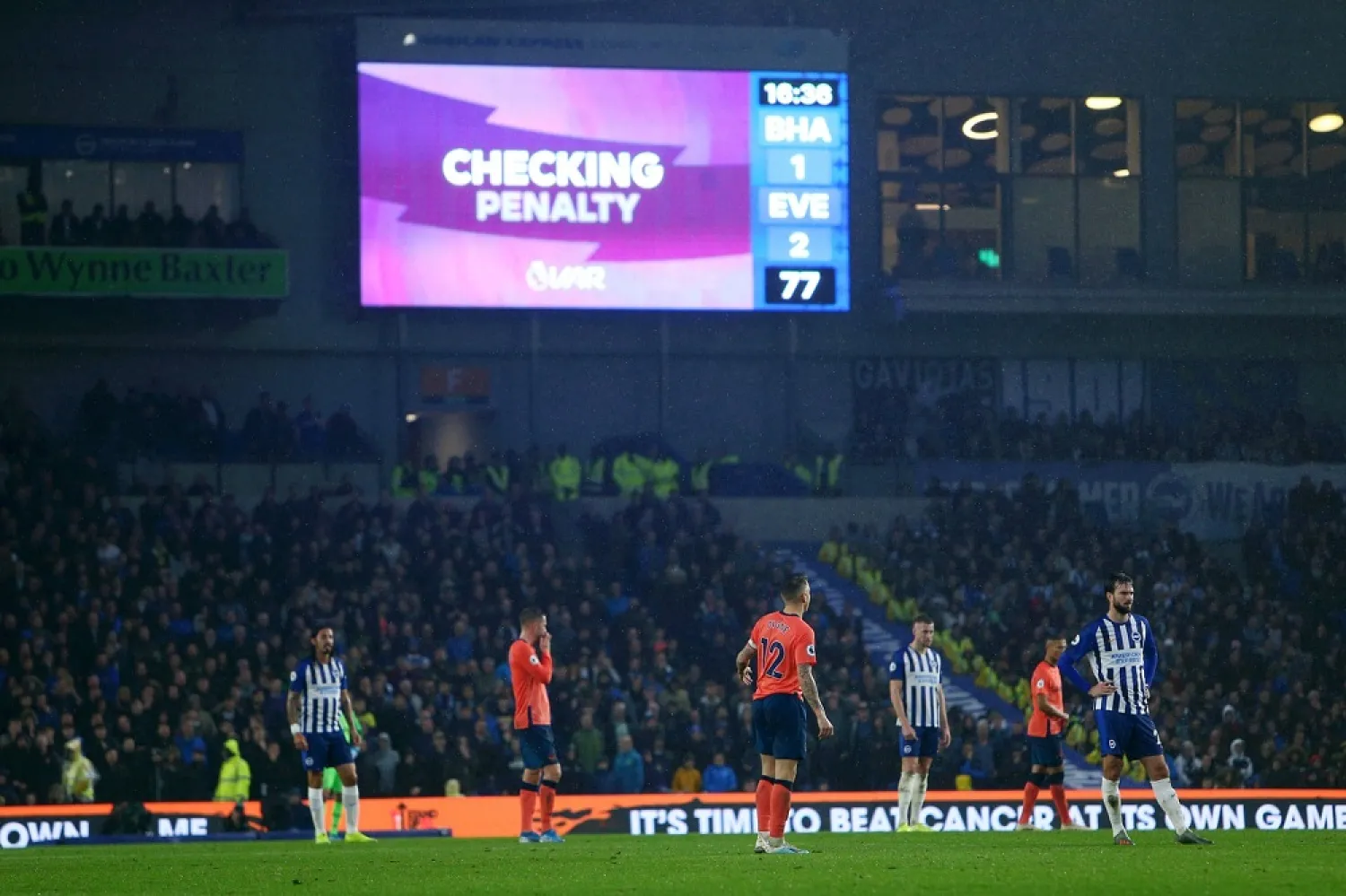
Fans were left baffled as VAR intervened to award Brighton a penalty against Everton on Saturday when Michael Keane accidentally stepped on Aaron Connolly’s toe. (Getty Images)
TT

Premier League Needs to Stop VAR Operating Like a Nitpickers’ Charter

Fans were left baffled as VAR intervened to award Brighton a penalty against Everton on Saturday when Michael Keane accidentally stepped on Aaron Connolly’s toe. (Getty Images)

Dissatisfaction with VAR seems to be back with a vengeance after the incidents of last weekend, with a meeting of Premier League clubs scheduled for November to discuss the implementation of remote technology and look into the reasons referees have been avoiding their pitch-side monitors.

Most of us imagined the ability to check a quick replay on the sidelines would be all officials needed to sort out contentious incidents not readily picked up in real-time. When VAR was being dreamed up the general idea seemed to be that travesties on the pitch that led to the referee being besieged by aggrieved defenders – think Thierry Henry’s sneaky 2009 handball against Republic of Ireland to take an old but obvious example – could easily be ironed out if the official in question were allowed a quick peek at a monitor. A short delay in the game might not be ideal, but a better option surely than allowing a cynically illegal goal to stand.

In practice VAR has not worked out anything like this and not simply because English referees have made some sort of pact to disdain pitch-side monitors for fear of holding up games for too long. This season there have been more than two dozen refereeing decisions overturned by VAR and not once has the referee trotted off to the available TV screen to have a look for himself.

The rationale appears to be that there is not much point peering into a portable black box when there are more officials with better screens and more playback opportunities in Stockley Park, yet this sort of distant, detached micromanagement has led to numerous complaints that the spontaneity is being sucked out of matches. Football is an emotional game, about a million people have already said this season, and for players and spectators alike the attraction is sharing that emotion together, not having to wait 30 seconds or more to see whether it is OK to start leaping around.

About a month into the season a voluntary moratorium on moaning about VAR seemed to take hold because it was all getting a bit boring and repetitive and it was generously imagined that any system would have teething troubles before settling down to run smoothly. That may still happen at some point but for now VAR not only keeps coming up with new controversies, it is introducing travesties into games instead of clearing them up.

The penalty awarded against Michael Keane at Brighton last Saturday was a case in point. Though clearly looking at the ball and not seeking to foul his opponent in any way, the defender accidentally stepped on Aaron Connolly’s toe in the act of playing the ball. Pre-VAR, such an incident would have gone completely unnoticed. Not only was the contact slight and trivial, the attacking player would have risked a card for diving had he hit the deck in search of a penalty, because no one would have been able to work out what sort of foul had taken place. The subtle difference now is that a player in search of a penalty for any sort of felt contact can be fairly sure VAR will back him up.

Andy Burnham is an Everton fan, as well as the mayor of Greater Manchester, but he raised a valid point when he described VAR as a nitpickers’ charter. That is precisely how it is operating and the Premier League meeting would do well to discuss that rather than the slow take-up of the pitch-side monitor facility.

In fairness to paying spectators inside stadiums, what referees should start doing anyway is calling for replays to be played on the big screens, rather than pitch-side monitors. It has long been ludicrous that people at games should get less information and less of a view than people watching from their sofas. The couple of major stadiums still without big screens – Anfield and Old Trafford – will just have to install them. It’s called progress.

The other aspect of VAR that urgently needs discussing is the number of perfectly good goals that have been disallowed for microscopic measurements of offside. The technology is at its most nitpicky and intrusive in this area, and there is simply no need for replays to be pored over again and again just to establish that someone was ahead of the offside line by a knee or a big toe.

The game should not really be interested in distances that small, because both attacker and defender are likely to be moving rather than static when the ball is played and unaware of the precise location of the line that will eventually be applied on-screen by remote officials. In those circumstances a player cannot possibly know whether he is an inch or two offside, and therefore cannot be accused of seeking to gain an unfair advantage.

Being broadly level with the last defender cannot be regarded as cheating – it is part of the forward’s remit to be as far up the pitch as permissible – but the effect of VAR has been to wipe out the concept of level. You are always going to be slightly on or off, even though you might not know which until a minute or so later when your potential winner has been disallowed.

This is a wholly unsatisfactory situation, annoying for everyone in the stadium, and in view of the likelihood that precise measurements are here to stay, the offside law itself needs looking at. If you are not deemed to be goal-hanging when you are level, why would you be assumed to be gaining an unfair advantage if you are momentarily caught a couple of inches in front without realizing it? The old concept of daylight between attacker and defender might be useful here, except VAR would doubtless end up spending most of its time measuring the tiniest of gaps before sanctioning goals. A more workable idea is that a player should be considered onside if any part of his body is onside. It is not perfect but it is better than seeing goals chalked off for offsides both fractional and accidental.

As with the Keane incident at Brighton, VAR cannot seem to differentiate between the accidental and the deliberate. The old certainties about what constitutes a foul inside the area or a player being caught offside are being eroded dangerously quickly. The technology is already impressive and will only get better; what is important, as ever, is that the game is careful about how best to use it.

The Guardian Sport


Shakhtar Boss Pays Ukrainian Racer $200,000 After Games Disqualification

Ukrainian President Volodymyr Zelenskiy holds helmet as he meets with a Ukrainian skeleton racer Vladyslav Heraskevych , who was disqualified from the Olympic skeleton competition over his "helmet of remembrance" depicting athletes killed since Russia's invasion and his father and coach, Mykhailo Heraskevych, amid Russia's attack on Ukraine, in Munich, Germany February 13, 2026. (Ukrainian Presidential Press Service/Handout via Reuters)
TT

Shakhtar Boss Pays Ukrainian Racer $200,000 After Games Disqualification

Ukrainian President Volodymyr Zelenskiy holds helmet as he meets with a Ukrainian skeleton racer Vladyslav Heraskevych , who was disqualified from the Olympic skeleton competition over his "helmet of remembrance" depicting athletes killed since Russia's invasion and his father and coach, Mykhailo Heraskevych, amid Russia's attack on Ukraine, in Munich, Germany February 13, 2026. (Ukrainian Presidential Press Service/Handout via Reuters)

The owner of ‌Ukrainian football club Shakhtar Donetsk has donated more than $200,000 to skeleton racer Vladyslav Heraskevych after the athlete was disqualified from the Milano Cortina Winter Games before competing over the use of a helmet depicting Ukrainian athletes killed in the war with Russia, the club said on Tuesday.

The 27-year-old Heraskevych was disqualified last week when the International Bobsleigh and Skeleton Federation jury ruled that imagery on the helmet — depicting athletes killed since Russia invaded Ukraine in 2022 — breached rules on athletes' expression at ‌the Games.

He ‌then lost an appeal at the Court ‌of ⁠Arbitration for Sport hours ⁠before the final two runs of his competition, having missed the first two runs due to his disqualification.

Heraskevych had been allowed to train with the helmet that displayed the faces of 24 dead Ukrainian athletes for several days in Cortina d'Ampezzo where the sliding center is, but the International Olympic Committee then ⁠warned him a day before his competition ‌started that he could not wear ‌it there.

“Vlad Heraskevych was denied the opportunity to compete for victory ‌at the Olympic Games, yet he returns to Ukraine a ‌true winner," Shakhtar President Rinat Akhmetov said in a club statement.

"The respect and pride he has earned among Ukrainians through his actions are the highest reward. At the same time, I want him to ‌have enough energy and resources to continue his sporting career, as well as to fight ⁠for truth, freedom ⁠and the remembrance of those who gave their lives for Ukraine," he said.

The amount is equal to the prize money Ukraine pays athletes who win a gold medal at the Games.

The case dominated headlines early on at the Olympics, with IOC President Kirsty Coventry meeting Heraskevych on Thursday morning at the sliding venue in a failed last-minute attempt to broker a compromise.

The IOC suggested he wear a black armband and display the helmet before and after the race, but said using it in competition breached rules on keeping politics off fields of play. Heraskevych also earned praise from Ukraine President Volodymyr Zelenskiy.


Speed Skating-Italy Clinch Shock Men’s Team Pursuit Gold, Canada Successfully Defend Women’s Title

 Team Italy with Davide Ghiotto, Andrea Giovannini, Michele Malfatti, celebrate winning the gold medal on the podium of the men's team pursuit speed skating race at the 2026 Winter Olympics, in Milan, Italy, Tuesday, Feb. 17, 2026. (AP)
Team Italy with Davide Ghiotto, Andrea Giovannini, Michele Malfatti, celebrate winning the gold medal on the podium of the men's team pursuit speed skating race at the 2026 Winter Olympics, in Milan, Italy, Tuesday, Feb. 17, 2026. (AP)
TT

Speed Skating-Italy Clinch Shock Men’s Team Pursuit Gold, Canada Successfully Defend Women’s Title

 Team Italy with Davide Ghiotto, Andrea Giovannini, Michele Malfatti, celebrate winning the gold medal on the podium of the men's team pursuit speed skating race at the 2026 Winter Olympics, in Milan, Italy, Tuesday, Feb. 17, 2026. (AP)
Team Italy with Davide Ghiotto, Andrea Giovannini, Michele Malfatti, celebrate winning the gold medal on the podium of the men's team pursuit speed skating race at the 2026 Winter Olympics, in Milan, Italy, Tuesday, Feb. 17, 2026. (AP)

An inspired Italy delighted the home crowd with a stunning victory in the Olympic men's team pursuit final as

Canada's Ivanie Blondin, Valerie Maltais and Isabelle Weidemann delivered another seamless performance to beat the Netherlands in the women's event and retain their title ‌on Tuesday.

Italy's ‌men upset the US who ‌arrived ⁠at the Games ⁠as world champions and gold medal favorites.

Spurred on by double Olympic champion Francesca Lollobrigida, the Italian team of Davide Ghiotto, Andrea Giovannini and Michele Malfatti electrified a frenzied arena as they stormed ⁠to a time of three ‌minutes 39.20 seconds - ‌a commanding 4.51 seconds clear of the ‌Americans with China taking bronze.

The roar inside ‌the venue as Italy powered home was thunderous as the crowd rose to their feet, cheering the host nation to one ‌of their most special golds of a highly successful Games.

Canada's women ⁠crossed ⁠the line 0.96 seconds ahead of the Netherlands, stopping the clock at two minutes 55.81 seconds, and

Japan rounded out the women's podium by beating the US in the Final B.

It was only Canada's third gold medal of the Games, following Mikael Kingsbury's win in men's dual moguls and Megan Oldham's victory in women's freeski big air.


Lindsey Vonn Back in US Following Crash in Olympic Downhill 

Milano Cortina 2026 Olympics - Alpine Skiing - Women's Downhill 3rd Official Training - Tofane Alpine Skiing Centre, Belluno, Italy - February 07, 2026. Lindsey Vonn of United States in action during training. (Reuters)
TT

Lindsey Vonn Back in US Following Crash in Olympic Downhill 

Milano Cortina 2026 Olympics - Alpine Skiing - Women's Downhill 3rd Official Training - Tofane Alpine Skiing Centre, Belluno, Italy - February 07, 2026. Lindsey Vonn of United States in action during training. (Reuters)

Lindsey Vonn is back home in the US following a week of treatment at a hospital in Italy after breaking her left leg in the Olympic downhill at the Milan Cortina Games.

“Haven’t stood on my feet in over a week... been in a hospital bed immobile since my race. And although I’m not yet able to stand, being back on home soil feels amazing,” Vonn posted on X with an American flag emoji. “Huge thank you to everyone in Italy for taking good care of me.”

The 41-year-old Vonn suffered a complex tibia fracture that has already been operated on multiple times following her Feb. 8 crash. She has said she'll need more surgery in the US.

Nine days before her fall in Cortina d'Ampezzo, Italy, Vonn ruptured the ACL in her left knee in another crash in Switzerland.

Even before then, all eyes had been on her as the feel-good story heading into the Olympics for her comeback after nearly six years of retirement.
