

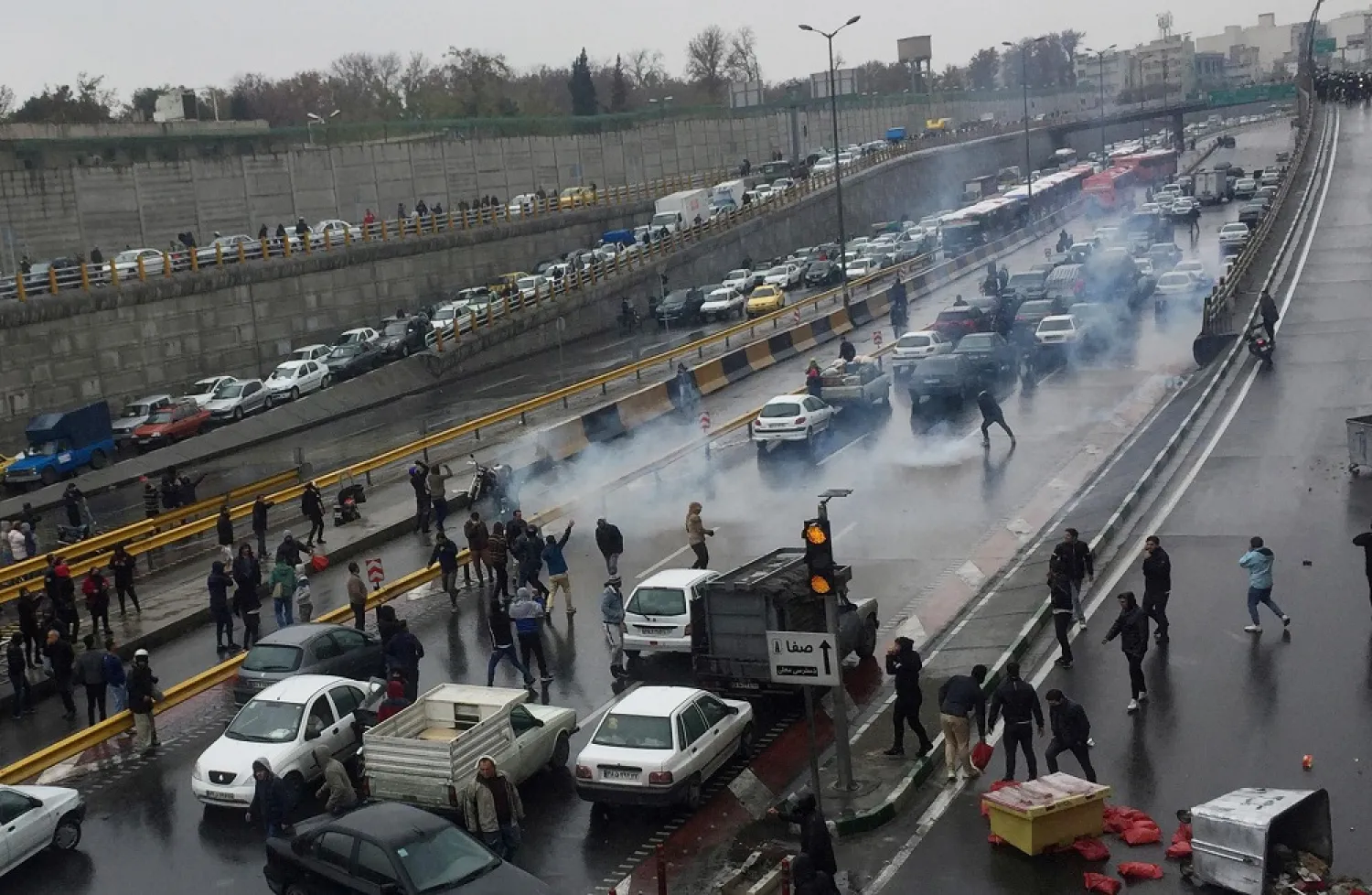

1 Killed as Angry Iranians Take to Streets to Protest Gasoline Price Hikes

People protest against gasoline price hikes, on a highway in Tehran, Iran on November 16, 2019. (Reuters)
TT

1 Killed as Angry Iranians Take to Streets to Protest Gasoline Price Hikes

People protest against gasoline price hikes, on a highway in Tehran, Iran on November 16, 2019. (Reuters)

Riot police and security forces clashed with demonstrators in Tehran and dozens of cities across Iran on Saturday, Iranian news agencies and social media said, as protests against a rise in gasoline prices turned political.

The reports said demonstrators chanted anti-government slogans around the country, a day after the government increased the price of regular gasoline to 15,000 rials ($0.13) a liter from 10,000 rials and rationed it.

State television said police clashed with what it called rioters in some cities and fired teargas to disperse them.

One person was killed and several people were wounded in the city of Sirjan in Kerman province on Friday, the ISNA news agency quoted a local official as saying on Saturday.

"People attacked a fuel storage warehouse in Sirjan and tried to set fire to it", the state news agency IRNA said.

Videos posted on social media from inside Iran showed protesters setting fire to buildings and clashing with riot police. In other videos protesters blocked roads and set fires in the streets in Tehran and some other cities. Some chanted slogans against top officials.

The videos and other images on social media could not be verified by Reuters.

"People are very angry here in Shiraz (city). I heard gun shots. Hundreds of people are in the streets. They burned a police car this morning," a witness, who asked not to be named, told Reuters by telephone.

Protests spread to least 40 cities and towns on Saturday, Iranian media said.

Videos on social media showed riot police firing teargas and using clubs to disperse protesters in several cities. A video shared on Twitter showed protesters setting fire to a bank.

State-run TV accused "hostile media" of trying to exaggerate the size of demonstrations by "using fake news and videos on social media".

General Prosecutor Mohammad Jafar Montazeri told state TV that demonstrators who blocked roads and clashed with security forces “certainly have roots outside the country".

Protesters were seeing slower internet speeds and limited access, social media reports said, an apparent effort by the authorities to limit communication between protesters.

Further squeeze on living costs

Many people in oil-producing Iran see cheap gasoline as a national right and price hike sparked worries about a further squeeze on living costs, despite assurances from the Iranian authorities that the revenue raised would be used to help needy families.

People's struggle to make ends meet has worsened since last year, when the United States pulled out of Iran's 2015 nuclear deal with six powers and reimposed sanctions on the country.

Combined with rising inflation, growing unemployment, a slump in the rial and state corruption, Washington’s policy of “maximum pressure” has further crippled the economy.

President Hassan Rouhani said 75 percent of Iranians were "under pressure" and the extra petrol revenues would go to them, and not the treasury.

Rouhani had tried to hike fuel prices in December but was blocked by parliament after protests that rocked Iran for days.

The speaker at the time ruled out the move as unpopular and said it was "not in the interests of the country".

The scheme comes at a sensitive time as Iran prepares for a February parliamentary election.

The head of Iran's Planning and Budget Organization, Mohammad Bagher Nobakht, said the price hike was agreed by the High Council of Economic Coordination made up of the president, parliament speaker and judiciary chief, implying it had across-the-board approval.

The council met again Saturday and, according to the government's official website, urged the "cooperation of all branches to successfully implement the plan".

Lawmakers were unhappy to have been circumvented, with Tehran MP Parvaneh Salahshouri tweeting that parliament had "lost its authority".

In 2015, during his first term, Rouhani had voiced opposition to a dual-price petrol regime adopted by his predecessor, Mahmoud Ahmadinejad, saying "it caused corruption and that is why we made a unified rate".

His administration also scrapped Ahmadinejad's fuel card scheme, only to revive it this year while still denying it was a precursor to rationing and price hikes.

The clerical rulers are anxious to prevent any repeat of unrest in late 2017, when people staged protests in 80 cities and towns over poor living standards, some calling on the clerical leaders to step down. Iranian officials said 22 people died in those protests.

Lawmakers will debate the price hike decision on Sunday, Iranian media reported, adding that some of them are urgently preparing a motion aimed at forcing the establishment to revise its decision.

Iranians mainly rely on cars or taxis for access around cities and towns. The government said the cost of using taxis and public transport will not change, according to media reports.

The gasoline price increase is expected to raise around $2.55 billion a year for additional subsidies for 18 million families, or about 60 million Iranians on lower incomes, the government said.



US Judge Blocks Deportation of Columbia University Palestinian Activist

Mohsen Mahdawi at a press conference in Vermont last year - Photo by Alex Driehaus/AP
TT

US Judge Blocks Deportation of Columbia University Palestinian Activist

Mohsen Mahdawi at a press conference in Vermont last year - Photo by Alex Driehaus/AP

A US immigration judge has blocked the deportation of a Palestinian graduate student who helped organize protests at Columbia University against Israel's war in Gaza, according to US media reports.

Mohsen Mahdawi was arrested by immigration agents last year as he was attending an interview to become a US citizen.

Mahdawi had been involved in a wave of demonstrations that gripped several major US university campuses since Israel began a massive military campaign in the Gaza Strip.

A Palestinian born in the occupied West Bank, Mahdawi has been a legal US permanent resident since 2015 and graduated from the prestigious New York university in May. He has been free from federal custody since April.

In an order made public on Tuesday, Judge Nina Froes said that President Donald Trump's administration did not provide sufficient evidence that Mahdawi could be legally removed from the United States, multiple media outlets reported.

Froes reportedly questioned the authenticity of a copy of a document purportedly signed by Secretary of State Marco Rubio that said Mahdawi's activism "could undermine the Middle East peace process by reinforcing antisemitic sentiment," according to the New York Times.

Rubio has argued that federal law grants him the authority to summarily revoke visas and deport migrants who pose threats to US foreign policy.

The Trump administration can still appeal the decision, which marked a setback in the Republican president's efforts to crack down on pro-Palestinian campus activists.

The administration has also attempted to deport Mahmoud Khalil, another student activist who co-founded a Palestinian student group at Columbia, alongside Mahdawi.

"I am grateful to the court for honoring the rule of law and holding the line against the government's attempts to trample on due process," Mahdawi said in a statement released by his attorneys and published Tuesday by several media outlets.

"This decision is an important step towards upholding what fear tried to destroy: the right to speak for peace and justice."


Fire Breaks out Near Iran's Capital Tehran, State Media Says

Smoke rises from a fire caused by an explosion in Tehran (File photo - Reuters)
TT

Fire Breaks out Near Iran's Capital Tehran, State Media Says

Smoke rises from a fire caused by an explosion in Tehran (File photo - Reuters)

A fire broke out in Iran's Parand near the capital city Tehran, state media reported on Wednesday, publishing videos of smoke rising over the area which is close to several military and strategic sites in the country's Tehran province, Reuters reported.

"The black smoke seen near the city of Parand is the result of a fire in the reeds around the Parand river bank... fire fighters are on site and the fire extinguishing operation is underway", state media cited the Parand fire department as saying.


Pakistan PM Sharif to Seek Clarity on Troops for Gaza in US Visit

US President Donald Trump looks at Pakistan's Prime Minister Shehbaz Sharif speaking following the official signing of the first phase of the Gaza ceasefire agreement between Israel and Hamas, during a world leaders' summit on ending the Gaza war, in Sharm El-Sheikh, Egypt, October 13, 2025. REUTERS/Evelyn Hockstein/File Photo
TT

Pakistan PM Sharif to Seek Clarity on Troops for Gaza in US Visit

US President Donald Trump looks at Pakistan's Prime Minister Shehbaz Sharif speaking following the official signing of the first phase of the Gaza ceasefire agreement between Israel and Hamas, during a world leaders' summit on ending the Gaza war, in Sharm El-Sheikh, Egypt, October 13, 2025. REUTERS/Evelyn Hockstein/File Photo

Before Pakistan commits to sending troops to Gaza as part of the International Stabilization Force it wants assurances from the United States that it will be a peacekeeping mission rather than tasked with disarming Hamas, three sources told Reuters.

Pakistan's Prime Minister Shehbaz Sharif is set to attend the first formal meeting of President Donald Trump's Board of Peace in Washington on Thursday, alongside delegations from at least 20 countries.

Trump, who will chair the meeting, is expected to announce a multi-billion dollar reconstruction plan for Gaza and detail plans for a UN-authorized stabilization force for the Palestinian enclave.

Three government sources said during the Washington visit Sharif wanted to better understand the goal of the ISF, what authority they were operating under and what the chain of command was before making a decision on deploying troops.

"We are ready to send troops. Let me make it clear that our troops could only be part of a peace mission in Gaza," said one of the sources, a close aide of Sharif.

"We will not be part of any other role, such as disarming Hamas. It is out of the question," he said.

Analysts say Pakistan would be an asset to the multinational force, with its experienced military that has gone to war with arch-rival India and tackled insurgencies.

"We can send initially a couple of thousand troops anytime, but we need to know what role they are going to play," the source added.

Two of the sources said it was likely Sharif, who has met Trump earlier this year in Davos and late last year at the White House, would either have an audience with him on the sidelines of the meeting or the following day at the White House.

Initially designed to cement Gaza's ceasefire, Trump sees the Board of Peace, launched in late January, taking a wider role in resolving global conflicts. Some countries have reacted cautiously, fearing it could become a rival to the United Nations.

While Pakistan has supported the establishment of the board, it has voiced concerns against the mission to demilitarize Gaza's militant group Hamas.