


The Real Test for the GCC: Dealing with Qatar's Crisis Skilfully

The Real Test for the GCC: Dealing with Qatar's Crisis Skilfully
TT

The Real Test for the GCC: Dealing with Qatar's Crisis Skilfully

The Real Test for the GCC: Dealing with Qatar's Crisis Skilfully

This is a Gulf week par-excellence, as the Gulf Cooperation Council (GCC), which was founded in 1981 with security as its primary concern, will hold it fortieth summit under exceptional circumstances. The Saudi capital Riyadh is considered the Council’s headquarters, but it is the land solutions for Gulf and Arab states year round. This December’s summit was preceded by various reports of a reconciliation that would likely see the Emir of Qatar in attendance after he had been absent from the summits of the last two years, since the boycott of Qatar was announced by three Gulf countries and an Arab country, Egypt.

The Gulf states know that “the solution is in Riyadh”. This was the case in 2013, when the crisis of the withdrawal of ambassadors erupted and was ended with the “Riyadh Agreement”, which was elaborated in November 2014. Doha’s disregard for the requirements of that agreement laid the foundation for the 2017 boycott. Despite the boycott, the Council continued to work on most files in the presence of various ministers, and the Council’s united front was maintained in international meetings. This confirms that the crisis is a Gulf crisis.

The Council was founded out of the security necessity brought about the eruption of the Iran-Iraq crisi, which went on for eight years. The Gulf states were clearly united, preventing their differences from leading to disputes. This confirmed that they knew how to deal with crisis, and perhaps Gulf analysts were right to say that the Gulf states were “one family”.

The “Qatar crisis” showed that the Council’s work could persist despite disputes. Many lessons can be learned from the Council’s handling of the situation, and different thinks tanks have studied it. Stratford, a US based think tank that deals with strategic and security issues, which concludes that, before and after the boycott, the Council had succeeded in creating a strong organization “perfect for dealing with security issues” but total integration is distant due to many differences on several levels, including the political level, where each country has its own perspective.

In response to the Qatar crisis, American and Europeans capitals rushed to find a solution because of regional circumstances: The Iranians were continuing to destabilize the region, and regional powers, like Turkey, exploited the crisis to establish a presence in Qatar. The Gulf leaders, though, know best to resolve the differences and even the disputes that emerged among the members of this family.

Discussing the Qatar crisis and its impact on the GCC, Kuwaiti political analyst Oda al-Sayer told Asharq al-Awsat: “Over the past two years, the Council has continued to work, but it was somewhat paralyzed”.

He said challenges the Council faces are clear, with the Iranian threat to regional security the most glaring. “However the Gulf states dealt with this challenge skilfully”, especially since they included the Qataris in meetings regarding this issue.

On the importance of reforming the Council and rebuilding its unity, at least on the strategic front, he says the Council succeeded in presenting a unified image and that it is important to revise certain clauses and rethinking much the Council’s work, especially with regard to foreign relations.

Differences are being dealt with flexibly. The most prominent example of this was the "Makkah" summit, as the second highest-ranking Qatari official Sheikh Abdullah bin Nasser al-Thani, Prime Minister of Qatar, attended the summit to represent his country in the leaders' meeting during the Arab and Muslim summits in late May. The Gulf meeting condemned the Houthi attacks on Saudi soil, as well as the attacks on merchant ships off the Emirati coast. Although Qatar has continued to press forward with actions that hinder the progress of the reconciliation effort led by the Emir of Kuwait, Sheikh Sabah al-Ahmad al-Jaber al-Sabah, the option of reconciliation remained. Doha did not deny The Wall Street Journal report of a visit from Qatari foreign minister, Sheikh Muhammad bin Abdul Rahman al-Thani, to Saudi Arabia, where he offered to "abandon the Muslim Brotherhood". A few days ago, he did issue a statement in which he revealed holding talks with Saudi Arabia and hoped that it "would lead to positive results".

The Council continues to collaborate on the "Gulf Interpol" project, based in Abu Dhabi, and the joint military exercises, conducted under the umbrella of the Peninsula Shield Force, also persist. Work on establishing a common market is ongoing as well. This shows that, regardless of the progress made in solving the Qatar crisis, the Council remains cohesive and continues to function and enhance its members’ security.


Saudi Govt Rejects Any Attempts to Undermine Somalia’s Sovereignty

Custodian of the Two Holy Mosques King Salman bin Abdulaziz Al Saud chairs the Cabinet meeting in Riyadh. (SPA)
TT

Saudi Govt Rejects Any Attempts to Undermine Somalia’s Sovereignty

Custodian of the Two Holy Mosques King Salman bin Abdulaziz Al Saud chairs the Cabinet meeting in Riyadh. (SPA)

The Saudi government stressed on Tuesday the Kingdom’s rejection of any attempts “to create parallel entities that undermine Somalia's unity, territorial integrity, or national sovereignty.”

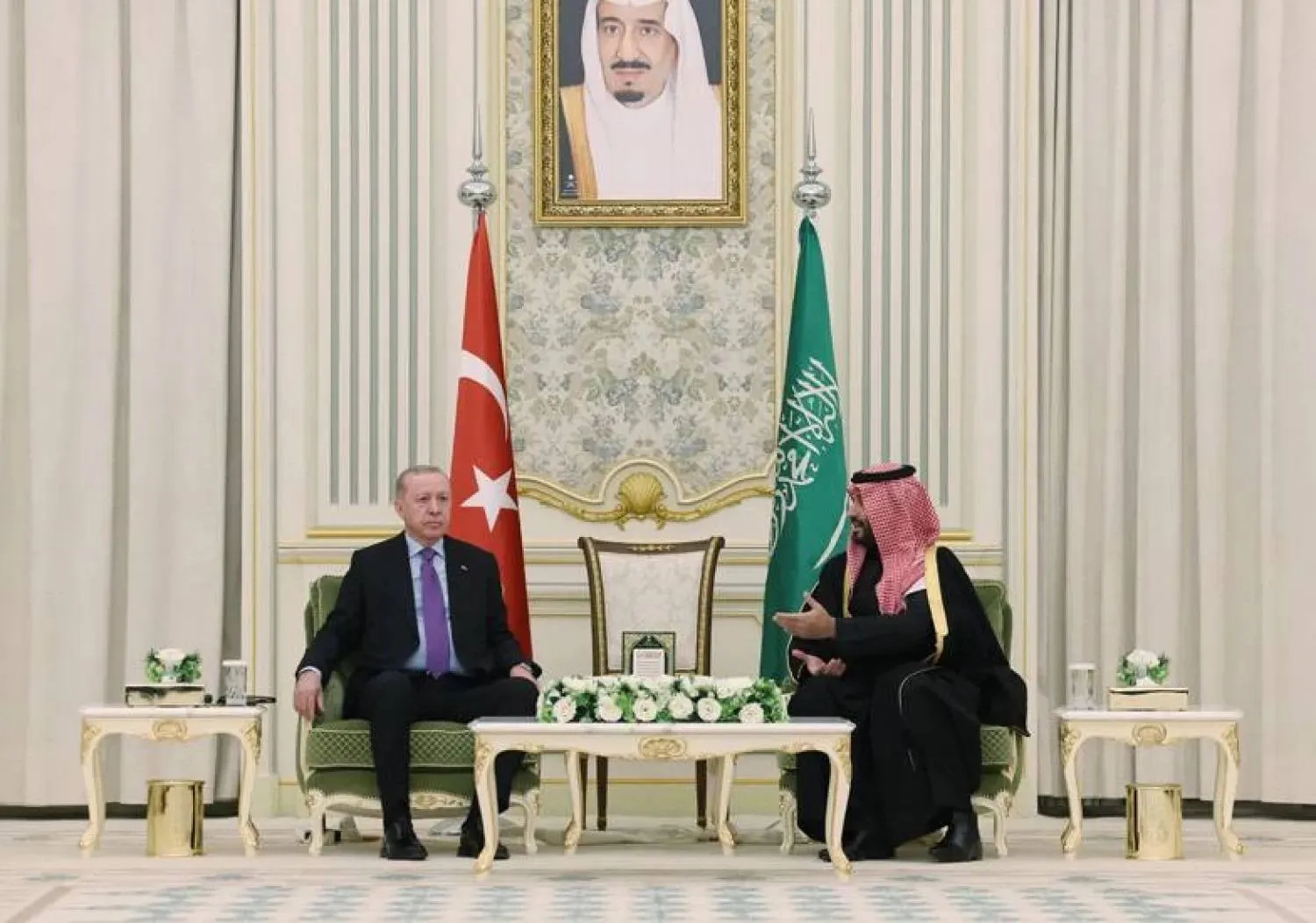
Custodian of the Two Holy Mosques King Salman bin Abdulaziz Al Saud chaired the Cabinet meeting that was held in Riyadh.

The Cabinet welcomed the outcomes of the Organization of Islamic Cooperation's extraordinary meeting on Somalia in Jeddah that stressed the Kingdom’s stance on Somalia.

The Cabinet reviewed recent high-level discussions between the Kingdom and various countries, focusing on regional developments, ongoing efforts to anchor security and peace, and the Kingdom's commitment to multilateral initiatives that drive global stability and foster collective responses to shared challenges.

The Cabinet reiterated the centrality of the Palestinian cause, stressing the Kingdom's unwavering support for a ceasefire in the Gaza Strip. These efforts aim to enable the Palestinian people to exercise their right to self-determination and to establish an independent state within the 1967 borders, with East Jerusalem as its capital.

The Cabinet commended the successful conclusion of the Gulf Shield 2026 joint military exercise, hosted by Saudi Arabia. Featuring the air and air defense forces of the Gulf Cooperation Council (GCC) and the GCC Unified Military Command, the exercise underscored the commitment to boosting regional defense cooperation and strengthening collective military readiness.

The Cabinet reviewed several high-profile economic events hosted by the Kingdom, specifically highlighting the Saudi-Japan Ministerial Investment Forum and the Saudi-Canadian Business and Investment Forum. The summits resulted in numerous memoranda of understanding across strategic sectors, including space, cybersecurity, ICT, manufacturing, education, finance, water, and agriculture.


Hadhramaut Figures: Saudi Arabia's Historic Stance Paves Way for New Phase of Stability

Sheikh Essam Al-Kathiri, Secretary-General of the Hadhramaut National Council. (Asharq Al-Awsat)
TT

Hadhramaut Figures: Saudi Arabia's Historic Stance Paves Way for New Phase of Stability

Sheikh Essam Al-Kathiri, Secretary-General of the Hadhramaut National Council. (Asharq Al-Awsat)

Several prominent figures from Yemen's Hadhramaut praised on Monday's Saudi Arabia's stance on the governorate that prevented it from sliding towards deeper unrest and instability.

The figures told Asharq Al-Awsat that the Kingdom's position was not limited to tackling the current crisis, but paves the way for a new phase of stability and development as parties prepare for a Riyadh conference on the southern issue.

The conference will mark a turning point in "rearranging" the political scene in the South, they remarked.

Hadhramaut is at a pivotal moment that demands united ranks that will come up with a unified vision that preserves the governorate's interests and allows it to play an effective role in any future political process, they added

Sheikh Essam Al-Kathiri, Secretary-General of the Hadhramaut National Council, told Asharq Al-Awsat that the Saudi Arabia's "historic" stance and determination over the December 3 developments prevented the governorate from slipping into chaos.

Hadhramaut may have escaped the crisis, but it has embarked on a new path towards progress and development, he stated.

The call for intra-south dialogue is a sign that a secure and stable future is on the horizon, he noted.

"We are already seeing these signs with Saudi Arabia's brotherly support," he remarked.

Another member of the council, Al-Hakam Abdullah al-Nahdi, told Asharq Al-Awsat that the support offered by Saudi Arabia, led by Custodian of the Two Holy Mosques King Salman bin Abdulaziz, Prince Mohammed bin Salman, Crown Prince and Prime Minister, and Defense Minister Prince Khalid bin Salman, will be "etched in Hadhramaut's memory and relayed to generations to come."

"Hadhramaut represents a natural strategic depth to the Kingdom and its security is indivisible from Saudi Arabia's," he added.

"Were it not for Saudi Arabia's stance, we would have been mired in chaos," he went on to say.

He said he was optimistic about the future as long as Saudi Arabia was by Hadhramaut's side, calling on the people to "seize this opportunity by rallying together and shunning division."


Somalia Cancels All UAE Deals

A meeting of the Somali government. (Somali National News Agency)
TT

Somalia Cancels All UAE Deals

A meeting of the Somali government. (Somali National News Agency)

Somalia's government said on Monday that it was annulling all agreements with the United Arab Emirates, including port deals and defense and ‌security cooperation, ‌citing ‌evidence ⁠the UAE had ‌undermined its national sovereignty. 

"The Council of Ministers has annulled all agreements concluded with the United Arab Emirates, ⁠including those involving federal governmental ‌institutions, affiliated entities, and ‍regional administrations ‍operating within the territory ‍of the Federal Republic of Somalia," a statement from Somalia's Council of Ministers said. 

"This decision applies to all agreements ⁠and partnerships relating to the ports of Berbera, Bosaso, and Kismayo ... (and) bilateral security and defense cooperation agreements," the statement added.