Damascus Launches Campaign to Confront Hiking Prices

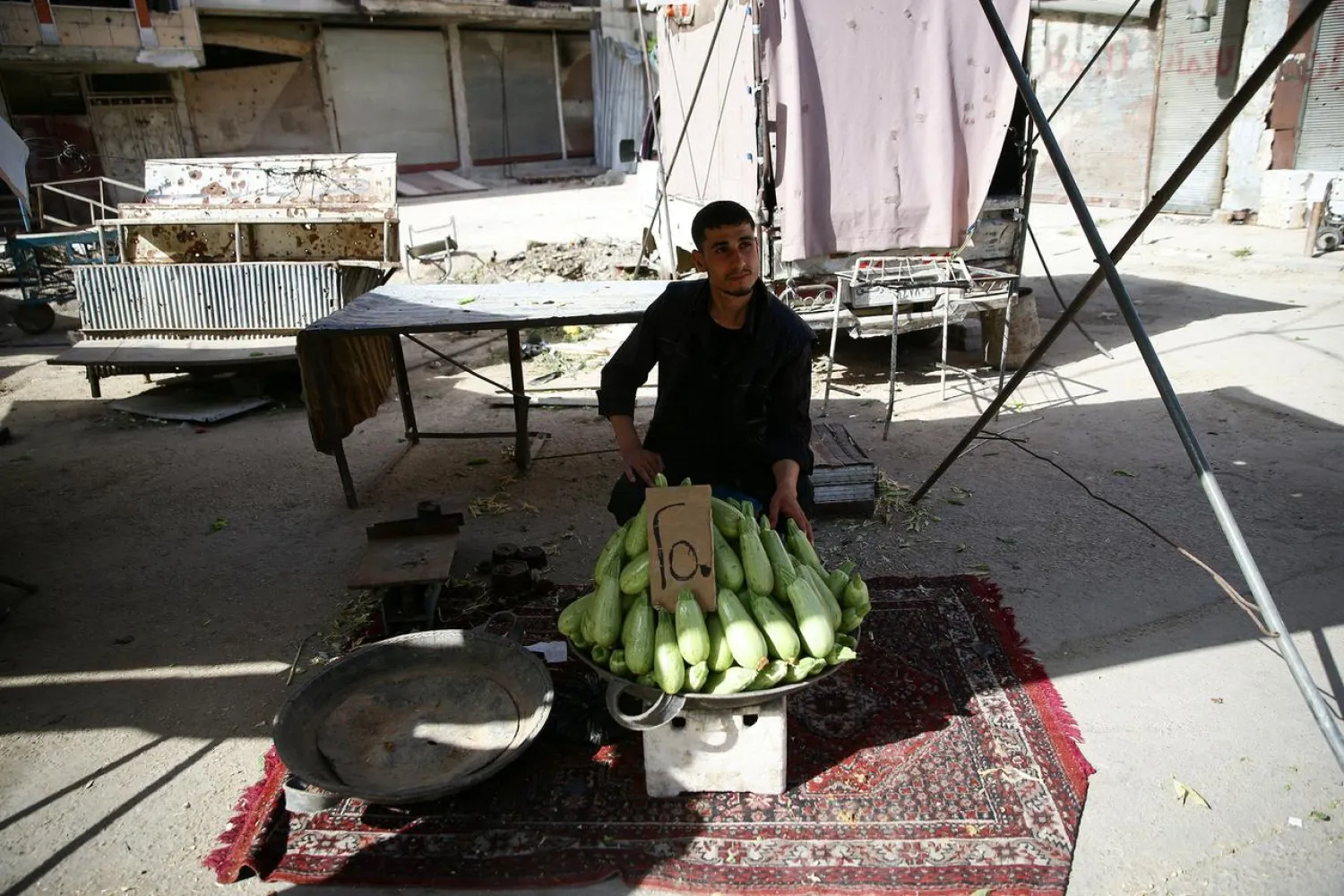
A man sells zucchini for 250 Syrian pounds a kilo in the city of Douma, in the eastern Damascus suburb of Ghouta, Syria May 10, 2017. (Reuters)
TT

Damascus Launches Campaign to Confront Hiking Prices

A man sells zucchini for 250 Syrian pounds a kilo in the city of Douma, in the eastern Damascus suburb of Ghouta, Syria May 10, 2017. (Reuters)

Syria’s Minister of Religious Endowments (Awqaf) Mohammad Abdul-Sattar al-Sayyed launched a campaign to confront the rising price of food and consumer goods, prompted by a sharp devaluation of the Syrian pound in the black market.

The minister launched the efforts days after regime leader Bashar Assad met with a delegation of preachers from the Ministry of Religious Endowments.

On Friday, mosque preachers were heard calling on merchants and businessmen to contribute to this campaign, and explained about the need and the importance of social solidarity and charity with the poor.

In Tartus, Sayyed said Assad demanded that the ministry focus on fighting corruption and on facing the rising prices and the economic war on Syria.

The economy has been suffering from an increase in prices of food and consumer goods since the eruption of the Syrian conflict in 2011.

The Syrian pound reached its lowest rate against the US dollar in the black market, after being sold at around 1,000 for one dollar last month before stabilizing at 850.

The official rate has remained stable at 434.

Meanwhile, the prices of food continued to increase as the regime failed to impose measures to stabilize the value of the currency and curb inflation.

The Ministry of Supply and Internal Trading had launched a campaign to monitor the prices of food items and to impose fines on shop owners who are not abiding by the fixed prices.

This campaign led to the closure of dozens of shops across the country, further paralyzing the markets.

As the prices of food and other commodities rise, the crash of the pound could throw more Syrians into poverty.

According to the UN, eight out of 10 Syrians live below the poverty line, making less than $100 a month.


Golden Halal Logo Launched at Makkah Halal Forum  

The Makkah Halal Forum 2026 was held from February 14 to 16. (SPA)
TT

Golden Halal Logo Launched at Makkah Halal Forum  

The Makkah Halal Forum 2026 was held from February 14 to 16. (SPA)

The Makkah Halal Forum 2026, which concluded on Monday, marked a pivotal milestone in the development of Saudi Arabia's halal industry, ushering in a new phase of structured institutional action.

This shift moves the sector beyond theoretical discourse toward a fully integrated implementation framework. It cements the Kingdom’s global leadership in halal and boosts the credibility of Saudi products in international markets.

The forum that began on February 14 witnessed the launch of a package of strategic enablers reflecting the maturity of the Saudi experience in the sector. Chief among them was the introduction of the Halal Academy as a specialized knowledge and training arm dedicated to building professional expertise and raising standards across the entire value chain.

The event also saw the unveiling of the Golden Halal logo, a high-level accreditation mark designed to provide global markets with a unified benchmark of trust, underscoring the Kingdom’s commitment to the highest standards of quality and compliance.

These initiatives signal a strategic shift that goes beyond the traditional concept of religious oversight. Instead, they frame halal as a comprehensive industrial and economic system that integrates Sharia compliance with high quality standards, advanced governance, and digital traceability. The approach is expected to boost the competitiveness of Saudi exports and facilitate their entry into global markets.

National success stories highlight the tangible impact of this transformation. CEO and founder of Roya Factory for Food Products Rasha Al Sanea noted that Saudi accreditation has evolved into a comprehensive quality certification that provides companies with a clear competitive edge abroad.

She noted that obtaining certification involves a rigorous process, including assessments of facility safety, manufacturing quality, and compliance with global standards ahead of final audits. These measures strengthen product reliability and boost readiness for international expansion.

The presence of international delegations and trade missions in Makkah on the sidelines of the forum helped accelerate expansion opportunities and open direct export channels to several markets, she added.

Pairing the Saudi Made logo with accredited halal marks, foremost among them the Golden Halal logo, enhances global consumer confidence and gives Saudi products a strong presence across diverse cultures and markets, she stressed.


Nissan CEO to Asharq Al-Awsat: Saudi Arabia Is ‘Golden Jewel’ Driving Regional Growth 

Nissan Chief Executive Ivan Espinosa. (Asharq Al-Awsat)
TT

Nissan CEO to Asharq Al-Awsat: Saudi Arabia Is ‘Golden Jewel’ Driving Regional Growth 

Nissan Chief Executive Ivan Espinosa. (Asharq Al-Awsat)

Nissan Chief Executive Ivan Espinosa has singled out Saudi Arabia as a cornerstone of the automaker’s global ambitions, calling the kingdom and the wider Middle East a “golden jewel” in the company’s international portfolio, driven by strong brand equity, steady profitability, and a deep, loyal customer base.

Speaking to Asharq Al-Awsat, Espinosa said Nissan has long enjoyed a solid foothold in Saudi Arabia and across the region, noting that Middle Eastern markets contribute a significant share of the company’s global earnings.

“We have a large base of supporters and loyal customers in the region, which makes it a pivotal market for both our present and our future,” he stressed.

Speaking during his first visit to the region as Nissan’s president, Espinosa said the company will continue investing in products tailored to local needs.

He cited the Nissan Patrol as a model born and developed to suit Gulf markets, particularly in its latest generations, which benefited from in-depth studies of user behavior and expectations.

He revealed that his visit was not limited to attending the recent Formula E event, but also aimed at gaining a deeper understanding of the Saudi market and strengthening Nissan’s position there. The company is working to expand its lineup and introduce more diverse products to serve a wider range of customers, he added.

Saudi visit

Espinosa described Saudi Arabia as “a wonderful place” where he continues to discover new facets reflecting the depth of its culture and the vibrancy of its society. The positive energy he sensed in the country reflects an ambitious and optimistic spirit, he said.

The Formula E event in which Nissan participated is a clear example of the Kingdom’s dynamism and its growing role in launching globally influential initiatives, underscoring its rising presence and confidence in shaping the future, he remarked.

Espinosa said Saudi Arabia’s ambitions under Vision 2030 intersect strongly with Nissan’s future vision, particularly in autonomous driving, artificial intelligence, and vehicles powered by new energy sources. The company sees promising opportunities for cooperation in the coming years.

With a long history and broad customer base in the Kingdom, Nissan aims to continue meeting expectations with innovative products, he said, noting that Saudi Arabia is a growing market with significant potential in technology and mobility solutions, reinforcing the company’s commitment to long-term investment in the region.

Strategic hub

Espinosa said Nissan is currently implementing its recovery plan, Re:Nissan, while preparing a strategic vision for the next phase. Regions have been classified according to growth priorities, with the Middle East among those given high priority.

He said describing the region as a “golden jewel” reflects the strength of the brand, the company’s long history there, and its solid profitability. Nissan aims to expand its market share through sustainable organic growth, he added.

Formula E

On Nissan’s participation in the Formula E World Championship, which concluded in Jeddah, Espinosa said it reflects the company’s competitive heritage and serves as a platform to showcase its electric vehicle technologies.

The championship serves as a real-world laboratory for transferring technology from race cars to production models.

He pointed to expertise in battery management and traction control derived from the Nissan Leaf, as well as the movement of engineers from the Formula E program into the development of future performance models, strengthening knowledge exchange between the track and the production line.

Three pillars

Espinosa said Nissan’s three-to-five-year plan rests on three pillars.

The first is completing the recovery plan by recalibrating the cost structure. So far, the company has achieved savings of about 160 billion yen, roughly $1 billion, in fixed costs, and launched more than 5,000 initiatives to reduce variable costs with potential savings of up to 240 billion yen, or about $1.5 billion.

Third-quarter results showed operating profit of 17 billion yen, or $114 million, despite tariff-related pressures, reflecting the company’s resilience and improved operational efficiency, he said.

The second pillar focuses on products and technology to accelerate the rollout of new models. The third aims to cement Nissan’s position as a leader in smart vehicles, he added.

Espinosa said the industry's future requires automakers to embrace technology without losing their core identity. Artificial intelligence has become central to design processes, with generative AI significantly shortening early design phases while enhancing creativity without replacing designers.

In autonomous driving, he cited Nissan’s partnership with a British software company that provides self-driving algorithms, while Nissan leverages its vehicle engineering expertise to deliver a natural driving experience that mimics human behavior.

He outlined a longer-term ambition for vehicles to learn their owners' driving styles and adapt their autonomous mode accordingly, whether dynamic or conservative, thereby enhancing trust and reducing anxiety.

Reshaping the industrial base

As part of the Re:Nissan plan, Espinosa said restructuring the industrial base is a key element of the transformation. The company will reduce the number of global plants from 17 to 10 to improve capacity utilization and boost profitability.

Among the most notable steps was the agreement to sell Nissan’s South Africa plant to Chery South Africa. The process was carried out with a high degree of responsibility and precision, he said, stressing that protecting jobs and ensuring employment continuity were core conditions of the deal.

A similar approach was adopted in Japan when the Oppama plant was closed. Nissan began early talks with employees and offered multiple options, including transfers to future operations in Kyushu, opportunities within other group units, and voluntary separation programs with attractive terms when necessary.

Plant reductions are being handled with great care while maintaining uniform global quality standards across production sites, supported by standardized control systems and specialized teams to ensure supply chain stability, particularly for semiconductors and electronic chips, said Espinosa.

Espinosa said the Re:Nissan plan is progressing on schedule, with clear signs of performance improvement paving the way for a smarter and more sustainable growth phase in global markets, led by the Middle East and Saudi Arabia.

Strategic flexibility

On hybrid and electric powertrains, Espinosa said Nissan is keeping pace with customer preferences while maintaining the view that electric vehicles will gradually become the dominant option.

The company offers a range of technologies, including internal combustion engines, e-Power systems, and fully electric vehicles, while shortening model development cycles to improve responsiveness to market demand.

The e-Power technology is expanding globally after its launch in Japan and Europe and is nearing entry into the US market, he went on to say. It will reach the Middle East in due course, particularly in mid-size segments.

Hybrid solutions for larger vehicles are also under study to meet regional towing requirements, he said.



Dammam Airport Launches Saudi Arabia’s First Category III Automatic Landing System  

Prince Saud bin Naif bin Abdulaziz, Governor of the Eastern Region, inaugurates the General Aviation Terminal and the upgraded automatic landing system at King Fahd International Airport in Dammam. (SPA)
TT

Dammam Airport Launches Saudi Arabia’s First Category III Automatic Landing System  

Prince Saud bin Naif bin Abdulaziz, Governor of the Eastern Region, inaugurates the General Aviation Terminal and the upgraded automatic landing system at King Fahd International Airport in Dammam. (SPA)

Prince Saud bin Naif bin Abdulaziz, Governor of Saudi Arabia’s Eastern Region, inaugurated on Monday two major aviation projects at King Fahd International Airport in Dammam: a dedicated General Aviation Terminal for private flights and the Kingdom’s first Category III Instrument Landing System (ILS), which enables fully automatic aircraft landings in low-visibility conditions.

The ceremony was attended by Minister of Transport and Logistics Services and Chairman of the General Authority of Civil Aviation (GACA) Saleh bin Nasser Al-Jasser and President of GACA and Chairman of the Saudi Airports Holding Company Abdulaziz bin Abdullah Al-Duailej.

Prince Saud said the projects represent a qualitative leap in strengthening the aviation ecosystem in the Eastern Region, boosting the airport’s operational readiness and its regional and international competitiveness.

The introduction of a Category III automatic landing system for the first time in Saudi Arabia reflects the advanced technological progress achieved by the national aviation sector and its commitment to the highest international standards, he stressed.

The General Aviation Terminal marks a significant upgrade to airport infrastructure. Spanning more than 23,000 square meters, the facility is designed to ensure efficient operations and fast passenger processing.

The main terminal covers 3,935 square meters, while aircraft parking areas extend over 12,415 square meters with capacity to accommodate four aircraft simultaneously. An additional 6,665 square meters are allocated to support services and car parking, improving traffic flow and delivering a premium travel experience for private aviation users.

The upgraded Category III ILS, considered among the world’s most advanced air navigation systems, allows aircraft to land automatically during poor visibility, ensuring flight continuity while enhancing safety and operational efficiency.

The project includes rehabilitation of the western runway, extending 4,000 meters, along with a further 4,000 meters of aircraft service roads. More than 3,200 lighting units have been installed under an integrated advanced system to meet modern operational requirements and support all aircraft types.

Al-Jasser said the inauguration of the two projects translates the objectives of the Aviation Program under the National Transport and Logistics Strategy into concrete achievements.

The developments bolster airport capacity and efficiency, support the sustainability of the aviation sector, and strengthen the competitiveness of Saudi airports, he added.

Al-Duailej, for his part, said the initiatives align with Saudi Vision 2030 by positioning the Kingdom as a global logistics hub and a leading aviation center in the Middle East.

The new terminal reflects high standards of privacy and efficiency for general aviation users, he remarked, noting the selection of Universal Aviation as operator of the general aviation terminals in Dammam and Jeddah.

Dammam Airports Company operates three airports in the Eastern Region: King Fahd International Airport, Al-Ahsa International Airport, and Qaisumah International Airport.