

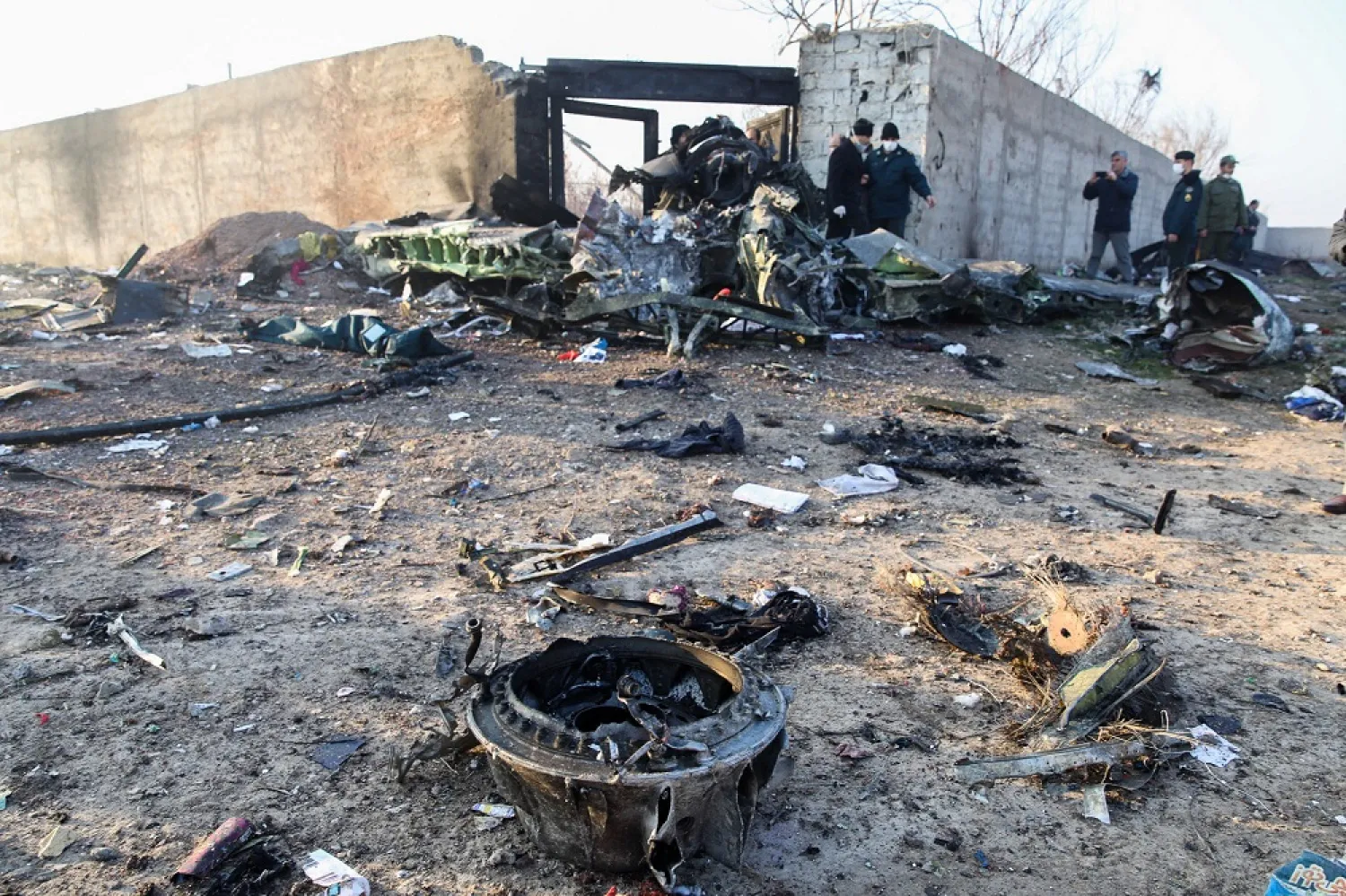

Recordings Reveal Iran Knew Ukraine Jet Hit by Missile

Rescue teams at the scene of the Ukraine plane crash. (Getty Images)
TT

Recordings Reveal Iran Knew Ukraine Jet Hit by Missile

Rescue teams at the scene of the Ukraine plane crash. (Getty Images)

A leaked recording of an exchange between an Iranian air-traffic controller and an Iranian pilot purports to show that authorities immediately knew a missile had downed a Ukrainian jetliner after takeoff from Tehran, killing all 176 people aboard, despite days of denials by Tehran.

Ukraine's President Volodymyr Zelenskiy acknowledged the recording's authenticity in a report aired by a Ukrainian television channel on Sunday night, said The Associated Press.

In Tehran on Monday, the head of the Iranian investigation team, Hassan Rezaeifar, acknowledged the recording was legitimate and said that it was handed over to Ukrainian officials.

After the Jan. 8 disaster, Iran’s civilian government maintained for days that it didn't know the country’s paramilitary Revolutionary Guard, answerable only to supreme leader Ali Khamenei, had shot down the aircraft.

The downing of the jetliner came just hours after the Guard launched a ballistic missile attack on Iraqi bases housing US forces in retaliation for an earlier American drone strike that killed the Guard's top general, Qassem Soleimani, in Baghdad.

A transcript of the recording, published by Ukrainian 1+1 TV channel, contains a conversation in Farsi between an air-traffic controller and a pilot reportedly flying a Fokker 100 jet for Iran’s Aseman Airlines from Iran’s southern city of Shiraz to Tehran.

"A series of lights like ... yes, it is missile, is there something?" the pilot calls out to the controller.

"No, how many miles? Where?" the controller asks.

The pilot responds that he saw the light by the Payam airport, near where the Guard’s Tor M-1 anti-aircraft missile was launched from. The controller says nothing has been reported to them, but the pilot remains insistent.

"It is the light of missile," the pilot says.

"Don’t you see anything anymore?" the controller asks.

"Dear engineer, it was an explosion. We saw a very big light there, I don’t really know what it was," the pilot responds.

The controller then tries to contract the Ukrainian jetliner, but unsuccessfully.

Publicly accessible flight-tracking radar information suggests the Aseman Airlines aircraft, flight No. 3,768, was close enough to Tehran to see the blast.

Iranian civil aviation authorities for days insisted it was not a missile that brought down the plane, even after Canadian Prime Minister Justin Trudeau and US officials began saying they believed it had been shot down.

Iranian officials should have immediately had access to the air-traffic control recordings and Zelenskiy told 1+1 that "the recording, indeed, shows that the Iranian side knew from the start that our plane was shot down by a missile, they were aware of this at the moment of the shooting."

Ukraine's president repeated his demands to decode the plane's flight recorders in Kiev - something Iranian officials had promised last month but later backtracked on.

On Monday, Ukrainian investigators were to travel to Tehran to participate in the decoding effort, but Zelenskiy insisted on bringing the so-called "black boxes" back to Kiev.

"It is very important for us," he said.

Iranian authorities condemned the publication of the recording as "unprofessional," saying it was part of a confidential report.

"This action by the Ukrainians makes us not want to give them any more evidence," said Rezaifar, the head of the Iranian investigators, according to a report by the semiofficial Mehr news agency.



Israeli Air Force Deploys First Laser Interception System

FILED - 26 March 2024, Israel, Jerusalem: Israel Katz attends a meeting at a hotel in Jerusalem. Photo: Christoph Soeder/dpa
TT

Israeli Air Force Deploys First Laser Interception System

FILED - 26 March 2024, Israel, Jerusalem: Israel Katz attends a meeting at a hotel in Jerusalem. Photo: Christoph Soeder/dpa

Israel's defense ministry said on Sunday it had deployed a new "Iron Beam" laser system for the air force to intercept aerial threats.

The laser system's main developers, the ministry's research and development department and defense contractor Rafael, delivered it to the air force at a ceremony in northern Israel.

"For the first time globally, a high-power laser interception system has achieved full operational maturity, successfully executing multiple interceptions," Defense Minister Israel Katz said at the ceremony, according to a statement.

"This monumental achievement... delivers a critical message to our enemies, near and far alike: do not challenge us, or face severe consequences," AFP quoted him as saying.

The handover marks a major milestone in a project more than a decade old.
"Israel has become the first country in the world to field an operational laser system for the interception of aerial threats, including rockets and missiles," said Yuval Steinitz, chairman of Rafael.

The laser system seeks to enhance and slash the cost of Israel's interception of projectiles, and will supplement other aerial defense capacities such as the more well-known Iron Dome.

Iron Dome offers short-range protection against missiles and rockets. The David's Sling system and successive generations of Arrow missiles are Israeli-American technology built to bring down ballistic missiles.

The defense ministry announced in early December that the laser system was complete, and would be deployed by the end of the month.

During the 12-day war launched by Israel against Iran in June, the country's missile defense system failed to intercept all the projectiles fired by Tehran toward Israeli territory.

Israel has since acknowledged being hit by more than 50 missiles during the war with Iran, resulting in 28 deaths.


Trump Says Had 'Productive' Call with Putin Ahead of Zelensky Meeting

US President Donald Trump takes part in a Christmas Eve dinner in the ballroom of his Mar-a-Lago club in Palm Beach, Florida, US, December 24, 2025. REUTERS/Jessica Koscielniak
TT

Trump Says Had 'Productive' Call with Putin Ahead of Zelensky Meeting

US President Donald Trump takes part in a Christmas Eve dinner in the ballroom of his Mar-a-Lago club in Palm Beach, Florida, US, December 24, 2025. REUTERS/Jessica Koscielniak

US President Donald Trump said he had a productive telephone call with his Russian counterpart Vladimir Putin on Sunday ahead of a planned meeting in Florida with Ukraine's leader Volodymyr Zelensky.

"I just had a very good and productive telephone call with President Putin of Russia" before the planned talks with Zelensky at Trump's Florida estate at 1:00 pm local time (1800 GMT), the US leader said on Truth Social.

Putin said Ukraine was in no hurry for peace and if it did not want to resolve their conflict peacefully, Moscow would accomplish all its goals by force.

Putin's remarks on Saturday, carried by state news agency TASS, followed a vast Russian drone and missile attack that prompted Zelensky to say Russia was demonstrating its wish to continue the war while Kyiv wanted peace.


Russia Sends 3 Iranian Satellites into Orbit, Report Says

In this photo released by Roscosmos space corporation on Thursday, Feb. 29, 2024, the Soyuz-2.1b rocket blasts off at the Vostochny cosmodrome outside the city of Tsiolkovsky, about 200 kilometers (125 miles) from the city of Blagoveshchensk in the far eastern Amur region, Russia. A Russian Soyuz rocket successfully put an Iranian satellite into orbit along with 18 Russian satellites on Thursday. (Roscosmos space corporation via AP)
TT

Russia Sends 3 Iranian Satellites into Orbit, Report Says

In this photo released by Roscosmos space corporation on Thursday, Feb. 29, 2024, the Soyuz-2.1b rocket blasts off at the Vostochny cosmodrome outside the city of Tsiolkovsky, about 200 kilometers (125 miles) from the city of Blagoveshchensk in the far eastern Amur region, Russia. A Russian Soyuz rocket successfully put an Iranian satellite into orbit along with 18 Russian satellites on Thursday. (Roscosmos space corporation via AP)

Russia on Sunday sent three Iranian communications satellites into orbit, the second such launch since July, Iranian state television reported.

The report said that a Russian rocket sent the satellites to circle the Earth on a 500-kilometer (310-mile) orbit from the Vostochny launchpad in eastern Russia. The three satellites are dubbed Paya, Kowsar and Zafar-2.

The report said that Paya, weighing 150 kilograms (330 pounds), is the heaviest satellite that Iran has ever deployed into orbit. Kowsar weighs 35 kilograms (77 pounds), but the report didn't specify how heavy Zafar-2 is.

The satellites feature up to 3-meter resolution images, applicable in the management of water resources, agriculture and the environment. Their life span is up to five years.

Russia occasionally sends Iran's satellites into orbit, highlighting the strong ties between the two countries. In July, a Russian rocket sent Iranian communications satellite Nahid-2 into orbit.

Russia, which signed a “strategic partnership” treaty with Iran in January, strongly condemned the Israeli and US strikes on Iran that came during a 12-day air war in June and killed nearly 1,100 Iranians, including military commanders and nuclear scientists. Retaliatory missile barrages by Iran killed 28 people in Israel.

As a long-standing project, Iran from time-to-time launches satellite carriers to send its satellites into space.

The United States has said that Iran’s satellite launches defy a UN Security Council resolution and called on Tehran to undertake no activity involving ballistic missiles capable of delivering nuclear weapons. UN sanctions related to Iran’s ballistic missile program expired in 2023.