

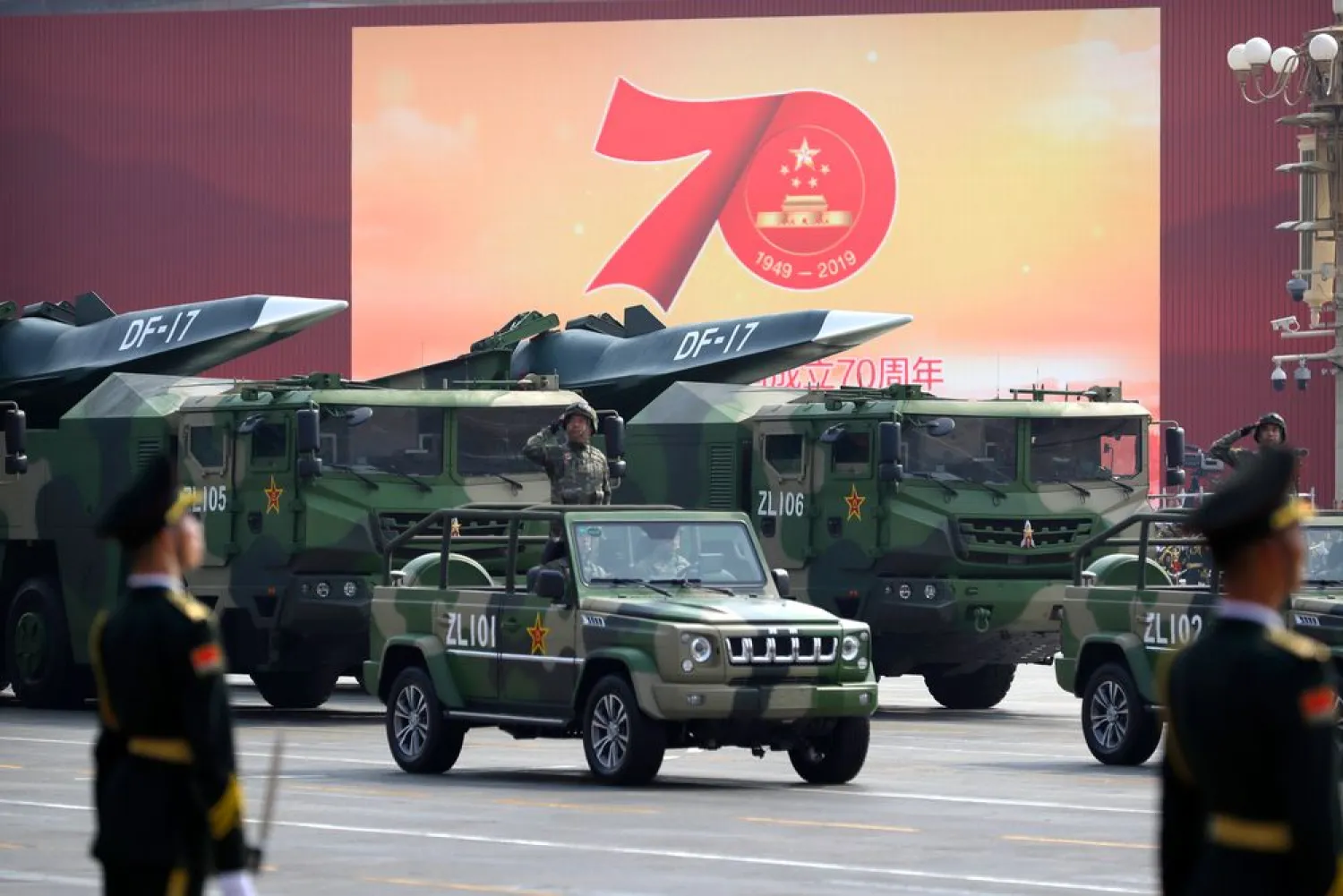

Global Defense Spending Up 4% in 2019

Chinese military vehicles carrying DF-17 ballistic missiles roll during a parade to commemorate the 70th anniversary of the founding of Communist China in Beijing, Tuesday, Oct. 1, 2019. (AP Photo/Mark Schiefelbein)
TT

Global Defense Spending Up 4% in 2019

Chinese military vehicles carrying DF-17 ballistic missiles roll during a parade to commemorate the 70th anniversary of the founding of Communist China in Beijing, Tuesday, Oct. 1, 2019. (AP Photo/Mark Schiefelbein)

The world's defense expenses rose 4% in 2019, compared to the previous year, a report released by the International Institute for Strategic Studies (IISS) revealed on Friday.

The report -- Military Balance 2020 --, which was revealed at the Munich Security Conference, showed the year 2019 posted the largest annual increase in defense spending during the last decade.

The institute prepares the report annually based on its global survey with 171 countries.

The report, of which Asharq Al-Awsat exclusively received a copy- starts by showcasing an unstable international security environment dominating defense debates. It reveals how key elements of the rules­based international order that characterized the post-­Second World War period are being challenged. The demise of the Intermediate­Range Nuclear Forces (INF) Treaty exemplifies this most clearly, with its collapse precipitated by Russian breaches as well as the Trump administration’s determination – with an eye to China’s military modernization – that the bilateral accord had outlived its usefulness. Nonetheless, Russia showed United States’ inspectors its new Avangard hypersonic glide vehicle in late November 2019 as part of its obligations under the New START treaty. Indeed, it is noteworthy that in the current climate, observers are looking nervously not just towards Moscow, but also anxiously in the direction of Washington for signs of interest in maintaining this remaining element of the strategic arms­control architecture when it comes up for renewal in 2021.

In its seventh chapter, the report featured defense strategies in the Middle East and North Africa region, where it pointed out that Egypt, Qatar, Oman, and Saudi Arabia are working on "recapitalizing elements of their combat-aircraft fleets." It noted that Iran's aggressive activity in the Strait of Hormuz and other areas has prompted the United States to try to build an international coalition under the name of the International Alliance for the Safety and Protection of Maritime Navigation and Insurance of the Safety of Seaways.

Furthermore, the report highlighted military capabilities- including those of land, maritime, and aerial armies- while also referring to cyber capabilities. The US ranked high on the scale of spending, followed by China, then Saudi Arabia, followed by Russia.

Today’s challenges
In this environment of continuous, evolving and even accelerating competition, the response options for Western states might include integrating increasingly novel technologies or spending more to stay ahead. Alternatively, they could accept a leveling playing field as a new norm and adapt their strategies instead. This relates not just to conventional mili­tary power but also to cyber capability and the consistently contested information environment.

A related challenge is that of competitor states now using strategies to achieve effect by operating below the threshold of war. Examples include Russia’s initial moves into Crimea and its denials over-involvement in eastern Ukraine, its use of chemical weapons in the UK and its alleged election meddling. Iran’s activities are another example. Its ability to conduct warfare through third parties has ‘given Iran a strategic advantage over adversaries reliant on conventional capabilities’, according to the IISS Strategic Dossier on Iran’s networks of influence.

Capabilities routed through third parties, disinforma­tion campaigns, or kinetic actions that are denied outright are hard to tackle with conventional military responses. They place a premium not just on developing the right military and intelligence capabilities, but on boosting the adaptability and resilience of equipment and military forces and, more broadly, of societies and political decision­making. The same holds true when dealing with developments in new mili­tary or militarily­ relevant technologies. In all cases, working effectively with partners, and making use of relevant interna­tional frameworks, have the potential to act as a force multi­plier. However, while conflict still involves hard military power, it is now more diffused than before. It now involves a greater number of actors and more capabilities, some of which are not traditionally ‘military’, and clear outcomes in peace, war, and the grey space between are, accordingly, less certain.

Defense economics
Global defense spending continued to rebound in 2019, with real-terms growth rising by 4.0% this year (when compared with 2018 and measured in constant 2015 US dollars). This was the highest year-on-year increase observed in the past ten years. Total defense spending, excluding US foreign military financing programs, reached US$1.73 trillion when measured in current dollars, against US$1.67trn in 2018.

In 2019, defense spending both in China and in the United States increased by 6.6%, when measured in real terms and compared to 2018. In nominal terms, the US increase alone (US$53.4 billion) almost equaled the United Kingdom’s 2019 defense budget (US$54.8bn), while China’s nominal increase (US$10.6bn) was just short of Taiwan’s entire 2019 defense budget (US$10.9bn).

After years of cuts, total defense spending in Europe, when measured in real terms, once again reached the levels seen before the financial crisis (US$277bn in 2008; US$289bn in 2019). This was an increase of 4.2%, when measured in real terms, compared to 2018. These spending increases are directed more and more towards procurements and research and development. Indeed, defense investments grew, as a share of total spending, from 19.8% in 2018 to 23.1% in 2019, for those countries where data is available.

However, this increase in European spending was modest when measured in nominal dollar terms, rising from US$290bn to US$291bn, because the euro depreciated against the dollar over the year.

When measured on a per capita basis, as well as in GDP terms, countries in the Middle East and North Africa spent the most on defense. Australia, Norway, Singapore, and the US are also in the top ten when spending is measured on a per capita basis. The UK, spending US$837 per person, is in 11th position.



US Plans to Deploy More Missile Launchers to the Philippines Despite China’s Alarm 

A US M142 High Mobility Artillery Rocket System (HIMARS) fires a missile during a Combined Joint Littoral Live Fire Exercise at the joint military exercise called "Balikatan", Tagalog for shoulder-to-shoulder in a Naval station in Zambales province, northern Philippines on Wednesday, April 26, 2023. (AP)
TT

US Plans to Deploy More Missile Launchers to the Philippines Despite China’s Alarm 

A US M142 High Mobility Artillery Rocket System (HIMARS) fires a missile during a Combined Joint Littoral Live Fire Exercise at the joint military exercise called "Balikatan", Tagalog for shoulder-to-shoulder in a Naval station in Zambales province, northern Philippines on Wednesday, April 26, 2023. (AP)

The United States plans to deploy more high-tech missile systems to the Philippines to help deter aggression in the South China Sea, where the treaty allies on Tuesday condemned what they called China’s "illegal, coercive, aggressive, and deceptive activities."

Beijing has repeatedly expressed alarm over the installation in the northern Philippines of a US mid-range missile system called the Typhon in 2024 and of an anti-ship missile launcher last year. It said the US weapons were aimed at containing China’s rise and warned that these were a threat to regional stability.

China has asked the Philippines to withdraw the missile launchers from its territory, but officials led by President Ferdinand Marcos Jr. have rejected the demand.

US and Philippine officials held annual talks Monday in Manila on broadening security, political and economic engagements and boosting collaboration with regional security allies.

The US and the Philippines outlined in a joint statement Tuesday specific defense and security plans for this year, including joint military exercises, Washington's support to help modernize the Philippine military and efforts "to increase deployments of US cutting-edge missile and unmanned systems to the Philippines."

The longtime allies "underscored their support for preserving freedom of navigation and overflight, unimpeded lawful commerce and other lawful uses of the sea for all nations," the statement said.

"Both sides condemned China’s illegal, coercive, aggressive and deceptive activities in the South China Sea, recognizing their adverse effects on regional peace and stability and the economies of the Indo-Pacific and beyond," it added.

Confrontations between Chinese and Philippine coast guard forces have spiked in the disputed waters in recent years. Vietnam, Malaysia, Brunei and Taiwan are also involved in the territorial standoffs.

Neither side elaborated on the planned missile deployments but Philippine ambassador to Washington, Jose Manuel Romualdez, who took part in Monday’s talks, said US and Filipino defense officials discussed the possible deployment this year of "upgraded" types of US missile launchers that the Philippines may eventually decide to purchase.

"It’s a kind of system that’s really very sophisticated and will be deployed here in the hope that, down the road, we will be able to get our own," Romualdez told The Associated Press.

The Typhon missile system that the US Army deployed to the main northern Philippine region of Luzon in April 2024 and an anti-missile launcher called the Navy Marine Expeditionary Ship Interdiction System that was deployed in April last year also to Luzon have remained in the Philippines, Romualdez said.

During joint drills, US forces have exhibited the missile systems to batches of Filipino forces to familiarize them with the weapons’ capabilities and usage, military officials said.

Romualdez said the US missile deployments to the Philippines did not aim to antagonize any country.

"It’s purely for deterrence," he said. "Every time the Chinese show any kind of aggression, it only strengthens our resolve to have these types."

The Typhon missile launchers, a land-based weapon, can fire the Standard Missile-6 and the Tomahawk Land Attack Missile. Tomahawk missiles can travel over 1,000 miles (1,600 kilometers), which places China within their target range, from the northern Philippine region of Luzon.

Last year, the US Marines deployed the anti-ship missile launcher, the Navy Marine Expeditionary Ship Interdiction System, to Batan island in the northernmost Philippine province of Batanes, which faces the Bashi Channel just south of Taiwan.

The sea passage is a critical trade and military route that the US and Chinese militaries have tried to gain strategic control of.


France's Macron Eyes Fighter Jet Deal in India

France's President Emmanuel Macron (C-R) and his wife Brigitte Macron (C) are welcomed by India's officials upon their arrival in Mumbai on February 17, 2026. (Photo by Ludovic MARIN / AFP)
TT

France's Macron Eyes Fighter Jet Deal in India

France's President Emmanuel Macron (C-R) and his wife Brigitte Macron (C) are welcomed by India's officials upon their arrival in Mumbai on February 17, 2026. (Photo by Ludovic MARIN / AFP)

French President Emmanuel Macron will meet Indian Prime Minister Narendra Modi in Mumbai on Tuesday, as he begins a three-day visit to India focused on artificial intelligence cooperation and a potential multibillion dollar fighter jet deal.

France is seeking to expand its military partnership with New Delhi, with discussions expected on a possible contract for 114 additional French Dassault Rafale fighter jets, said AFP.

Modi, in a statement on social media addressed to his "dear friend" Macron, after he began his trip with his wife Brigitte in India's financial capital, said he looked forward to "advancing our bilateral ties to new heights".

Modi, who will meet Macron later on Tuesday afternoon, said he was "confident that our discussions will further strengthen cooperation".

Macron, on his fourth visit to India since taking office in 2017, began on Tuesday with a program including honoring the victims of the 2008 Mumbai attacks, and meeting Bollywood film stars, including Shabana Azmi and Manoj Bajpayee.

He also called Modi his "dear friend", in post on X, saying they will "go even further" in cooperation.

The visit follows New Delhi's confirmation last week that it intends to place a major order for Rafale jets, as well as the signing of a landmark free trade agreement between India and the European Union in January.

Macron will travel to New Delhi for an artificial intelligence summit on Wednesday and Thursday.

- 'Contract of the century' -

New Delhi has sought over the past decade to reduce its dependence on Russia, its traditional main supplier of military equipment, turning to other countries while also pushing for more domestic production.

An Indian defense ministry statement last week said the proposed purchase of Rafale jets had been cleared -- with "the majority" of them to be manufactured in India.

Christophe Jaffrelot, an India specialist at Sciences Po Center for International Studies in Paris, described the potential EUR30 billion ($35 billion) deal for 114 Rafales as the "contract of the century".

If finalized, the jets would add to the 62 Rafales that India has already purchased.

The French presidency has voiced optimism that what it calls a "historic" agreement could be reached.

- 'Good chemistry' -

Modi and Macron will also inaugurate on Tuesday, via videoconference, India's first helicopter final assembly line, a joint venture between India's Tata Group and Airbus.

The facility in Vemagal, in the southern state of Karnataka near the tech hub of Bengaluru, will manufacture the Airbus H125, the company's best-selling single-engine helicopter.

France has emerged as one of India's most important defense and economic partners in the last decade.

"Through this visit, we seek to further strengthen cooperation" with India, and to "diversify" France's economic and trade partnerships, Macron's office said.

India, the world's most populous country with 1.4 billion people, is on track to become the fourth-largest economy globally.

This week's talks are also expected to address global economic uncertainty triggered by tariff policies under US President Donald Trump, as well as China's influence in the region.

Bilateral trade between France and India, driven largely by defense and aerospace -- India's commercial fleet includes a substantial number of Airbus aircraft -- stands at around EUR15 billion ($18 billion) annually.

French foreign direct investment in India totals nearly EUR13 billion ($15 billion).

The two leaders will also be keen to nurture close personal ties.

"There is apparently a good chemistry, a good personal rapport," Jaffrelot said.

One sensitive issue remains Ukraine: India has not condemned Russia's 2022 invasion and has continued buying oil from Moscow.

US President Donald Trump has said India had committed to halting the purchases, though that has not been formally confirmed by New Delhi.

"If the Indians stop buying Russian oil, they won't be blamed for abstaining at the UN," Jaffrelot added.


New Mexico Approves Comprehensive Probe of Epstein’s Zorro Ranch 

This undated photograph in an unidentified location released by the US Justice Department on December 19, 2025, shows Jeffrey Epstein, a wealthy US financier who died in jail in 2019 while awaiting trial for sex trafficking underage girls. (Handout / US Department of Justice / AFP)
TT

New Mexico Approves Comprehensive Probe of Epstein’s Zorro Ranch 

This undated photograph in an unidentified location released by the US Justice Department on December 19, 2025, shows Jeffrey Epstein, a wealthy US financier who died in jail in 2019 while awaiting trial for sex trafficking underage girls. (Handout / US Department of Justice / AFP)

New Mexico lawmakers on Monday passed legislation to launch what they said was the first full investigation into what happened at Zorro Ranch, where the late US sex offender Jeffrey Epstein is accused of trafficking and sexually assaulting girls and women.

A bipartisan committee will seek testimony from survivors of alleged sexual abuse at the ranch, located about 30 miles south of Santa Fe, the state capital. Legislators are also urging local residents to testify.

Epstein died in what was ruled a suicide in a New York jail in 2019 while facing federal sex trafficking charges.

The so-called truth commission, comprising four lawmakers, seeks to identify ranch guests and state officials who may have known what was going on at the 7,600-acre property, or taken part in alleged sexual abuse in its hacienda-style mansion and guest houses.

The Democratic-led investigation adds to political pressure to uncover Epstein's crimes that has become a major challenge for President Donald Trump, weeks after the Justice Department released millions of Epstein-related files that shed new light on activities at the ranch.

The files reveal ties between Epstein and two former Democratic governors and an attorney general of New Mexico.

The legislation, which passed New Mexico's House of Representatives by a unanimous vote, could pose risks to any additional politicians linked to Epstein in the Democratic-run state, as well as scientists, investors and other high-profile individuals who visited the ranch.

The $2.5 million investigation, which has subpoena power, aims to close gaps in New Mexico law that may have allowed Epstein to operate ‌in the state. The ‌committee starts work on Tuesday, and will deliver interim findings in July and a final report by year-end.

"He was basically doing ‌anything he ⁠wanted in this ⁠state without any accountability whatsoever," said New Mexico state Representative Andrea Romero, a Democrat, who co-sponsored the initiative.

Testimony to the committee could be used for future prosecutions, she said.

Victim advocates applauded the move, saying Zorro Ranch had been overlooked by federal investigations that focused on Epstein's Caribbean island and New York townhouse.

"Many of the survivors had experiences in New Mexico, and as we've learned, you know, there were local politicians and other people that were aware of what was happening in New Mexico," said attorney Sigrid McCawley, whose law firm has represented hundreds of Epstein survivors.

They include the late Virginia Giuffre, who was abused many times at the ranch, she said.

The US Department of Justice passed a request for comment to the FBI. The FBI declined comment.

EPSTEIN OPERATED AT THE RANCH FOR DECADES

Several civil suits accuse Epstein of sexually assaulting girls at Zorro Ranch. He was never charged for the alleged offenses.

Romero said there was no record of federal law enforcement searching what was known locally as "the playboy ranch" where Epstein is accused of sexually abusing ⁠a 16-year-old girl as early as 1996.

Former New Mexico Attorney General Hector Balderas launched a probe in 2019 that was put on hold ‌at the request of federal prosecutors to avoid "parallel investigation," he said in a statement.

New Mexico Attorney General Raul Torrez has assigned ‌a special agent to probe allegations that may come through the truth commission, spokesperson Lauren Rodriguez said.

A state house committee rejected accompanying legislation to extend New Mexico's statute of limitations for childhood sexual assault to allow ‌civil actions by Epstein survivors, said state Representative Marianna Anaya, who co-sponsored the legislation to create the truth commission. The legislation raised concerns about increased insurance costs for public institutions facing abuse ‌lawsuits, Anaya said.

Epstein bought the ranch in 1993 from Bruce King, a three-time New Mexico Democratic governor who died in 2009. Epstein's estate sold the property in 2023 to Texas businessman and politician Don Huffines, according to the Santa Fe New Mexican. Huffines is prepared to cooperate with any law enforcement investigation of the ranch, the newspaper reported on Monday, citing his spokesperson.

Epstein flew in guests and "masseuses" to the ranch, and hired local massage therapists to work there, ranch manager Brice Gordon told the FBI in 2007, according to a report in the Epstein files.

In an unsealed 2016 court deposition, Giuffre testified Epstein's partner Ghislaine Maxwell told her to give ‌the late former New Mexico Governor Bill Richardson a "massage" at the ranch. In Giuffre's memoir, she said an instruction from Maxwell to provide a "massage" meant a victim should provide a sexual encounter to an abuser.

Richardson's representative Madeleine Mahoney in a 2019 statement said Giuffre's allegations ⁠were "completely false."

Gordon told the FBI that most of ⁠the masseuses Epstein used at the ranch were hired locally through the spa Ten Thousand Waves, a Santa Fe institution, or by referrals.

Spa spokesperson Sara Bean said in a phone interview last Tuesday that Ten Thousand Waves neither provided nor referred masseuses to Zorro Ranch.

In the documentary "Surviving Jeffrey Epstein," former Santa Fe massage therapist Rachel Benavidez accused Epstein of sexual abuse when she was hired to work at the ranch.

Investment consultant Joshua Ramo said on Sunday he visited the ranch once for a 2014 lunch on behalf of professors from the Massachusetts Institute of Technology and Harvard University, who were present.

Ramo, at the time CEO of consulting firm Kissinger Associates, said he and Epstein met with business figures and scientists around 14 times in New York between 2013 and 2016.

"I deferred to the due diligence of the institutions involved, assuming that his presence signaled he had been appropriately vetted," Ramo, in a statement, said of his ranch visit and other meetings with Epstein. "I feel a deep sense of grief for the survivors of his crimes."

Emails show Epstein contacted Ramo in 2015 to tell him he was going to Ten Thousand Waves, suggesting they meet for lunch in Santa Fe. Ramo responded, "I assumed we were meeting at the pink bottom ranch." Ramo, who is currently CEO of consulting firm Sornay LLC, said he had no recollection of that comment, or whether the two met that day.

Over the years, Epstein contributed to the political campaigns of New Mexico Democrats such as Richardson and King's son Gary King, a former New Mexico attorney general. When contributions were reported in the press, the men pledged to either return the money, or give it to charity.

Gary King flew on a plane chartered by Epstein when he was running for New Mexico governor in 2014, according to emails in the Epstein files. Epstein said he would cover around half the cost of the $22,000 charter and King would pay the rest. King did not respond to a request for comment.