


Atlético's Saul Niguez: 'We Know How We Can Hurt Liverpool'

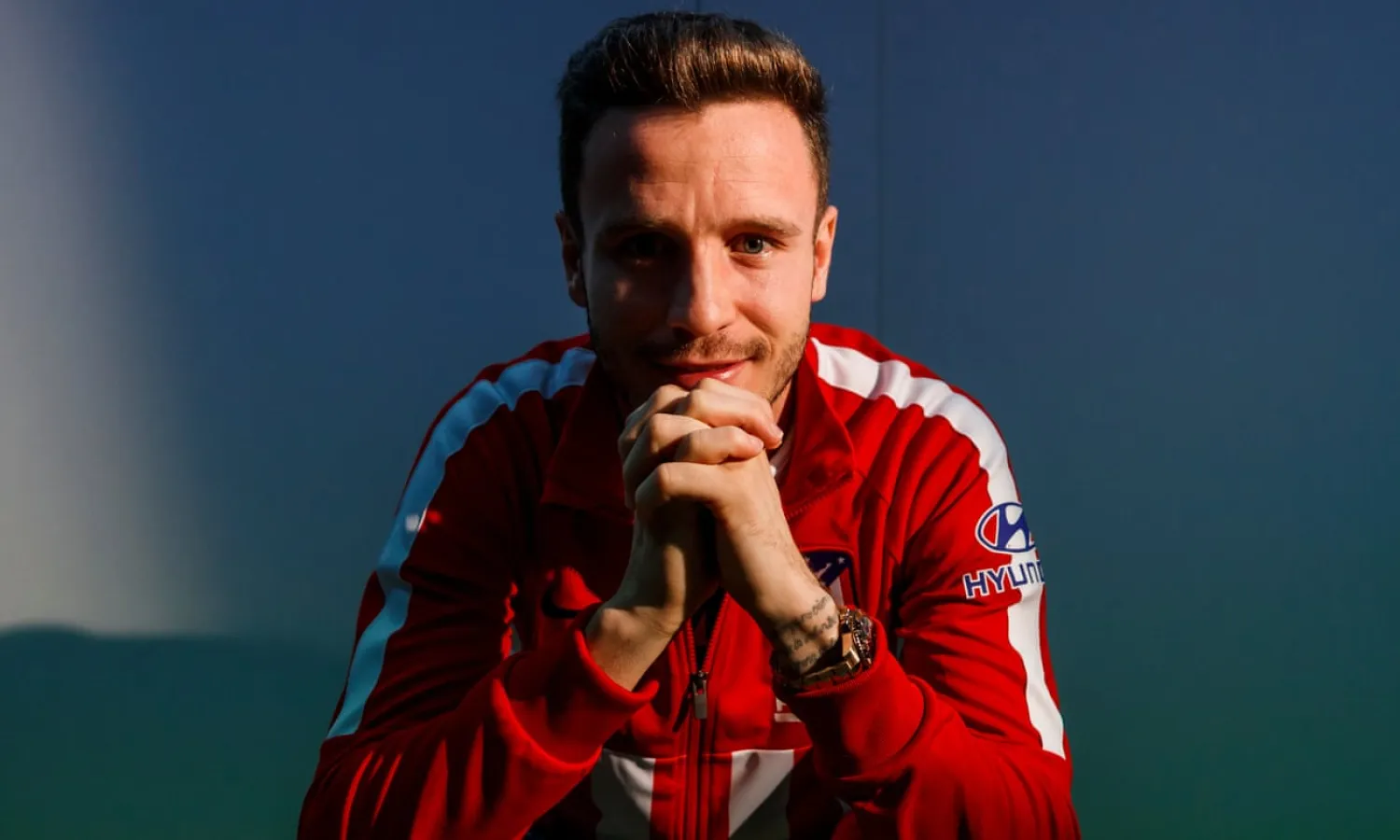
 Saúl Niguez says of Atlético Madrid: ‘I don’t think evolution is the path: we have to be what we always were, what allowed us to compete.’ Photograph: Pablo Garcia
Saúl Niguez says of Atlético Madrid: ‘I don’t think evolution is the path: we have to be what we always were, what allowed us to compete.’ Photograph: Pablo Garcia
TT

Atlético's Saul Niguez: 'We Know How We Can Hurt Liverpool'

 Saúl Niguez says of Atlético Madrid: ‘I don’t think evolution is the path: we have to be what we always were, what allowed us to compete.’ Photograph: Pablo Garcia
Saúl Niguez says of Atlético Madrid: ‘I don’t think evolution is the path: we have to be what we always were, what allowed us to compete.’ Photograph: Pablo Garcia

As it circles Madrid to the south, the M30 motorway emerges from the tunnel beneath the city and heads north-west across the middle of what was once the pitch at the Vicente Calderón, from box to box. Most of the ground has been demolished but one side is just about still standing, the shell of Atlético’s former home. Thousands drive through daily; occasionally, Saúl Ñíguez joins them. Some days he takes friends, aware it will soon be gone. “I tell them: ‘I scored right here,’” he says. “Seeing it hit you. It’s emotional.”

It is Sunday morning at Atlético’s Cerro del Espino training ground, two days before the game that will define their season and possibly beyond and there is a significance to the scene Saúl is replaying, like something was lost when they left. “Only the main stand remains. My friends say ‘get a photo’ and I think: ‘Leave it there, people will come to see it, they’ll come.’ It’s unique, historic. The club needed to change, grow, and it’s hard to say this because we’re at the Metropolitano, which is more comfortable, but the Calderón was different: the magic it generated, the people. Special.

“I always say my best memory is a defeat. At the Calderón against Real Madrid, we won but we were knocked out. And yet the whole stadium stays, no one goes. There’s a deluge and all the Madrid fans have raincoats on. Ours are just in shirts, soaked and they sing in the rain; support us, console us. And you think: ‘Pfff, how can I ever not give everything for these people?’”

That game in 2017 was Atlético’s last European night at the Calderón, a Champions League semi-final. It hasn’t been quite the same since, the concern now that it may not be just the stadium slipping into the distance. Saúl sees the shift, has suffered from it, but he resists. Atlético were finalists in 2014, quarter-finalists in 2015, finalists in 2016 – “losing that was the worst thing that can happen to you in your footballing life,” he says – and semi‑finalists in 2017, beaten by Madrid every time. Since then, they have not passed a knockout round and few expect them to do so against a team who may have better memories of their new stadium than they do. Liverpool claimed their sixth European Cup at the Metropolitano eight months ago.

That night at the Calderón, Diego Simeone said he wished he could clone players such as Diego Godín and Gabi Fernández, sensing an era coming towards the end. This season, that feeling is even more acute. Both have gone and Saúl feels the absence of his former captain particularly keenly. Six players departed in the summer, including Griezmann and Rodri, and although Atlético spent almost €250m they had their worst start under Simeone. Twelve points behind in the league, out of the cup to third-tier Cultural Leonesa, Tuesday is all that is left.

For the first time, there are doubts about the man who Gazzetta dello Sport depicted as Che Guevara. There is an unusual sense of drift in the stands, although there surely won’t be on Tuesday, and the feeling that Atlético are searching for an identity. It is a disconnect between what they always were and those signings suggest they should be, embodied by João Félix – a slight, creative 20-year-old No 10 who cost €126m. If there was to be an evolution, it remains incomplete. Equally, something of what they were sometimes seems to be missing.

Listening to Saúl, someone is missing, the expression of that identity and the captain who allowed him to play his own game. Saúl knows there is a belief that he has stagnated, no longer the marauding midfielder set to lead club and country. In fact, on some levels he shares it. He also explains it, a hint that he has felt misunderstood, maybe even under-appreciated.

He is startlingly candid about the restrictions of responsibility, being “bored” in some positions. He talks of the “need to enjoy football”, to be “let loose”, released to run, but rejects the suggestion he’s at the wrong club. “A couple of years ago, I could do those things. Gabi’s intelligent and although there are other players [now] who are better technically, he made teammates’ jobs easier. I could play to enjoy it.

“Being Gabi isn’t easy: you have to cover everyone. And although people don’t see it, I do that [now]. I feel I’m doing it well. I have to help: on the left, the right, a lot of positions. The team comes first, even if individually I’m not at the same level as two years ago. I’m leaving parts of my game behind and I don’t know that it’s a good thing because you stop enjoying it. I’d like to focus on one position and improve there, learn.”

Maybe it is the security as much as the frustration that enables him to speak this clearly. “I have a long contract,” he says with a laugh. It runs until 2026, with a €150m (£125m) buyout clause. And, he says: “Simeone is the only one who values my work. I play almost every minute. He knows I suffer in positions that are not ideal for me, but he appreciates what I do and I can’t say no to him. I can adapt to any style and I’m grateful to the club: they’ve treated me like a member of the family since I was very young.”

Besides, if Saúl appears suited to a more expansive game, he also insists: “I don’t think evolution is the path. We have to be what we always were, what allowed us to compete,” he says, his pace quickening into a manifesto, more passionate with every passage. “It’s a hard year, a transition. A lot of important people left. Important people came too but they’re young, people who don’t know the club and need to adapt. You have to feel it, believe in it. Don’t think, go. Day after day after day after day, training, training, training until it’s automatic. And if we die, let it be with our own ideas.”

Saúl is 25, but a veteran now, one of four left from the final in Milan in 2016. If they are to return, they will need him. The Champions League is Atlético’s only target and Liverpool are fearsome opponents that he analyses with depth and nuance. “They have those perros de presa [hunting dogs] in the middle who run, press. It’s not just running for the sake of running. They do things that aren’t normal and it looks disordered but it’s ordered, mechanised,” he says. His kind of football, in other words.

“One comes out here and you think: ‘That’s mad, why’s he there?’” he says, marking positions. “But the other man knows and comes from here. [Jürgen] Klopp said they play with their heart, but it’s planned too. One breaks out to press, wild, but they follow. It’s very hard to escape when they come at you like that. It’s incredible. They press like animals, because they know that even if they get turned there will be seven of them running like mad to get back.

“Liverpool are very complete, a great team in every area [but] they find it hardest when you’re deep because they’re very, very, very good in transition. I watched them against Norwich and if it wasn’t for [Sadio] Mané’s extraordinary control, they don’t win. They’ve won lots of games they could have drawn or lost, which tells you something about what they have inside. It’s not luck. It’s work, sacrifice, not giving up a single ball for lost.”

And it’s frightening. European champions, top of the league having collected 103 of 105 points, there is pessimism in Madrid, but Saúl rebels. What do you do with stats such as Liverpool’s? “You break them,” he says.

“There’s no memory in football: what you did yesterday is no use. We had a good run before Christmas then we fell away and it was hard. People wanted to kill us. Do I think it’s unfair? Honestly, yes. But it’s life. People whistle Cholo, important players; the fans are demanding. If we win two or three games, it’ll change again. We know how we can hurt Liverpool their strengths and weaknesses, and we always compete against big teams. We have to make the most of the home game. There will be an incredible atmosphere, more than ever.”

But the Metropolitan still lacks something. “Yeah, time,” Saúl replies. “There have been few moments like at the old Calderón but it’s a great stadium, they’re great people. It’s about epic games, comebacks, wins, big nights against big teams. That’s what builds the magic.”

The Guardian Sport



Sunderland Worst Hit by Losing Players to African Cup of Nations 

14 December 2025, United Kingdom, London: Sunderland's Habib Diarra (L) and Leeds United's Gabriel Gudmundsson battle for the ball during the English Premier League soccer match between Brentford and Leeds United at the Gtech Community Stadium. (dpa)
TT

Sunderland Worst Hit by Losing Players to African Cup of Nations 

14 December 2025, United Kingdom, London: Sunderland's Habib Diarra (L) and Leeds United's Gabriel Gudmundsson battle for the ball during the English Premier League soccer match between Brentford and Leeds United at the Gtech Community Stadium. (dpa)

Premier League Sunderland will have to do without six players over the next few weeks and are the club worst hit as the Africa Cup of Nations takes its toll on European clubs competing over the holiday season.

Sunderland, eighth in the standings, had four of their African internationals in action when they beat Newcastle United on Sunday, but like 14 other English top-flight clubs will now lose those players to international duty.

The timing of the African championship, kicking off in Morocco on Sunday and running through to January 18, has long been an irritant for coaches, with leagues in Belgium, France, Germany, Italy, Netherlands, Portugal, and Spain also affected.

Hosting the tournament in the middle of the season impacts around 58% of the players at the Cup of Nations, though the Confederation of African Football did try to mitigate the impact by moving the start to before Christmas, so it is completed before the next round of Champions League matches.

The impact on European clubs was also lessened by allowing them to release players seven days, rather than the mandatory 14 days, before the tournament, meaning they could play for their clubs last weekend.

Sunderland's Congolese Arthur Masuaku and Noah Sadiki, plus full back Reinildo (Mozambique), midfielder Habib Diarra (Mali), and attackers Chemsdine Talbi (Morocco) and Bertrand Traore (Burkina Faso) have now departed for Morocco.

Ironically, Mohamed Salah’s absence from Liverpool to play for Egypt should lower the temperature at the club after his recent outburst against manager Arne Slot, but Manchester United will lose three players in Noussair Mazraoui, Bryan Mbeumo and Amad Diallo, who scored in Monday’s 4-4 draw with Bournemouth.

France is again the country with the most players heading to the Cup of Nations, and with 51 from Ligue 1 clubs. But their absence is much less impactful than previously as Ligue 1 broke after the weekend’s fixtures and does not resume until January 2, by which time the Cup of Nations will be into its knockout stage.

There are 21 players from Serie A clubs, 18 from the Bundesliga, and 15 from LaLiga teams among the 24 squads at the tournament in Morocco.


Rodgers Takes Charge of Saudi Team Al-Qadsiah After Departure from Celtic 

Then-Celtic head coach Brendan Rodgers greets supporters after a Europa League soccer match between Red Star and Celtic at Rajko Mitic Stadium in Belgrade, Serbia, Sept. 24, 2025. (AP)
TT

Rodgers Takes Charge of Saudi Team Al-Qadsiah After Departure from Celtic 

Then-Celtic head coach Brendan Rodgers greets supporters after a Europa League soccer match between Red Star and Celtic at Rajko Mitic Stadium in Belgrade, Serbia, Sept. 24, 2025. (AP)

Brendan Rodgers has returned to football as the coach of Saudi Arabian club Al-Qadsiah, six weeks after resigning from Scottish champion Celtic.

Al-Qadsiah, whose squad includes Italian striker Mateo Retegui and former Real Madrid defender Fernandez Nacho, is in fifth place in the Saudi Pro League in its first season after promotion.

Rodgers departed Celtic on Oct. 27 and has opted to continue his managerial career outside Britain for the first time, having previously coached Liverpool, Leicester and Swansea.

In its statement announcing the hiring of Rodgers on Tuesday, Al-Qadsiah described him as a “world-renowned coach” and said his arrival “reflects the club’s ambitious vision and its rapidly growing sporting project.”

Aramco, the state-owned Saudi oil giant, bought Al-Qadsiah in 2023 in a move that has helped to transform the club’s status.

“This is a landmark moment for the club,” Al-Qadsiah chief executive James Bisgrove said. “The caliber of his experience and track record of winning reflects our ambition and long-term vision to establish Al-Qadsiah as one of Asia’s leading clubs.”

Rodgers is coming off winning back-to-back Scottish league titles with Celtic, where he won 11 major trophies across his two spells. He also won the FA Cup with Leicester.

Al-Qadsiah's last two coaches were former Liverpool striker Robbie Fowler and former Spain midfielder Michel.


Portugal to Return to F1 Calendar in 2027 and 2028 

12 July 2025, United Arab Emirates, Abu Dhabi: Red Bull driver Max Verstappen leads into turn one during the Abu Dhabi Grand Prix at the Yas Marina Circuit, Abu Dhabi. (dpa)
TT

Portugal to Return to F1 Calendar in 2027 and 2028 

12 July 2025, United Arab Emirates, Abu Dhabi: Red Bull driver Max Verstappen leads into turn one during the Abu Dhabi Grand Prix at the Yas Marina Circuit, Abu Dhabi. (dpa)

Formula One will return to Portugal's Portimao circuit in 2027 and 2028 after the Dutch Grand Prix at Zandvoort drops off the calendar.

Formula One announced a two-year deal in a statement on Tuesday.

The 4.6-km Algarve International circuit in the country's south last hosted the Portuguese Grand Prix in 2020 and 2021, both seasons impacted by the COVID-19 pandemic with stand-in venues.

In 2020, seven-times world champion Lewis Hamilton took his 92nd career win at Portimao, breaking the record previously held by Michael Schumacher. Hamilton also won in 2021.

"The interest and demand to host a Formula One Grand Prix is the highest that it has ever been," said Formula One chief executive Stefano Domenicali, thanking the Portuguese government and local authorities.

The financial terms of the deal were not announced.

"Hosting the Grand Prix in the Algarve reinforces our regional development strategy, enhancing the value of the territories and creating opportunities for local economies," said Economy Minister Manuel Castro Almeida.

Portugal first hosted a grand prix in Porto in 1958, with subsequent races at Monsanto and Estoril near Lisbon. The late Brazilian great Ayrton Senna took his first grand prix pole and win at the latter circuit in 1985.

Formula One announced last year that Zandvoort, a home race for four-times world champion Max Verstappen, would drop off the calendar after 2026.

The championship already features a record 24 races and Domenicali has spoken of European rounds alternating to allow others to come in.

Belgium's race at Spa-Francorchamps is due to be dropped in 2028 and 2030 as part of a contract extension to 2031 announced last January.