


Football Clubs' Good Deeds Go a Long Way but Shutdown Exposes Financial Faultlines

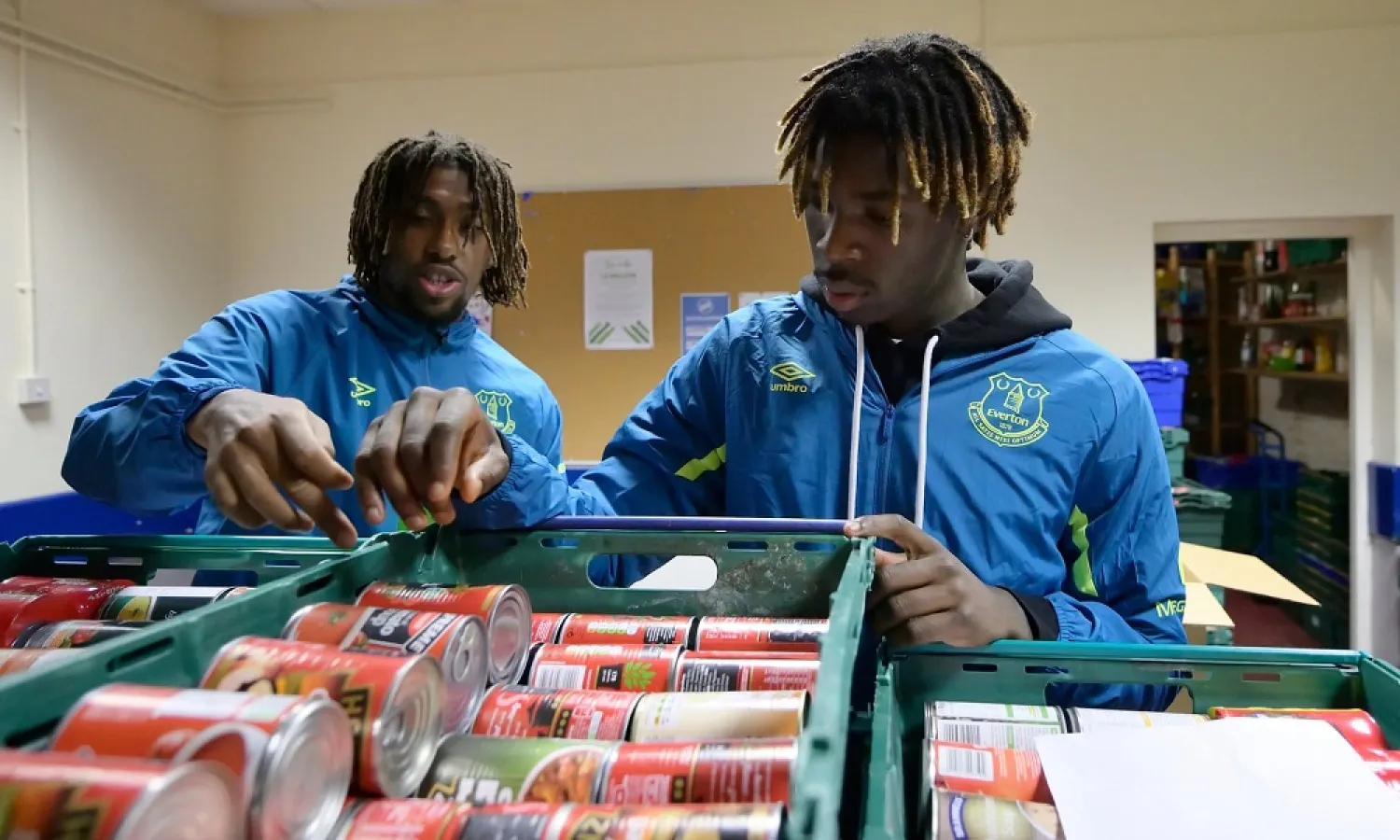
Everton players Alex Iwobi and Moise Kean help out at a foodbank in Liverpool. (Getty Images)
TT

Football Clubs' Good Deeds Go a Long Way but Shutdown Exposes Financial Faultlines

Everton players Alex Iwobi and Moise Kean help out at a foodbank in Liverpool. (Getty Images)

“What is football without a crowd?” Pep Guardiola asked a couple of weeks ago, just before it became plain that crowds of any kind now had to be avoided.

The short answer is not very much. Football has probably only just realized how much of its appeal lay in its ability to attract and entertain large numbers of people packed close together. Football stadiums are designed to accommodate crowds, to facilitate companionship; up and down the country those large edifices now standing empty and silent are powerful reminders that the human urge to congregate and commune is what has been suspended indefinitely.

Consider also the distinct lack of appetite for any sort of behind-closed-doors conclusion to the various loose ends of the season. No one is really going to do that, surely? It is hard to imagine anything more likely to demonstrate that football’s imperatives and emergencies are utterly disposable when set against the present difficulties in the real world. As an industry with crowd-pleasing as its raison d’etre, football is just going to have to wait until crowds can make a reappearance, however long that might take.

That does not mean the game has to stand idly by on the sidelines while the time of contagion passes, and nor is it. As befits a wealthy operation with legitimate claims to be community-based, football has responded in several different ways to the crisis. Manchester City and Manchester United were quick to announce a joint £100,000 donation to a local foodbank scheme, an approach also mirrored by Everton and Liverpool.

Watford have made their ground available to the NHS – Vicarage Road is close to a hospital, so think conference facilities and car parking rather than daytime kickabouts – and Chelsea have done the same with their luxury hotel. Gary Neville and Ryan Giggs were the first to announce they would keep their hotel running and make the beds available for NHS purposes, before Guardiola made a donation of €1m to help provide medical equipment in Spain.

Many leading players around Europe have made similar charitable contributions, either to nearby medical centers or to hard-pressed health workers back in their homelands. Of course, they can afford it, though there is no need to be cynical about football’s efforts to support the community when so many multimillionaire captains of industry and commerce seem to be going out of their way to appear aloof and uncaring.

Most clubs want to be seen to be doing something, whether it is donating equipment to local hospitals (Wolves), offering free tickets to frontline NHS workers for future games (Brighton and Bournemouth), or checking up on the more vulnerable members of their local community (Everton). Brighton are also telephoning elderly supporters who might be living alone to provide reassurance and help if necessary. “It’s a small but practical thing we can do to help support people that mean a lot to us,” the club’s chief executive, Paul Barber, explained.

All very commendable, though entirely predictably the virus has also exposed faultlines within football itself. The industry is not universally thriving, as we all know in a season that featured the demise of Bury and severe financial crises at similar-sized clubs, and neither do the often grotesque levels of wealth generated by the Premier League percolate through the divisions as effectively as one might wish.

While Arsenal were able to announce they would continue paying all their match-day staff and casual workers until April 30, a pledge most Premier League clubs have been able to match, Birmingham were among the first English clubs to find it necessary to propose a 50 percent pay cut as a deferral of wages for players earning £6,000 a week or more. A day later, when mighty Barcelona admitted they would be asking all their players to take a 70 percent cut until normal football can resume again, Birmingham probably wished they had gone a little further. Everyone will be joining in soon.

While most playing squads are happy to take cuts or deferrals in wages to help ensure clubs’ non-playing staff still get paid, the swiftly emerging reality is that most football wage bills are a barely tolerable burden at the best of times, and this is clearly not that. Birmingham are closer to the top than the bottom of professional football’s financial pyramid in this country, otherwise they would not be paying anyone £6,000 a week, but the effect of sudden, enforced inactivity has been to highlight the inescapable fact that what appears from the outside to be a slick business is actually a house of cards, stability always precarious due to the enormous drain on resources exerted by the players’ wages.

That principle tends to run through the whole of football, though the equally ludicrous amounts of cash coming from broadcasting rights at the top end tend to shield the leading clubs from the rest of the country’s financial reality. At the bottom end, quite simply, some of the smaller clubs may not survive this hiatus.

The solution, as Neville recently suggested, would be for Premier League clubs to pretend the present situation is as big a deal as Richard Scudamore retiring and organize a whip-round to support their struggling lower-league brethren, though when Gillingham’s chairman, Paul Scally, asked for assistance from the wealthier wing of the game, the Football League chairman, Rick Parry, insisted he was not a fan of “begging-bowl culture”.

Football and football clubs, to be clear, are not exempt from the hardship and suffering the rest of society is feeling at the moment, and it would be a mistake also to imagine only pampered players in gated mansions are affected by the shutdown. In the lower divisions the players are not all that pampered anyway, but any professional club has far more employees on the payroll than those who actually take to the pitch.

In that sense, a football club with a couple of hundred or more staff is a local employer like any other, and an industry with mega-earners at its top end ought to be better placed than most to look after itself.

If the worst comes to the worst and smaller clubs do go out of business, the greed-is-good league will inevitably get some of the blame because of the immense amounts of money it generates for itself. Begging-bowl culture is not yet as familiar an expression, yet it already has the potential to be equally damning and tenacious.

The Guardian Sport


IOC Boss Coventry Hails Milano Cortina Games a Success

 20 February 2026, Italy, Milan: President of the International Olympic Committee (IOC) Kirsty Coventry holds a press conference. (dpa)
20 February 2026, Italy, Milan: President of the International Olympic Committee (IOC) Kirsty Coventry holds a press conference. (dpa)
TT

IOC Boss Coventry Hails Milano Cortina Games a Success

 20 February 2026, Italy, Milan: President of the International Olympic Committee (IOC) Kirsty Coventry holds a press conference. (dpa)
20 February 2026, Italy, Milan: President of the International Olympic Committee (IOC) Kirsty Coventry holds a press conference. (dpa)

The Milano Cortina Olympics exceeded expectations despite a shaky build-up, IOC President Kirsty Coventry said on Friday, hailing the first spread-out Winter Games a success.

"These Games are truly ... successful in a new way of doing things, in a sustainable way of doing things, in a way that I think many people thought maybe we couldn't do, or couldn't be done well, and it's been done extremely well, and it's surpassed everyone's expectations," Coventry told a press conference.

It was the International Olympic Committee chief's clearest endorsement yet of a format that split events across several Alpine clusters rather than concentrating them in one host city.

Her assessment came after two weeks in which organizers sought to prove that a geographically dispersed Games could still deliver a consistent athlete experience.

The smooth delivery ‌comes after years ‌of logistical and political challenges, including construction delays at Milan’s Santagiulia Arena ‌and ⁠controversy over building ⁠a new sliding center in Cortina against IOC advice.

Organizers have also faced isolated disruptions during the Games, such as suspected sabotage on rail lines and protests in Milan over housing and environmental issues.

Transport concerns across the dispersed venues have been mitigated by limited cross-regional travel among spectators, though some competitors had to walk to the Cortina Curling Olympic Stadium in heavy snowfall that stopped traffic.

Central to the success of the Games, Coventry argued, was the effort to standardize conditions across multiple athlete villages despite the distances separating venues from Cortina d’Ampezzo to ⁠Livigno and Bormio.

Italian athletes’ performances also helped ticket sales, which amounted to ‌about 1.4 million.

"And the athletes are extremely happy. And they're happy ‌because the experiences that the MiCo (Milano Cortina) team and my team delivered to them have been the same," she ‌said.

Mixed relay silver medalist Tommaso Giacomel did, however, lament the fact there was no Olympic village near ‌the Antholz-Anterselva Biathlon Arena and that competitors were dotted around different hotels near the venue instead of in one place.

TWO OPENING CEREMONIES

Two opening ceremonies were held - the main one at Milan’s San Siro stadium and a more low-key parade on Cortina d’Ampezzo's Corso Italia, where athletes and spectators were within touching distance.

Feedback from competitors suggested the more intimate ‌settings had in some cases enhanced the Olympic atmosphere, Coventry said, taking the Cortina opening ceremony as an example.

The Zimbabwean, presiding over her first Games ⁠as IOC chief after elections in ⁠2025, framed Milano Cortina as proof of concept for future hosts grappling with rising costs and climate constraints, while acknowledging adjustments would follow.

"It allows us to really look at ourselves and look at the things that we have in place and how we're then going to make certain adjustments for the future," she said.

Beyond logistics, Coventry pointed to the broader impact of the Games, highlighting gender balance - with women making up 47% of competitors - and global engagement as marks of progress.

"But it's been an incredible experience and we're all very proud to have gender equity playing a big role in the delivery of the Games," she said, describing a "tremendous Games" in which athletes have "come together and shared in their passion".

With the closing ceremony in Verona approaching, Coventry said the focus would soon shift to a formal evaluation process, but insisted the headline conclusion was already clear.

"So we look forward to doing that and to learning from all the incredible experiences that I think all of the stakeholders have had across these Games, across these past two weeks," she said.


‘A Huge Mistake.’ Kompany Hits Out at Mourinho for Vinícius Júnior Comments

14 February 2026, Bremen: Bayern Munich coach Vincent Kompany gestures during the German Bundesliga soccer match between Werder Bremen and Bayern Munich at Weserstation. (dpa)
TT

‘A Huge Mistake.’ Kompany Hits Out at Mourinho for Vinícius Júnior Comments

14 February 2026, Bremen: Bayern Munich coach Vincent Kompany gestures during the German Bundesliga soccer match between Werder Bremen and Bayern Munich at Weserstation. (dpa)

Bayern Munich coach Vincent Kompany has criticized José Mourinho for attacking the character of Vinícius Júnior after the Real Madrid star accused an opponent of racially insulting him during a Champions League match.

Benfica coach Mourinho suggested that Brazil forward Vinícius had incited Benfica's players with his celebrations after scoring the only goal in Tuesday's playoff match.

Vinícius accused Benfica's Gianluca Prestianni of calling him "monkey" during a confrontation after his goal.

Mourinho also questioned why Vinícius, who is Black and has been subjected to repeated racist insults in Spain, was so frequently targeted.

"There is something wrong because it happens in every stadium," Mourinho said. "The stadium where Vinícius played something happened. Always."

Speaking on Friday, Kompany condemned Mourinho's comments.

"So after the game you have the leader of an organization, José Mourinho, who attacks the character of Vinícius Júnior by bringing in the type of celebration to discredit what Vinícius is doing in this moment," Kompany said. "And for me in terms of leadership, it’s a huge mistake and it’s something that we should not accept."

Mourinho’s celebrations

UEFA appointed a special investigator on Wednesday to gather evidence about what happened in Lisbon in Madrid’s 1-0 win in the first leg of the Champions League playoffs. Madrid said it had sent "all available evidence" of the alleged incident to European soccer's governing body.

Referring to Vinícius' celebrations after curling a shot into the top corner, Mourinho said he should "celebrate in a respectful way."

Kompany pointed out Mourinho's own history of exuberant celebrations — such as when he ran down the sideline to cheer when his Porto team beat Manchester United in the Champions League.

Kompany said Mourinho's former players "love him" and added "I know he’s a good person."

"I don’t need to judge him as a person, but I know what I’ve heard. I understand maybe what he’s done, but he’s made a mistake and it’s something that hopefully in the future won’t happen like this again," he said.

Prestianni denied racially insulting Vinícius. Benfica said the Argentine player was the victim of a "defamation campaign."

‘Right thing to do’

Kompany said Vinícius' reaction "cannot be faked."

"You can see it — his reaction is an emotional reaction. I don’t see any benefit for him to go to the referee and put all this misery on his shoulders," he said. "There is absolutely no reason for Vini Junior to go and do this.

"I think in his mind he’s doing it more because it’s the right thing to do in that moment."

Kompany added: "You have a player who’s complaining. You have a player who says he didn’t do it. And I think unless the player himself comes forward, it’s difficult. It’s a difficult case."


FIFA to Lead $75m Palestinian Soccer Rebuilding Fund

President of FIFA Gianni Infantino attended the inaugural meeting of US President Donald Trump's 'Board of Peace'. CHIP SOMODEVILLA / GETTY IMAGES NORTH AMERICA/AFP
TT

FIFA to Lead $75m Palestinian Soccer Rebuilding Fund

President of FIFA Gianni Infantino attended the inaugural meeting of US President Donald Trump's 'Board of Peace'. CHIP SOMODEVILLA / GETTY IMAGES NORTH AMERICA/AFP

FIFA will spearhead a $75 million fund to rebuild soccer facilities in Gaza that were destroyed by the war between Israel and Hamas, President Donald Trump and the sport's governing body said Thursday.

Trump made the announcement in Washington at the first meeting of his "Board of Peace," an amorphous institution that features two dozen of the US president's close allies and is initially focused on rebuilding the Gaza strip, said AFP.

"I'm also pleased to announce that FIFA will be helping to raise a total of $75 million for projects in Gaza," said Trump.

"And I think they're soccer related, where you're doing fields and you're getting the greatest stars in the world to go there -- people that are bigger stars than you and I, Gianni," he added, referring to FIFA president Gianni Infantino, who was present at the event.

"So it's really something. We'll soon be detailing the announcement, and if I can do I'll get over there with you," Trump said.

Later Thursday, FIFA issued a statement providing more details, including plans to construct a football academy, a new 20,000-seat national stadium and dozens of pitches.

The FIFA communique did not mention Trump's $75 million figure, and said funds would be raised "from international leaders and institutions."

Infantino has fostered close ties with Trump, awarding him an inaugural FIFA "Peace Prize" at the World Cup draw in December.

At Thursday's meeting, the FIFA president donned a red baseball cap emblazoned with "USA" and "45-47," the latter a reference to Trump's two terms in the White House.

In FIFA's statement, Infantino hailed "a landmark partnership agreement that will foster investment into football for the purpose of helping the recovery process in post conflict areas."

The "Board of Peace" came together after the Trump administration, teaming up with Qatar and Egypt, negotiated a ceasefire in October to halt two years of devastating war in Gaza.

The United States says it is now focused on disarming Hamas -- the Palestinian group whose unprecedented October 7, 2023, attack on Israel triggered the massive offensive.
