Fontenrose to Asharq Al-Awsat: We Expect More Iranian Attacks, We Will Retaliate with Force

Four Iran Guards vessels are seen next to the guided-missile destroyer USS Paul Hamilton in the Gulf, April 15, 2020. (Reuters)
TT

Fontenrose to Asharq Al-Awsat: We Expect More Iranian Attacks, We Will Retaliate with Force

Four Iran Guards vessels are seen next to the guided-missile destroyer USS Paul Hamilton in the Gulf, April 15, 2020. (Reuters)

Kirsten Fontenrose is the director of the Scowcroft Middle East Security Initiative at the Atlantic Council. A graduate of the Harvard Business School, in 2018 she served as senior director for the Gulf at the National Security Council, leading the development of US policy toward the Gulf Cooperation Council countries, Yemen, Egypt, and Jordan. Prior to that, she served for years at the Defense Department, with her work always focusing on the Middle East. She is well-known to decision-makers in the Arab Gulf and closely watches Iran’s actions, whether inside Iran or beyond its borders.

In an interview to Asharq Al-Awsat, Fontenrose stressed the United States’ commitment to its Gulf partners and addressed Iran’s threats to the region and Washington’s policy in countering them. She warned that if Iran attempted to attack American forces in Iraq “one more time”, then it will be met with a “very strong” retaliation, meaning the Iraqi Hezbollah will be “wiped off the map” and Iranian Revolutionary Guards naval bases will be targeted. Below is the interview:

Does the United States, specifically President Donald Trump’s administration, still consider the Arab Gulf countries partners and allies?

Of course, we have seen how the US withdrew from long conflicts, such as the one in northeastern Syria. The forces were pulled out because they were needed elsewhere and because we are living during a time of major rivalries. For years, we used to perceive terrorism as the real danger, but not anymore. The US therefore, needed to reposition itself. In fact, what we would like to know is whether some Gulf countries were still committed with us or not, because all of our pullouts were linked to Gulf security. We have seen how some Gulf countries are seeking to purchase the S-400 missile system from Russia and are establishing relations with China and assessing ties with Huawei.

Bahrain, for example, listened to our advice in early 2018 when we told them that 5G and Huawei were Chinese means for gathering intelligence, under commercial guises. Bahrain realized that. China, however, is threatening American security, so what side of the equation is more committed to the relationship? Everyone claimed that the US pulled out of northeastern Syria because President Trump will not allow rockets to rain down on our army in Iraq, but the truth is, we believe that Gulf states must be more committed with us.

But the Gulf is important for American national security…

We can discuss this. Gulf countries are our partners and we trust them. We want the partnership to continue. At one point, these countries were the only ones providing oil in the world. They were then necessary for American national security. I am not saying they are not important now, but the relationship leans less towards economy and more towards partnership. We want these countries to be our partners in fighting terrorism and extremism and in stabilizing the economic markets. There are many things we want them to be partners with us in. We share with them their vision of the global system. It doesn’t matter that they have a different system of rule or religions, but we are looking at where the world is headed. We need them as partners, and they need us. We have drawn in Europe and Japan into this circle, and sometimes India. It is a partnership over common interests, more so than the fact that the Gulf is important geo-strategically for US national security.

Khamenei ordered the rehabilitation of houses on islands belonging to the United Arab Emirates and occupied by Iran. The Revolutionary Guards even spoke of building residential compounds and two airports. How do you interpret this? Should the Gulf countries prepare for more hostile acts?

Yes, I believe so. They should definitely be prepared because Iran has no intention of backing down since it has declared goals, which is forcing the US out of the region. This means pressuring Gulf countries to sever relations with Washington, meaning Iran wants to have its presence felt anywhere it can.

In Iraq, it pledged to allow the formation of an Iraqi government because it wants international attention away from it and its hands are a bit tied after the attack on American forces in Iraq. It is therefore looking beyond Iraq, for example, the Arabian Sea. Let’s go to the Greater Tunb and Lesser Tunb and Abu Moussa islands. It is trying to do a lot. It wants to demonstrate that with Khamenei in quarantine – because several officials have contracted the coronavirus – that it is not weak or that nothing can distract it from its expansionist goals.

Some Iranian officials are trying to rally the people, claiming that dangers are constantly lurking around them. They take advantage of that to threaten America and Sunni regimes. This is why the Iranian regime tries to keep these threats alive. If the situation calms down, then it will be difficult to rally the people around it. They keep on making threats to enemies to provoke reactions to later claim: “See, they are threatening us. They want to topple us and so, we must remain united.”

This is how they function and we should expect more. We have also been very clear recently and Iran knows full well what America is thinking about now: If Iran attempts to attack American presence in Iraq one more time, the response will be very strong. It will not just target logistic positions as it did in the past, because that has proven ineffective in deterring Iran. If they try to mobilize their groups or strike American forces in Iraq, then America’s response will be much harsher. It could mean wiping the Iraqi Hezbollah off the map or attacking Revolutionary Guards naval bases. Escalation will definitely happen. I believe that Iran knows that America is considering these options and it does not want to risk it. That is why it is looking beyond Iraq and see where else it can pursue its provocations, while still avoiding escalation.

It wants to remain on the edge…

Exactly. Iranian officials believe that the whole world is preoccupied with the virus and will not notice its activities, even though they know that the international community is watching Iraq. They are therefore, moving outside of Iraq by targeting small areas beyond the border. They are waiting for a reaction. They think that if the world is watching and turned a blind eye, then it can go ahead with another operation. However, they recently realized that Washington will not allow that. The Iranians are standing in the way of our relations with Iraq and they want to drag it into a war for them. We will never allow that from now on. A strong strike is in store and the Iranians must realize that. It appears that they are.

How can the Gulf countries prepare for that?

There are two ways to get ready: First, they must make sure that the international community is watching, because Iran will not act if it knew it will be condemned internationally. One of the reasons why it has continued its attacks was because Europe did not take a strong stance against it. Gulf countries must make sure that Europe is closely watching developments, the US as well. Gulf countries must realize that the US will be by their side. Unfortunately, some Gulf countries have opened secret channels with Tehran in pursuit of their own interests. I do not like what is happening, because from an American perspective it seems that they want America to remain in the region to protect them as they receive attacks from Iran. Also, some Gulf countries have struck bilateral agreements with Iran to protect their interests, but it is essential that they reach non-aggression pacts with Iran.

Do you think Iran would respect a non-aggression pact?

Maybe they will. Last fall, Iran proposed a comprehensive agreement as the UN General Assembly drew near. The deal, however, was like Jared Kushner’s peace plan, no one wanted to read it.

It did have some good ideas. I read Iran’s plan as someone who adopts a hardline approach against it. I saw some positive things in it, but also saw Iran’s desire for America to leave the region so that it would emerge as the main player. The parts on non-aggression pacts are good ideas, but they were not groundbreaking. A non-aggression agreement had been struck in the past between Iran and Saudi Arabia.

This was during the rule of Hashemi Rafsanjani?

Yes, this can be achieved as nothing is impossible. But we know that Iran has many goals in the Gulf. If it starts with a non-aggression agreement, then it would have achieved its goals. If it wants America out of the region, then it should start with deals with the Gulf, meaning America would no longer be needed in the region for protection.

But how can the Gulf trust Iran when it wants to impose its hegemony?

That’s true. There is no need for an alliance if the threat still stands. Moreover, how can it accept an alliance while the international community is watching and while American troops are there and the Fifth Fleet is deployed in Bahrain?

President Trump has ordered the US Navy to retaliate to any harassment by Revolutionary Guards boats.

All he did was voice out loud orders that the naval command implicitly knows. They always have the right to defend themselves in the Gulf. The president said nothing new. Defense Secretary Mark Esper recently signed a plan that says if Iran provoked us, we will respond immediately. This means that naval commanders do not need to turn to Washington for approval. The president’s statement was aimed at Iran.

Will naval commanders respond?

Yes, but the commanders are experienced and they will not be perturbed. If Iran continued in carrying out the same operations it is used to, to assert its presence, the commanders will not respond. Such operations are only significant to Iran.

Like the story of the elephant and the ant…

Exactly. We have seen in the past how the Revolutionary Guards planted mines around an oil tanker in the Gulf. If the commanders notice an Iranian vessel loaded with explosives, then they will definitely blow it up. If they see a speedboat racing towards a ship, they will definitely strike. But they will not respond to acts committed by an “ant”.

We noticed that Iran launched its first ever military satellite shortly after Trump made his threats. Does this mean that all American pressure has so far failed, meaning before the new policy you just mentioned?

No, I don’t believe the launch was a response to the president’s threats. A satellite cannot be launched within a week.

But it could have delayed a launch…

Yes, or Iran could have launched it without fanfare. I think it launched it so that we would know and for the world to know. It was a show of force…. They are definitely trying to build their capabilities to reach farther grounds, not America, of course. It was a warning that it harbors enmity towards our partners and allies.

What of the mullah regime in Iran that backs proxies in Lebanon, Iraq, Syria and Yemen? We have recently seen Germany blacklist Hezbollah.

The designation of Hezbollah as a terrorist group is a result of Germany’s observation of the suffering of Lebanon and the Lebanese expatriates in Germany. US Ambassador to Germany Richard Grenell was on the verge of being appointed national security advisor after John Bolton’s resignation. He is a hawk and was insisting on a German stance. The Germans realized that he is an influential figure and not just a diplomatic envoy.

I also know that the Lebanese diaspora in the US is very influential. They are all highly educated, politically active and respected. This is why Washington is keen on Lebanon, even if it is a small country. True, there is Hezbollah and General Michel Aoun is president, but Lebanon is not in a good place and is close to becoming a failed state. The people are suffering and the Europeans, the Germans, specifically, have stated to sense that they cannot abandon the Lebanese people. I am very proud with the German position.

How can Lebanon be saved from Hezbollah?

Good question. I believe Lebanon needs an international work group. There is an elite, but no prominent actors. No one knows how to run a country. All of those who protested wanted change, but no one knows how to implement it. And Hezbollah is taking advantage of this. The international community must therefore, focus on helping Lebanon combat Hezbollah’s actions and back the role of civil political parties and hold elections. The Lebanese army must be trained to be capable of defending itself. The police must also be trained. Everyone wants to support Lebanon. People are now interested in Lebanon, but the White House is not looking at Lebanon. American officials are wrong when they say that “as long as Hezbollah is in control, then we will not talk to the Lebanese.”

Will the US allow the International Monetary Fund to offer loans to Lebanon?

Pressure will be exerted on Washington to save Lebanon and it will allow the loans. It will not allow the IMF to offer Iran any loan. In 2018, the White House was interested in Lebanon, but then the elections happened and Hezbollah emerged victorious, and so it turned its back on the country.

Back to the future of the mullah regime…

I am worried. We used to believe that the elderly mullahs will go in peace and a new era in Iran will emerge. I don’t think that will happen. The generation that will succeed Khamenei will be just like him or even more extreme. There is Khamenei’s son, Mojtaba. He is a hardliner and a close friend of the head of Iranian intelligence, Ali Shamkhani. They are the ones running everything.

Since Qassem Soleimani’s killing, Khamenei’s group has been confined in quarantine, but he is still in control. There is Mojtaba and Soleimani’s successor, Esmail Ghaani, he is not as charismatic, but he is a logistic planner. There is also Zeinab, Soleimani’s daughter, who is used to attract people and appeal to the proxies and hardliners.

A struggle for power will ensue when Khamenei is gone. Some figures who are older and calmer than this circle have been marginalized. They believe that one of them should succeed Khamenei, but then there is his ambitious son, who will say that he holds the money and he was his father’s right-hand man. He will also say that the intelligence agency backs him. We will see a struggle for power, but they will keep it under wraps. I don’t think any of the older figures wants Mojtaba to come to power. I also don’t think that Mojtaba will allow others to marginalize him.

When Khamenei dies, they will keep everything secret until the struggle is sorted out. They will then announce his death and we wouldn’t have even known that he died.

Similar to what happened with Mullah Omar, the leader of Taliban, whose death was revealed two years after his passing…

Yes. We should applaud the Taliban for their feat, but I don’t think the Iranians will keep Khamenei’s death secret for two years.

After the satellite launch, General Amir Ali Haji Zada declared that Iran was now a major power…

Iran is no more a major power than North Korea. Being a rogue state does not make you a major power. Being under the watchful eye of the international group due to the problems you make does not make you a world power. Furthermore, if it were a world power, then its withdrawal from the global markets should have sparked a crisis. With all of the sanctions against Iran and its exclusion from all markets, no such crisis has taken place.

True, it does have a large army, but it is outdated. All revenues have gone to the Guards. All the military vehicles are old and broken. Moreover, they lack creativity. All they have exported is the revolution.
Healey to Asharq Al-Awsat: UK Has More Jets Flying in the Region Than at Any Time in the Last 15 Years

British Secretary of State for Defense John Healey arrives for a cabinet meeting at 10 Downing Street in London, Britain, 24 March 2026.  EPA/ANDY RAIN
British Secretary of State for Defense John Healey arrives for a cabinet meeting at 10 Downing Street in London, Britain, 24 March 2026. EPA/ANDY RAIN
TT

Healey to Asharq Al-Awsat: UK Has More Jets Flying in the Region Than at Any Time in the Last 15 Years

British Secretary of State for Defense John Healey arrives for a cabinet meeting at 10 Downing Street in London, Britain, 24 March 2026.  EPA/ANDY RAIN
British Secretary of State for Defense John Healey arrives for a cabinet meeting at 10 Downing Street in London, Britain, 24 March 2026. EPA/ANDY RAIN

British Defense Secretary John Healey revealed Wednesday that UK pilots and aircrew have flown over 1,200 hours on defensive missions across the Middle East since the conflict with Iran erupted, saying they have now had over 80 engagements together with RAF Regiment Gunners.

In an interview with Asharq Al-Awsat following his visit to Saudi Arabia, Healey said that the UK has around 1,000 personnel in the region and an extra 500 air defense personnel in Cyprus.

“I continue to work closely with our partners in the region on what further support we can provide,” he said, lauding the UK-Saudi Arabia defense partnership which he said is “founded on mutual security interests and longstanding industrial collaboration.”

“Although our friendship is historic, it has evolved into a modern partnership that responds to contemporary challenges,” he added.

On ties between Moscow and Iran, Healey did not rule out a hidden Russian hand behind some of the Iranian tactics.

The following are the key points from the interview:

80 engagements

“UK pilots and aircrew have flown over 1,200 hours on defensive missions across the region. Together with our RAF Regiment Gunners, they have now had over 80 engagements since the conflict began,” said Healey.

“I am proud of the work that our UK Armed Forces are doing alongside our Gulf partners to help keep people safe in the region. Their dedication and professionalism is helping to save lives as Iran indiscriminately targets countries across the Gulf,” he added.

Heavy Deployment

“The UK has around 1,000 personnel deployed to the region, not including our personnel in Cyprus,” he told Asharq Al-Awsat. “Force protection is at the highest levels for UK bases in the region.”

“We have more UK jets flying in the region than at any time in the last 15 years. We are undertaking defensive counter air operations over Bahrain, Jordan, Qatar, and the UAE as well as Cyprus,” he said.

“Since January, I have deployed extra equipment and people to the region. This includes Typhoon and F-35 jets, Wildcat helicopters armed with purpose-built counter-drone Martlet missiles, a Merlin Crowsnest helicopter, providing airborne surveillance and control plus radar systems, air defense systems and counter-drone units.”

He added that there are now an extra 500 air defense personnel in Cyprus, and the warship, HMS Dragon - which is fully integrated within the layered air defense system with allies and partners - is deployed in the Eastern Mediterranean.

Defense Systems to Support the Gulf

“I continue to work closely with our partners in the region on what further support we can provide, which was the purpose of my visit (to Riyadh) this week,” Healey told Asharq Al-Awsat.

“I confirmed during my meeting with the Defense Minister, His Royal Highness Prince Khalid bin Salman Al Saud, that we will deploy Sky Sabre to the Kingdom of Saudi Arabia - an air defense system that will be integrated into Saudi Arabia’s defenses to support Saudi Arabia's efforts in repelling Iran's attacks,” he added.

He also said that Rapid Sentry – a system made up of a radar and a missile launcher – was deployed to Kuwait, and Lightweight Multiple Launchers to Bahrain.

“We have extended the operations of our jets in Qatar which are flying defensive missions every night, and through Taskforce Sabre we're ensuring UK industry steps up too. The Taskforce brings together industry who offer counter drone and air defense capabilities with governments, including Gulf partners ... to rapidly provide them with the equipment they need.”

Advanced defense partnership with Saudi Arabia

On his visit to Saudi Arabia, he said the trip was aimed at showing support “during this period of sustained and indiscriminate Iranian attacks, and also to discuss further cooperation between our nations to protect our people and our shared interests in the Kingdom. That's why I was delighted to meet with His Royal Highness Prince Khalid bin Salman to discuss recent events in the region.”

“The UK and Saudi Arabia have a close, longstanding friendship, and share a decades-long defense partnership, founded on mutual security interests and longstanding industrial collaboration.”

That friendship “has evolved into a modern partnership that responds to contemporary challenges. This really matters in times like today: it means we have the trust and the shared understanding to respond quickly and decisively when the security environment demands it. It is precisely because of that deep foundation that we are able to act as we have done, such as deploying Sky Sabre to Saudi Arabia.”

Russian-Iranian cooperation

On Russia’s role in the Iran war, Healey said: “Our assessment is that, even prior to US and Israeli strikes, Russia highly likely shared intelligence and provided training to Iran, including on things such as drone technology and operations, and electronic warfare. And our intelligence also indicates that this cooperation is ongoing.”

“No one will be surprised that Putin’s hidden hand may be behind some of the Iranian tactics and potentially some of their capabilities as well. We see an axis of aggression between Russia and Iran - two countries that menace their neighbors and that pose a threat more widely to us all.”

No assessment on targeting Europe

Healey said that there is no assessment Iran is trying to target Europe with missiles. “Even if they did, we have the resources and alliances we need to keep the UK and our allies safe from any kind of attacks, whether it's on our soil or from abroad. The UK stands ready 24/7 to defend itself and protection of forces is at the highest levels for our bases in the region.”


Spain’s FM Backs Saudi Arabia, Tells Asharq Al-Awsat that Iranian Attacks Are ‘Unjustified’

Spanish Foreign Minister Jose Manuel Albares. Photo: Foreign Ministry
TT

Spain’s FM Backs Saudi Arabia, Tells Asharq Al-Awsat that Iranian Attacks Are ‘Unjustified’

Spanish Foreign Minister Jose Manuel Albares. Photo: Foreign Ministry

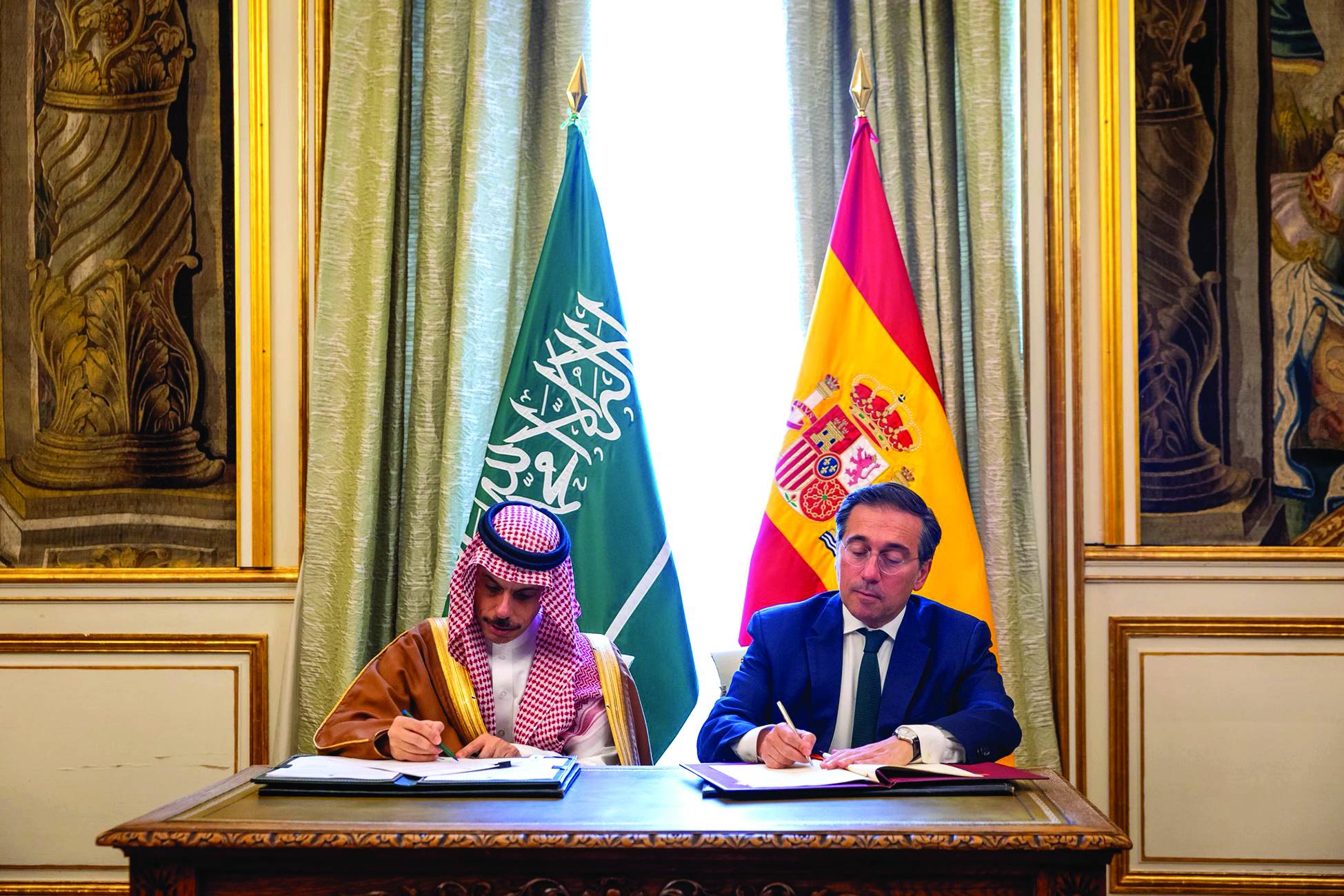
Spanish Foreign Minister Jose Manuel Albares has expressed Madrid’s support to Saudi Arabia, describing Iranian attacks on the Kingdom and other countries in the Gulf as “unjustified.”

In an interview with Asharq Al-Awsat published Thursday, the minister revealed that efforts were being exerted by Spain as part of several European countries and in coordination with nations in the Middle East to de-escalate, resort to diplomacy and put an end to the US-Israeli-Iranian war.

Albares said “Spain has openly condemned” the Iranian attacks and summoned Iran’s ambassador to convey “its firm rejection of violence.”

The Spanish Foreign Ministry also “called for an immediate cessation of these attacks," he said.

“The attacks conducted by Iran are completely unjustified,” Albares told Asharq Al-Awsat, while stressing full solidarity with Saudi Arabia and other Gulf countries against the Iranian attacks.

Saudi Crown Prince Mohammed bin Salman has recently received a phone call from the Spanish Prime Minister, Pedro Sanchez, who expressed “Spain’s support and solidarity in light of the unjustified attacks that the country is suffering.”

“Spain's stance is firmly rooted in defending international law and the United Nations Charter, rather than the principle of might makes right,” said Albares.

This message has been conveyed to Saudi Arabia, Bahrain, Kuwait, the United Arab Emirates, Oman, Qatar, Jordan, Türkiye, Egypt, Uzbekistan and Azerbaijan, he added.

Call for de-escalation and negotiation

“Spain advocates de-escalation, negotiation, and respect for international law. Our voice aims to bring reason and restraint to the current situation. We cannot accept the idea of war becoming a means by which countries interact with one another or a mechanism for establishing a balance of power in the Middle East. Violence never brings peace, stability or democracy; it only creates more violence and chaos,” said the minister.

“In light of this military escalation, Spain is acting coherently in accordance with the values of peace and solidarity that define Spanish society — values that are also shared by the majority of European states. Our country makes its decisions in line with European principles, the UN Charter, and international law,” he added.

The war has already had consequences that extend beyond the Middle East. For example, it has affected Cyprus and Türkiye, he said, warning that this increases the risk of the ongoing conflict spreading beyond the region.

The minister told Asharq Al-Awsat that the war is also affecting international trade and production of energy, which have a direct impact on global economies and geopolitics.

“The unpredictable consequences of the current conflict are making the situation extremely dangerous for the security and stability of the Middle East, including the Gulf states, which are being particularly targeted,” he said in response to a question.

Countries involved in the confrontation

Albares spoke about the situation of several countries in the region, including Lebanon, which he said “is facing a dramatic situation with numbers of victims increasing daily, an overstretched medical system incapable to attend them, more than a million of displaced people, and the destruction of civil infrastructure. The life of the people of Lebanon is disappearing before their eyes.”

He said Spain has condemned the attacks carried out by Hezbollah, that are fueling the spiral of confrontation, as well as Israel's attacks. “An Israeli land invasion is already ongoing, a grave error in a country that has already endured immense suffering.”

“We cannot ignore the attacks by Israel and non-State actors on UN forces, on UNIFIL, in which Spain has a significant presence, nor the repeated violations of international humanitarian law," Albares said.

The minister also expressed concern over the situation in Gaza and the West Bank. “There is no clear vision for the future, and humanitarian aid is not reaching the area, with access blocked and NGOs and humanitarian actors prevented to operate on the ground. In the West Bank in particular, settlement expansion and settler violence continues to increase with impunity,” he said.

High-risk situation defined by an unpredictable conflict

“We are facing an escalation of violence that has already killed thousands of people and negatively impacted maritime navigation in the Strait of Hormuz, and critical energy infrastructures, with direct consequences for global energy security,” he said.

“In short, it is an extremely high-risk situation defined by an unpredictable conflict that poses a direct threat to the security and stability of the Middle East, with repercussions that can be felt across the globe,” he added.

Asked about his views of the Gulf's concern about the war’s repercussions, Albares said: “Spain fully understands the Gulf countries' concerns about the consequences of this war. This has been reflected in the diplomatic outreach that I have conducted with my counterparts in the region.”

“Increasing insecurity in countries under attack from missiles and drones without justification — attacks that Spain firmly condemns — particularly those launched by Iran, contribute to an increasingly dangerous and complex situation. In this context, Spain advocates clear de-escalation, negotiation and respect for international law, insisting that we must avoid anything that adds to the tension.”

He added that “the situation in the Strait of Hormuz is also extremely worrying, as its impact on energy security and international trade is clear.”

He stressed that the conflict has human and humanitarian dimensions, such as loss of life and displacement, warning that this could have direct consequences also in Europe. So, he called for “a responsible solution based on solidarity.”

Unified position

“The only clear thing is that a response is necessary, and in this sense, Spain supports a response based on the unity of the international community around the universal applicability and respect of International law and the UN Charter,” said Albares.

Asked to what extent the current situation is likely to explode into a broader war,” the minister said: “The consequences of the actions of Israel, as well as Iran’s response, are unpredictable. We are entering a situation that makes it difficult to determine where the escalation could lead and what the ultimate effects could be.”


Al-Khanbashi to Asharq Al-Awsat: We Warn Against Incitement, Hadramout Has Room for All

Governor of Hadramout, Salim Al-Khanbashi delivers a press conference in the city of Mukalla in Yemen's coastal southern Hadramout province on January 19, 2026. (Photo by FADEL SENNA / AFP)
TT

Al-Khanbashi to Asharq Al-Awsat: We Warn Against Incitement, Hadramout Has Room for All

Governor of Hadramout, Salim Al-Khanbashi delivers a press conference in the city of Mukalla in Yemen's coastal southern Hadramout province on January 19, 2026. (Photo by FADEL SENNA / AFP)

Presidential Leadership Council (PLC) member and Governor of Yemen's eastern Hadramout province Salem al-Khanbashi says he believes that “Hadramout triumphed for itself,” and that what took place there in December 2025 and early January 2026 marked a decisive moment in which Hadhramis reclaimed their right to protect their identity and blocked any political project seeking to dissolve the “Hadhrami self” under the slogans of outsiders.

In an interview with Asharq Al-Awsat Podcast, recorded in Riyadh on February 9, 2026, al-Khanbashi advised the new Yemeni government led by Dr. Shayea al-Zindani to steer clear of partisanship, raise performance levels, and combat corruption. During the discussion, he presented his account of events, framing the operation as a “takeover of military camps,” not the “ignition of a war.” He broadened the discussion to what he views as the priority of the current phase: consolidating stability, activating development, and opening the door to long-awaited Hadhrami investments returning home.

“Liberate us" from ourselves?

In describing the outcome of the confrontation, the deputy rejects reducing the picture to who won and who lost. He says the real victory was achieved when the people of Hadramout rejected the notion that someone could arrive and say, “We came to liberate you,” asking: “Liberate you from whom? From ourselves?” He stresses that the governorate, with its history stretching back “thousands of years,” cannot have another identity imposed upon it. He records his appreciation for those who stood in defense of this distinctiveness, while at the same time extending explicit thanks to the Kingdom of Saudi Arabia, its leadership and role, which he said was a key player in containing last month’s events.

On the moment he was tasked with the governorship at an extremely sensitive time, al-Khanbashi recounts that he was residing in Hadramout and did not leave except when necessary, before receiving a call from President Rashad al-Alimi and from parties including Saudi officials and colleagues on the Leadership Council, asking him to assume responsibility for the governorate “because we need you.”He says he tried to decline, but accepted under the pressure of “necessity,” emphasizing that he is a son of Hadramout who spent most of his life there, and that he accepted the post fully aware of the weight and complexity of the phase.

The picture becomes heavier as al-Khanbashi moves to his successive roles: governor, then commander of the National Shield Forces in Hadramout , then a member of the Leadership Council with the rank of vice president. He deliberately labels the January operation a “battle to take over the camps,” so that it would not be understood as targeting civilian society or as a search for settling scores.

Al-Khanbashi says his overriding concern was to spare Hadramout street fighting, protect civilian infrastructure, and minimize human losses. He describes the operation as “swift and decisive,” with a limited number of casualties.

Securing withdrawals... and a political outlet

Asked whether the military operation in Hadramout ended with reprisals against opponents, al-Khanbashi is keen to deny this. He says the withdrawal of departing forces was secured and that they were not subjected to any military or popular harassment. “We instructed that no one who was in the Southern Transitional Council, whether military or civilian, be harmed,” he says. At the same time, he explains that he took decisions to dismiss certain security and military leaders accused of involvement in looting weapons and ammunition or of poor performance, and that they will be referred for accountability in accordance with what they committed against the governorate.

Amid this, al-Khanbashi reiterates a message he wants widely understood: “Hadramout has room for all.” He calls for civic conduct that avoids incitement, and warns against marches he believes target civil peace and provoke the local scene.

He again urges adherence to civil behavior without incitement, citing gatherings that took place in early February 2026 in Seiyun. He suggests they were not spontaneous, saying: “We have evidence that these people were paid, and we want them not to force us to take measures involving a degree of coercive force against those who want to practice such acts. We are still under a state of emergency, and all measures can be taken.”

In the broader political context, al-Khanbashi speaks of moves to convene a broad Hadhrami meeting in Saudi Arabia bringing together political and social components, including Hadhramis from the Southern Transitional Council, with the aim of preparing a unified vision in the name of Hadramout to be presented to the Southern Dialogue Conference. He notes that a preparatory committee was formed in Mukalla to draft a position reflecting “all societal and political forces” in the governorate, alongside a parallel desire to represent the voice of Hadhrami expatriates within a single vision.

Electricity and investment

Electricity tops the services file, according to the governor. He places it at the head of priorities, explaining that the needs of the coast and the valley differ, but the headline is the same: energy that does not meet demand, especially in summer, with humidity and heat on the coast and harsh desert conditions in the valley.

He speaks of support projects to generate 300 megawatts for the coast, and other projects for the valley, alongside proposals for gas-powered plants and private-sector solar energy options with capacities that could reach 150 megawatts. He believes that a medium-term solution is not a substitute for a long-term strategic project for a large gas plant capable of covering Hadramout's future needs.

From energy he turns to investment as the other face of stability. Al-Khanbashi lists opportunities he sees as promising: tourism, real estate, the export of high-purity gypsum, potential minerals, coal in specific areas, black sands and heavy elements, fisheries, and the idea of aquaculture. He recalls his participation in a Hadhrami investment conference, calling on businessmen to balance their external investments with investing in Hadramout, while pledging to provide facilitation and an attractive environment.

On government affairs, al-Khanbashi describes the discussions that preceded the formation of the new government as having focused on criteria of competence, experience, and geographic balance, while rejecting the principle of quota-sharing. He then offers three pieces of advice he places at the core of the government’s test: moving away from ego and partisan drift, combating entrenched corruption in several ministries, and raising the level of revenue collection and transferring it to the central bank, especially in revenue-generating ministries. He highlights the need to regulate the financial relationship between the center and the governorates in accordance with the Local Authority Law, arguing that strict application would ease many chronic problems.

He recalls Hadramout's experience with oil revenues before exports were halted, noting that the governorate received 20 percent of the value of exported oil and used it for development projects such as electricity, roads, health, and education, before this resource stopped after the Houthis targeted export facilities.

"No barriers" with Saudi Arabia

In assessing Saudi development support, al-Khanbashi links relief and reconstruction as a single window for enabling Yemen to overcome its crisis, pointing to packages of projects in electricity, roads, health services, and others within Hadramout.

He places this within a relationship he describes as intertwined, difficult to separate socially, economically, and politically, invoking the extended borders, shared tribes, and cultural ties, to conclude that it is not possible to erect a “barrier” between Hadramout and the Kingdom.

Asked about the moment that remained most vivid in his memory during the 48 hours of the operation, al-Khanbashi says he feared the forces might not withdraw easily and what that could entail in terms of destruction and casualties, before the operation ended in record time with limited losses. He says this is what he will continue to take pride in: that Hadramout succeeded in avoiding internal fighting. In his message to the people of Hadramout, he calls for unity, abandoning the causes of division, and prioritizing security and development, pledging that the expansion of stability will lead to a “bright development era” reflected in the lives of the governorate’s residents.